
Growth follows investment and attitude.
We talk about growth mindsets. We talk about innovation. These are attitudes or approaches to our work and our lives. There are best practices we can apply to achieve our goals. And superseding best practices are our actual practices. Our efforts to be great.
Those who take growth seriously invest their personal energy into using past knowledge to envision what could be. These are the people who lead in small ways and big. We look to them for inspiration, and they motivate us to do more.
I recently had the opportunity to participate in the Junction 91 Gathering in Delhi. I also joined the GenNext tour and visited academic leaders in four additional cities (Ahmedabad/GIFT City, Jaipur, Hyderabad, and Bangalore).
Meet Intead!
- Find us at at NAFSA in Orlando in May. Be in touch to share a cup of coffee in person.
Fight for your Internationalization Program Funding with Data
-
Benchmark your internationalization strategy and outcomes against 100+ U.S. peer institutions. Join AIEA’s groundbreaking study on what drives internationalization success.
The GenNext tour, led by Girish Ballolla and Pritika Sachar, was top-notch. The GenNext team provided the connections to be sure we met with senior-level folks at each university. Also important when traveling internationally, when so many things can easily go wrong, GenNext had the logistics down with all the city hopping, ensuring we arrived where we were supposed to be each day of the trip.
The conversations were eye-opening, refreshing, and valuable. We spoke candidly to students along the way.
Here’s the thing: India is all about growth mindset right now. oh, and investment.
This, while the big four English-speaking student destinations (US, UK, Australia, and Canada) are all struggling to figure out what they care about and where to invest.
Read on for insights about what this means for our work building global campuses and some eye-opening global data. Don't miss our bottom line recommendation at the end!
Right now, India has clarity of vision, forward motion, and an enviable level of economic investment, specifically in higher education. Similarly, the technology and finance sectors in India are also seeing energetic growth. Chaos in the countries commonly considered the top producers of talent (US, UK, Canada, Australia) is prompting new pathways to employment. India is capitalizing on that chaos.
While the US is seeing amazing growth in technology and finance sectors, education is caught in a vortex of its own making. There is no growth. Many academic leaders are trying to find stability as they spin wildly out of control. The job market in the US is struggling as well, and well-trained talent is about to become harder to find due to evolving and limiting US visa policies.
Now, higher education funding models in India are vastly different and unlike anything we find in the big four. It gets complex, and you need a guide to help you understand the regulatory environment in India. At the Junction 91 Gathering, Divya Shani, AVP Education Strategy Consultant from Ernst & Young, gave an excellent presentation on some of this. In GIFT City, we had eye-opening conversations with Akshat Ganeriwala, Manager with IFSCA, the group managing development in GIFT City. Both of these people are valuable guides to a complex landscape.
Click for a 15 second video showing GIFT City growth.
The reality is that while academic and political leaders in the US and UK are moving sideways (if moving at all), India is moving forward, and fast. Comparing the US to India, the sheer size of the US economy and the amount of investment capital available is staggering. Simply put, US volume dwarfs India's.
However, US funds are NOT flowing into education. According to recent reporting by the Financial Times, the surge in EdTech investing prompted by the Covid pandemic lost steam dropping form $17B to $3B between 2021-2024. Education sector deal volume continued to drop in 2025 by another 20% as reported this month in the Wall Street Journal.
Meanwhile, corporate investment in India is focused on expanding housing, technology, and preparing students to enter the workforce. Private higher education institutions in India are growing and re-aligning curricula to improve the job pipeline.
Consider this: where the US graduates some 140,000 engineers every year, India graduates 800,000+. Every year. So the competition for jobs is tough, but employers have SO much talent to choose from.
And here’s another thing driving investment in India: computing giants like Microsoft, Google, and Amazon, as well as finance giants like Bank of America and JP Morgan, all of them can hire engineers in India for 70% less than hiring that talent in the US.
These global corporate giants with headquarters in the US are all investing heavily in expansion in India’s major cities. They are adding tens of thousands of seats in glass towers and expecting to fill them with the very best talent from India’s university system. (See link above for 15 second video).
A few telling figures:
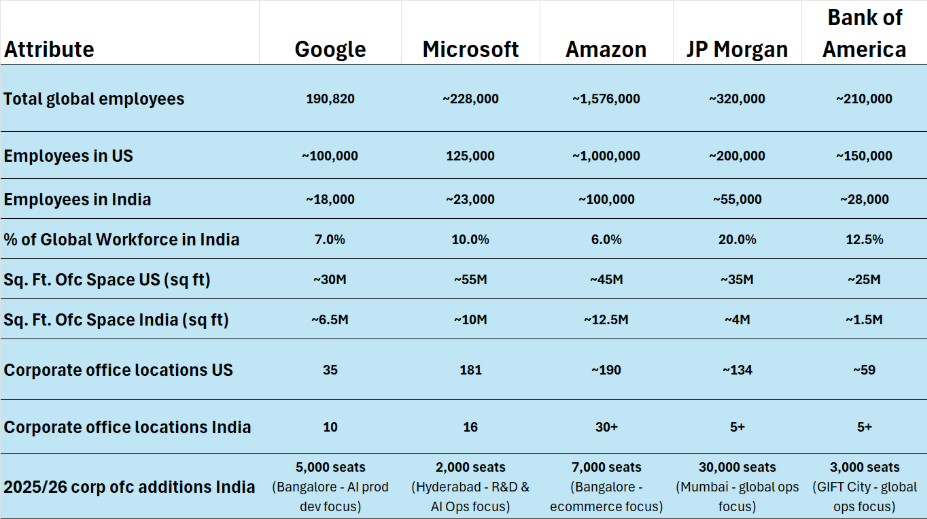
Important context to this US to India comparison. The US has far fewer people and a MUCH larger economy.

Bottom Line: The opportunity to partner with institutions in India is now. Indian students, currently questioning the availability of a US student visa or a US-based OPT position, are increasingly looking to US employers in India and clamoring to secure those seats. US institutions offering affordable online certificates and other credentials can help Indian students become more attractive job candidates in the fierce Indian job market. Does your institution have these opportunities available and on display?
When we talk about adapting and innovating, this is what we mean. Those institutions able to move quickly will reap the benefits in the near term and again as the visa and employment landscape changes in the years ahead. And yes, they will change in the years ahead.
If you need some insider guidance to help you make wise decisions, we know a few people you could talk to. Be in touch.
Special thanks to @GirishBallolla and GenNext Education for helping us build valuable connections. Highly recommend.