
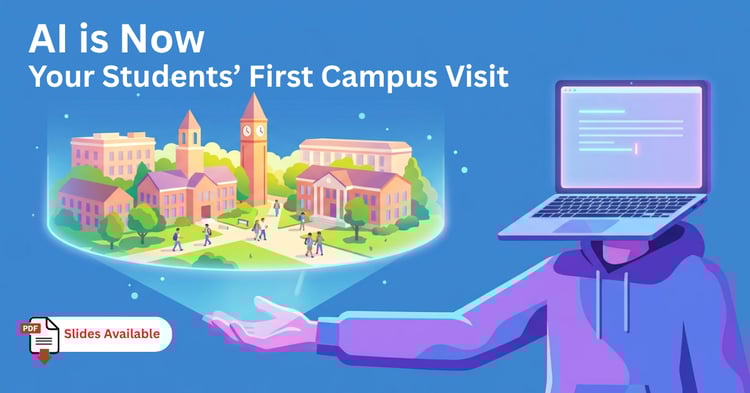
Students used to learn about universities the old-fashioned way: browsing websites. (How very Millennial of them.)
Soon enough, social media became prospective students’ means of discovery.
Now? Increasingly, students are using AI to identify and evaluate their academic options. Long before they see your website, they have already developed an AI-informed opinion.
We have helpful slides available below from our AIEA session presentation by Balaji Krishnan, Vice Provost at University of Memphis and our own Marketing Analytics Director, Iliana Joaquin.
One SIO told us afterward, “That was the most useful session of the conference.” We’re not surprised. The content shift happening right now isn’t simply about search rankings. It’s about how institutions are being understood in an AI-mediated world.
To be certain, websites and social media are still incredibly important to student search processes. Even direct mail and out-of-home have their place in the marketing mix. But the truth is AI has quickly become a (The?) go-to research tool for students and their parents.
In case you need stats for confirmation, the Pew Research Center found:
- ~64% of US teens report using AI chatbots
- ~ 3 in 10 use them daily for questions, research, and learning
Further research from the Associated Press-NORC Center for Public Affairs Research finds that roughly 60% of US adults have used AI to search for information. This is from July 2025. That number is even higher now. Consider the frequency of your own use of AI tools compared to last year.
Meet Intead!
- Today only: Find us at ASU+GSV in San Diego in April, and at NAFSA in Orlando in May. Be in touch to share a cup of coffee in person.
Shape Institution-Agency Partnerships
Join your peers across IEM and complete AIRC’s 15-minute survey about your experience working with recruitment agencies. Participants will receive the resulting report. Deadline: May 1st
If students aren’t using ChatGPT or Claude, Google’s Gemini often steps in as AI gatekeeper. It’s fundamentally reshaping the way students conduct research and what they see when they search online, including about your institution.
And so, AI is now the first campus visit.
Below we offer 3 steps you can take to improve the value of your content for students’ AI searches. And yes, you can try this at home: try an open-ended prompt: “What university is best to become a [fill in career of choice]?”
Read on for the quick notes worth sharing with your marketing and recruitment teams plus access to our slides…
When we tried the prompt above (via ChatGPT), the response offered a quick set of suggestions:
-
For engineering, MIT.
-
For business, University of Pennsylvania or Indiana University.
-
For liberal arts, Amherst College or Williams College.
-
For big city, consider New York University.
-
For small, close-knit campus, how about Bowdoin.
Try that vague search yourself – the results might surprise you, particularly if (when) your institution doesn’t appear. Different geographic locations will get different results. And depending on your use of Google or your chat tools, the same prompt will likely produce different results simply based on what the AI tool already knows about you.
With this general search, aimless students suddenly have direction and some degree of context. Your institution has already made its first impression, and the students aren’t likely to find your YouTube page, or your website. Realistically, students do have more specific search prompts based on their location, their price point, and their academic interests, among other lifestyle considerations.
Once students have a few institutions in mind, their inquiries become even more specific.
“Tell me about [insert the name of any institution] and compare it to [insert name of competitor institution]” Here’s hoping AI spins the right story. As they say, you only get one chance to make a first impression.
Your SEO rules need a rewrite.
At the annual AIEA conference this February, our colleague Balaji Krishnan University of Memphis SIO joined Iliana Joaquin, Director of Marketing Analytics at Intead to present “Your Old SEO Approach No Longer Cuts It.” The conversation was all about how institutions can rethink their SEO strategy in a generative AI environment.
This isn’t just your marketing team’s problem.
AI-driven search is reshaping reputation, positioning, and visibility — whether institutions engage with it or not. This deserves a shared conversation with marketing comms, enrollment management, domestic and international recruitment teams.
The shift is simple but significant. Traditional search engines ranked pages of content. AI systems assemble answers. When a student asks a question, AI pulls information from sources it considers credible and synthesizes a response. In effect, it creates a dynamic FAQ about your institution.
For a while, FAQ pages fell out of favor per adjustments Google made to its results pages. Marketers reacted, and rightly so, by focusing on developing other forms of more SEO-friendly content. Now that generative AI tools assemble answers from across the web, structured questions-and-answer content is highly valued by AI crawling tools because it makes institutions’ information easier for the AI systems to interpret and extract. And since it is on your website, the content ranks high on credibility for an AI crawler.
And so, the FAQ is back.
AI doesn’t just rank pages, it assembles answers from trusted sources. It favors clarity, evidence, and authority.
Content holes? Don’t worry, AI fills in the gaps.
(Read: Actually, do worry!)
When an institution’s strengths and outcomes aren’t clearly articulated on its website, AI decides them for you. Risky.
We know that AI tends to ignore generic claims (e.g., top-ranked program, student-centered community) and prefers to pull outcomes from third parties (e.g., US News & World Report). With watered-down, non-specific content, even strong institutions can become invisible.
Notably, AI amplifies institutions that act like primary sources. In other words, it pulls information from websites that offer clear explanations (instead of aspirations), credible evidence, and identifiable expertise. It’s important to understand that how clearly you communicate your message is more valuable than how often you repeat it.
The questions that matter: When someone asks AI a high-stakes question about your institution, are you the source? Are your facts and messaging priorities being amplified?
Three steps institutions can take now to improve AI-driven results:
1. Decide what you want to be known for.
Choose 3 to 4 strengths that are backed by evidence, not aspiration, and make it easy for both people and AI to find and understand.
2. Prove it in public.
Tie each prioritized message to clear outcomes or proof, written in plain language on your website. Before publishing, ask yourself if an intelligent outsider could explain this accurately in 30 seconds? If the answer is no, your content isn’t strong enough.
3. Share the responsibility.
This isn’t solely a communications challenge. Institutional messaging must be aligned from leadership across departments. Leadership defines institutional priorities and outcomes. Marketing translates those priorities into clear, consistent, visible messaging.
If your digital content is not performing as you’d like on AI results, then there’s work to be done. And it’s manageable. A useful goal over the next 12 months, get this onto your website:
- One page explaining who you are
- One page proving your outcomes
- One page explaining who you are not for
Helpful Slides from AIEA
Download our AIEA session slides on rethinking SEO with AI. And remember, rethinking your SEO approach is not about chasing algorithms, rewriting everything, or buying tools. It’s simply being smart about the tools you already have and strengthening your current content.
Need help thinking this through or creating relevant content? Be in touch. This is where our team shines!