Recruiting Intelligence

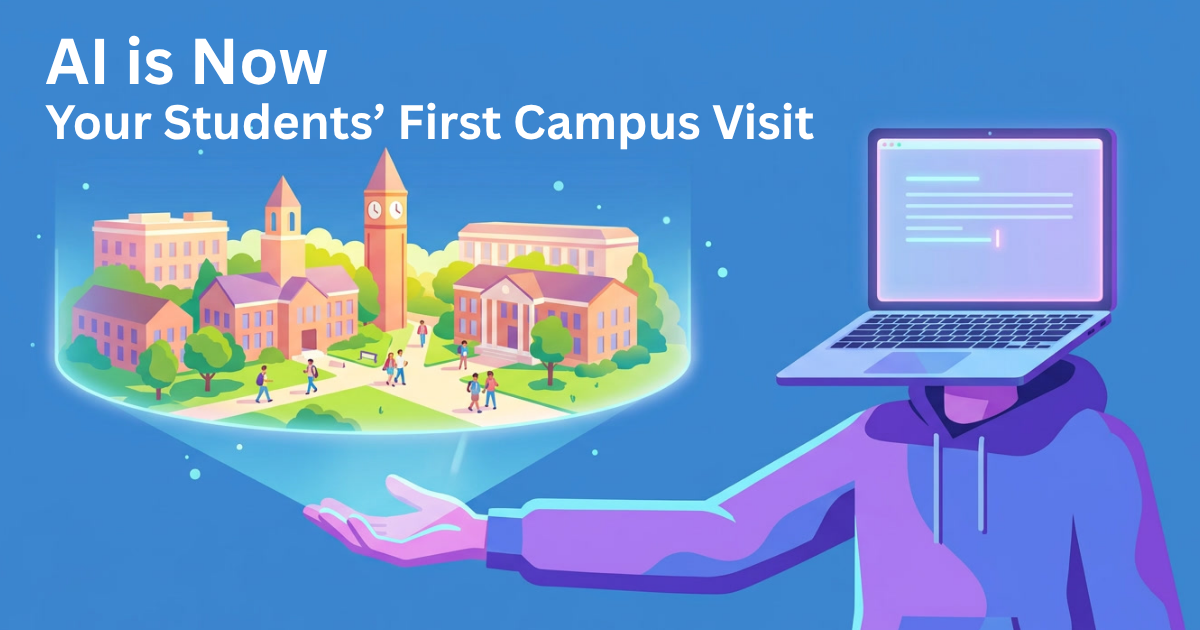
AI is Now Your Students’ First Campus Visit

Students used to learn about universities the old-fashioned way: browsing websites. (How very Millennial of them.)

Soon enough, social media became prospective students’ means of discovery.

Now? Increasingly, students are using AI to identify and evaluate their academic options. Long before they see your website, they have already developed an AI-informed opinion.

We have helpful slides available below from our AIEA session presentation by Balaji Krishnan, Vice Provost at University of Memphis and our own Marketing Analytics Director, Iliana Joaquin.

One SIO told us afterward, “That was the most useful session of the conference.” We’re not surprised. The content shift happening right now isn’t simply about search rankings. It’s about how institutions are being understood in an AI-mediated world.  

To be certain, websites and social media are still incredibly important to student search processes. Even direct mail and out-of-home have their place in the marketing mix. But the truth is AI has quickly become a (The?) go-to research tool for students and their parents.

In case you need stats for confirmation, the Pew Research Center found:

  • ~64% of US teens report using AI chatbots
  • ~ 3 in 10 use them daily for questions, research, and learning

Further research from the Associated Press-NORC Center for Public Affairs Research finds that roughly 60% of US adults have used AI to search for information. This is from July 2025. That number is even higher now. Consider the frequency of your own use of AI tools compared to last year.


Meet Intead!

  • Today only: Find us at ASU+GSV in San Diego in April, and at NAFSA in Orlando in May. Be in touch to share a cup of coffee in person.

Shape Institution-Agency Partnerships
Join your peers across IEM and complete AIRC’s 15-minute survey about your experience working with recruitment agencies. Participants will receive the resulting report. Deadline: May 1st


If students aren’t using ChatGPT or Claude, Google’s Gemini often steps in as AI gatekeeper. It’s fundamentally reshaping the way students conduct research and what they see when they search online, including about your institution.

And so, AI is now the first campus visit.

Below we offer 3 steps you can take to improve the value of your content for students’ AI searches. And yes, you can try this at home: try an open-ended prompt: “What university is best to become a [fill in career of choice]?”

Read on for the quick notes worth sharing with your marketing and recruitment teams plus access to our slides…  

Read More
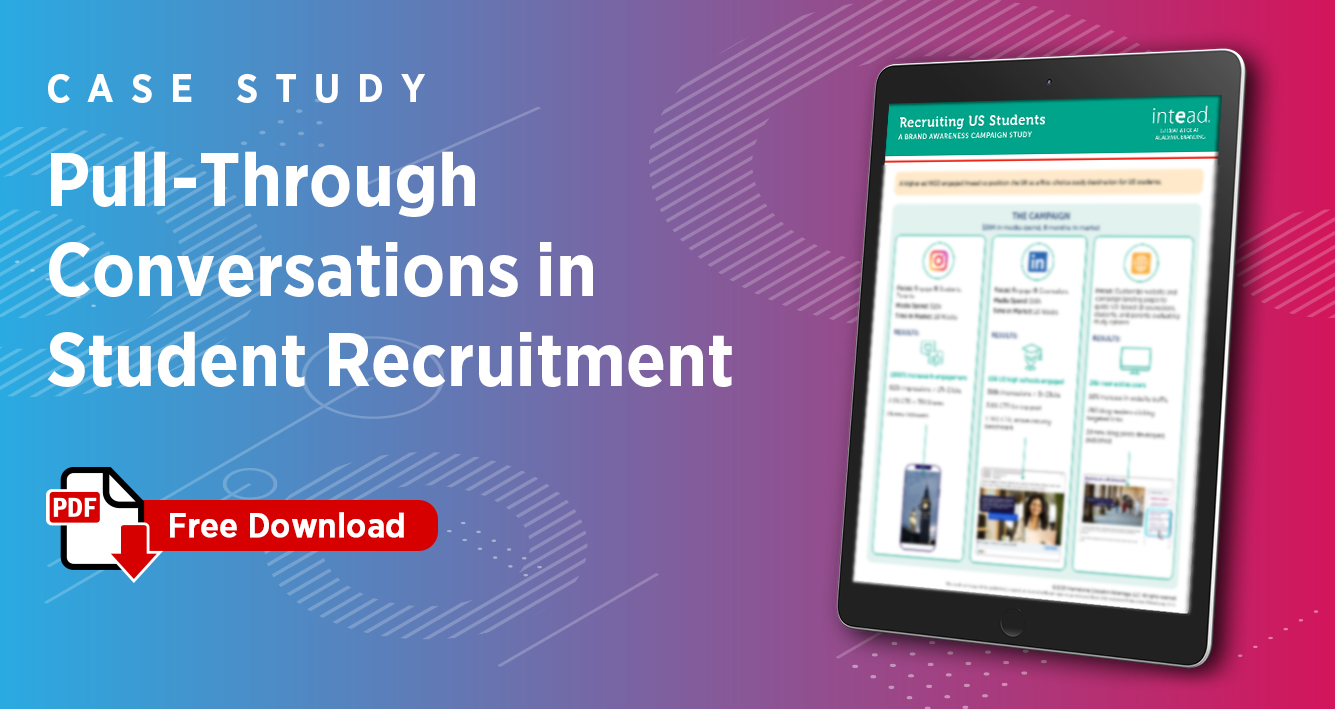

Pull-Through Conversations: A Case Study in “Reel” Student Connections

When we talk about brand building, especially in the edu space, we often focus on the big strategies: multichannel campaigns, search engine marketing, CRM integration, data analytics. All undeniably important. But what really breaks through to students? Content that feels personal – the kind that makes your target audience feel seen and understood. 

Think, an Instagram Reel featuring a current student sharing their journey and pouring a bit of their heart out. A TikTok breaking down the real cost of living on campus and the pride in managing the cost. Stories that help students bring their imagined academic and social experiences to life. Our audience is on the cusp of a new chapter, be it undergrad, grad, or secondary school.

Good content helps them see their future. Great content helps them feel it. Below you can download our case study and use our results as a benchmark as you evaluate your own campaigns.


Meet Intead! 

  • Find us at NACAC in Columbus in September, NAFSA Reg XI in Springfield in November, and AIRC in Atlanta in December. Be in touch to share a cup of coffee in person.

eBook Reboot:  88 Ways to Recruit International Students 2025 update. Your tactical toolkit for the year ahead. Covering all the bases in 10 quick-read chapters. Fosters great ideation discussions with your team.


We recently worked with a higher ed NGO positioning the UK as a first-choice study destination for US students. The campaign was a success (more on the metrics below). Why? We delivered content that spoke directly to our audience. That, and we brought the conversation to them on the right channels. We made the academic options feel within reach.  

The thing about social media is it gives you a chance to kickstart real conversations. What’s campus life like there? What’s the social scene like? What does student support really look like? How hard are the academics, really?  

Well-scripted content doesn’t always need polish (though sometimes it helps). The point is: it should be intentional, relatable, and relevant. All that authenticity stuff. If you’re doing it right, you’re not tossing up a Reel and hoping for the best. You’re showing up in the spaces your audience already trusts, with content they actually want to watch.  

What made our recent campaign especially effective was the pull-through. As the target audience engaged with the content and wanted to learn more, we extended the conversation across platforms.  

In this case, we built connections with students on Instagram and targeted high school counselors via LinkedIn. From there, we directed each audience to tailored pages on the organization’s website, delivering the information we knew they would be looking for -- anticipating their questions.

Understanding your user journey is all about anticipating and responding to the questions they will want answered. 

The campaign we ran lasted 8 months and had a media buy budget of just $28k. Want a closer look? Read on to download our quick-hit case study and our benchmarking data… 

Read More

Do You Know #Studyspo?

Studying up on the latest digital trends in higher ed? We have one that may surprise you but it is certainly familiar to your student intern.  

We’re talking about Studyspo: the trend turning study time into scroll-worthy content.


Opportunities to Meet the Intead Team 

  • Look for us at NAFSA in May, NACUBO and APLU in June, and NACAC in September. Let us know  if you want to connect at these events.

Bookmark this: Intead’s Resource Center 
Access 800+ articles, slides decks, reports with relevant content on any topic important to enrollment management and student recruiting.  Check it out.


In recent years, every nook of the internet—from Pinterest boards to TikTok stories—has gained noteworthy momentum in helping students build connective digital spaces and communities where students share life hacks and ideas with each other. And now, students are convening on these platforms even more frequently—even to study. 

Studyspo, a blending of “study” and “inspiration,” involves students sharing posts, videos, hashtags, and the like, to show how they’re studying. Generating noteworthy digital engagement, Studyspo is, indeed, trending.  

The hashtag #Studyspo has been used in over 1,011,091 posts on Instagram, with an average of 12 new posts per hour. On average, these posts receive 106 “likes” and 2 comments each, indicating moderate engagement. Other related hashtags frequently used alongside #studyspo include #studygram, which has garnered over 13 million posts, #studying with around 6.7 million posts, and #studymotivation with about 3.5 million posts.  

More of the same can be seen on Tumblr, where hashtags related to studying and similar topics (like #studyblr) also enjoy substantial popularity. For example, #studyblr has over 500,000 posts, showing that the study-related community on Tumblr is incredibly active.  

But, trends they are fleeting. How do you know when to jump on the social media fad train (and hashtag) and when to happily let it pass you by? Let’s get into it. Read on…

Read More

Understanding Social Media Algorithms for Student Recruitment


Despite what our writers like to think, it’s not all about content. Digital marketing is also about math. Social media runs on numbers after all. Since we just presented at PIE Live in Boston last week, we are pretty sure there is a pun about the value of pi and algorithms here somewhere.   

While marketers don’t need to build the algorithmic equations that power social media platforms, understanding how they work, or rather the intent of why they work, does matter.  


Opportunities to Meet the Intead Team

  • AIRC, Seattle-Bellevue, Washington, Dec. 4-7 -- including our pre-conference global marketing workshop. A full day of Intead global intel (lunch included ; -). Details here.
  • AIEA in March and NAFSA in May, we'll be presenting our latest findings at both. Let us know if you want to connect at either of those two events.

Bookmark this: Intead’s Resource Center 
Access 800+ articles, slides decks, reports with relevant content on any topic important to enrollment management and student recruiting.  Check it out.


Social media algorithms evaluate and prioritize user behavior. These algorithms, a set of rules and signals that rank content, are proprietary and organize social feeds based on user interaction. Each algorithm aims to create highly relevant, interesting content for individual users, which is of course the crux of our society’s love-hate relationship with this addictive medium.  

Today we dive into the intent behind the feeds of 5 top platforms so you can better fit and filter the content you’re pushing out to prospective students. We break down how algorithms differ across major social media platforms (TikTok, Instagram, Facebook, LinkedIn, and X). You’ll want your team to keep this post handy when thinking on your social media marketing strategy. Read on…

Read More

AI Affects Your SEO - But not in the ways you think


Is AI affecting my SEO? One among a legion of questions surfacing since generative AI went mainstream. But it’s one we’re fielding a lot, so let’s get into it.   

First, the basics. SEO, or search engine optimization, is how you optimize your website content to up the odds that search engines like Google will rank your webpages high on their results pages. The goal is to appear as the top result for relevant search queries. You’re likely more than familiar with the concept.  

You may also know that search engines have been utilizing AI for years. It’s what helps them understand the meaning and intent of a search query – a function known as semantic search, which uses machine learning and natural language processing to help Google and other search tools understand what users are searching for.   

So, it’s not AI, per se, that’s got marketers worried. It’s generative AI.  


Opportunities to Meet the Intead Team 
- American Marketing Assn Higher Ed, Las Vegas, NV, Nov. 10-13, 2024
- PIE Live North America, Boston, MA, Nov. 19-20, 2024
- AIRC, Seattle-Bellevue, Washington, Dec. 4-7 -- including our pre-conference global marketing workshop. A full day of Intead global intel (lunch included ; -). Details here. 

Bookmark this: Intead’s Resource Center 
Access 800+ articles, slides decks, reports with relevant content on any topic important to enrollment management and student recruiting.  Check it out.


There’s a concern circulating that ChatGPT will become people’s first-stop search engine. Or that when people use Google, its Gemini content will usurp any hard-won top-ranking SEO results.   

We’ll put it this way: Do not worry. Do, however, get informed on how to use generative AI to boost your SEO. Really.

Our recommendation: share this post with your Search Engine Optimization team and get around a table and talk it through. Below, we suggest some helpful discussion prompts to get the conversation going.

Read on… 

Read More

Why Personas Get a Bad Rap


Imagine a mid-size, private university, call it Opportunity University, gearing up for a recruitment push in Vietnam – a new target market for the institution. Excited by the potential and the green light from the provost, the nimble international recruitment team of two assembles a marketing campaign targeting what they assume to be their typical international prospects: high school students motivated to get a liberal arts education at a US institution that will lead to future career success.  

The standard international student profile, right? (Wrong, but we’ll get to that.) Running on a tight budget and timeline, they repurposed a campaign strategy that had previously proven successful with the Indian market (a dominant source of students for their computer science graduate programs). The response, however, was not what they had hoped.

The errors of this somewhat exaggerated story highlight a critical marketing misstep: relying on shallow persona development. Not thinking this stuff through can lead to serious marketing misses. Anyone who takes a simple bullet list of traits and runs with it (high school student, career-minded, uses WhatsApp, seeking international education) is not taking their role as marketer seriously.  

Personas often get a bad rap from jaded marketers who have seen the process based on simplistic stereotypes and then relied on as a holy grail. We hear you! We are not seeking Hollywood stereotypes here.

But well considered personas do align your broader marketing team so that your communications speak with a consistent integrity to each potential student segment. Well-crafted personas are all about internal team alignment around a common voice and marketing approach.


Opportunities to Meet the Intead Team 
- NAFSA Region XI, Hartford, Connecticut, Oct. 27-29, 2024
PIE Live North America, Boston, MA, Nov. 19-20, 2024
- AIRC, Seattle-Bellevue, Washington, Dec. 4-7 -- including our pre-conference global marketing workshop. A full day of Intead global intel (lunch included ; -). Details here. 

Bookmark this: Intead’s Resource Center 
Access 800+ articles, slides decks, reports with relevant content on any topic important to enrollment management and student recruiting.  Check it out.


Unlike the fictitious Opportunity University, institutions that think critically and dive deep into student persona analysis understand that the development of multidimensional profiles is foundational to successful student recruitment strategies. They get that personas, when thoughtfully crafted, can anchor the entire marketing team around a coherent, effective, audience-centered strategy. It’s a north star for guiding marketing tactic selection, content development, design, student interactions, and marketing execution which includes selecting recruitment channels. 

The process of creating marketing personas itself helps dissect the complex student decision-making process by considering the target audience’s lifestyle, challenges, media consumption habits, and underlying motivations. It is so much more than a surface demographic dig. What you uncover during the process can lead to really compelling marketing that will resonate with your prospects because you will have firm insights into their mindset, influencers, and ultimately, their choices.  

On more than one occasion we’ve seen the persona discovery process actually lead to market retreat because the more intimate understanding made it clear the audience and programs on offer weren’t a good fit after all. Better to find out in the early stages than committing to a no-win grind. A sort of check and balance of your strategy. 

Complex persona development is the kind of thing large consumer packaging companies are so good at. During one of our internal innovation sessions the Intead team got into a discussion about how understanding your audience plays out. One quick case study was P&G’s “Thank You, Mom” campaign from the 2012 Olympics (London). If you don’t recall what we’re talking about, see the link below. Let us know your reaction. Tip: grab tissues first.  

So much emotion, and yet, all they were selling was laundry detergent and other basic goods. They knew exactly who their target audience was and why they used their products. And no, it wasn’t to simply keep clothes clean. The tagline lays it out, "It takes someone strong to make someone strong. Thank you, Mom." Suddenly, I have this urge to buy Tide. But I digress… 

The lesson here is the student journey to your institution is so much more complex and life altering. Just imagine what a thoughtful, well-understood persona could do for your student recruitment. Read on for our tips (pass them on to your team) … 

Read More

Is Your Content Functional but Vibeless?


So, my oldest child joined us for dinner out the other night. She dressed with her usual flair, all yellow and brown this time. And she ordered herself a drink to match – some cocktail concoction that apparently took a cue from her hues. I had never ordered a drink to match my look before, so I asked her what I should get. Her response: "Dad, I have no idea. Your look is functional but vibeless – jeans with a black fleece. How about a Miller Lite?" 

Absolutely loved that line: functional but vibeless. How common is that situation in the marketing/communications world? Consider all of the functional but vibeless emails we receive. You probably can’t consider them. They’re all just so forgettable.  


Our next opportunity to meet! 
NAFSA Region XI, Hartford, CT, Oct 27-29. The Intead team will be there presenting on Admission Process Analysis, Marketing Data Analytics, and Marketing Study Abroad with university partners from our New England region friends from Quinnipiac, Johnson and Wales, Clark, and Emerson. Practical strategies and creative tactics to hit your enrollment targets.  Hope to see you there! 

The Resource Center for Industry Insiders 
Take your challenge of the day and plop it into our search bar. With 800+ publications and our 15 years of weekly blogging, you will find relevant content on any topic important to enrollment management and student recruiting.  Valuable perspective and data on topics you care about. From agent-university partnerships to predictive modeling and CRM efficiency, to new market development, our Resource Center has you covered. Check it out.


Examples of what we mean:

→ Dear inquiring student, 

Thank you so much for submitting your application. We note you are still missing one document. Blah, blah, blah…our deadline is approaching. 

Thanks, Vibeless University Admissions Team 

---

→ Dear admitted student, 

Let us introduce you to all of the really great student associations you could join here at Vibeless U! When you arrive, you should look into one. Oh, and here’s a fun picture … 

Sincerely, Vibeless University Admissions Team 


All function, no form, low response rate, immediately forgotten. Instantly deletable. 

Taking time, tapping consumer insights from your current students, injecting creativity, tracking the metrics to figure out what works, what converts. These are the activities that produce results. These are the activities that will share your institution’s true vibe far and wide. 

Every communication you have with students and prospective students, matters. It’s how you connect with them. Correction: It’s how you stay connected. Retention is as important as recruitment.

Today, we offer the three golden rules to creating a lead nurturing campaign that’s got the function you need and that all important vibe. We think this post will be really helpful for your team members tasked with the nuts-and-bolts details of your institution’s prospective student outreach.

Important to communicating vibe: the order you present your messaging matters by region and student type. Is affordability your first hook? Career opportunity? Environmental justice? Academic prowess? All important content areas. Different student segments will click on one or another topic at different points in their decision-making process. THAT is what consumer insight research confirms for you as you use your content to improve application rates and yield.

Share this one with the right folks on your team and, read on 

Read More

Required: Cultural Nuance in Edu Marketing - 3 Helpful Examples


Cultural nuance is no “nice to have.” It’s a must. Does your current marketing team understand this? Do they have the deep consumer insights needed to attract, recruit, and convert different cultural cohorts? Let’s get into it.  

When we talk about audience segmentation – the customization of content by region or country or academic interest AND country/region – what we’re talking about is the language and metaphors, images, and offers that resonate. We’re talking about deep consumer insight research that enables marketing efforts to move the needle in a competitive marketplace. Without these insights, your colorful examples, imagery, phrases, and language can only take a campaign so far.  

Non-marketers you can roll your eyes if you like. We suggest you take a look at our 3 examples below for a quick look under the hood at how deep market research informs the creative process and produces stronger results. 


Opportunities to Meet In Person 

The Intead team is gearing up for some amazing presentations and we hope you can join us. 

  • The Forum on Education Abroad in Boston, March 21, 2024
  • AIRC Spring Symposium and ICEF North America in Niagara, Canada, April 30 - May 3, 2024
  • NAFSA 2024 Annual Conference and Expo in New Orleans, May 28-31, 2024

Let us know if you’ll share a cup of coffee and a conversation about all things global and digital (info@intead.com) 


As we develop approaches to attract and recruit students to institutions, we carefully consider what they will find relatable and help them make wise decisions. What will capture their attention among the many ads and posts they see online? What phrases will resonate with them as they consider their options – at each point in the decision process (the marketing funnel)?

Essentially, we are trying to figure out what will pause their scroll and prompt the smart click.

Prospects can only follow up with so many offers. In the end, they will apply to somewhere between 5 and 20 institutions. Most will receive 3 to 7 acceptance letters, sometimes more. What will help them make a wise decision for their particular situation? Will the content you create and disseminate influence them to apply and then enroll? 

So many institutions believe their own marketing and put out the most generic messaging because they think the great pool of prospective students will simply find them and connect with them. Some faculty and administrative leaders still believe that "marketing" is unnecessary (or worse) because their institutions are clearly excellent and students will simply find and select them. This point of view persists within the academic community -- marketing as snake oil sales. And hey, there are plenty of marketers out here lacking integrity in their approach, so, we understand the disdain for the marketing field.

To be clear, effective marketing is communication with integrity. Effective marketing helps consumers make wise decisions. Full stop.

Read on to explore the use of motivational language, colorful metaphors, and local language to create marketing campaigns that will attract attention, resonate, inform, and recruit. 

Read More

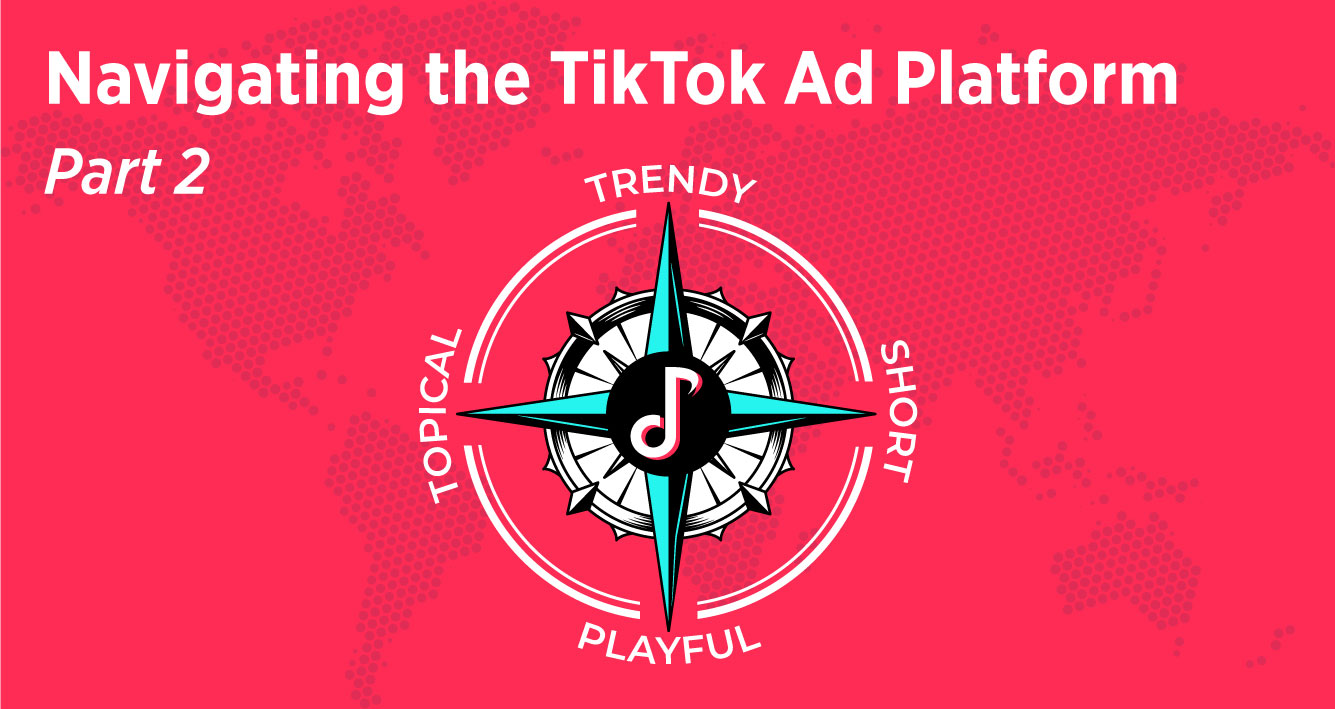
Navigating the TikTok Ad Platform: Part 2


Last week we helped dissect the TikTok ad platform. If you took anything away from that read, we bet you learned that:

  • Its popularity among Gen Z is undeniable (76% use it!).  
  • Branded and search-based advertising on TikTok is possible (hello Brand Takeover and Search Ads Toggle!).
  • Surprisingly, TikTok targeting leaves something to be desired. Proceed with a partner who knows how to make an impact.

But for all of that, we didn’t even touch on content creation. And with this platform, that’s the crux of it all. 


Opportunities to Meet In Person 

The Intead team is gearing up for some amazing presentations and we hope you can join us. 

  • AIRC Annual Conference – we’ll be offering our full day digital marketing workshop here in Phoenix, Dec 6-9, 2023 
  • ICEF North America Workshop in Miami, Dec 11-13, 2023 

Let us know if you’ll come share a cup of coffee and a conversation about all things global and digital (info@intead.com) 


Back to the matter of Tik Tok content. On the one hand, institutions have professional brands to uphold, yet the audience engaging on TikTok demands a more organic, playful view of said brand. It’s a marketing balancing act to say the least. And then there’s the matter of targeting capabilities, which on TikTok are more or less hamstrung. (Wait a minute – what?! If this surprises you, then you may be behind on your reading. Important to catch up with last week’s post. Here's the link again. We promise it will be worth 5 minutes of your time. TikTok may be famous for its algorithm, not so much for its audience segmentation.)

TikTok thrives on the art of brevity and entertainment. Your content must engage and convey your message within seconds, 9-15 is optimal. And to do that you must not only know what it is you want to say, you must know what it is your audience wants to receive. While that’s true of any marketing channel, it’s do or die here. Understanding the unique language and rhythm of this platform is paramount. More bluntly, if your ad isn’t a video that is short, sweet, and entertaining, don’t bother.

Today we offer pro tips for doing just that. Read on to learn how to make your content feel native to TikTok’s seemingly all-knowing algorithm so you can maximize the impact of your ad spend. This post is a short read, and one you won’t want to miss.

Read More

So That’s Your Strategy?

People look smart when they reference strategy. It elevates any discussion to greater importance as soon as the word strategy enters. Often, it gets others in the room thinking, “Right, maybe I’m not thinking about this strategically.” Followed by the thought, “What exactly would a strategic version of this discussion look like?”

The idea of strategy is often misunderstood. I fully admit, it really can be difficult. I can’t tell you how many discussions I’ve been in where people describe their tactical execution plan as the strategy. 

A simple example of why folks get confused, and I’ll use what we know best, the world of marketing: Your marketing strategy to enroll more students requires great marketing content. Content is a tactic you will employ to achieve your strategic goal. Yet, you will need a content strategy to be successful. So, content is not a tactic. It is a strategy, right? No, it is a tactic in this scenario. A tactic that needs its own strategy.

Oy vey.

Our team, of course, lives in the world of marketing strategy, planning, and execution. Today's post shares some insights into how to simplify the discussion and confirm when you are employing a strategy vs. discussing the tactical execution of any given initiative.

Read on and maybe we can shed some light on how to actually be smart in the discussion, not just look smart.

Read More