Recruiting Intelligence

Do You Know #Studyspo?

Studying up on the latest digital trends in higher ed? We have one that may surprise you but it is certainly familiar to your student intern.  

We’re talking about Studyspo: the trend turning study time into scroll-worthy content.


Opportunities to Meet the Intead Team 

  • Look for us at NAFSA in May, NACUBO and APLU in June, and NACAC in September. Let us know  if you want to connect at these events.

Bookmark this: Intead’s Resource Center 
Access 800+ articles, slides decks, reports with relevant content on any topic important to enrollment management and student recruiting.  Check it out.


In recent years, every nook of the internet—from Pinterest boards to TikTok stories—has gained noteworthy momentum in helping students build connective digital spaces and communities where students share life hacks and ideas with each other. And now, students are convening on these platforms even more frequently—even to study. 

Studyspo, a blending of “study” and “inspiration,” involves students sharing posts, videos, hashtags, and the like, to show how they’re studying. Generating noteworthy digital engagement, Studyspo is, indeed, trending.  

The hashtag #Studyspo has been used in over 1,011,091 posts on Instagram, with an average of 12 new posts per hour. On average, these posts receive 106 “likes” and 2 comments each, indicating moderate engagement. Other related hashtags frequently used alongside #studyspo include #studygram, which has garnered over 13 million posts, #studying with around 6.7 million posts, and #studymotivation with about 3.5 million posts.  

More of the same can be seen on Tumblr, where hashtags related to studying and similar topics (like #studyblr) also enjoy substantial popularity. For example, #studyblr has over 500,000 posts, showing that the study-related community on Tumblr is incredibly active.  

But, trends they are fleeting. How do you know when to jump on the social media fad train (and hashtag) and when to happily let it pass you by? Let’s get into it. Read on…

Read More

Need Better Results? Consider These 12 Options


We’re going to state the obvious and break it down. Because it seems some of your colleagues may need to hear this. Better coming from us than you.  Helpful perspective: historical data tell us that 30% to 40% of all US institutions see declining international enrollment in any given year. So, for your consideration...

First: If you are not seeing the enrollment results you want, something must change to produce new outcomes. (Someone wise has said: insanity is repeatedly doing the same thing and expecting different results. Apparently, it wasn’t Albert Einstein. Nevertheless, it holds up).   

Second: If you want to increase university enrollment fast, you’re going to have to put real money into the process. You’re likely going to continue doing what you already do because even though you are seeing diminishing returns, you can’t afford to lose them. So, new funds must be added to the existing budget.   

All obvious, right? Well, it seems folks need to hear it. But we have more to share here to help you get the numbers ... 


Opportunities to Meet the Intead Team 

  • AIRC, Seattle-Bellevue, Washington, Dec. 4-7, 2024. Our team is here now with 3 powerful sessions on budgeting, pathways, and streamlining admissions processes. Come find us. 
  • AIEA, Houston, Texas, March 02-05, 2025
  • NAFSA Annual, San Diego, CA,  May 27-30, 2025

Bookmark this: Intead’s Resource Center 
Access 800+ articles, slides decks, reports with relevant content on any topic important to enrollment management and student recruiting.  Check it out.


Third: If you cannot access additional funds, you will have to cut something you are currently doing and reallocate those funds. If your leadership is of the innovative risk-taker mindset, you can stop doing some of your current, less effective things and put that money into the new thing. Your stronger results will be slow to materialize, and your leadership needs to stay the course (not pull the funding) when fabulous new results do not magically appear in year one. To maintain internal support, you must track your activity and report on the results along the way.

What you want with all the tracking is your ability to provide your leadership with the confidence that there is learning and progress going on that will lead to stronger results in the next couple of years. Know that your leadership is facing down a whole lot of criticism including daggers from across campus trying to remove your funding. The dagger throwers are expecting your plans to fail.  

Fourth (getting into the details): You have options when you think about innovating to produce new, stronger results. We review 12 primary recruiting options when we run our conference workshops on student recruiting. Today we take a quick look at each tactic with a careful eye on cost and flexibility.

Read on for our 12 recruitment option tips and perspective… 

Read More

Did you say something?...I’ve already scrolled on


With the amount of time prospective students spend online, you’d think connecting with them would be easier.  

The average US teen spends 7 hours 22 minutes each day looking at a screen, or 43% of their waking hours, per Exploding Topics. And that’s being conservative – Common Sense stats show teens on screens 8 ½ hours per day outside of school-related screen time. Need confirmation? Just look around your campus at all the students not looking at you, but rather their screens. (Reality check: the rest of us aren’t off the hook as the average person clocks 6 hours 58 minutes of screen time per day, just so you know. So yes, that is where all the time goes!) 

Do you know the average number of phone notifications a US teenager receives each day? We answer that below. Make sure you are sitting down when you read it.

Yet, despite all their screen time, or perhaps because of it, your prospective students are discerning consumers of marketing. If they’ve seen one university ad, they’ve seen a thousand. We’re certain you can relate. We all can. But some messages clearly do get through, and it almost always comes down to creativity, cultural nuance, and an appetite for taking a little risk.

Fun fact for the risk takers: Humor is a tough marketing message to achieve with a broad and diverse audience, but when you get it, it REALLY works. 


The Intead team is gearing up for some amazing presentations and we hope you can join us. 

  • ICEF North America in Niagara, Canada, April 30 - May 3, 2024
  • NAFSA 2024 Annual Conference and Expo in New Orleans, May 28-31, 2024
  • GMAC 2024 Annual Conference in New Orleans, June 19-21, 2024

Let us know if you’ll share a cup of coffee and a conversation about all things global and digital (info@intead.com) 


Take fintech, an increasingly rising "it" program in the eyes of so many STEM-degree seekers, especially those with a bent toward accounting and money-making in general. And rightly so as financial services operations around the world increasingly rely on new technologies to do business. (Shout out to Worcester Polytechnic Institute on its recent fintech doctoral program launch giving students a full-stack (BA>MS>PhD) option in this coveted field. Talk about reading the market!!!)  

Fintech is a huge, booming industry and one that universities with fintech programs are leveraging to draw the attention of prospects. The same can be said for Data Analytics, Cybersecurity, AI, and other “sexy” programs that now drive global and local economies. 

Important note: the counsel that follows here applies to how you message your programs even if you computer sciences are oversubscribed and you are trying to attract students to other options.

We want to promote programs that will draw eyes and pique interest. Highlighting them in your recruitment efforts makes sense. Of course, you know this. And yet somehow marketing that ultimately makes it onto the screen in front of your prospective students’ gaze is so often watered down, generalized speak about “great programs in computer science” or “practical business degrees” or the now far overused, “advance your career.” Ugh. Your prospect just scrolled on.

We know you know exactly what we’re talking about. So often there is a fear of getting too specific. Why mention one computer science program and ignore the others when students need to know there are many amazing degrees from which they can choose?  

Here’s why: you need their attention, and the coveted, interesting, or unusual programs will get it. Not the generalized track that simply prompts the finger flick and scroll right by. 

It’s not just your message you need to consider, it’s also the medium.

95% of US teens now own or have access to a phone per Pew Research. Worldwide, the stats vary (China has the most active smartphone users, followed by India, the US, Indonesia, and Brazil), but it’s safe to say many of your prospective students living outside of the US are on their phones, too. In Sub-Saharan Africa, affordability and access is improving such that there will be 692 million unique mobile users by 2030, 88% of whom will be using smartphones according to lobby group GSMA.

Many of your prospective students will not only be accessing information about your institution via smartphone, but will be completing the entire application process on it as well. Something your international team knows but your domestic team might not be thinking about. 

Marketers and message makers read on for our tips on phone screen engagement tips. Like all good listicles, we’ve got 5 steps to push your team to create effectively... 

Read More

New to WhatsApp Business? Yup, we got you! - Part 1


What’s up with WhatsApp is a question we find ourselves answering a lot lately, especially when talking about student recruitment. And it is a bit more for international students than domestic, though this blog is useful intel for both. As a teaser, more than 100 billion messages are sent each day on WhatsApp. Yes, that was 100 billion per day! We have more eye popping stats below. 

An important messaging tool because it works across countries, many institutions have been using personal WhatsApp accounts that are attached to a single phone number. That works, but as far as standard operating procedures go, that’s a bit flimsy.  

WhatsApp, a Meta company for 10 years now, has an answer called WhatsApp Business. That too has been around awhile (WhatsApp Business launched in 2018), but it’s just been a bit cumbersome for many overly busy international offices to onboard. And many of their domestic student recruitment counterparts have taken a why-bother approach. 

Our take: it’s time to bite the bullet – it’s easier than you think – and set up a WhatsApp Business account that can be managed from a desktop (see our quick hit 11-step process). We concede that it can be time consuming, but there are just so many benefits to having a verified account on behalf of your institution that we think it’s worth your while.   


Events you won’t want to miss:

Let’s talk international student enrollment at the upcoming AIRC Spring Symposium on April 30. Intead will be presenting on student recruitment marketing budgets – we've got some great new insights to share. Register today!

The Intead team is gearing up for some amazing presentations at: 

  • ICEF North America in Niagara, Canada, May 1-3, 2024
  • NAFSA 2024 Annual Conference and Expo in New Orleans, May 28-31, 2024
  • GMAC 2024 Annual Conference in New Orleans, June 19-21, 2024

Let us know if you’ll share a cup of coffee and a conversation about all things global and digital (info@intead.com) 


This is exactly the kind of stuff so many of you read our blog for, right? What is the time investment? What is the upside? How do I set my enrollment management systems up for success?   

So, let’s get right to it. Read on to learn why WhatsApp is proving to be a good tool for many student recruiters right now – international and domestic – and how to go about setting up your business account. We’ll make it easy for you, as always. And yes, this is one of those posts you’ll want to share with your team (link at bottom) and discuss in the next team meeting. 

Read More

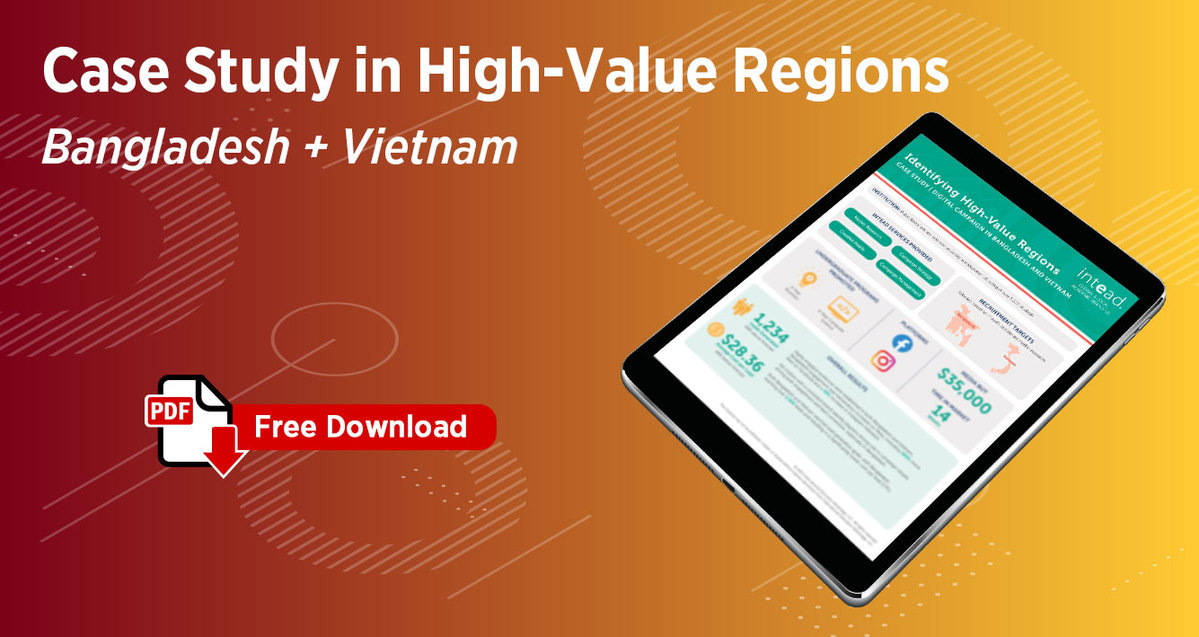
Case Study in High-Value Regions: Bangladesh + Vietnam


Market diversification is one obvious answer to sustaining enrollment numbers. How to successfully go about it, however, is often less obvious. Looking beyond your own campus to see how others are doing it can help. So, we have a story to share. 

If you've seen our other case studies, you know we share more concrete details and data than any other agency out there. We want to make you that much more dangerous and demonstrate the value of investing in customized, creative, and well-tracked paid campaigns.

In 2021, a mid-tier, public, Midwest regional university needed to recruit international students. It’s a student segment they’d had success with in the past, but Covid, as it does, threw a wrench in their recruitment efforts. It became clear they needed new ways to reach prospective students residing overseas. We know you were wrestling with this very issue at the time, too. We all were. 


Find us at AIRC and ICEF. Let’s connect! 

The Intead team is gearing up for some amazing presentations and we hope you can join us. 

  • AIRC Annual Conference – As you read this, our team is in Phoenix offering our full-day digital marketing workshop. If you are at the AIRC conference, please look for us here in Phoenix, Dec 6-9, 2023 
  • ICEF North America Workshop in Miami, Dec 11-13, 2023. We'll be offering a half-day workshop on Dec 11 and meeting with everyone on Dec 12-13.

Let us know if you’ll come share a cup of coffee and a conversation about all things global and digital (info@intead.com) 


Back to the results of our digital campaigns in Bangladesh and Vietnam.

With a media buy budget of $35,000, the institution was admittedly skeptical they’d be able to make any meaningful progress in a new market. We always want more wiggle room with our media buys, but we also felt certain they could succeed, with the right approach. They trusted our experience and the market research we delivered.

Our mission: understand who and where the prospective families are and then reach them in ways that prompt engagement. So our data detectives and creative talents set out to: 

  • Confirm the institution’s high-value student recruitment regions and where there might be room to grow
  • Develop on-brand, targeted, and effective digital marketing assets   
  • Launch and optimize digital campaigns to generate highly qualified leads (and build awareness, but really, we all want the high-value leads) 
  • And of course, report on campaign analytics to inform future marketing investments.

By any measurement, it went really well. One $12,000 media buy generated 40 million impressions, 500,000 clicks, 1,087 leads, 122 applications, 40 admitted students, and 7 enrolled. But who’s counting? (Please say you are!)

It was a fast, 14-week campaign involving two markets, two academic programs, and two social platforms. Want more insight? Download our free case study. Read on… 

Read More

You’re In the Right Place: Predicting the Future of Student Recruiting

The enrollment cliff has everyone a little on edge. People are burned out and frustrated. Leadership is looking for bigger gains in shorter time frames. And traditional students just aren’t showing up in ways they traditionally have.

It’s so clear that higher ed is at an inflection point. Thank the pandemic. Thank technology. The economy and unpredictable job market. The changing student landscape. What you need now more than anything is support. Ideally in the form of a soothsayer to tell you where and how to invest your time, energy, and resources. If only.

Our advice: take a deep breath and read this post.

While soothsayer we may not be, we do have some perspective on what lies ahead. And our record for predicting changes in the market has proven accurate for more than a decade. Long before the recommendations below became standard practice in enrollment management (they all sound so obvious now, right?), we advised colleagues to:

  • Make better use of your CRM (or get one if you don’t have one), and embrace the add on features and API connections that improve tracking and results.
  • Identify staff with the skills you need for each function of the enrollment process. Your creatives are not your meet and greeters and they are not your data analysts. You need all of these skills.
  • Develop your international alumni as global ambassadors. (Most of you are still not doing this).
  • Find reputable commission-based recruiting agents in your target countries and invest time in managing them very carefully.
  • Train your domestic recruitment team in the nuances and needs of international students already studying in the US so they know how to address the important topics (visas, parental concerns, economic realities, etc.)

We know, it’s all old hat now. But a decade ago, very new to international enrollment management teams.

Today we are facing some pretty significant headwinds. Post-pandemic changes to how students evaluate universities. Growing financial pressures facing families. Increasing importance of careers and the ROI of your degrees. Heightened interest in certificates and shorter paths to career growth. Political divisiveness harkening back to the US civil unrest of the 1960s (or 1860s?). Are you factoring social justice including climate activism into your marketing plans?

These factors are all part of the student and parent mindset as they evaluate investments in university level education. The pool of nontraditional students is much larger and more diverse than the shrinking traditional student pool. And yet, the international student pool is one that is growing and projected to grow dramatically in the coming years.

If you’re ignoring any of these market segments, we strongly advise you don’t. Our analysis of and predictions about what influences student decision making, the tools and processes you need in place to be both efficient and effective, this counsel has been spot on for a very long time (our blog records act as our receipts).

You’re in the right place. Read on to be sure you are able to anticipate what is next and what to do about it.

Read More

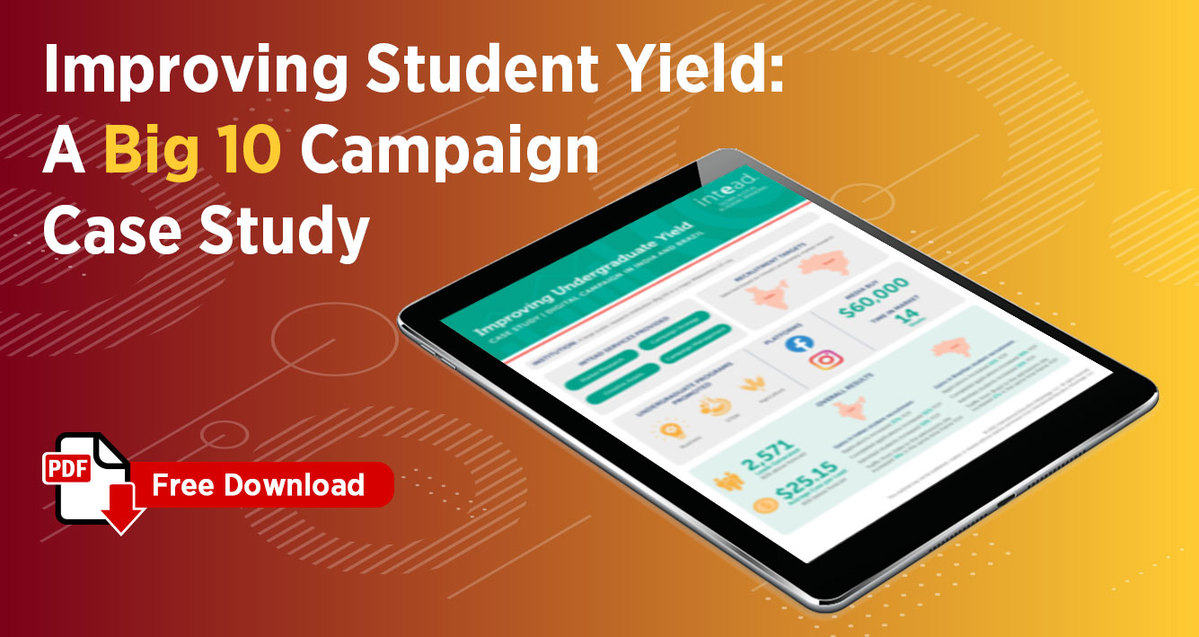
Improving Student Yield: A Big 10 Campaign Case Study

Day One of #NAFSA2022 and it just feels so good to be back together. Optimism is in the air. The social media chatter among our colleagues here is exuberant.

Even if you’re not in Denver this week, we bet your office is feeling the energy of an industry that is projected to grow by as many as 1 million students globally next year. Sure, that growth is more of a rebound, but it’s welcome news nonetheless.

As the tsunami of NAFSA conversations washes over us, the buzz is all about diversifying source countries and everyone is wondering about the best way to go about it.

You, too? Right, because China.

We’re always happy to help lend insight into these international student recruitment conversations based on our global market research and recent client experiences. Often that’s best done through real-world case studies that speak directly to the need to diversify enrollment and improve yield. Today we release our most recent case study diving into a really successful international digital campaign we recently ran for a US Midwest Big 10 research institution.

Let’s meet in person!

If you’re at NAFSA this week, be in touch. We will absolutely do our best to fit in another meeting while in Denver. You’ll see Ben, Patricia, and Iliana racing from our presentations to a bunch of IEM sessions and all those networking events and 1:1 meetings.

Our 2022 can’t miss sessions:

In the meantime, read on to download our latest Big 10 case study all about improving undergraduate yield.

Read More

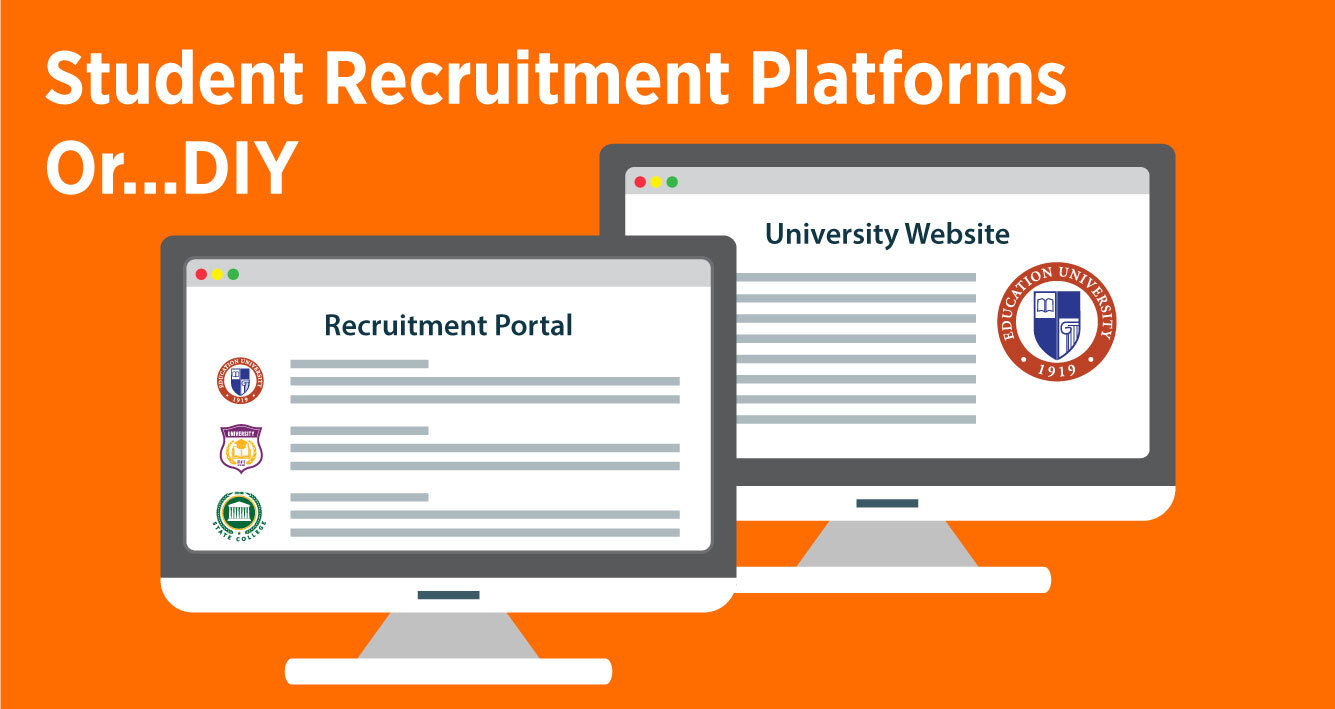
Student Recruitment Platforms Or…DIY

Online student recruiting platforms have become an industry staple and the proclamations of power and reach among them as they battle for market share is reaching a crescendo. They promise to find you leads and/or enrollments. They talk about customized approaches while their business model is all about rinse and repeat, cookie cutter marketing. 

Is their automated customization going to get you the results you want? Will they draw the valuable student click? You know, the one that is serious about pursuing your institution? Or simply the click that looks good on digital reach reports but never converts?

More importantly, are these platforms your only option for digital student recruiting? You actually have a DIY secret weapon that so many have lost sight of.

Read on to learn how your institution just may have all the tools it needs to be its own digital student recruiting platform (spoiler: it starts with your website).

Read More

Quick Hit Digital Campaigns: Performance Benchmarks (3)

We can’t dive into our digital marketing insights this week without first acknowledging where we are right now here in the US. As human beings, we share an acute craving for security. Such a strong desire for a return to “normal”.

This desire for safety cannot stand in the way of our need for change. We, as a community, stand for diversity of thought, culture, and expression. We stand for academic exploration and shared knowledge.

Our team brings the fortitude and commitment to stand day after day and stare straight ahead. We will continue to embrace opportunities to be in this community together, with each other and for each other.

Remember where to look when you need support and encouragement. Courage grows with numbers. We will be here, standing up for our shared ideals for as long as we are able.

And with that weighty and heartfelt commitment to all of you, we will turn to the business of the day with a much lighter tone—

We don’t usually endorse cheating off your neighbor’s paper, but today, we’re making an exception in the spirit of moving us all forward.

We’re excited to share this work with you: actual digital marketing campaign results from a campaign we recently ran for a US institution targeting international student prospects in Colombia and South Africa. We’re offering you a case study with real, granular detail straight from our marketing dashboards to help you answer digital marketing’s most common questions:

  • Am I doing this right?
  • What should I measure?
  • What does success look like?

Read on for a case study snapshot and to download the full version for yourself. We’re talking real performance data here, including top performing creative assets, actual CPC, CPM, and conversion data, and more.

Read More

One Million Student Prospects Vanished This Spring

Just poof, gone!

But we know where they are hiding.

An excerpt from Jeff Selingo’s highly anticipated forthcoming book, Who Gets In and Why: A Year Inside College Admissions:

“A student’s name is sold by College Board, on average, 18 times over her high school career, and some names have been purchased more than 70 times…The coronavirus prevented more than a million first-time SAT takers in the high-school class of 2021 from taking the test this spring or summer. The canceled ACT/SAT doesn’t only leave rising seniors lacking a score; it also results in the loss of names for colleges to fill the top of their recruitment funnel.”


If you have typically used those purchased names to fill the top of your recruitment funnel…it’s time to rely more heavily on digital marketing to generate those leads.

Generating your own leads instead of purchasing them produces prospective students who have clearly expressed interest in what your institution offers. Higher quality prospects produce more efficient, lower cost results. In the end, a streamlined recruitment process to fill your classes.

But contrary to what Facebook and Google might have you believe, a successful lead generation campaign is more than just a few clicks in an ad platform. You’ve got to have the expertise to set up your audience criteria and so much more.

If you are concerned about meeting your enrollment targets, may we suggest a bit of help from the Intead team and our Intead Plus resource library?

Our Intead Plus members have access to the worksheets and data that help them justify their student enrollment marketing plans and craft targeted, ROI-positive campaigns. A year-round resource, Intead Plus offers strategic support, data analysis, recruitment planning, student personas, and industry perspective.

Oh, and did we mention that we are offering steep Intead Plus membership discounts to state consortium members? Study Illinois started the trend and now it might be available to you.

If you are a member of your state consortium, be in touch: info@intead.com.

Read on to figure out where those 1M students went and how you can reach them.

Read More