Recruiting Intelligence

Cracking the Student Success Code

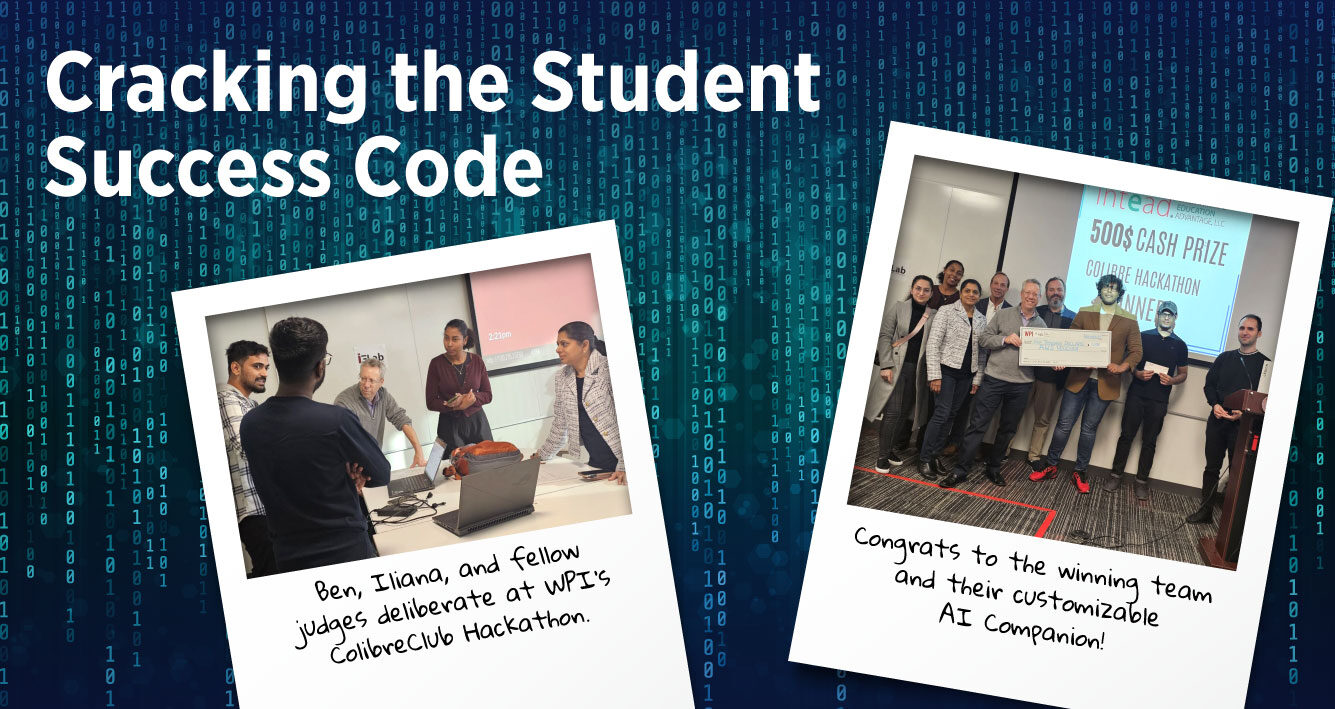
Grad students Poorajith Sasikumar Thenmozhi and Anurag Bansal needed a problem to solve. As founding members of ColibreClub, a student-led organization at Worcester Polytechnic Institute Business School, they were gearing up for their inaugural student hackathon and were in search of a real-world problem statement their competitors could sink their teeth into. 

That’s when the Business School’s Assistant Dean Sandhya Balasubramanian stepped in. Sandhya a friend and colleague of ours reached out to the Intead team to see if we had ideas. Our answer: Always! 

Trend watchers and challenge seekers, we didn’t take long to share one of the many higher ed research topics that interest us in the area of student success. Prior to and through the Covid-19 Pandemic, we watched student mental health concerns grow dramatically. We also noted that issue rising on the list of major worries being carried by university presidents and provosts.   


Opportunities to Meet the Intead Team 

  • Our AIEAstint ends today as we turn our focus to ASU+GSVin April, and NAFSA in May. Let us know  if you want to connect at these events.  

Bookmark this: Intead’s Resource Center 
Access 800+ articles, slides decks, reports with relevant content on any topic important to enrollment management and student recruiting.  Check it out.


Data underlines the urgency. Sallie Mae’s How America Completes College 2024 report on undergraduate barriers to graduation reveals 42% of at-risk students who consider leaving school do so for reasons involving motivation and mental health issues. When asked what resources would have helped them stay, 30% said more mental health resources/support.  

In our work with academic institutions, we’ve seen such a range of responses on campuses that make services available to students in different ways and importantly, help students become aware of and access those services in different ways as well. 

Assurances to help individuals who are struggling academically/mentally/physically are part and parcel of student communications. You know as well as we do that prospective students and their parents care a lot about this topic so including it in your recruitment materials has become routine. For some families, wanting to know about academics and sports top the list as they evaluate an institution. At some point, a growing number of parents worry about whether their kid, as mature as they are, is going to have the support services they need to succeed, including mental health services. 

So, the Intead team has been thinking a lot about actual accessibility, or lack thereof, of these types of programs. Some universities promote the services and access far more than others. Are they living up to their promises to students? Are there innovative ways to improve both student communication and accessibility? The WPI student hackathon tackled these questions with gusto!

Read on...

Read More
Internationalization is About Risk, Reward, and Your Culture


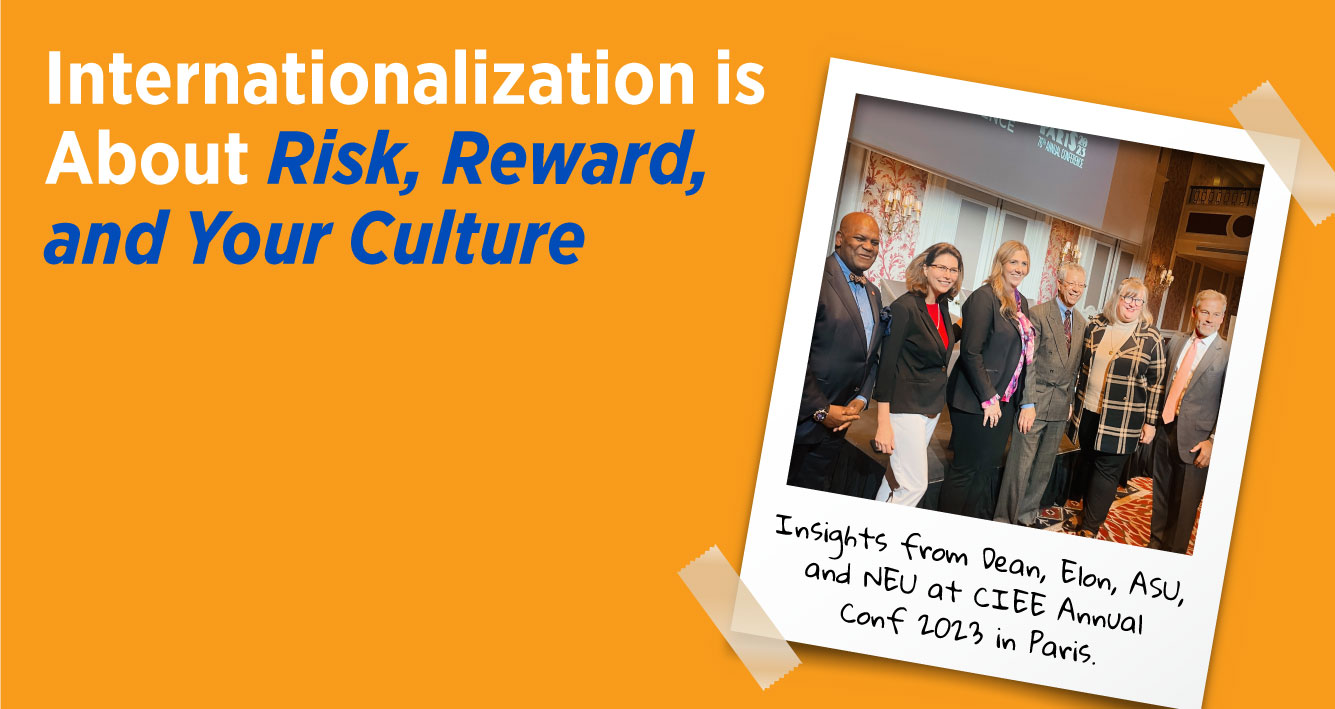
The opening plenary at the 76th CIEE conference drew a crowd earlier this month in Paris. No wonder. With a jaw-dropping panel representing Elon, Arizona State, Northeastern, and Dean College, the discussion presented some rare gems. 

The goal: set the conference off on the right foot. Get everyone thinking deeply about how international experiences can reach more students. 

The crowd clearly held the belief that a global education holds the promise of a brighter future. The proof was simply in the stories told by leaders in academia, government, and pretty much every institution in attendance. Those with international experience as a student spoke of the indelible mark that it had on their life and career. The global experiences changed their views of the world and shaped their decisions about how they would participate in it. No doubt, many of you can relate. 


Opportunities to Meet In Person 

The Intead team is gearing up for some amazing presentations and we hope you can join us. 

  • AIRC Annual Conference – we’ll be offering our full-day digital marketing workshop here In Phoenix, Dec 6-9, 2023 
  • ICEF North America Workshop in Miami, Dec 11-13, 2023 

Let us know if you’ll come share a cup of coffee and a conversation about all things global and digital (info@intead.com) 


Why we work so hard at this and gather to define the path forward: we are looking to make international education more accessible for current and future students. And we want those experiences to be deeply rewarding. We need to be sure the programs have a solid curriculum, strong faculty leadership, and finely tuned logistics and support services.  

We can only take on so much at one time. What I heard as the specific foci at this CIEE gathering: 

  • Clarify the steps to improving broad student access.  
  • Increase our capacity to provide student mental health support services.  
  • Focus efforts on environmental sustainability initiatives. 

The conference provided a foundation for robust, challenging discussions among study abroad leadership and all the many practitioners in the room. And these talks will continue. Fortunately, the resources to do the work, to make these ideas meaningful, not just esoteric, are in place.  

The discussions embraced big visionary approaches (can we foster greater employer engagement in internationalization?) and concrete touch points (can we provide each traveling student with a sustainability cookbook customized to each of 30+ destination cities?). The ideas shared and evaluated poured forth.  

Granted, there is never enough money to do all we want to do. But roughly 75 years ago, a poignant point in time following World War II, many smart and good people got together to launch global initiatives, including the United Nations, IIE, the Fulbright program, NATO, WHO, IMF, the World Bank, and CIEE to name just a few of the most prominent efforts to bridge cultures globally. 

I had the great privilege of moderating the opening plenary and speaking at length with: 

  • Rebecca Kohn, Ph.D., provost and vice president of academic affairs for Elon University 
  • Amy Stevens, Ph.D., vice chancellor of global experiential pathways for Northeastern University 

I wish all of you could have been there. That’s why today I’m sharing with you a few of my personal notes from talks with these industry leaders and other observations from the 3-day event. It’s a quick read, but one I know will spur ideas and get your wheels turning. Read on… 

Read More

Thinking Big Opportunities: NAFSA 2023 Slides

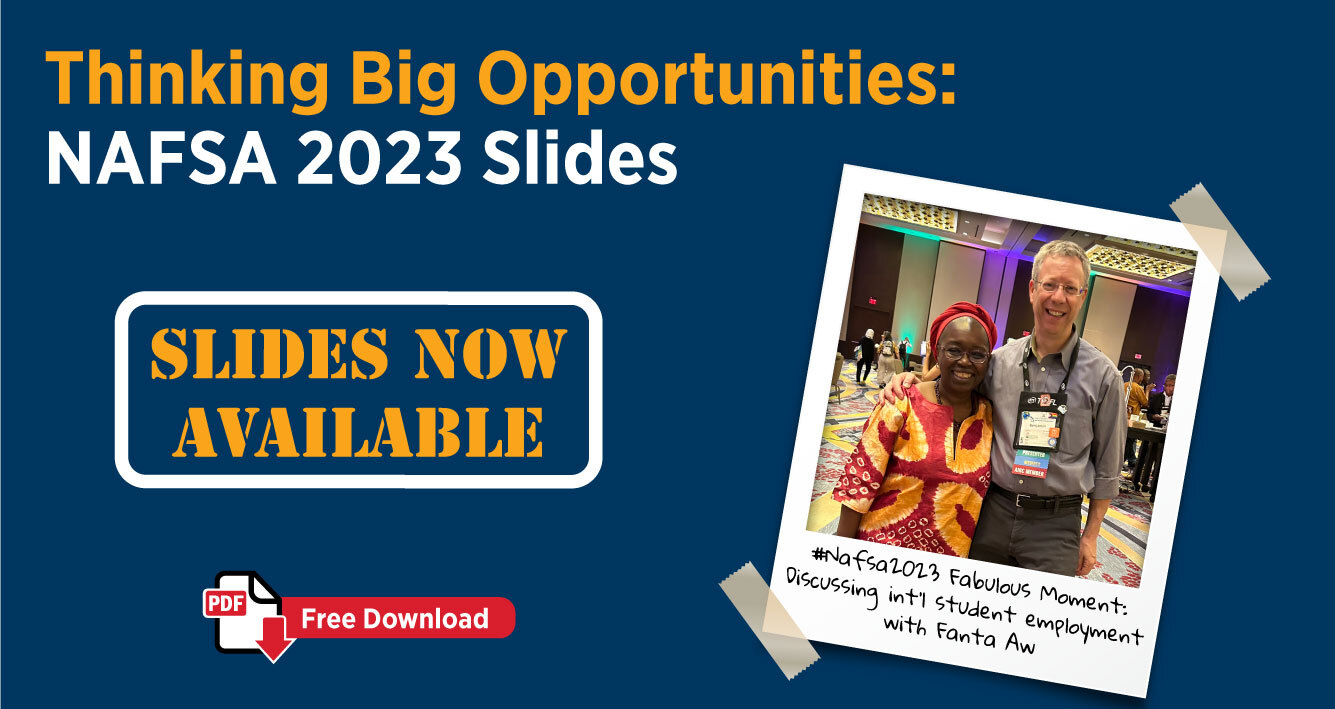
Let’s start with this: our NAFSA 2023 slides are perhaps the most concise and clear educational tool we have produced to-date. When you have 3 strong speakers and just 50 minutes, you really need to focus if you want to get your point across.

Each slide represents far more content and conversations we would love to have with you. During one of our future conference sessions, webinars, or anytime, really, just reach out and let us know you want to chat.

Today we share our biggest takeaways from NAFSA 2023. These are thinking big opportunities.

We were honored to share the dais with Paulo Zagalo-Melo, SIO and Associate Provost at Western Michigan University and Karin Fischer, Senior Writer at Chronicle of Higher Education. Our focus: what kind of data and other information can truly inform our international student decision-making? And we considered the flip side: what information is TBU (True But Useless)?

A bit of foreshadowing: A focus for the Intead team going forward is going to be on international student employment and all we need to do as a community to make that process work better. You’ll see much more on that topic from us over the next year+. We have some amazing partners to help us get you the data and tools you need to improve your institutional approach. Watch this space.

You want answers about valuable vs. TBU data? Check out our NAFSA 2023 slide deck (download link at the bottom of this post.) Yes, we are making you work for it ; -)

Read More

Spontaneous Learning

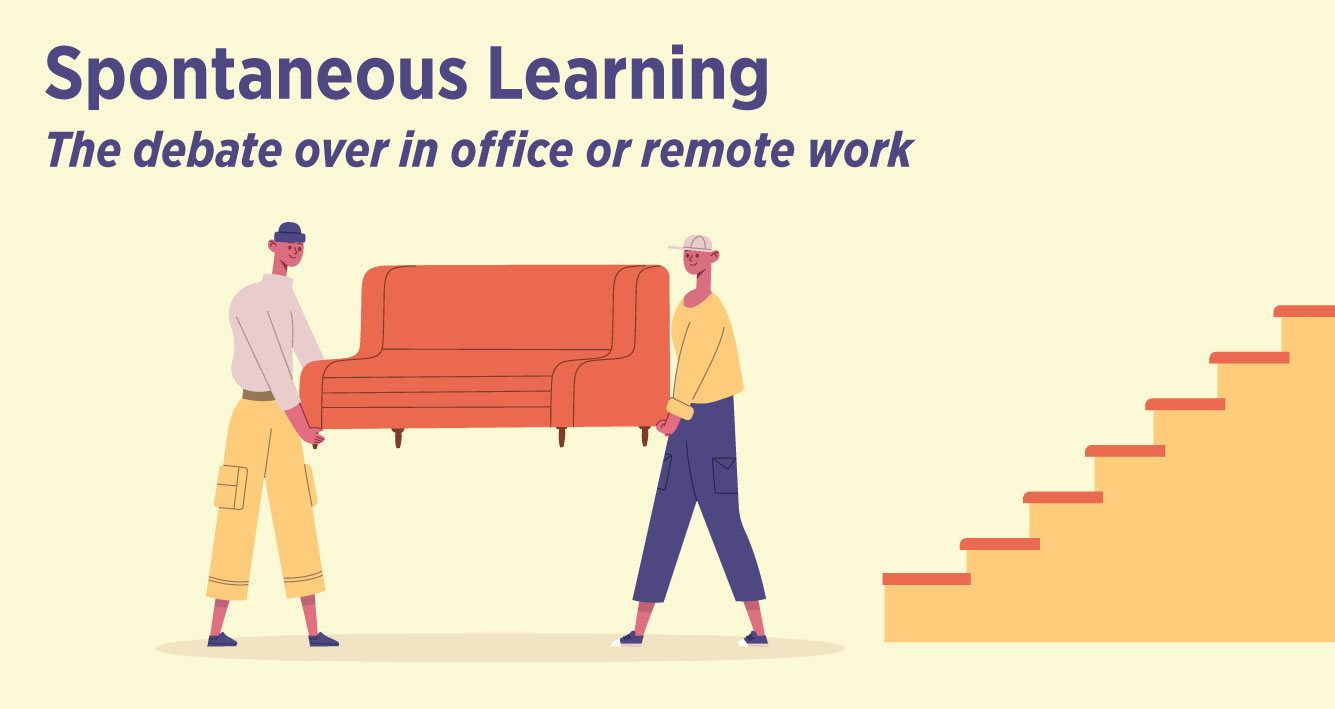
I need this couch moved to our second floor sitting area. Clearly this is going to take both of us working in tandem.

“You want to go up first?” You ask.

“Sure,” I say.

I reach for the bottom and the side. You find your handholds as well. We lift in unison.

I need to adjust my grip as I navigate the first stair. You feel the couch shift and adjust accordingly. We make eye contact over the bulky thing and nod to each other. We are innovating as we climb and adapt to the shift in weight and the angle of the couch with each step.

Innovating together in real time. Communicating with words and body language. Collaborating on our way to achieving our goal.

I have to give credit to my friend and colleague Dr. Michael Mascolo, Professor of Psychology at Merrimack College for this metaphor I’m employing. During a recent conversation with Mike, I was making observations about the debate over remote vs. in-office collaboration. We’ve all seen it: the loss of innovation and spontaneous learning when the whole team is working remotely.

As much as we want to leave the commute behind, put a quick load of laundry in after the 9:30am Zoom call is done, even bake a banana bread mid-day, because, why not? Look, I’ve been running virtual teams since 1993 (mmm hmmm, that’s when I started consulting, dinosaur that I am). The power and efficiency of remote work is undeniable.

And yet, and yet…also undeniable is the loss of opportunity for us to learn from each other (even at my dinosauric age, I am learning from the team here). What we all need is much, much more face-to-face interaction – from the fresh graduates entering the workforce to those with decades of experience. We grow and learn together in different ways. We innovate in real time.

Over the past few years, we’ve been growing significantly here at Intead. More universities, high schools, rising edtechs, and established academic providers have been tapping our expertise. So, we’ve been hiring more talent. The talent market has shifted and there are a lot of folks looking for greener pastures right now.

Read on for a bit of perspective that I am surprised far too few current job applicants seem to grasp...

Read More

Marketing Culture. What’s Yours?

We’ve all heard about how company culture eats company strategy for lunch, yeah?

Last week, we wrote about how folks often confuse strategy and tactics. And we gave a little side eye to those colleagues among us who use the word “strategy” to appear smart and make others feel less than.

The cheat sheet on that one: replace the word “strategy” or “strategic” with “different” or “differentiation” and you’ll be able to get to the nub of the discussion topic quickly. Strategy has everything to do with position in the marketplace, which means how you stand out and leverage your differences against the competition. Tactics are all about the marketing tools and channels you use to make your institution’s valuable differences shine, be heard, and understood.

But in academic marketing (and virtually every other operation we can think of), how we achieve our strategic differentiation, how we meet our institutional goals, has everything to do with the team we have to do the work (the team that creates and delivers the product).

An interesting observation here: academic institutions really are all the same, right? Sure, there is R1 and R2, public and private, not-for-profit and for-profit, 4-year and 2-year, but these categorizations, when you get down to it, are not that significant, at least at the undergraduate level, right? They are all producing the same thing and in the eyes of the consumer, what is really different? They all have the same administrative and academic departments. And the rankings are a sham anyway, right?

Read on for how to counter that sad and ineffective point of view.

Read More

How to Say 'No' to Ideas That Aren't Good Enough

Brilliant and creative enrollment professionals, we know your pain.

So many great ideas, so little time, and so little budget.

It’s the refrain of higher education (that, and “Don’t talk to me during application season”). And while we know you want to tackle everything with an enthusiastic “yes”, saying “no” more often than “yes” is nearly always required to keep your institution and your strategy on track.

With budget season inching towards the finish line, we know you’re already thinking about putting that budget into action in the new fiscal year. We also know that making the most of that budget will require focus, a concrete plan, and most importantly, that discipline to say “no” to lots of shiny new ideas that pass you by.

Steve Jobs said it best: “Deciding what not to do is as important as deciding what to do.” But with great ideas and options coming at you from all sides, how do you decide what will maximize value for your institution?

With this enrollment cycle murkier than ever and past performance clearly not indicative of future success, turning your gaze on some downhome marketing truths is a good idea.

Read on for five key questions to ask yourself next time that lightbulb moment hits you and your team. Our insights will help you hone your efforts on the ideas that will produce results and justify that budget.

Read More

The More Things Change…The More We Need to Figure Out

So, ICE tells all the online international students in the U.S. to go home and Harvard tells all students to go online for Fall 2020 (without lowering tuition). That’s quite a news day.

From day to day, the landscape continues to shift, sometimes dramatically.

If you’ve missed the past few months of Recruiting Intelligence posts because you’ve had other pressing priorities (we get it), then you may want to take a scroll through it all.

Read on for a quick summary of all the things we all need to figure out. (Spoiler alert: we've already figured out a lot of them).

Read More

Perceived Value: Online vs. On Campus

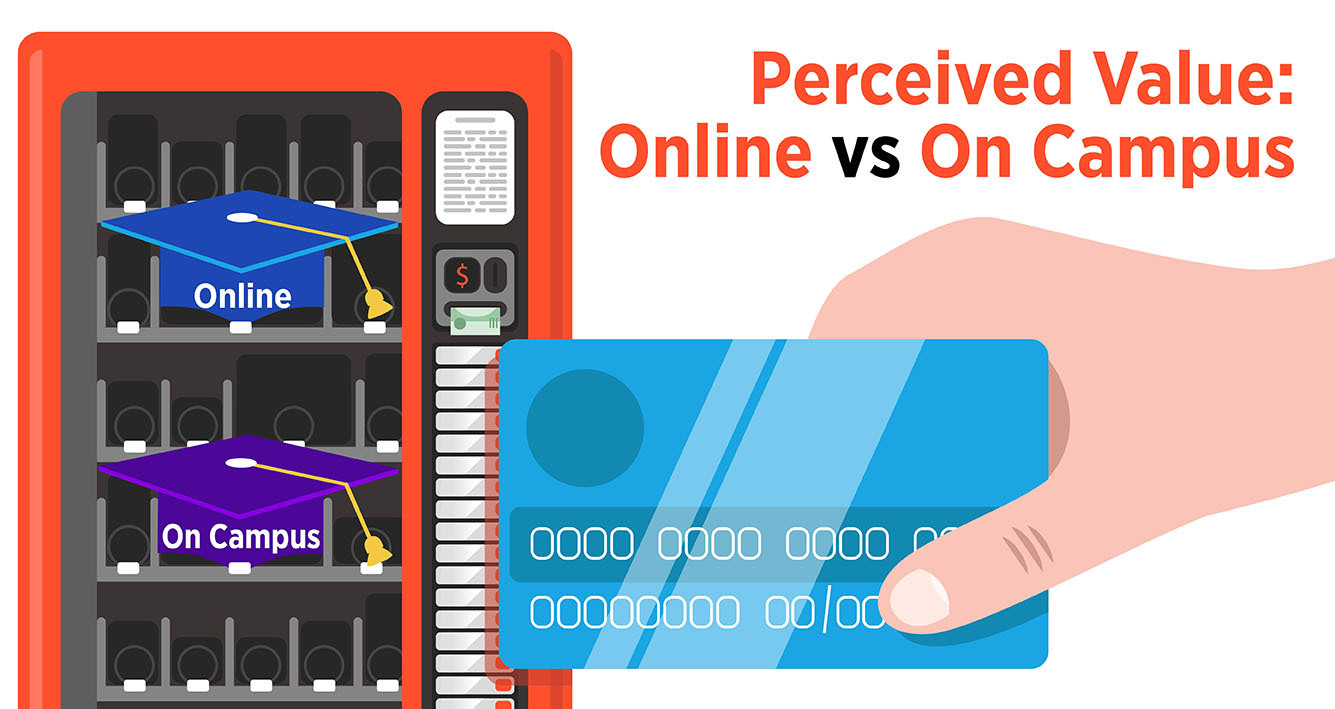
What are your students willing to pay for an online education?

Here is what you are really after: given your brand reputation, the demographics of your student cohort and the potential to create a new service delivery model, what should you offer and how much should you charge for it?

Let’s get that answered!

Our primary message: custom research into what your student cohort is willing to pay for your brand on campus or online is invaluable. An important part of innovation is the upfront market research that points your team in the right direction.

Below we review some new pricing research that offers insights and a conceptual approach to getting this type of data for your institution.

The context: During a high school Zoom graduation ceremony we watched this past week (my niece got her paper!), the valedictorian shared the experience of his last day in high school in March this year – a day like any other, except that at the end of it, the principal quite suddenly told everyone there would be no school the next day. A mundane day that suddenly marked the end of all he had worked for. No celebration, no Senior Week pranks, no high fives, just, head home and, as it turned out, don’t return.

His comment at the close of his valedictorian graduation speech: Don’t ever doubt that the world can change in an instant.

Across the globe, students and institutions shared that experience. How will all those valedictorians and all their friends make decisions going forward. College? Job? Remote learning and a job?

Read on for pricing research perspective to get you thinking.

And watch this space over the next few weeks as we dive into the doing that is prompted by the thinking. We’ll be sharing detailed case studies of some of the successful digital marketing work we’ve been doing for a variety of institutions around the world.

Yes, even during a pandemic, especially during a pandemic, digital marketing will connect you with your target audiences. We will show you how and give you benchmarks to help you evaluate how you are doing.

Read More

Investing in Growth, Looking Beyond Fall

Your institution’s mission has not changed.

Despite all that is swirling around us, you are still in the business of helping people improve and achieve. You are still helping them understand what to learn and how to learn it.

Resilience is Built

Many institutional leadership teams are demonstrating the very resilience their mission statements say they will instill in their students. Others are suggesting business as usual with little change to their operations beyond physical distancing practices.

Investing in adaptation and innovation builds long-term resilience. This is what students are doing by investing in their educations – building resilience.

What is the story we tell students and parents? “Take the risk. We know it is a lot of money, but you’ll be better off in the long-term.” We tell students to invest in a 4-year growth plan, and we reinforce it along the way, “Don’t be deterred! Finish in 4 years!”

Are academic leaders following that same advice to build resilience for their institutions? Or are they crying poor, just like the students they are trying to convince to spend savings and take on debt for future gains?

Here’s the thing: institutions rarely stick to their own 4-year plans.

Example: Enrollment marketing initiatives often start with 3-5 year plans. The team acknowledges that real returns won’t materialize in years 1 or 2. And then, turnover in senior administrators and other outside factors suddenly defund the growth plan and little to no progress gets made. The planned investment halts after just 12 months.

I’m sure you’ve seen this happen all too often.

What To Do?

Develop the vision. Build the buy-in. Invest in the execution. Stay the course.

We will be adding a new set of research and resources available to our Intead Plus members over the next 8 weeks to help you do just that.

Read on to take a look at where forward-looking institutions are making these investments for longer-term growth (case studies are available).

Read More

Micro-Innovations: Opportunities Speak Loudest to Those Who...

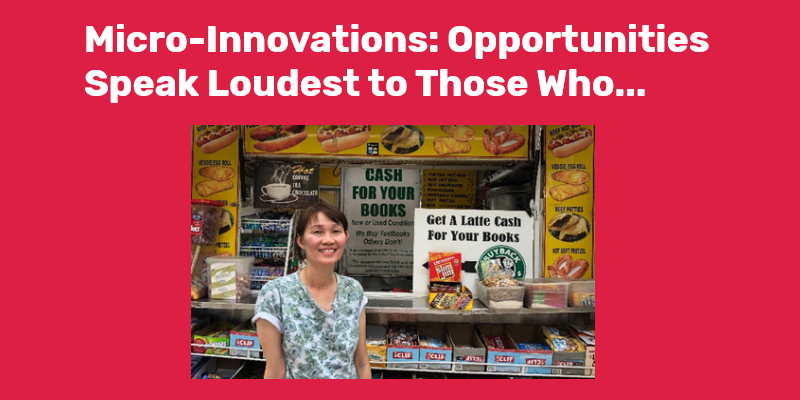
I met Jenny on a sunny July day at the corner of H and 22nd Streets in DC -- in the center of George Washington University’s campus.

Jenny’s been running this hot dog stand at this corner for 22 years.

Originally from Vietnam, she has two children currently attending the University of Virginia. With all these university ties, GWU, UVa, you’d think she works in our field of academia. And in a way, she does.

Take a closer look at that stand behind her. See the signs? Jenny is an entrepreneur and a micro-innovator. She recognizes opportunities and she goes after them. And she succeeds.

As Jenny and I talked, she shared that she sees a small boost in revenue at the end of each semester (in May and December) with her cash for books deal, in addition to the hot dog and soda sales. Her location gives her an opportunity that another hot dog vendor, at say the corner of H and 14th Streets, does not have. Her micro-innovation has proven a consistent, small incremental value to her overall operation.

It is the start of a new school year and we have so many ideas to share with you. This is no time to sit on your hands, or wring your hands. It is time to put those hands to work, get them dirty.

Read on for ideas about how thinking about micro-innovations might be just the thing that can energize your team and add up to significant growth for your recruitment funnel.

Read on...

Read More