
Recruiting Intelligence

Why Personas Get a Bad Rap


Imagine a mid-size, private university, call it Opportunity University, gearing up for a recruitment push in Vietnam – a new target market for the institution. Excited by the potential and the green light from the provost, the nimble international recruitment team of two assembles a marketing campaign targeting what they assume to be their typical international prospects: high school students motivated to get a liberal arts education at a US institution that will lead to future career success.  

The standard international student profile, right? (Wrong, but we’ll get to that.) Running on a tight budget and timeline, they repurposed a campaign strategy that had previously proven successful with the Indian market (a dominant source of students for their computer science graduate programs). The response, however, was not what they had hoped.

The errors of this somewhat exaggerated story highlight a critical marketing misstep: relying on shallow persona development. Not thinking this stuff through can lead to serious marketing misses. Anyone who takes a simple bullet list of traits and runs with it (high school student, career-minded, uses WhatsApp, seeking international education) is not taking their role as marketer seriously.  

Personas often get a bad rap from jaded marketers who have seen the process based on simplistic stereotypes and then relied on as a holy grail. We hear you! We are not seeking Hollywood stereotypes here.

But well considered personas do align your broader marketing team so that your communications speak with a consistent integrity to each potential student segment. Well-crafted personas are all about internal team alignment around a common voice and marketing approach.


Opportunities to Meet the Intead Team 
- NAFSA Region XI, Hartford, Connecticut, Oct. 27-29, 2024
PIE Live North America, Boston, MA, Nov. 19-20, 2024
- AIRC, Seattle-Bellevue, Washington, Dec. 4-7 -- including our pre-conference global marketing workshop. A full day of Intead global intel (lunch included ; -). Details here. 

Bookmark this: Intead’s Resource Center 
Access 800+ articles, slides decks, reports with relevant content on any topic important to enrollment management and student recruiting.  Check it out.


Unlike the fictitious Opportunity University, institutions that think critically and dive deep into student persona analysis understand that the development of multidimensional profiles is foundational to successful student recruitment strategies. They get that personas, when thoughtfully crafted, can anchor the entire marketing team around a coherent, effective, audience-centered strategy. It’s a north star for guiding marketing tactic selection, content development, design, student interactions, and marketing execution which includes selecting recruitment channels. 

The process of creating marketing personas itself helps dissect the complex student decision-making process by considering the target audience’s lifestyle, challenges, media consumption habits, and underlying motivations. It is so much more than a surface demographic dig. What you uncover during the process can lead to really compelling marketing that will resonate with your prospects because you will have firm insights into their mindset, influencers, and ultimately, their choices.  

On more than one occasion we’ve seen the persona discovery process actually lead to market retreat because the more intimate understanding made it clear the audience and programs on offer weren’t a good fit after all. Better to find out in the early stages than committing to a no-win grind. A sort of check and balance of your strategy. 

Complex persona development is the kind of thing large consumer packaging companies are so good at. During one of our internal innovation sessions the Intead team got into a discussion about how understanding your audience plays out. One quick case study was P&G’s “Thank You, Mom” campaign from the 2012 Olympics (London). If you don’t recall what we’re talking about, see the link below. Let us know your reaction. Tip: grab tissues first.  

So much emotion, and yet, all they were selling was laundry detergent and other basic goods. They knew exactly who their target audience was and why they used their products. And no, it wasn’t to simply keep clothes clean. The tagline lays it out, "It takes someone strong to make someone strong. Thank you, Mom." Suddenly, I have this urge to buy Tide. But I digress… 

The lesson here is the student journey to your institution is so much more complex and life altering. Just imagine what a thoughtful, well-understood persona could do for your student recruitment. Read on for our tips (pass them on to your team) … 

Read More

Is Your Content Functional but Vibeless?


So, my oldest child joined us for dinner out the other night. She dressed with her usual flair, all yellow and brown this time. And she ordered herself a drink to match – some cocktail concoction that apparently took a cue from her hues. I had never ordered a drink to match my look before, so I asked her what I should get. Her response: "Dad, I have no idea. Your look is functional but vibeless – jeans with a black fleece. How about a Miller Lite?" 

Absolutely loved that line: functional but vibeless. How common is that situation in the marketing/communications world? Consider all of the functional but vibeless emails we receive. You probably can’t consider them. They’re all just so forgettable.  


Our next opportunity to meet! 
NAFSA Region XI, Hartford, CT, Oct 27-29. The Intead team will be there presenting on Admission Process Analysis, Marketing Data Analytics, and Marketing Study Abroad with university partners from our New England region friends from Quinnipiac, Johnson and Wales, Clark, and Emerson. Practical strategies and creative tactics to hit your enrollment targets.  Hope to see you there! 

The Resource Center for Industry Insiders 
Take your challenge of the day and plop it into our search bar. With 800+ publications and our 15 years of weekly blogging, you will find relevant content on any topic important to enrollment management and student recruiting.  Valuable perspective and data on topics you care about. From agent-university partnerships to predictive modeling and CRM efficiency, to new market development, our Resource Center has you covered. Check it out.


Examples of what we mean:

→ Dear inquiring student, 

Thank you so much for submitting your application. We note you are still missing one document. Blah, blah, blah…our deadline is approaching. 

Thanks, Vibeless University Admissions Team 

---

→ Dear admitted student, 

Let us introduce you to all of the really great student associations you could join here at Vibeless U! When you arrive, you should look into one. Oh, and here’s a fun picture … 

Sincerely, Vibeless University Admissions Team 


All function, no form, low response rate, immediately forgotten. Instantly deletable. 

Taking time, tapping consumer insights from your current students, injecting creativity, tracking the metrics to figure out what works, what converts. These are the activities that produce results. These are the activities that will share your institution’s true vibe far and wide. 

Every communication you have with students and prospective students, matters. It’s how you connect with them. Correction: It’s how you stay connected. Retention is as important as recruitment.

Today, we offer the three golden rules to creating a lead nurturing campaign that’s got the function you need and that all important vibe. We think this post will be really helpful for your team members tasked with the nuts-and-bolts details of your institution’s prospective student outreach.

Important to communicating vibe: the order you present your messaging matters by region and student type. Is affordability your first hook? Career opportunity? Environmental justice? Academic prowess? All important content areas. Different student segments will click on one or another topic at different points in their decision-making process. THAT is what consumer insight research confirms for you as you use your content to improve application rates and yield.

Share this one with the right folks on your team and, read on 

Read More

It’s Time to Rethink Your ROI - New ‘Late Bloomers’ Insight


Have we been selling ourselves short? A recent working paper by the National Bureau of Economic Research has got us thinking, "Yeah, maybe." 

The not so fine print in “Late Bloomers: The Aggregate Implications of Getting Education Later in Life” is this: the age at which you get your degree matters. The economists found that the younger you are when you get degreed, the stronger your financial return on the investment from that degree. As a result, it may be time to take a closer look at how you present your institution’s ROI.  


Events you won’t want to miss:

Let’s talk international student enrollment at the upcoming AIRC Spring Symposium on April 30 . In-person learning will cover developing, managing, assessing, and sustaining international enrollment focused partnerships. Intead will be presenting on student recruitment marketing budgets – we've got some great new insights to share. Register  today!

And look for us at these other industry events coming around the bend:

  • ICEF North America in Niagara, Canada, May 1-3, 2024
  • NAFSA 2024 Annual Conference and Expo in New Orleans, May 28-31, 2024
  • GMAC 2024 Annual Conference in New Orleans, June 19-21, 2024

The Late Bloomers paper (link below), which looks at university grads beginning with the US 1930 birth cohort onward, also reveals that around 20% of students obtain their 4-year degree after age 30, hence the late bloomer label. A not so insignificant figure, with more than a few not so insignificant implications.  

Sure, the popular notion that university grads are early 20-somethings remains true enough, but the 1-in-5-student stat reveals this belief is not the whole truth – and never was. Turns out the non-traditional student market is significant (you’ve read our series on the non-traditional student advantage, yes?).  

Significant and new with this paper: the understanding that late bloomers’ ROI may not be as strong as once thought. On the flip side, the new data analysis means the ROI for younger grads is even stronger than we believed. Interesting, and worth promoting.  

Other notable findings from the paper: Late bloomers have helped narrow the gender and racial gaps in university enrollment, even despite a widening racial gap among the early university grad set. And, late bloomers account for more than half of the growth in the share of university-educated adults from 1960 to 2019.  

There’s a lot to unpack here, including why we think you may be selling yourself short based on these fresh insights. Read on…we’ll keep it actionable. 

Read More

The Non-traditional Student Advantage Part 5: Audience Targeting

The non-traditional student can be anyone. To have one definition of a non-traditional learner would limit what we’re trying to achieve. And trying to reach all of them is essentially like trying to boil the ocean. – Hillary Dostal, former director of global marketing, recruitment, and enrollment initiatives at Northeastern University  

A 26-year-old who has just been laid off and seeks to complete a credential program and a 45-year-old stay-at-home mom thinking about a return to the workforce will respond to different messages communicated in different ways. These two prospects will be intrigued by selling points that speak to their own interests. They will prefer messaging written in different tones. They get their information through different channels. At their core, they have different wants, needs, concerns, and aspirations.  

Still, both are terrific prospects for your institution.  

This is part 5 in our 5-part blog series on reaching and enrolling non-traditional students. Find part 1, part 2, part 3, and part 4. 

So, what to do? Get to know your individual audiences. Speak directly to them on their terms. This is how you convey truly compelling messaging. It doesn’t require separate marketing initiatives per se, but it does require audience segmentation and very specific targeted messaging and execution. 

Importantly, before you dive into the engagement piece, you’ll want to be sure that what you have on offer will help these prospective students succeed. 


This is a very insightful ebook. It underscores the importance of differentiating non-traditional students from traditional students throughout the pipeline–from marketing to student success and engagement. The section on conducting an effective marketing audit is a good conversation starter for strategic development conversations. The real-world insights make the book a unique and valuable resource.  ~ Santhana Naidu, Vice President for Marketing and Communications at Rose-Hulman Institute of Technology  


Done well, market segmentation enables you to create better-targeted content and helps ensure that you are spending your resources on initiatives that are the best fit for your institution. This marketing work is simply the organization of your potential students into groups by demographic, psychological, and behavioral characteristics. Segmentation allows you to decide which group represents the biggest opportunity for your institution. And by opportunity, we mean they will find success and their investment of time and money will pay off for them. 

Make that group your target audience and create an offer that will appeal to them specifically. 

Ready to learn how? Read on. 

Read More

The Non-traditional Student Advantage Part 2: What Exactly Makes Them Non-traditional?

For a while, there were fairly common rules. First you graduate high school around age 18. Then go to university. Four years later you graduate with a degree and an employable set of skills. Got it. 

But times have changed. And university tuitions don’t stop rising. And that’s exactly what’s happening right now. Traditional students are heading for the enrollment cliff making way for a more non-traditional set of students. And that means new rules.

Last week we started this 5-part blog series on reaching and enrolling non-traditional students

Today’s students are vastly different from those of decades ago, but colleges are still structured as if 18- to 21-year-old, full-time students are in the majority. ~ The Lumina Foundation Report on Today’s Students

Let’s look at the basics. Typically, a traditional university student is:

  • 18-24 years old
  • Enrolled full time
  • Lives on campus
  • Financially dependent

Intead’s ebook is a timely resource appropriate for the seasoned administrator as well as educators just beginning to tackle the challenges of digital marketing today. Bringing together expert advice from experienced administrative colleagues and successful marketing strategies from work with Intead’s institutional partners, this book stimulates the reader to address the recruitment of non-traditional students from a holistic context that pays attention to student learning methods, delivery of academic content, academic success services, and other areas of student support non-traditional students need to achieve their goals. ~ Jon Stauff, Assistant Vice President for International Affairs at South Dakota State University


Per the National Center for Education Statistics (NCES), of the 15+ million students enrolled at US Colleges and universities in 2021, nearly 65%  were between ages of 18 – 24. Of course, age only tells us so much. A student can be both 18 and non-traditional.

By NCES standards, a non-traditional student is someone who meets one or more of the following criteria :

  • Outside the traditional 18-24 age range
  • Financially independent
  • Has one or more dependents
  • Is a single parent or caregiver
  • Does not have a high school diploma
  • Delayed enrollment into postsecondary education
  • Works full time
  • Enrolled part-time

Other bodies of research define the term more broadly, also including students who are either married or are veterans.

And yes, we hear you. There’s more than a few of you who are bristling at our use of the term “non-traditional.” Truth is, traditionally “traditional” students are no longer the overwhelming majority. And that matters. Which is why understanding the growing and highly important non-traditional audience has become a priority for enrollment teams. In fact, it should be a priority across all of your departmental teams, from nutrition services, to housing, registrar, IT, and career services. (Please tell us that Academic Affairs, Student Services, Career Services and Development are considered a given.)

We can ditch the non-traditional label in due time.

You may see where this is going and why it is important to you as an enrollment professional. The demographic cliff has arrived and non-traditional students are one option for your institution’s continued success. Take a few minutes and we will help you clarify the path forward.

Read on to learn more about reaching specific non-traditional student market niches and the process of engaging them…

Read More

Rinse and Repeat is Not the Answer

Every CFO’s dilemma: how much discounting do we have to do to fill our classes?

But before you get there, it is the Enrollment Management team’s job to answer a few other questions:

  1. To whom do we market? (this takes us from suspect to application)
  2. Whom do we accept? (this takes us from applicant to accepted pool)
  3. And now we turn to the CFO and financial aid team to answer, “How much do we award them?” (this takes us from accepted to tuition-paying)

The Intead team is hyper-focused on question number 1 in ways that others in the student marketing world seem to miss or oversimplify. Zip code and IPEDS analyses will tell you that there are roughly 250K families in the US able to afford tuition bills of $30K or more. And that pool is shrinking as the Chronicle of Higher Ed and industry analysts consistently remind us. The fear of 2025 is growing!

Private institutions have faced, and will continue to face, a world of trouble in the years ahead. If you are not clear about what makes your institution highly valuable to your target audience (and no, the answer is not, “we provide a personalized level of attention to our students”), then your classrooms and dorms are going to look sparser. Those doubles you converted to triples will be double again.

And for other institutions, those with lower price points, there are significant headwinds in terms of how students and parents are evaluating your value as well. Competition will continue to grow.

We'll be talking about all of this at #NAFSA2022 in Denver in just 5 weeks. Please be in touch to set up a meeting or join us for one of our four interactive NAFSA presentations where we are honored to share the dais with our colleagues from Benedict College, San Diego State University, Clark University, Northeastern University, CIEE, ICEF, and GNET.  

With this post we share our concern, and it should be yours as well, that the marketing agencies offering enrollment/recruitment services for so many institutions are taking their marketing plans from their most recent client and applying them to the next one that comes in the door.

Literally, some of them are simply slapping your logo on the marketing plan they delivered to the client that came before you and selling it to you as something unique and fresh. They are that cynical about their own work and what you are doing on your campus.🙄

Read on for tips on how to frame the pertinent questions and approach the answers for your institution. While the framework has common elements for all, the resulting marketing plan must be different based on your specific institution type, location, ranking and academic strengths, tuition, culture, etc.

Your student enrollment marketing must focus on what makes you, you.

We’re here to say very loudly: rinse and repeat is not the answer.

Read More

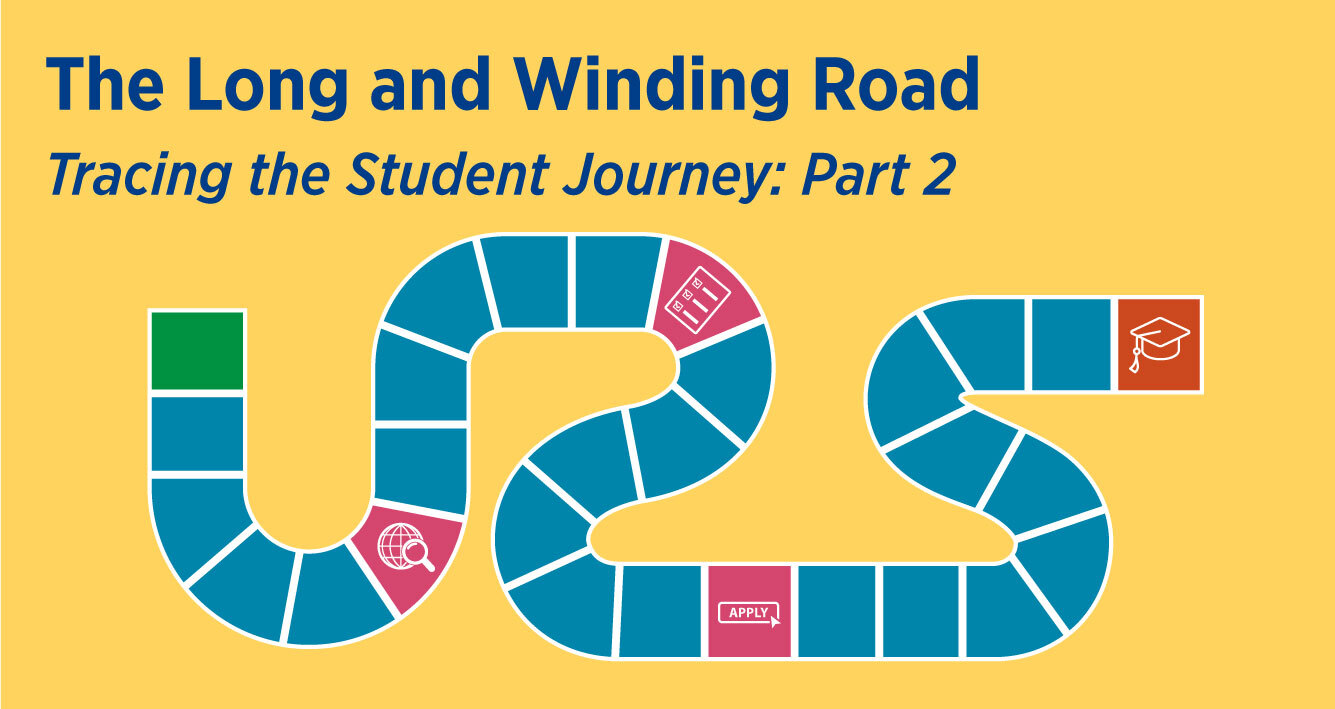
The Long and Winding Road Tracing the Student Journey: Part 2

Last week we began tracing the evolving international student journey, with a look at what might help or hinder your relationship with prospects along the way. In short, it’s all about engaging content and great follow-up. But that’s just part of the story.

When marketing to students, we often focus on the information we want to give them, but it’s equally important to consider what information a prospect needs to give you and what steps you need that prospect to take. So let’s explore a few ways to entice students to click that CTA and follow your channels, register for an event, download that guide… You get the idea.

Read on for our next installment reviewing the student journey elements that are so important to the phase we are in right now as application deadlines approach.

Read More

Step-by-Step Digital Marketing with Intead Plus

Today we’re taking you behind the scenes of some of our most valuable Intead Plus tools.

Our Digital Marketing Worksheets.

Yep, you read that correctly. Good, old-fashioned pen-to-paper worksheets. Although if you decide to fill them out on your computer, we promise we won’t tell. After all, learning is moving online these days, haven’t ya heard?

Looking to engage a new market? Develop a new content strategy and dissemination plan? Get your new hires thinking through the international student recruitment process?


Last Chance: For our colleagues leading private high schools we are offering a free webinar today at 3pm (Eastern) with TABS (The Association of Boarding Schools) all about how student recruiting must be reimagined given the loss of recruitment travel. Register Here.


It’s all about the framework.

The Intead Digital Marketing Worksheets will guide you every step of the way forward — and ask the difficult questions. These are the worksheets we take folks through when we run our full-day global marketing workshops at AIRC and our International Student Recruitment Bootcamps. So, really helpful during those new recruitment season kickoff meetings.

All of the worksheets mentioned in today’s post are available to Intead Plus members and are tried and tested. Intead Plus members receive full access to an extensive (and exclusive) library of marketing intelligence materials (including our seminal eBook, 88 Ways to Recruit International Students, now an industry standard in its second edition), podcasts, webinars, and more, with new market research being released each year.

Read on for a sneak peek at these valuable resources to kickstart your global approach and your digital marketing strategy. Whether you’re just in the early stages of a new initiative or in the process of developing a digital campaign this content is going to be helpful. And if you want these tools at your fingertips 24/7, you know what to do.

Read More

International Persona Development: 101

You've heard us talk about the importance of persona development for your marketing work.

It's time to take this conversation to the next level. You're really going to want to share this post with your team, again. (Have you asked them to subscribe to the blog yet?)

The persona is such an essential tool in our industry, but do you really know what a persona is? Or why it's so important? And if so, when was the last time you stepped back to really examine best practices for developing your personas?

Switching topics for just a sec...Ben is in Moscow this week presenting at the Forum on International Education about digital marketing techniques to reach the global student market. Watch this space for a post with insights about the Russian student market at the high school, undergraduate, and graduate levels, as well as the Russian market's level of interest in certificate and online learning opportunities. The US-Russian relationship is at a fascinating point. There will be some great stories we are eager to share with you.

In this week's blog, we're taking it back to the basics. We invite you to join us for an quick tutorial on persona development and we offer you the option to download Intead's basic Persona Development worksheet. 

Read More