
The case we’ve been making for the past two decades, that internationalization affects the entire institution, not just a small cohort of students – you know the one? Turns out, the US government is making the case for us.
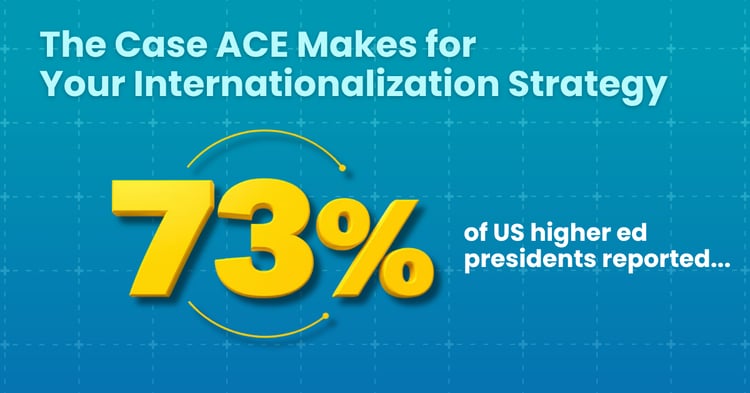
The recent American Council on Education (ACE) 2026 Fall Term Pulse Point Survey puts a number on the impact of current federal policy volatility: 73% of US higher ed presidents surveyed reported that declining international enrollment has reduced institutional revenue. Money talks.
The financial impact of fewer international students has consequences that reach across campus. Among the 328 senior higher ed leaders who responded to ACE’s recent survey, 23% reported reductions in research or student support, 9% reported program closures or mergers, and 11% reported reduced institutional financial aid. All of this reduces the effectiveness and value of US domestic student education opportunities.
The reality: for so many US institutions, entire departments and degree programs were established and grew through the last decades with funding derived from international student enrollment tuition. For those taking time to look at the financials, that reality is becoming even clearer now.
Over this past year, we’ve talked directly with more than 250 institution leaders, and we can say with certainty that leadership is giving international enrollment much more consideration. They are evaluating the opportunity with a new lens. And they are fearful of the potential pitfalls.
The Intead team has spent this year with AIEA building the Examining Success Factors in Internationalization benchmarking study, now underway across 100+ interested institutions.
If you haven’t already inquired about this project, now’s the time. This industry-leading study is designed to help you understand where your institution stands, how your approach to internationalization compares with peers, and what the peer-to-peer data means for your broader business strategy.
What are peer institutions seeing? Where are they exposed? What strategies are they using to respond? How much are they investing and what are their results? Importantly, what does “holding steady” or “growth” actually look like for an institution like yours?
Word to the wise: only those institutions participating in the AIEA-Intead study will have access to the findings and benchmarking results.
With so many eyes on internationalization, it’s important we get this moment right.
Here’s your opportunity.
Can benchmarking help universities navigate today’s internationalization headwinds?
Yes - but don't take our word for it. Read The PIE News coverage about our new AIEA benchmarking study. 22+ institutions have joined, 40+ in progress, 120+ more evaluating the opportunity. Are you?
Meet Intead!
Find us at Fulbright Annual Conference in DC Oct 23-25, AIRC Annual Conference in Dallas Dec 1-4, and AIEA Annual Conference in DC Feb 15-18. Be in touch to share a cup of coffee in person.
Last year, we told SIOs to use this sudden attention to bring international across campus. Essentially, use external pressures to build internal bridges by going on a cross-departmental road show focused on the many roles international education plays within your institution.
At the time, the campus sentiment was all about: I’m so worried about what is happening to our international students.
Now, it’s: What happens to the institution when international enrollment doesn’t hold?
It’s time to take the conversation to the business office. Read on for perspective on your most powerful talking points…
The ACE report makes clear that international is just one priority weighing on leadership’s mind. Long-term financial viability, public perceptions of higher education’s value, financial aid, federal policy, deferred maintenance, and research funding cuts are also top priorities. Of course, international programs and enrollment affect each of those focus areas. Institutions are recognizing now just how much.
The current spotlight on international student mobility is bringing internationalization into that broader conversation about institutional financial health. The question is no longer simply how many international students you can enroll, but what that enrollment actually means for the institution. And then, the questions about which strategically wise approach to take for recruiting and securing this cohort. And whether that investment is even worth it anymore.
For the most fearful and least creative, the answer is, "no." For those with the chops to right the ship, internationalization must be among the forward-looking opportunities evaluated.
Of note for international offices making the case for program investment:
- 49% of the responding senior leaders cited long-term financial viability as the top institutional concern
- 37% cited enrollment for the upcoming term as one of their three most pressing concerns
- 36% cited immigration restrictions and visa revocations as issues they’re least prepared to navigate
Your president and trustees need to understand what international enrollment means for the institution, and what it may take to navigate the uncertainty ahead. You and your team is uniquely positioned to help them answer those questions.
You know your admissions numbers year over year: inquiry, applied, admitted, enrolled. You know the ebb and flow of student mobility by region. And you understand the investment required to recruit and enroll those students, the tactics that are producing, and those that have taken a hit recently.
But are you able to defend your approach to international student enrollment to leadership?
As your institution’s leadership is likely aware, NAFSA is projecting a 9.5% decline in international enrollment nationally (and there’s your own data as well), but that stat doesn't tell your provost how your international enrollment stands to fare. For that, you need more context.
What are peer institutions seeing? What are they investing to achieve returns?
That context isn't just useful for understanding where you stand. It helps you make the case for what you need to do next; what you need to invest. If your institution needs to maintain or grow international enrollment, peer benchmarks will help show what it takes to get there - where other institutions are investing, what approaches are working, and where additional resources may be needed. That information gives SIOs and provosts a stronger foundation for conversations about staffing, recruitment investment, markets, programs, and the funding required to achieve the enrollment goals the institution has set.
Because international is finally getting the attention we've been asking for.
Now we need to be ready to do something useful with it. Again, here’s your opportunity. Join the AIEA-Intead study.