
Is your leadership happy right now? How about your staff?
We’re talking to you, enrollment leaders. The conversations we are having consistently are about managing up and managing down. The challenge of leading those around you through significant disruption.
Your institutional leadership is rightfully worried about the enrollment future (domestic and international). Your staff are rightfully worried that the current climate is a doomsday scenario for academic institutions. There is a lot of job dissatisfaction going around.
Still, truth is, there have always been times like these. The stressors may be different, the intensity a bit higher, but the anxiety and resulting need for focused work to solve problems are nothing new.
Meet Intead!
- Find us at AIEA in DC in February, WEIC in DC in March, and ASU+GSV in San Diego in April. Be in touch to share a cup of coffee in person.
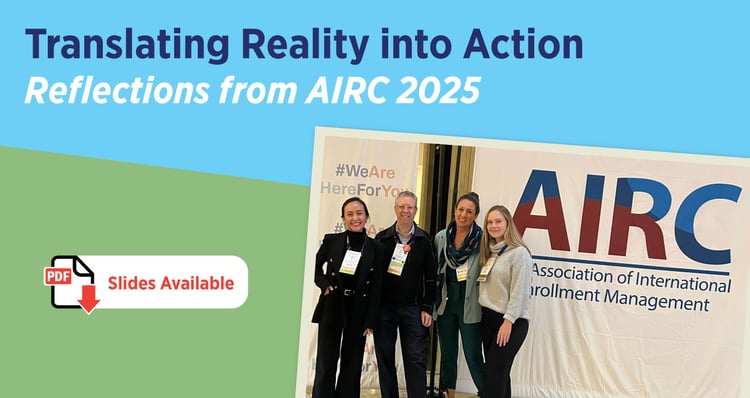
At the AIRC 2025 conference that just recently wrapped in Atlanta, almost all of the presenters and participants ultimately addressed the question of how to talk to institutional leadership and help them to understand the complexities of internationalization – because most academic leaders are unaware of how the international education community works.
Helpful slides from one of our sessions are available below. They speak to 6 hesitations leadership leans on when deciding not to invest in international and what you might present to them to modify their perspective.
But here’s the focus: institutional leaders do not need to know HOW it all works. They simply need to see the value of it and the investment required. To do that, they need to listen to and trust the messenger (that’s you).
Read on…
Taking an example from outside the enrollment arena: if a university chancellor learns that the institution needs a new approach to managing its IT infrastructure, the chancellor and senior leadership do not need to understand how it all works. They know it is complicated. What they need to know from IT leadership is:
- How the current state is not serving the institution (document the problem)
- What the future state will offer the institution (the benefits of change)
- How much it will cost to achieve the future state (and timing)
- Who will lead and implement the changes (and can we trust them to produce the desired result despite the obstacles)
Strong leaders then empower the change management team to make the needed changes by deploying a reliable process with the right stakeholders involved or informed (team alignment). As we discussed in one of our sessions at AIRC, progress benchmarks and accountability become part of any successful implementation (see RACI framework for helpful perspective).
This is pretty standard stuff when organizations want to implement change. And typically, organizations only implement change when there is a problem to solve or an opportunity to capitalize on. Otherwise, simply stay the course.
Right now, we have both – problems to solve and opportunities to capitalize on. The thing about enrollment growth, unlike IT investments, is that enrollment success produces more revenue. IT investment does not.
Enrollment improvement initiatives are typically future-focused while they dissect the current state and internal processes. If you’d like to dive deeper into admissions process analysis, check out this post based on our presentation at the 2024 AIRC conference.
Adding to that internal process analysis, we might evaluate the need to change from two other marketing perspectives, each with different levers to drive better outcomes:
1. The product development approach:
- Which programs generate student interest (usually driven by employer interest and salary potential)
- What are the student qualifications required to get in
- What is the length of time a student must invest to earn the degree or certificate
- What is the cost to the student (and net revenue to the institution from that enrolled student)
2, The student attraction approach:
- Where are the student segments most interested in the program (domestic and international market research)
- How can you make those students aware of the offering (straight up brand and product marketing)
- How will students apply and enroll in the program (user experience)
Dive Deeper
We experienced so many amazing interactions at the AIRC 2025 conference in Atlanta this year. Below we offer 4 slide decks from the event:
- Two sessions addressing big picture student recruitment planning to support your arguments for a product development approach. These sessions help you talk to leadership about International Education to help them understand the opportunity:
- The Curry vs. The Cherry: How to counter 6 reasons leadership hesitates to invest in IE
- Recruiting Initiatives in an Unstable Political Climate: Practical advice on leading through a storm
- Two sessions addressing the student attraction approach:
- Aligning Digital Marketing with Recruitment Travel: This action-oriented case study with The College of the Canyons turned out to be THE most attended session of the conference. The Q&A following was robust and valuable.
- Rethinking International Undergraduates Recruitment: How to leverage your existing markets in new ways, with a look specifically at the Indian undergraduate market. We talked about how to gain access to small and powerful influencer groups that can help you promote the opportunities your institution represents.

Use these slides as you navigate the challenges and opportunities this moment presents. Need a partner to help move ideas into action? Be in touch.