
Next week the British are coming, albeit to the opposite US coast.
As part of a broader effort celebrating collaboration between the US and the UK, the British Council’s Study UK team is hosting a large pop-up experience in Los Angeles designed to give area students, families, and educators an up-close look at what UK higher education is and can be. Sixteen UK universities, along with an array of niche experts and exhibits, are crossing the pond to put their best foot forward for students contemplating their academic futures.
Full disclosure, the Intead team is proudly part of the effort to develop the cross-border collaboration.
Though the event has been in the works for quite some time, as May 22 draws near, the timing seems particularly relevant as increasing numbers of US students are evaluating and taking advantage of study abroad opportunities.
The UK, of course, is already a top study abroad destination for American students.
Meet Intead!
- Find us at at NAFSA in Orlando in May. We're presenting at NACUBO in July. Be in touch to share a cup of coffee in person.
Fight for your Internationalization Program Funding with Data
-
Benchmark your internationalization strategy and outcomes against 100+ U.S. peer institutions. Join AIEA’s groundbreaking study on what drives internationalization success.
Outbound with room to grow
In 2023-24, nearly 300,000 Americans studied abroad for academic credit, a 6% increase from the year prior, according to the latest data from IIE, marking a strong rebound toward pre-pandemic levels (~347,000 in 2018-19).
That said, only about 9% of US undergraduates study abroad for credit in any given year, and most for a short stint.
So, while the trend line is moving upward, participation remains modest relative to the opportunities available.
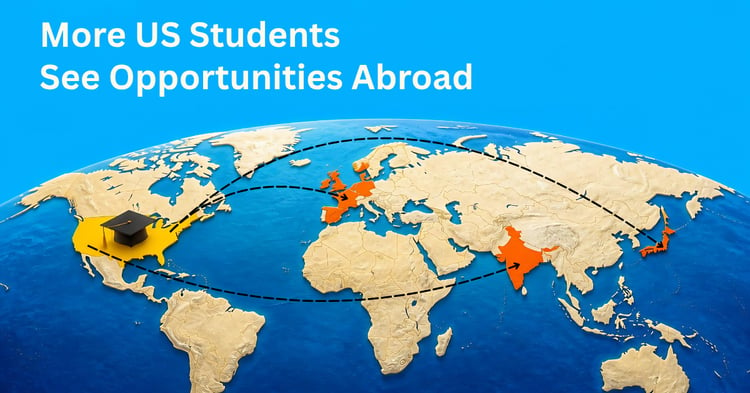
Most (64%) US study-abroad students go to Europe, with Italy, Spain, the UK, and France hosting nearly half of all participants. Japan became the fifth-largest destination for the first time in 2023-24, with 16% growth.
More interesting than the short-term numbers is what’s happening at the full-degree level.
IIE’s Project Atlas reports that more than 95,000 Americans are enrolled in full-degree programs at institutions abroad. Fifteen years ago, that number was much lower at 41,000 (with some caveats due to expanded reporting countries). Still, IIE confirms the trend is clear: more US students are opting to earn their full credentials abroad.
An increasing number of countries are taking note. 18 countries, including the UK, now have institutions accepting the Common App, meeting US students in a system they already know and trust. Our recent discussions with the Chinese Consulate in DC also point to increased efforts to attract international students to degree programs in China.
Those of us committed to the ideal of international education and the global ties these programs create have always understood the appeal. And while the number of American students doing so remains modest, the outbound trend is real, the drivers are tangible, and the institutions paying attention now will be better positioned for what’s coming.
Read on for our tips on how institutions can leverage this trend to enhance their connection to their current students and attract new applicants.
Unless you’re new to the field, the reasons driving the increased interest in study abroad are obvious: cost, climate, and career.
Cost: Try as some might to explain away the cost of a US degree, there’s no getting around the bottom line. Tuition increases at many US institutions have outpaced inflation for years, and student debt remains a mounting concern for families and institutions alike. In an increasingly global market, it’s reasonable for goal-oriented students to evaluate all their options, including often less expensive degrees abroad.
And it’s not just the tuition: time to degree is often shorter in other countries as well. As of 2026, that reality is pushing US institutions to develop 3-year bachelor’s degrees, which have been on offer in the UK since the mid-1800’s (yes, you read that correctly).
Climate. And yes, we mean the political climate. In one survey ahead of the 2024 election, one in five Americans said they’d be interested in moving abroad if their candidate did not win. On the day of the 2024 election in the US, Studyportals showed a 5X surge in interest from US students seeking to study abroad. These signals, though short-term, sit alongside broader structural pressures, including billions of dollars in proposed shifts to US federal research funding and increasing uncertainty around grant availability and other academic policies. To be clear, increased search activity around international study does not translate into action for the vast majority of searchers. Still a valuable signal of consumer interest/curiosity.
Career. Many of the shorter international degree programs, especially in Europe (3 years to a bachelor’s, 1 year to a master’s), put graduates into the field faster. Also, a recent Forum on Education Abroad survey of 8,000 undergraduate business majors found that those who studied abroad earned an average of $4,159 more in their first job after graduation than those who did not. Long understood: studying abroad signals adaptability, independence, and cross-cultural fluency – key attributes many employers seek. If only more students understood this.
What this means for US enrollment teams
These drivers raise two important questions for US enrollment teams:
Question 1. Are you using your global partnerships and study abroad programs to foster student attraction and retention?
There is a reasonable argument that robust, well-resourced international learning opportunities like semester programs, dual degrees, and exchange partnerships reduce the appeal of going fully abroad. Some students who want a global experience but also want a US degree, want the compelling option to stay in your ecosystem while accomplishing both.
Where to focus? Follow student behavior. With most US students heading to Europe, seeking partnerships with institutions in the UK and EU builds your global brand and establishes student opportunities. Use these partnerships to bolster your student attraction efforts.
Keep in mind that opportunities can also be found far beyond Europe. India is actively expanding and internationalizing its higher education system. Historically, India has not been a significant draw for US students. Yet, the country is moving quickly in developing very clear paths from tech degrees to employment in Indian companies and some of America’s global corporate giants (JP Morgan, Bank of America, Microsoft, Google). We dove deeper into the corporate investment in India in our last post. We encourage you to check it out.
Offering your students intriguing alternatives to Europe (see reference to growing interest in Japan, among other globally connected economies) will help differentiate your academic offerings as you seek to expand enrollment. Which leads to…
Question 2. How does your institution appear to students actively comparing global options?
The students actively researching full-degree options abroad are doing comparative shopping. Some of them are your prospective students. And they are evaluating not just brand, but cost, time to degree, career outcomes, and overall experience. Their international options are increasingly visible and accessible.
The current trend is a signal telling US institutions to revisit their value propositions. Are your reasons to apply/enroll clearly articulated or simply assumed? Are you talking about our globally connected world, employer expectations in a range of fields, and how your institution creates career opportunities? When was the last time you sought your current students’ perspective on your marketing messaging, your choice of dissemination channels, and, importantly, your academic offerings, including global study options?
These student touchpoints (user experience) provide a guiding light on how international partnerships and study abroad opportunities can support your enrollment targets and student outcomes. Need a few experienced hands to support this kind of thinking? Be in touch.
The British bellwether
One thing the Study UK Pop-up Experience illuminates: students have more options, more information, and more agency than ever.
The question is no longer whether they’ll look abroad. It’s whether your institution is positioned to support that student thinking. Those institutions doing this well, seamlessly weaving a global education into their degree programs, will find success with this growing, proactive student segment.