
Recruiting Intelligence

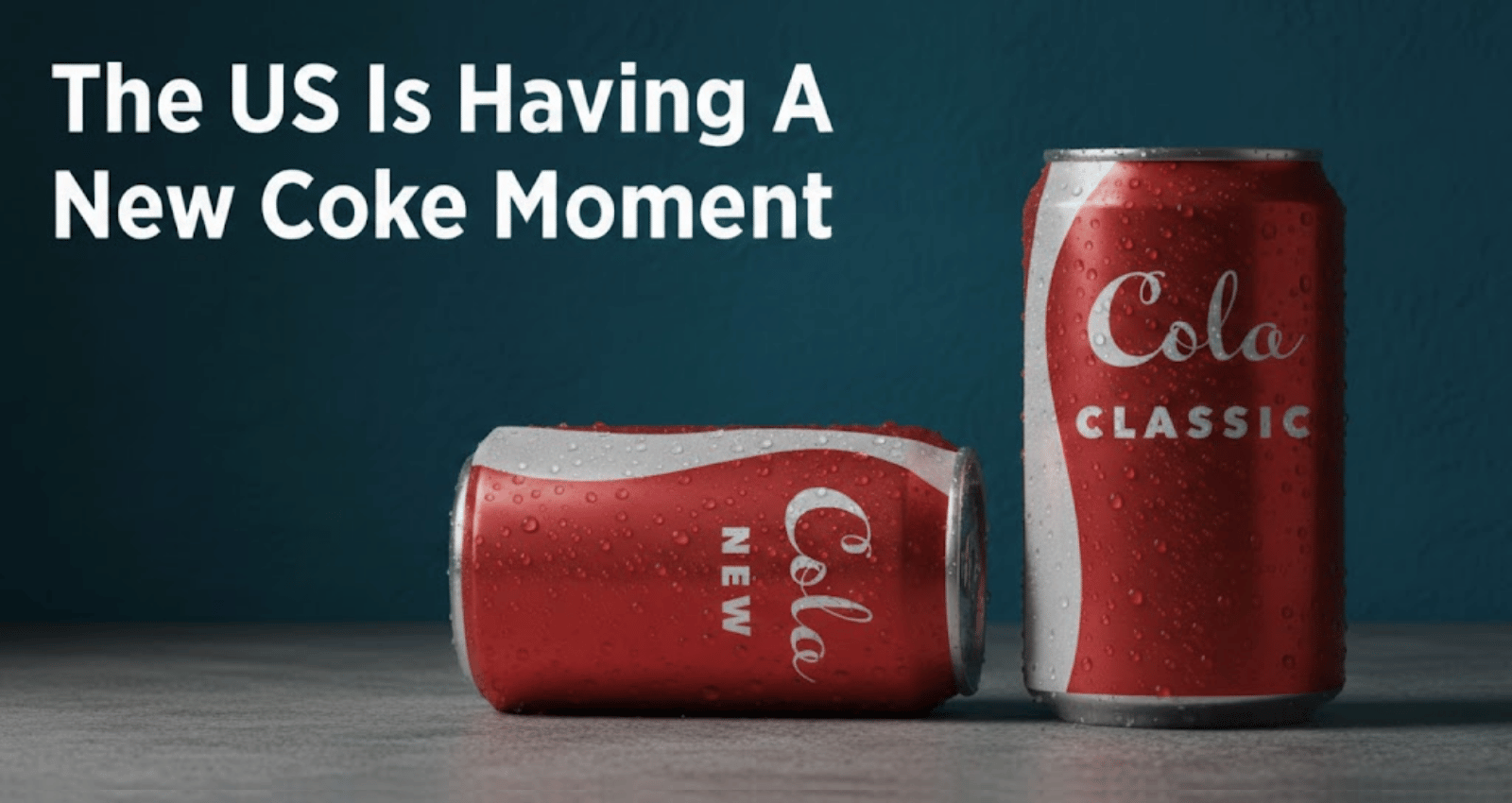
The US is Having A New Coke Moment

In 1985, Coca-Cola’s leadership concluded the soft drink needed to change. Sales of nemesis Pepsi were on the rise and thousands of blind taste tests suggested consumers preferred something sweeter. Their answer: New Coke.

So, on April 23 of that year, they unveiled an “improved” formula, giving consumers a new taste, new logo, and a massive new product rollout. Welcome to New Coke. You can imagine the financial investment made.

Almost immediately, consumers revolted. Recorded consumer sentiment:

“Changing Coke is like breaking the American dream, like not selling hot dogs at a ball game.”

“My dearest Coke: You have betrayed me.”

“Millions of dollars worth of advertising cannot overcome years of conditioning. Or in my case, generations. The old Coke is in the blood.”


MEET US AT AIEA 2026!

We'll be presenting:

  • Resilient IEM: A History Lesson for Managing Current Chaos
  • AI: Your Old SEO Approach No Longer Cuts It

Or, be in touch to grab a cup of coffee. We'd love to connect!


That’s just a taste (so to speak) of the feedback Coke received. The company had wanted to re-energize the brand. They clearly energized something!

The company fielded up to 8,000 calls a day from dissatisfied customers and received over 40,000 complaint letters. Imagine if social media had existed then. Sales volume plummeted sending rival Pepsi sales through the roof. In today's dollars, this was roughly a $100M mistake.

Clearly, Coca-Cola got the message. A quick 79 days after New Coke’s launch, the original formula was back in market, rebranded as Coca-Cola Classic. Sales soared beyond previous highs. Consumers didn’t just return; they came back with enthusiasm and loyalty. Within a year, Coca-Cola was outperforming Pepsi more decisively than before. The Coca-Cola brand had emerged stronger than ever.

Why bring this up now?

Because the US is experiencing a New Coke moment all its own. You feel it, too, right?

Read on… 
Read More

Groundbreaking Data: International Student Employment After Graduation


The NAFSA room was sold out; every seat taken.  

That morning we really weren’t sure what to expect with our session being held in the very furthest room on the 3rd floor of the New Orleans Convention Center. And that convention center is one of the largest we’ve ever seen. Like, you need an Uber to get from one end to the other. 

We could not have been more thrilled with the turn out. What everyone came for: new data, never before collected, on what international students are doing after they earn a US degree. 

What’s been missing from our community’s conversation on the value of US degrees for international students is real ROI. Sure, we talk about ROI: “94% of our students are employed or pursuing advanced degrees 6 months from graduation.” But we’ve never quantified actual ROI...until now.  

Today we’re sharing a preview of new research on the career progress of international students who graduated from US institutions. (The full report will publish later this summer. Be among the first to receive this and 2 other groundbreaking reports by pre-registering. You’ll also get our NAFSA 2024 session slides.)  

This NAFSA research report will be the first of what will become an even deeper analysis based on more research between now and 2025. We want to truly understand what a US degree produces for international students. Is it worth their investment? Is it worth ours? This is data we’ve been wanting to mine for years.   


Our next opportunities to meet! 

GMAC Annual Conference, New Orleans, June 19 – 21, 2024. Ben will be presenting on how global elections are influencing student mobility. More than just the US presidential election has the power to upend what students will choose to do next.  

EducationUSA, Washington, D.C., July 30-August 1. Ben and Viginia Commonwealth University SIO Jill Blondin will share insights on Navigating Budget Challenges in International Recruitment: Practical Strategies for Every Phase.  

Be in touch! We’ll buy the coffee. 


I was extremely honored to have presented our latest research at NAFSA last week alongside Dr. Joanna Regulska, vice provost and dean of global affairs at UC Davis. UC Davis is one of the 12 innovative and forward-thinking institutions participating in this groundbreaking study. 

Our research involved a 22-question survey sent to international students who graduated from our 12 university partners between 2019 and 2023 (see below for the full list). With a 5.3% response rate, 1,797 graduates from 131 countries answered our survey questions. Of these, 1,323 still reside in the US, 474 live elsewhere. 

What we learned will have a direct impact on international student recruitment, as well as offer perspective on US immigration policy. Data informs how we make sense of the world and move forward as a community and a society. The data collected encourages us to understand the value of CPT/OPT to our international students and the US.  

Laid bare: the real outcomes and the positive impact international student graduates are having on the US economy.  

For those of you interested in taking part in our next survey, be in touch at info@intead.com. So many of our higher ed colleagues at the conference raised their hands to evaluate participating in the next research phase of this project. Be a part of that! 

Below we share key takeaways from our research and provide you quick access to the slides from our NAFSA presentation. Read on... 


Read More
