
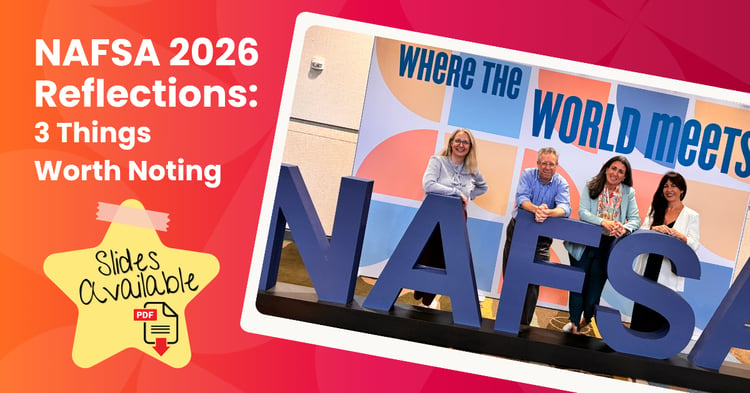
A general and intriguing observation from NAFSA 2026: academic leaders working in blue state institutions tend to be knee deep in defensive postures due to policy changes, while academic leaders working in red state institutions tend to be getting on with the work. Where do you fall?
If there’s one thing NAFSA confirmed, it’s that those who attended are focused on resilience. You’ll find slides below that speak to this point and offer recommendations.
For university leadership, international staff, and current and prospective international students, it is palpable. Which is why NAFSA and other industry conferences are so valuable. They remind us we are in this together, working toward a greater good. There’s power in numbers and in the learnings we gather from being outside our own institutions for a few days.
Speaking of in it together, we were thrilled that industry insider Lindsey Lopez joined the Intead team just before attending NAFSA this year. As our new chief strategy officer, her 20+ years of senior leadership experience with enrollment management, domestic and global recruitment, edtech tools, and so much more adds the kind of hard-won perspective our clients are leaning on right now. Lindsey is working hand in hand with Chief Operating Officer Britt Godshalk, Director of Marketing Analytics Iliana Joaquin, and the rest of the Intead team.
Meet Intead!
- We're presenting at NACUBO in July alongside College of the Canyons, University of Memphis, and UC San Diego. Be in touch to share a cup of coffee in person.
Fight for your Internationalization Program Funding with Data
-
Benchmark your internationalization strategy and outcomes against 100+ U.S. peer institutions. Join AIEA’s groundbreaking study on what drives internationalization success.
Industry veteran Steven Boyd of Quinnipiac University offered sage advice during a NAFSA 2026 session: identify three conference takeaways you want to implement or pursue, write them on a sticky note, and post them where you’ll see them.
He’s not wrong. Attending NAFSA is like drinking from a fire hose. Centering your focus on the learnings applicable to your work is how to put the conference to work for you.
Taking Steven’s cue, today we offer three motivational ideas shared at NAFSA that have stuck with us, from an inspiring session by Barbara Bouza, designer of spaces and facilities who leads CannonDesign, insights from Karin Fischer of the Chronicle of Higher Education, and strategies for enrollment success in this political climate from our session with Steven Boyd and Karissa Peckham of Quinnipiac University, Melissa Wharton of University of Missouri-Kansas City, and our own Britt Godshalk. Our notes and a link to our session presentation deck follow. Read on…
What to Put on Your Post-Nafsa Sticky Notes
Sticky Note #1: It’s not the odds. It’s the opportunity.
Facilities designer and architect Barbara Bouza spoke of Julia Morgan, a pioneering figure in American architecture in the early 1900s, who defied norms by wearing pants beneath her skirts so she, like her male colleagues, could climb ladders on job sites. A practical but unorthodox workaround to level the playing field. Decades later, Bouza forged her own path, becoming one of the 0.4% of black female American architects. Her perspective: it’s not the odds, but the opportunity. Though her session was a broader and more visually interesting look at how to design an experience, this particular message is a mantra and so appreciated as US higher ed faces steepening competition abroad. Do we pine for the students who’ve turned elsewhere, or do we find those who are still interested?
Sticky Note #2: Support those supporting international students.
Chronicle of Higher Ed reporter Karin Fischer sat on a panel including Sherif Barsoum of New York University and Frederico Ling Sanz Cerrada of Northeastern, led by Clay Hensley of International Baccalaureate. An informative conversation from some of our community’s most revered leaders, but one comment by Fischer cut through:
“I worry about those who support the students.”
So do we.
The international student services staff, the advisor absorbing daily questions about visa status, policy changes, and what comes next. These (you) are the people holding a lot right now and holding it all together. It’s hard to see the forest for the trees when you’re deep in the details of chaos. Being front-line and helping the students around you is paramount. There are actions you can take to lighten your load:
-
Invest in your team, your messaging, your partners, your internal advocates, and critically, your processes.
-
Identify external partners who can provide strategic services that ease your load – think marketing strategy, digital integrations, and other must-do tasks that pull you away from the internal and student-facing work only you can do.
-
Rely on your community. The peer network at NAFSA exists for exactly moments like this. Use it. Our community can be rejuvenating.
-
Get your leadership on board. Internationalization, as we all know, must start at the top. Make sure they are in lock step with your vision and advocate for your work. Those who have this know how powerful it can be. Those missing it know they are trudging up a steep slope in the mud. The only way to fix it is to invest the time, present the data, and build the relationships that matter. See Karrisa’s tip below.
Sticky Note #3: Find enrollment success despite it all.
Britt’s session featured the gamut of international education experience: Steven Boyd with decades under his belt, Karissa Peckham with 15+ years, Britt Godshalk with 7+, and Melissa Wharton with 3+. Each presenter brought personal anecdotes of real actions they’ve taken to move the enrollment needle on their campuses, proving that there are things within our control, no matter our role or years of experience on the enrollment team.
One tip that stood out: Karissa’s Weekly Data Truth Report, which emphasizes the narrative behind the numbers so that everyone (read: leadership) is genuinely informed on the international enrollment story. Her point well taken: sharing data is one thing. Using data is another. To get leadership on board with your ideas, use data to tell a story that resonates. Connect enrollment data over time to dollars spent. Preemptively answer for leadership: How does your recruitment strategy pay off? How has your team performed over time? Which tactics do you need to lean on in times like these?
The throughline
You have more agency than the news cycle would have you believe. Focus on the opportunity, not the odds. Check in on your colleagues. Use data to tell stories that resonate, don’t just share the numbers. And if you’d like to view the presentation deck from Intead’s session, find it here.
Also, our internationalization research, being conducted with AIEA, offers our partners the data that will tell your story to leadership. If you’ve not met with us yet to discuss this study, learn more.
Next stop: NACUBO. Will you join us?