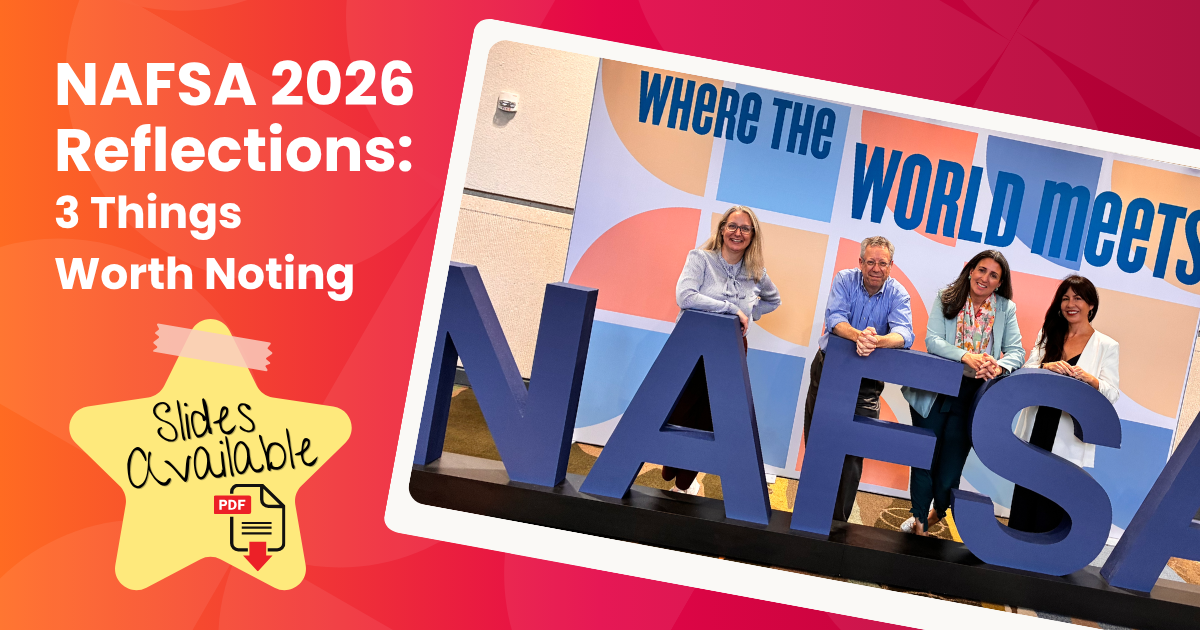
A general and intriguing observation from NAFSA 2026: academic leaders working in blue state institutions tend to be knee deep in defensive postures due to policy changes, while academic leaders working in red state institutions tend to be getting on with the work. Where do you fall?
If there’s one thing NAFSA confirmed, it’s that those who attended are focused on resilience. You’ll find slides below that speak to this point and offer recommendations.
For university leadership, international staff, and current and prospective international students, it is palpable. Which is why NAFSA and other industry conferences are so valuable. They remind us we are in this together, working toward a greater good. There’s power in numbers and in the learnings we gather from being outside our own institutions for a few days.
Speaking of in it together, we were thrilled that industry insider Lindsey Lopez joined the Intead team just before attending NAFSA this year. As our new chief strategy officer, her 20+ years of senior leadership experience with enrollment management, domestic and global recruitment, edtech tools, and so much more adds the kind of hard-won perspective our clients are leaning on right now. Lindsey is working hand in hand with Chief Operating Officer Britt Godshalk, Director of Marketing Analytics Iliana Joaquin, and the rest of the Intead team.
Meet Intead!
- We're presenting at NACUBO in July alongside College of the Canyons, University of Memphis, and UC San Diego. Be in touch to share a cup of coffee in person.
Fight for your Internationalization Program Funding with Data
-
Benchmark your internationalization strategy and outcomes against 100+ U.S. peer institutions. Join AIEA’s groundbreaking study on what drives internationalization success.
Industry veteran Steven Boyd of Quinnipiac University offered sage advice during a NAFSA 2026 session: identify three conference takeaways you want to implement or pursue, write them on a sticky note, and post them where you’ll see them.
He’s not wrong. Attending NAFSA is like drinking from a fire hose. Centering your focus on the learnings applicable to your work is how to put the conference to work for you.
Taking Steven’s cue, today we offer three motivational ideas shared at NAFSA that have stuck with us, from an inspiring session by Barbara Bouza, designer of spaces and facilities who leads CannonDesign, insights from Karin Fischer of the Chronicle of Higher Education, and strategies for enrollment success in this political climate from our session with Steven Boyd and Karissa Peckham of Quinnipiac University, Melissa Wharton of University of Missouri-Kansas City, and our own Britt Godshalk. Our notes and a link to our session presentation deck follow. Read on…
Read More