
A few weeks ago, we wrote about bringing your admitted leads into focus, sharing in-the-moment tactics for keeping this fall's cohort from wavering.
This is the after-action version. Fall matriculation has come and gone. The instinct is to exhale and move on to the next cycle. Don't.
The month after enrollment locks is exactly when you have the clearest view of where commitments went soft. Address issues now for your team’s best shot at fixing the process before you're back in the thick of recruiting next year’s cohort. Future you will thank you.
Can benchmarking help universities navigate today’s internationalization headwinds?
Yes - but don't take our word for it. Read The PIE News coverage about our new AIEA benchmarking study. 22+ institutions have joined, 40+ in progress, 120+ more evaluating the opportunity. Are you?
Meet Intead!
Find us at Fulbright Annual Conference in DC Oct 23-25, AIRC Annual Conference in Dallas Dec 1-4, and AIEA Annual Conference in DC Feb 15-18. Be in touch to share a cup of coffee in person.
Our Buttoning Up Counsel
We've mapped specific checkpoints along the prospective student journey where a "yes" either grows stronger or goes silent. Your basic map at your institution looks something like this, right?
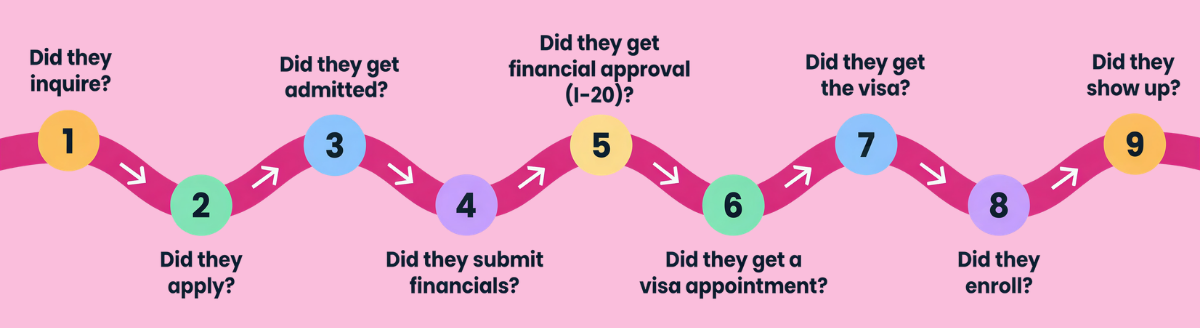
Note though, the student journey is not a Candy Cane game path (above). As we've presented at a range of conferences and in our publications, the student journey is much more of a neural network concept as described in this blog post- where you will find access to really helpful slides from an AIRC conference presentation about student journey perspective. (Very much worth the click.)
Your early fall task: Convene your full team (be sure to include your data analyst and those with frequent CRM access) and discuss each recruitment/enrollment stage. What worked well? Where were hiccups? Pain points should be easy to identify, though with the full team in the room, there may be a few surprises; all the better. Read on for guidance on a quick lessons-learned evaluation at each stage:
To be certain, not all melt is within your team’s control. Visa delays and denials are obvious examples. But some melt is addressable and controllable.
So, order a pizza, gather your team, and settle in for a working session that will smooth the admissions road ahead. As you do this, consider only scenarios that happen 80% of the time (to keep you sane and productive). Too many of these conversations stall or stop as participants bring up confounding anomalies. Don't let that happen to your working session. Stage-by-stage questions to guide the conversation:
Inquiry stage:
Do you know where your inquiry came from and where it ended up? Was your team’s response fast enough, and personal enough, to keep the lead warm?
Application stage:
Did the process itself cause a drop-off before submission? Do you have general submission requirements that push students away? Do you have application requirements that help you assess the quality/seriousness of your applicants? Did you give them enough time to submit their application documents before the deadline? Were you and your recruiting agents in lockstep? Was the melt rate of agent-sourced prospects similar to direct-sourced prospects, or was it quite different?
Admitted stage:
How long between their letter of admittance and your nurture outreach? Silence here reads as disinterest. Do you provide authentic student-voice encouragement/reassurance to prospects who may be reacting to news headlines generated by US events?
Financial submissions stage:
Do your financial thresholds account for scholarships and other discounts? Did students know your requirements early enough? Do they know that a large cash infusion showing up on their bank statement a month before applying will be viewed with suspicion?
Financial approval stage (I-20):
Was turnaround fast enough to leave time for the next step?
Visa appointment:
Were you aware of each admitted student’s visa journey and how they were moving through it? Can you offer them guidance and encouragement from a current international student with experience getting through the visa appointment?
Visa granted:
Are you continuing to encourage enrollment with authentic student-voice content? Were denied or delayed students offered an alternative, such as a deferral or online start? Do they know how to do it?
Enrolled stage:
Did anything happen between deposit and enrollment confirmation, or did the student go quiet? Are you calling non-enrolled deposits to find out why they made a different choice?
On-campus arrival:
Do you know what travel and housing arrangements the student has made? Do you know why the no-shows didn't show, or are you guessing?
The unglamorous but important key to the process: name an owner.
If nobody is explicitly responsible for watching an admitted and deposited student move through each of those checkpoints, no one will notice when they stop moving.
The process is worth addressing now, while the memory of this cycle's gaps is still sharp, rather than trusting yourself to remember each point where things got messy. Your Slate (or other CRM data) is critical to evaluating all of this. Equally important: define a Standard Operating Procedure that supports not only the named point-person for watching the admissions funnel, but the process itself. That’s the thing about processes: the people running them ultimately move on. SOPs help ensure continuity.
The rules may keep shifting under us, this month’s Duration of Status policy stutter steps are the latest example, but a clean, well-owned process travels with you from cycle to cycle, regardless of policy changes at the federal level.
Reflect on and refine your process now, while you can still see exactly where this year's commitments got tenuous.
If you want a second set of eyes on your post-admit process, be in touch. We're always up for a conversation.