
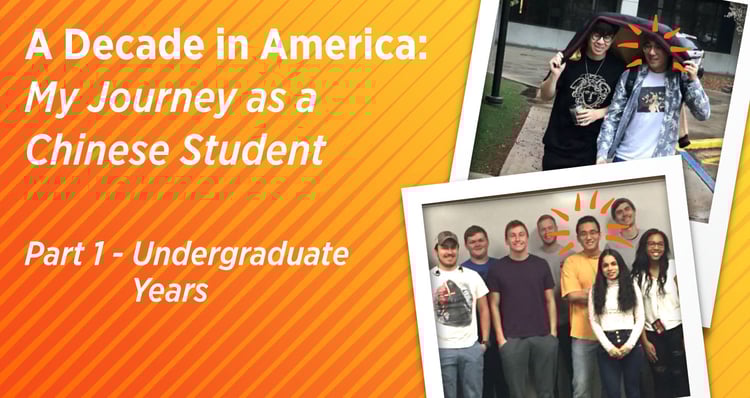
After a decade of studying, working, and contributing to US higher education, Tianyu Shen has returned to China – a move that mirrors what many Chinese students who studied in America have experienced. As so many countries are revising their policies about who may come and how long they may stay, this recounting of Tianyu’s experience is particularly poignant.
Many of you know Tianyu, the affable, talented Data Analyst who did some amazing work during his time at Intead as a STEM OPT student. Like so many international students, Tianyu’s initial inclination to study abroad was rooted in adventure. His initial thought more than a decade ago: Let’s go to New Zealand! And, like so many others from China, his parents redirected him to the US.
So that was 2015, and at the time, IIE was reporting that US universities were experiencing the highest growth rate in 35 years, with China as the key driver. At the time, the influx of Chinese students in particular helped many US universities launch new academic degree programs that benefited American students as well as international cohorts. Now, in hindsight, analysts point to how the revenue generated by the growth in international students from 2010-2020 gave many institutions the capacity to invest in infrastructure and academic advances that created huge opportunities for the entire campus.
Now, there’s a very different narrative being played out in the US and globally. We wonder where Tianyu’s parents would advise him to go for study abroad if he were starting his journey today.
We think you’ll enjoy his observations about Hollywood movies, and comparisons of Boston, MA to Lincoln, NE.
Meet Intead!
- Find us at WIEC in DC in March, and ASU+GSV in San Diego in April. Be in touch to share a cup of coffee in person.
eBook Reboot: 88 Ways to Recruit International Students updated for our times. Your tactical toolkit for the year ahead. Covering all the bases in 10 quick-read chapters. Fosters great ideation discussions with your team as you seek to diversify your recruitment efforts.
Because Tianyu’s experience mirrors that of so many students sitting in US classrooms and working OPT jobs right now, we asked him to take you through his student journey. What is it really like to come to the US still needing to learn English while seeking an adventure? When does the mindset turn toward career? And what did the OPT experience really deliver?
Today, Tianyu offers his perspective on the formative time he spent learning English in Boston and as an international undergrad studying in Nebraska, where he says he spent some of the happiest years of his life. An overview of his more career-focused years as a grad student will come in our next post. Be sure to check back for that. Read on now for his unvarnished take as a recent international student. And please, share with those who are shaping the American higher ed system today…
My Journey as a Chinese Student, Undergrad Years
As a Chinese student who has studied, lived, and worked in the United States for a full decade, I’ve experienced firsthand the opportunities - and the challenges - that come with an American education. The recent wave of restrictive policies targeting international students under President Trump has deeply discouraged many families like mine, dissuading students who once dreamed of studying in the U.S. from even applying. These changes cut to the core of who I am, because my own life was shaped by the doors America opened.
How It Began: A Father’s Decision
In 2015, during my final year of high school, I started talking with my family about studying abroad. At that time, my plan was simple: follow two of my close friends to New Zealand. Honestly, I didn’t know much about the country or its universities. I was just a teenager eager to step into a new world with familiar faces.
My parents initially agreed, but my father quickly intervened. He told me, with the blunt honesty of a Chinese parent, that New Zealand might be a good place for retirement or raising cattle, but not for higher education. “If you’re going abroad,” he said, “go to the best, strongest country, where you can learn the most advanced ideas and knowledge.” His words reflected the mindset of many Chinese parents who equate America with excellence, opportunity, and global leadership.
And so, even though I had never set foot in the US before, my destination was decided: I would go to America.
First Stop: Boston, for Language and Culture
Because my English was weak, I began my US journey at a language school in Boston. At the time, obtaining an F-1 visa with only a language school acceptance letter was relatively easy. Today, that process has become far more difficult.
Boston was overwhelming at first. I couldn’t order food without hesitation, and I often froze when strangers spoke too quickly. But immersion worked. Within six months, I reached the TOEFL score I needed, and my confidence in speaking skyrocketed. The city, with its crowded trains and centuries-old campuses, introduced me to a kind of intellectual energy I had never felt before.
Yet when it came time to choose a university, I didn’t stay in Boston. I wanted something different, more affordable, more immersive, and more aligned with the college life I had seen in American movies.
Nebraska: Four Years of Growth
I enrolled at the University of Nebraska–Lincoln. For many of my Boston peers, this seemed puzzling. Why leave a city of prestigious schools for a “middle-tier” university in the Midwest?
The answer was practical: Nebraska offered me a half-tuition scholarship. Housing costs were one-fifth of Boston’s. And emotionally, I wanted to experience campus life in a close-knit, friendly environment. I wanted to gain a broader sense of the American experience.
Funny enough, my first impression of Nebraska actually came from a movie - Yes Man starring Jim Carrey. In the film, he and his girlfriend randomly choose a city to fly to, and they end up in Lincoln. They have a great time there, which planted a seed in my mind: maybe this “random” Midwestern city wasn’t such a bad place to be.
Still, although Nebraska met all my criteria on paper, I was stunned when I first saw the city from the plane. Below lay endless farmland, with almost no trace of urban life. After landing, I hailed an Uber from Lincoln’s small airport to the university (I didn’t know at the time that the school offered a shuttle service for international students). I knew the university was located in downtown Lincoln, so when the driver told me we had arrived, I double-checked that this was really the city center and not the suburbs.
The scenery on the way in felt a little depressing, but campus life quickly put me at ease. The campus was beautiful, and there were student staff members assigned to show me around. I learned the purpose of each building, the story behind the football culture, and how important the Cornhuskers are to the identity of Nebraska. There was even a museum with dinosaur fossils on campus, which amazed me.
I was also relieved to find that I was not the only international student. I saw students from all over the world, including many Chinese students. That mattered a lot to me. I didn’t want to be dropped into an environment made up only of “typical Americans,” because I worried I wouldn’t be able to integrate quickly.
During my four years of college, I made several close friends in the dorms, Korean, Indian, Vietnamese, and others. Through them, I experienced different cultures and cuisines. These cross-cultural friendships still influence who I am today.
The people of Nebraska left the deepest mark on me. A sneeze in class would earn you a chorus of “Bless you” from strangers. You could strike up an easy, friendly conversation with almost anyone nearby. If you got a flat tire on the street, a pickup truck would likely pull over and help you change it in minutes. These small acts of kindness made me feel that Nebraska was not just a place to study, but a community I truly belonged to.
So, I chose to stay in Nebraska for all four years until I completed my undergraduate degree. To this day, whenever I think of that time, I feel a quiet warmth. There is truly no place like Nebraska.
Those four years remain some of the happiest of my life. Nebraska forced me out of my comfort zone. In classrooms, I had to speak up, debate professors, and wrestle with ideas far beyond anything I had encountered in my Chinese high school. Outside the classroom, I embraced American culture.
My initial major was actually mechanical engineering. I was largely inspired by Iron Man. Back then, my fantasy was that with a mechanical engineering degree, I’d be able to build an Iron Man suit by the time I graduated. However, my first mechanical engineering class was daunting. The material was completely out of my depth, and even the people around me fit the stereotypical “engineer” image, which made me seriously consider dropping out.
Fortunately, undergraduate education in the US is quite different from that in China. In China, it is very difficult to change your major, but in the US, it’s relatively easy as long as you pay attention to credit transfer. My mechanical engineering classes were not going well, but the good news was that I was getting almost full marks in calculus. That gave me confidence, so I started researching career paths for math majors, including statistics and data analysis. If you go on to graduate school, a math background can also be an advantage when applying to computer science programs. Many Chinese students who choose math think along the same lines.
I didn’t participate in many clubs, and the few I joined were mostly Chinese student activities, such as singing competitions organized by the CSSA (Crop Science Society of America) and Lunar New Year parties. I even served as a host at one of the New Year's events; the Governor and First Lady of Nebraska attended, and I had the chance to shake their hands.
At the time, I really wanted to integrate better into the local student community and experience a different culture. One day I had an idea: why not learn a new language? In a beginner-level language class, almost everyone is starting from zero, so my disadvantage as a non-native English speaker wouldn’t be as obvious. In that environment, I could be on a more level playing field with American students. So I enrolled in two semesters of Spanish. Just as I had imagined, everyone was learning from scratch, and I had many more opportunities to interact with American classmates. I practiced Spanish with them, gave presentations in my new language, and even made people laugh.
To this day, whenever I think back on Nebraska, I smile. It was here that I truly learned what resilience, curiosity, and openness mean.
Editor’s Note: From Dreamer to Doer
Tianyu’s story underscores what many of us see in the data: that belonging, affordability, and human connection often matter more than ranking or prestige.
In our next post, Tianyu shares what happened after graduation from Lincoln-Nebraska – a reality check for any campus committed to career readiness and global talent retention along with important perspective on OPT. See you then.