
Landmark College offers a master class in designing and delivering an exceptional student experience. The college deeply understands its students and goes to great lengths to create a collegiate experience in which they can thrive. Here’s an example: Landmark unofficially boasts a 27:1 student-to-therapy dog ratio.
If you’re not familiar with Landmark, it’s a small Vermont institution designed exclusively for neurodivergent students. The students we’ve talked to there consistently reinforce the same lesson: when the college experience is designed around how students actually learn and engage, it can fundamentally change their ability to succeed.
Can benchmarking help universities navigate today’s internationalization headwinds?
Yes - but don't take our word for it. Read The PIE News coverage about our new AIEA benchmarking study. 22 institutions have joined, 40 in progress, 100 more evaluating the opportunity. Are you?
Meet Intead!
Find us at AIRC Annual Conference in Dallas Dec 1-4, and AIEA Annual Conference in DC Feb 15-18. Be in touch to share a cup of coffee in person.
Full disclosure: Landmark is an Intead client. But our perspective is grounded in the work we see them do every day. So, are we biased? Yes. Do we confidently stand by our views? Also, yes.
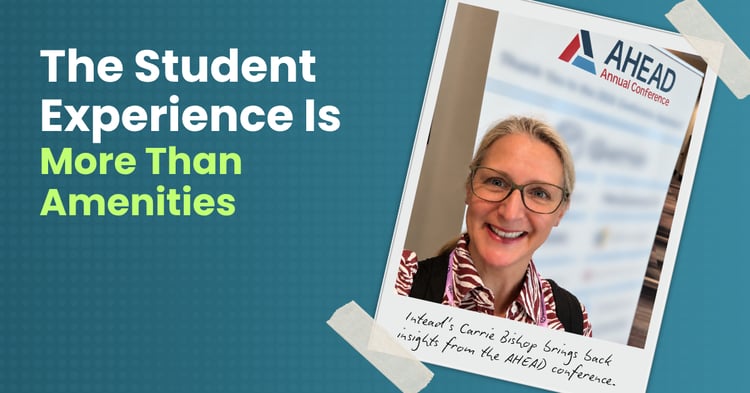
A recent Chronicle of Higher Education piece backs us up by featuring institutions turning to Landmark for guidance on creating classroom experiences that work better for their students. Landmark trains hundreds of educators each year through its on-campus research institute LCIRT and partners with an increasing number of schools to help them improve. Another proof point: the steady stream of educators at Landmark’s booth at the recent AHEAD conference in Providence, Rhode Island. Clearly, educators aren’t just admiring what Landmark does. They want to know how to do it themselves.
Landmark has spent decades working to deeply understand its students and design an experience around what it is their students actually need, rather than simply asking students to adapt to the institution.
That distinction matters far beyond the practice of educating neurodivergent students.
When an institution understands its students well enough to remove friction and create the right conditions for them to thrive, student experience becomes more than a promise in a recruitment campaign. It feeds the reasons they choose the institution, and the reasons they stay.
Read on for tips on improving student experience at your institution…
Enrollment sells the experience. But who delivers it?
We are tasked with the same goal as you: find right-fit students and persuade them to enroll. In doing so, enrollment teams spend considerable time thinking about and promoting the experience students can expect.
But enrollment teams don't control most of that experience. They don't control whether a student can get an advising appointment. Whether a professor responds quickly. Whether a student finds community, the academic accommodation process is straightforward, or career services is easy to navigate.
That scenario raises a critical question: Is the experience delivered the same experience students were led to expect?
As you know, students form their expectations well before move-in day, shaped by websites, campus visits, admissions counselors, social media, current students, parents, rankings, and countless other touch points in the recruitment ecosystem, not the least of which, chats with other students (oh, and chats with AI).
For a really valuable slide deck about the student journey as a neural network, see this blog post - where you will gain access to one of our AIRC conference presentations about student journey perspective. (Very much worth the click.)
And a while back, we wrote a popular post Spotlight on Your Institution’s Student-First Approach. The post emerged from conversations with students and enrollment leaders about what student-first actually looks like. Our conclusion was uncomfortable but familiar: institutions can talk about putting students first while competing priorities, siloed departments, and limited resources produce a very different student experience.
Students notice. And they talk (and then AI listens and reports). A great experience creates advocacy. A frustrating one travels through families, friends, social media, and prospective-student networks. And word travels fast.
For an institution that has invested heavily in recruiting a student, what happens after enrollment is part of the return on that investment.
Connecting the promise to the reality.
So how does an enrollment team find out whether the promise matches the reality?
Start with the promise. Pull the language from your website, admissions presentations, marketing campaigns and student communications. What are you telling students they will experience? This should be a quick task. Your institutional messaging is perfectly aligned across channels, right?!
Then the reality check.
1. Talk to current students, particularly the populations you are trying to enroll. Ask what they expected when they chose the institution, what matched those expectations, what didn't, and where they encountered friction. Let the conversation flow easily. Relax and listen. This is not a time to defend practices. You are learning about someone else's lived experience. Pro tip: a little pizza and ice cream go a long way.The answers may be surprisingly mundane, and revealing.
A few concrete examples from the many student conversations we have when we dine-in with an institution:
- A domestic student expected an advisor to respond within a day and waited two weeks.
- An international student expected to find community but discovered that most social events were difficult to navigate without an existing friend group.
- A student expected an academic accommodation process to be straightforward and instead encountered multiple offices, forms, and explanations.
2. Analyze your own reputation. What’s happening on Instagram, X, Reddit, TikTok, YouTube, elsewhere? What are alums saying? Parents? Students?
Then take those findings to the people delivering the experience on your campus. Where do their views align with students' views? Where do they diverge?
A domestic student who says, “I couldn't figure out where to go for help,” may reveal a bigger institutional problem: three offices believe they provide that help, but nobody owns that student's journey.
An international student who says, “I thought it would be easy to make friends,” may not need more events. The institution may need to make it easier for new students to find their way into the campus community.
Those gaps point to where your promise breaks down. And those breakdowns lead to fewer students succeeding at your institution. They also harm your institution’s online rep.
And yes, these meetings and the action items developed take time, energy, and leadership. Developing great student experience requires someone with the authority to prioritize this entire effort.
The rationale: experience is the differentiator.
An institution may promote a welcoming campus, but does that translate into an experience that helps an international student find community, understand the American classroom, navigate healthcare, access career support, and know where to turn when something goes wrong?
For neurodivergent students and others with disabilities, does a commitment to accessibility translate into a straightforward process for getting support? Or does the student have to navigate a maze of offices and processes?
For any student, does “personalized attention” mean something beyond a phrase on the website?
These aren't amenities. They are the experience.
Landmark College offers an important lesson because its differentiation comes from those at the top prioritizing student experience as core to the institution's success -- success as defined by the success of its students. That means understanding its students deeply enough to design the entire campus experience around them. It isn't simply offering more services. It has built an environment that fits the students it exists to serve.
Most institutions will never look like Landmark. They don't need to.
But they can adopt the discipline behind the model: understand the students you are trying to enroll, identify what matters most to them, and design an experience around those needs. The goal: build a better experience.
Need a partner to help deliver on that promise? Be in touch.