Recruiting Intelligence

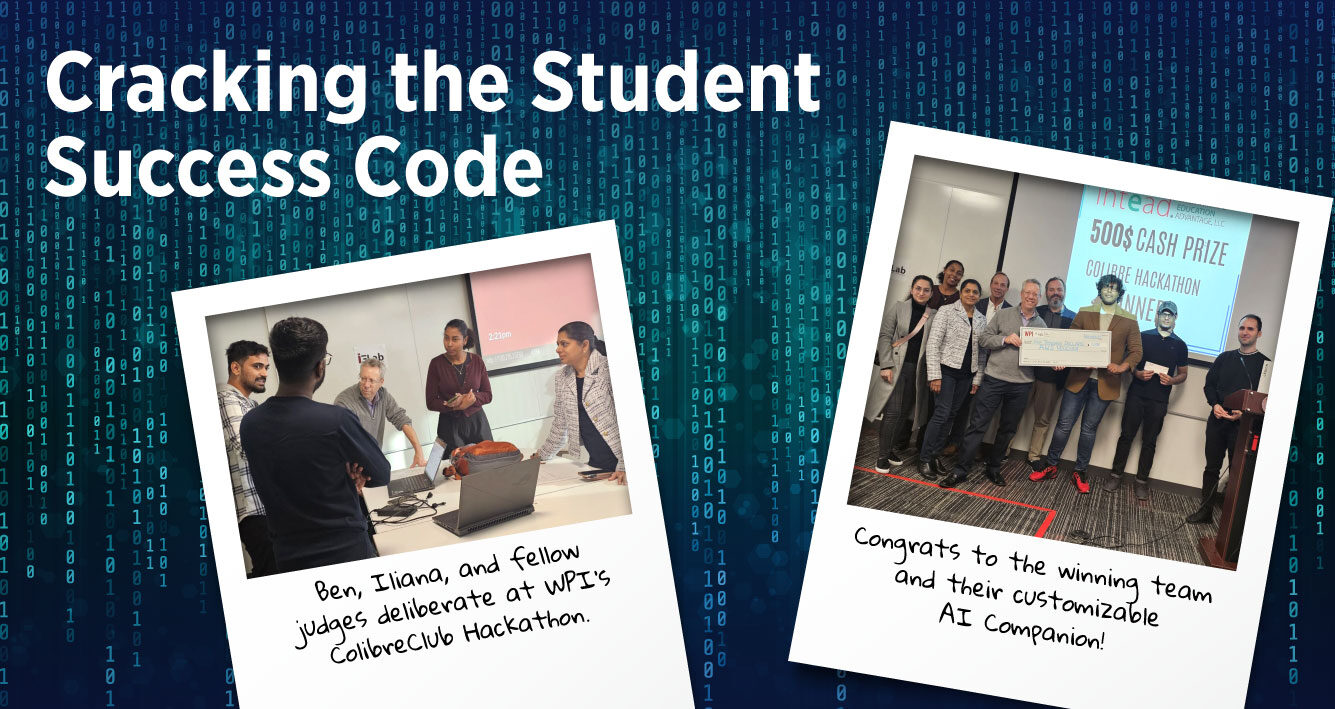
Cracking the Student Success Code

Grad students Poorajith Sasikumar Thenmozhi and Anurag Bansal needed a problem to solve. As founding members of ColibreClub, a student-led organization at Worcester Polytechnic Institute Business School, they were gearing up for their inaugural student hackathon and were in search of a real-world problem statement their competitors could sink their teeth into. 

That’s when the Business School’s Assistant Dean Sandhya Balasubramanian stepped in. Sandhya a friend and colleague of ours reached out to the Intead team to see if we had ideas. Our answer: Always! 

Trend watchers and challenge seekers, we didn’t take long to share one of the many higher ed research topics that interest us in the area of student success. Prior to and through the Covid-19 Pandemic, we watched student mental health concerns grow dramatically. We also noted that issue rising on the list of major worries being carried by university presidents and provosts.   


Opportunities to Meet the Intead Team 

  • Our AIEAstint ends today as we turn our focus to ASU+GSVin April, and NAFSA in May. Let us know  if you want to connect at these events.  

Bookmark this: Intead’s Resource Center 
Access 800+ articles, slides decks, reports with relevant content on any topic important to enrollment management and student recruiting.  Check it out.


Data underlines the urgency. Sallie Mae’s How America Completes College 2024 report on undergraduate barriers to graduation reveals 42% of at-risk students who consider leaving school do so for reasons involving motivation and mental health issues. When asked what resources would have helped them stay, 30% said more mental health resources/support.  

In our work with academic institutions, we’ve seen such a range of responses on campuses that make services available to students in different ways and importantly, help students become aware of and access those services in different ways as well. 

Assurances to help individuals who are struggling academically/mentally/physically are part and parcel of student communications. You know as well as we do that prospective students and their parents care a lot about this topic so including it in your recruitment materials has become routine. For some families, wanting to know about academics and sports top the list as they evaluate an institution. At some point, a growing number of parents worry about whether their kid, as mature as they are, is going to have the support services they need to succeed, including mental health services. 

So, the Intead team has been thinking a lot about actual accessibility, or lack thereof, of these types of programs. Some universities promote the services and access far more than others. Are they living up to their promises to students? Are there innovative ways to improve both student communication and accessibility? The WPI student hackathon tackled these questions with gusto!

Read on...

Read More


New to WhatsApp Business? Yup, we got you! - Part 2


If you’re on the fence about WhatsApp, know this: Meta’s goal is to make WhatsApp a household name, whether it is to shop, chat, or stay on top of news and events. That from a recent New York Times article. In it, Will Cathcart, head of WhatsApp confirms what we are already seeing, that the conversation has moved from ‘WhatsApp is the app I use outside the US when I travel,’ to something much more mainstream in the US. Below, we get detailed and actionable about what this means to you.

Word from Apptopia confirms as much. Its numbers show WhatsApp’s daily active users grew by 9% in the US last year, with 50% of these users chatting daily on the app, 78% weekly. Aside from Meta’s interest in cementing this app as the singular messaging tool among consumers worldwide, pundits point to a variety of reasons for the uptick in the US – the preference for messaging versus emailing, the preference for closed-group messaging rather than social media blasts, the increase in post-pandemic international travel, and the app’s ease of use for business communication just to name a few. 


Events you won’t want to miss:

Let’s talk international student enrollment at the upcoming AIRC Spring Symposium on April 30. Intead will be presenting on student recruitment marketing budgets – we've got some great new insights to share. Register today!

The Intead team is gearing up for some amazing presentations at: 

  • ICEF North America in Niagara, Canada, May 1-3, 2024
  • NAFSA 2024 Annual Conference and Expo in New Orleans, May 28-31, 2024
  • GMAC 2024 Annual Conference in New Orleans, June 19-21, 2024

Let us know if you’ll share a cup of coffee and a conversation about all things global and digital (info@intead.com)


Those who readlast week’s post know how we feel. (Get to it!). It just makes so much sense for universities to have a Business WhatsApp account, especially those who work with international students. And now, we believe, for domestic markets, too. Check out our handy, quick-hit, 11-step check list.

Just like last week, this post is the kind of thing you might want to share with your enrollment team and prompt a discussion at the next team meeting. How would you adapt our recommendations to your particular situation (CRM, staff structure, enrollment pipeline, etc.)?

If you are going to be using WhatsApp, we strongly recommend you puppeteer these communications from a WhatsApp Business account. We got into the meat and potatoes of setting these accounts up last week. Now, let’s get to dessert, aka best use practices. Read on… 

Read More

New to WhatsApp Business? Yup, we got you! - Part 1


What’s up with WhatsApp is a question we find ourselves answering a lot lately, especially when talking about student recruitment. And it is a bit more for international students than domestic, though this blog is useful intel for both. As a teaser, more than 100 billion messages are sent each day on WhatsApp. Yes, that was 100 billion per day! We have more eye popping stats below. 

An important messaging tool because it works across countries, many institutions have been using personal WhatsApp accounts that are attached to a single phone number. That works, but as far as standard operating procedures go, that’s a bit flimsy.  

WhatsApp, a Meta company for 10 years now, has an answer called WhatsApp Business. That too has been around awhile (WhatsApp Business launched in 2018), but it’s just been a bit cumbersome for many overly busy international offices to onboard. And many of their domestic student recruitment counterparts have taken a why-bother approach. 

Our take: it’s time to bite the bullet – it’s easier than you think – and set up a WhatsApp Business account that can be managed from a desktop (see our quick hit 11-step process). We concede that it can be time consuming, but there are just so many benefits to having a verified account on behalf of your institution that we think it’s worth your while.   


Events you won’t want to miss:

Let’s talk international student enrollment at the upcoming AIRC Spring Symposium on April 30. Intead will be presenting on student recruitment marketing budgets – we've got some great new insights to share. Register today!

The Intead team is gearing up for some amazing presentations at: 

  • ICEF North America in Niagara, Canada, May 1-3, 2024
  • NAFSA 2024 Annual Conference and Expo in New Orleans, May 28-31, 2024
  • GMAC 2024 Annual Conference in New Orleans, June 19-21, 2024

Let us know if you’ll share a cup of coffee and a conversation about all things global and digital (info@intead.com) 


This is exactly the kind of stuff so many of you read our blog for, right? What is the time investment? What is the upside? How do I set my enrollment management systems up for success?   

So, let’s get right to it. Read on to learn why WhatsApp is proving to be a good tool for many student recruiters right now – international and domestic – and how to go about setting up your business account. We’ll make it easy for you, as always. And yes, this is one of those posts you’ll want to share with your team (link at bottom) and discuss in the next team meeting. 

Read More

For Chinese Students, Authenticity Counts

Let’s talk about specific tactics for mid- to lower-funnel marketing communications. And specifically, what do Chinese students really want? And how are they making their decisions? For those in our line of work, it’s on everyone’s minds right now. A lot.

On average, international students are receiving 3-5 admissions letters. What they do next to select their top institution has everything to do with the information they have available to them. This is no time for institutions to let go of the recruitment communications.

With all of the turmoil and enrollment fluctuation with Chinese students in the US, when we publish on this topic we see a significant uptick in our blog and site traffic. What to do about Chinese student enrollment is a popular topic. See our latest relevant insights here:

While recent declines in Chinese enrollment in the US have a range of reasons (slow visa processing, political tensions, Covid response disparities, US violence, economic turmoil), the past decade has also brought increasing global competition for Chinese students. The intensity has only grown in the past few years.

Look, beyond all the headlines about this decline in Chinese student changes of heart, we are willing and able to predict the future. Similar to Warren Buffet’s prognostications about the stock market (it will go up, but we don’t know exactly when it will go up), we are extremely confident that China as a source of international students will not struggle forever. Over time, it will return in strength. In the meantime, it continues to be a dominant source among all international sources.

The institutions ready to take advantage of global recruiting opportunities will be the winners. That’s why when we ran across a handful of new student handbooks written by current US-based Chinese students for prospective Chinese students, we wanted to learn more.

Sure, the handbook idea is nothing new. What really intrigued us was the fact that so many institutions don’t actually have this tool in play. Seriously? We all know how meaningful personalized, authentic, and tailored communication is to international students. Going the extra mile takes your recruitment and retention efforts so much further.

Truly, it’s the small authentic gestures that count.

So we did a small thing. We took a minute to review the handbooks (they are written in Chinese for incoming Chinese students). It’s always interesting to see what current international students think is important for the newbies. And it’s important you know, too.

Read on to learn what these handbooks have to say and how they are being used.

Read More

The Long and Winding Road Tracing the Student Journey: Part 2

Last week we began tracing the evolving international student journey, with a look at what might help or hinder your relationship with prospects along the way. In short, it’s all about engaging content and great follow-up. But that’s just part of the story.

When marketing to students, we often focus on the information we want to give them, but it’s equally important to consider what information a prospect needs to give you and what steps you need that prospect to take. So let’s explore a few ways to entice students to click that CTA and follow your channels, register for an event, download that guide… You get the idea.

Read on for our next installment reviewing the student journey elements that are so important to the phase we are in right now as application deadlines approach.

Read More

The Long and Winding Road Tracing the Student Journey: Part 1

As we settle into 2022, we can't help but think about journeys – those we've been on and the ones we're embarking on now. Two important processes are staring us in the face right now. One for our prospective students and one for us. In reality, both are for us:

  • Application season
  • Budget planning

As enrollment management professionals, we know the elements of the student journey – from evaluation of the options, to defining the shortlist, applying, and then making the final selection – and all the small stops along the way that influence the student’s ultimate enrollment decision.

When we talk about the student journey, we think about everything we can do from a marketing and communications point of view to put the right information in front of prospective students at just the right time. What is our team doing well? What tools do we have in place? What are we missing? Our answers to these questions speak to both the application season and budget planning process.

If you’ve not yet downloaded our framework for budget planning (1-page chart), you’ll find some helpful insight there. Simple, straightforward steps to clarify your rationale for funding one recruitment project over another.

If you are attending the 2022 AIEA conference in New Orleans (Feb 20-23), be in touch and we’ll find time for a coffee and an exchange of ideas.

Read on for a helpful review of what the student journey is all about given the new twists and turns that the past two years have forced upon all of us.

Read More

Small Talk, So Underrated

You are welcome here.

DEI efforts to address inclusion.

These are big concepts that deserve big discussions on campuses everywhere. Discussions with senior leaders setting policies and developing programs to make everyone on campus feel involved and connected.

And to make all that happen, that feeling of being welcome and included, will rely on some of the small things that often are met with eye rolls. Yet, these small things are really important to this whole inclusion effort.

You know that inside joke and the trendy celebrity stuff you are not on top of? The conversation that just kind of left you like roadkill as it blew right by? Maybe silly. Perhaps kind of uncomfortable. Happens to all of us. And it happens to your new students frequently. Domestic, yes. International, all the time.

If you think small talk is meaningless, think again.

In our work for a large, highly ranked Midwestern institution, we were talking with Pham (not his real name). He traveled from Vietnam for his US studies. A natural networker, smart, interested in business, he chose to major in Business Management Information Systems and Finance. With that degree, it is no wonder he was snapped up by Deloitte where he currently works as a Senior Consultant in Tax Management.

To hear Pham tell it, connecting to the US community with small talk was critical to his success. He came to understand this during his studies as he tried to connect with the other international students and with his American peers. He found he was struggling to make friends.

Read on for Pham's perspective and our tips for getting these really important conversations started. It is all about personal and student success. 

Read More