Recruiting Intelligence

Need Better Results? Consider These 12 Options


We’re going to state the obvious and break it down. Because it seems some of your colleagues may need to hear this. Better coming from us than you.  Helpful perspective: historical data tell us that 30% to 40% of all US institutions see declining international enrollment in any given year. So, for your consideration...

First: If you are not seeing the enrollment results you want, something must change to produce new outcomes. (Someone wise has said: insanity is repeatedly doing the same thing and expecting different results. Apparently, it wasn’t Albert Einstein. Nevertheless, it holds up).   

Second: If you want to increase university enrollment fast, you’re going to have to put real money into the process. You’re likely going to continue doing what you already do because even though you are seeing diminishing returns, you can’t afford to lose them. So, new funds must be added to the existing budget.   

All obvious, right? Well, it seems folks need to hear it. But we have more to share here to help you get the numbers ... 


Opportunities to Meet the Intead Team 

  • AIRC, Seattle-Bellevue, Washington, Dec. 4-7, 2024. Our team is here now with 3 powerful sessions on budgeting, pathways, and streamlining admissions processes. Come find us. 
  • AIEA, Houston, Texas, March 02-05, 2025
  • NAFSA Annual, San Diego, CA,  May 27-30, 2025

Bookmark this: Intead’s Resource Center 
Access 800+ articles, slides decks, reports with relevant content on any topic important to enrollment management and student recruiting.  Check it out.


Third: If you cannot access additional funds, you will have to cut something you are currently doing and reallocate those funds. If your leadership is of the innovative risk-taker mindset, you can stop doing some of your current, less effective things and put that money into the new thing. Your stronger results will be slow to materialize, and your leadership needs to stay the course (not pull the funding) when fabulous new results do not magically appear in year one. To maintain internal support, you must track your activity and report on the results along the way.

What you want with all the tracking is your ability to provide your leadership with the confidence that there is learning and progress going on that will lead to stronger results in the next couple of years. Know that your leadership is facing down a whole lot of criticism including daggers from across campus trying to remove your funding. The dagger throwers are expecting your plans to fail.  

Fourth (getting into the details): You have options when you think about innovating to produce new, stronger results. We review 12 primary recruiting options when we run our conference workshops on student recruiting. Today we take a quick look at each tactic with a careful eye on cost and flexibility.

Read on for our 12 recruitment option tips and perspective… 

Read More
English Language Programs as Enrollment Barometers


English language programs (ELP) are a barometer for future enrollment trends. Canaries in the coal mine if you will. When participation is strong, your upcoming application season will likely also be strong. On the other hand, a drop in participation can foreshadow a similar fate for near-term enrollment. (source: see pandemic) 

Understanding the health of this academic niche makes a lot of sense, especially for those tasked with program development or international student recruitment, which is why we so appreciate the efforts of EnglishUSA and their partners BONARD and Pearson Test of English, for their work on the recently published Annual Report on English Language Programs in the USA 2023. The report offers insights helpful to edu institutions across the board. And in this, their second annual report, they offer good news: ELP enrollment is up.

A special thanks to Cheryl Delk-Le Good for bringing this report to our community.

The analysis of the canaries gives us the signposts we all want. The countries where ELP numbers are up give us perspective on where it might make sense to focus our international student recruitment investments.


Our next opportunity to meet! 
NAFSA Region XI, Hartford, CT, Oct 27-29. The Intead team will be there presenting on Admission Process Analysis, Marketing Data Analytics, and Marketing Study Abroad Programs with university partners from our New England region friends from Quinnipiac, Johnson and Wales, Clark, and Emerson. Practical strategies and creative tactics to hit your enrollment targets.  Hope to see you there! 

PIE Live North America, Boston, MA, Nov 19-20. We will be talking about our analysis of career success data and how institutions can use that data to improve recruitment initiatives around the world. Our powerhouse co-presenters: Kerry Salerno, Chief Marketing Officer, Babson College and Andrew Chen, CEO, F1 Hire.

Bookmark this: Intead’s Resource Center 
Take your challenge of the day and plop it into our search bar. With 800+ publications and our 15 years of weekly blogging, you will find relevant content on any topic important to enrollment management and student recruiting. Check it out.


According to the EnglishUSA report, the global English language teaching sector continues to recover and is now 77% of its 2019 student numbers, signaling a positive trend in overall postsecondary enrollment. In the US, the recovery rate was 69% – lower, but still positive.   

Compare this to US institutions as a whole. While all enrollment (domestic + international) is still down 800,000 students from 2019 numbers per the National Student Clearinghouse, solid gains have been made to rebuild enrollment. The latest IIE data on international students in the US (2022/23) indicates that numbers have reached 98% of the 2019/20 levels.  

On a global scale, the EnglishUSA report shows 1.1 million students in 2023 took an English language course in one of eight major destinations – Australia, Canada, Ireland, Malta, New Zealand, South Africa, the UK, and US.  Among these, the US was the third most popular country, hosting 13% of the students, falling in line behind the UK and Australia. And that 13% added up to over $1.7 billion in direct economic impact to the US economy. Education is a solid export for the US. 

These numbers just scratch the surface of the nuanced report, which offers perspective on preferred course types, recruitment channels, visa challenges, more on the economic impact of ELP students, and other valuable insights.  

With students back on campus, we know you’re busy. So, today a quick overview of the stats we found particularly interesting as global marketers. Read on… 

Read More

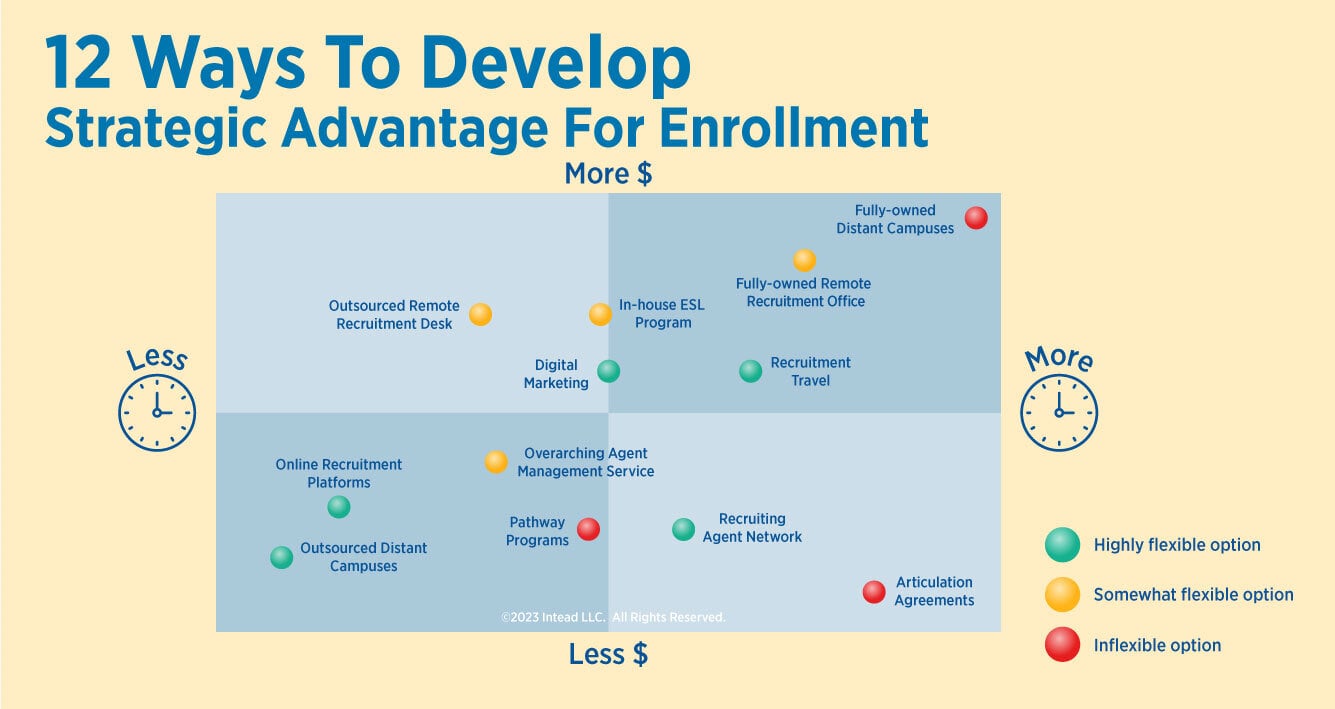
12 Ways To Develop Strategic Advantage For Enrollment

The student recruitment landscape has been in a state of flux that was forced upon all of us. Institutions have adapted in obvious ways (ramping up online education) and subtler ways that vary by institution. [Note: In Spring 2023, We updated this blog post from our previous summary of 10 international recruitment options to now incorporate 12 options]

Looking a bit over the horizon, we recognize that there is always the potential for unanticipated disruptions in addition to the challenging factors we see very clearly. As we consider what is next, the lever that has the greatest value is flexibility. The ability to ramp up or down with relative ease. The avoidance of plans that lock us into something long-term constricting our ability to adapt as circumstances change.

Building Flexibility Into the System

With that in mind, we offer up a quick comparison of 12 ways to develop strategic advantage for enrollment and their relative flexibility. In this case, we measure flexibility by two factors:

  • Time: Investment of administrative/staff time into making it happen and sustaining it
  • Money: Investment of capital (cash out) to make it happen

When we consider time, we also think about commitment – alliances and partnerships come with contracts that may or may not be easy to modify or escape from as factors on the ground change.

All in all, we see the largest value in those options that offer the greatest flexibility – least amount of effort (time), least amount of financial investment (money), and ability to ramp up or down on short notice (flexible contracts).

A little ways back, Brad Farnsworth, formerly at ACE and now running Fox Hollow Advisory, joined me to present at the CIEE Summit 2021. We discussed some of the options raised in this blog post and how they relate to institutional initiatives that deepen internationalization efforts.

Read on for more on those strategic advantages.

Read More

Student Recruitment Mistakes of the Desperate: Part 1

Many enrollment leaders are reporting terrific application rates for fall 2021, which is certainly welcome news. Campus enrollment numbers look promising for a number of reasons, primary among them:

  • Campuses are planning to open this fall with in-person learning as an option — highly desirable after this past year’s Zoom school.
  • Prospective students look like they will find summer jobs (unlike last year), suggesting they can afford to return to university.

However, there is plenty we do not know as we write this post in early May 2021.

Where India looked like they had successfully kept COVID-19 at bay, more recently, the country has become inundated. As of this writing, many areas of Canada are taking significant precautions to stem the spread. Here in the US, there is a common expectation that the country is on a positive trajectory with regard to the pandemic, and yet, India and Canada thought they were in the clear not too long ago. Our point: the future is murky.

With ambiguity, comes fear and inaction for some; for others, opportunity.

Let’s assume that as summer 2021 hits, your enrollment numbers are not where they should be. Budget dollars are extremely tight. And yet, growth is demanded. What to do?

Often (more often than we all care to admit and especially in times of crisis like we’ve experienced in the past year), we are approached by academic leaders from institutions around the world who are desperate and seeking student recruiting advice.

More often than not, institutions are hung up on the common challenges of people, tools, and budget. This is true of most service industries (and, in fact, product driven industries as well). There is no lack of ideas and opportunities. The only thing holding them back is the difficulty of aligning the team (people) and willingness to risk the funds (because there are no guarantees of success).

Note, an A-level team with B- or C-level tools will still crush it. B-level team with A-level tools? Not so much.

Back in 2018, we published a two-part “Mistakes of the Desperate” series, discussing the all-too-common mistakes we witness academic leaders making as they navigate enrollment challenges. Those who have been in the industry for a number of years have seen this state of affairs at different times: the pressure to produce without the time and resources to do it right. And looking back at those times, we all know what the result was: ineffective and disappointing.

In this particularly dynamic time for student enrollment and with so much ambiguity around what will happen next, we think this series deserves a second look as your team gears up for the next recruiting cycle. 

And for additional resources for your team navigating this challenging year, we hope you will tune it for our two sessions at the upcoming annual NAFSA (virtual) conference in June:

  • Achieving Global Agility: The Flexibility of Global Campus Options on the value of global campuses and how to implement them in a nimble, flexible way (presenters: Intead with Seamus Harreys from CIEE and Ita Duron from Massachusetts College of Health and Pharmacy Sciences University); and
  • Going from 0-60: Internationalization about the challenges and successes of taking your university’s internationalization efforts to the next level (presenters: Intead with David DiMaria from University of Maryland, Baltimore County).

Read on for three common mistakes academic leaders make when desperately trying to improve student enrollment numbers and how your institution can avoid them.

Read More

#Trending: Managing the Process and Flow of Pathway Programs


This one is just begging for industry commentary. Kudos, REALLY BIG KUDOS, to Elizabeth Redden and Inside Higher Ed for her reporting on pathway programs. So many recruitment realities revealed, and struggles documented. Elizabeth’s research and prolific writing have advanced the industry conversation more than anything I’ve seen in a long time.

This post should be handy when your president or provost asks for your take on "what is happening with international" these days?

What just stole the industry conversation away from pathway programs is, of course, the U.S. Supreme Court upholding the Trump Travel Ban (aka the "Muslim Ban" that is *not* a Muslim Ban, cough, cough). With all the walls being built around this country by Washington to keep foreigners out, it just may be that pathway programs are more important than ever as a pipeline for recruiting international students. But as Elizabeth's reporting makes clear, institutions can't travel this path without clear leadership and a well defined strategy. Many are going this route in a way that will confound and harm them later

Our just-completed webinar with Karin Fischer addressed the Travel Ban decision and some of its ramifications. The recording will be available next week for viewing for all Intead Plus members (see below).

The institutions willing to share their struggles and successes with Elizabeth for the Inside Higher Ed story gave readers real insight into so many of the challenges in international student recruiting. Much of it has to do with factors external to the university and largely out of their control. Other factors are very much in their control and have everything to do with internal politics and alignment (or lack thereof).

When tied to Elizabeth’s article about recently released NAFSA research on the lack of planning that most universities have done around international student recruiting, one’s mind begins to spin. Lack of strategy and planning coupled with long-term contracts is a really bad mix. 

Read on for Intead's perspective on how pathway programs do and don't work. Buckle up...This will be worth the ride.

Read More

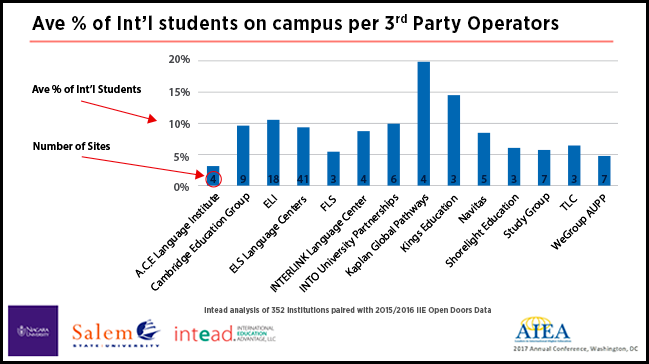
AIEA Conference Slides Available: Harnessing the Power of Language Schools as University Pathways


A couple of weeks ago, we were at AIEA talking about language schools as university pathways for international students. We had the honor of presenting with David Silva, Provost of Salem State University, and Deborah Curtis, Director of the Niagara University Center for Language, Culture and Leadership. 

With the global changes we are witnessing and the political landscape here in the US, this turbulent time is taking a toll on language school enrollments. These programs act as early indicators of trends in international recruiting, and we can see that many of them are starting to face challenges. These challenges are likely going to spread to international student enrollment more broadly over the coming months.

Yet, any significant enrollment declines we see coming will likely be limited to specific regions (think Middle East, Mexico, perhaps India) . This will be harsh enough for everyone in our industry. And still, there will be bright spots where students are less concerned and student interest in the US may, in fact, increase (think Russia).

Time will tell, and our market research is helpful as you develop your marketing/recruiting plans. We work hard to make your planning targeted and effective in each region. Your use of language programs is just one tool among many to draw students to your campus and your programs.

Read on to see what our language school research uncovered and to download our AIEA presentation slides.

Read More