
Our regular readers know our devotion to cross-cultural intersections. Today we focus your attention on the financial value of global.
At the NACUBO 2026 Annual Meeting, I spent several days listening to chief business officers talk about the problems consuming higher education: rising personnel costs, deferred maintenance, enrollment pressure, AI investments, student success vs. access, the loss of institutional knowledge as long-serving leaders retire, oh, and changing Federal policies and guidelines.
Important to note: just 13% of CBOs say their institution understands per-student program and activity costs very well as reported in Inside Higher Ed from their annual survey of CBOs. There’s an opportunity for you right there.
You know what did not come up at the conference? International enrollment.
Ready to benchmark your internationalization strategy against your peers?
Find out live. Join Dr. GianMario Besana (DePaul) and Dr. Cheryl Young (Miami University) as they unpack early findings from the AIEA-Intead Internationalization Benchmarking Study.
August 27, 12:30-1:15pm EST. Have you registered yet?
Not yet a subscriber?
Get Recruiting Intelligence delivered to your inbox. Smart move.
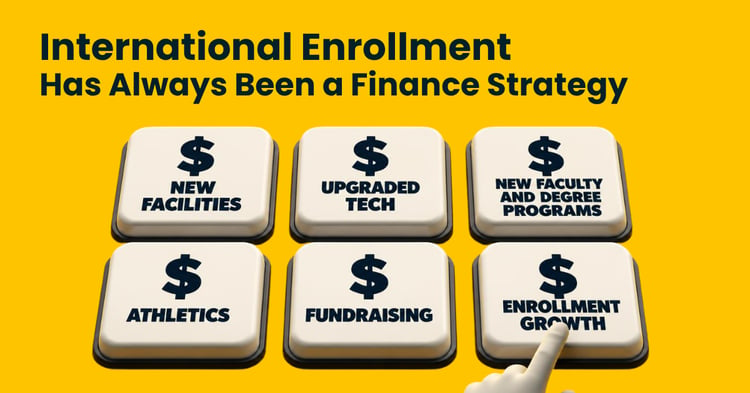
Nearly every concern being discussed at NACUBO pointed toward the need for new, sustainable revenue streams. While international enrollment cannot solve every financial challenge facing a college or university, it can become a meaningful part of the solution. And given today’s pressures, international is just as reliable as any other options for revenue-sustainability being evaluated by your leadership.
The larger point is easy to miss amid headlines about visa delays, geopolitics, and fluctuating student demand: international enrollment drives revenue. And that revenue opportunity is not well understood by your business officers. In fact, your CBO needs to hear from you, and this is important: they don’t know that they need to hear from you.
Read on...
The opportunity hiding behind the headlines
Higher education leaders are right to be cautious. International markets move. Government policies change. Currency values shift. A strong pipeline from one country can weaken quickly. None of that makes pursuing international enrollment growth any riskier than other revenue opportunities your institutional leaders are considering. Like other revenue streams, international must be managed as a portfolio. Your CBO needs your help to see that.
As CBOs well know, institutions routinely invest in new academic programs, fundraising campaigns, research capacity, technology, and facilities without expecting immediate returns. Yet international recruitment is often asked to prove itself within a single budget cycle. That is not a serious investment framework. Further, that expectation demonstrates a lack of understanding of enrollment markets.
Building a sustainable international enrollment stream commonly requires two or three years of focused work: market analysis, program positioning, relationship building, staff capacity development, partnership development, lead generation, conversion marketing, and student support services. The return can be significant, but the runway is real.
The current difficulties experienced by some institutions that once relied heavily on international enrollment do not erase the value those international students generated over many years. In numerous cases, international tuition helped fund academic innovation, student services, new program development, and broader institutional priorities that supported overall institutional growth and domestic student opportunities.
The lesson is not that international enrollment failed. The lesson is that concentration creates vulnerability. Diversification matters -- in countries of origin, academic programs, degree levels, recruitment channels, partnerships, and revenue sources.
Those in this field have pushed for diversification for decades. It’s typically institutional leadership that pushed for concentrated efforts in China and India through limited recruitment channels. When leadership clings to this myopic viewpoint, the current scenario underscores the importance of the international team providing guidance on how to diversify your well-managed international portfolio.
We need CBOs to see international enrollment as a core function
Too often, international enrollment remains contained within an organizational box labeled global, international, or admissions. The people doing the work understand the mission value. They know how international students enrich classrooms, research, campus life, and the experiences of domestic students. Cross-border, cross-culture interactions -- the very intersectionality that feeds progress.
Those outcomes matter. They are also insufficient when the institution is deciding where to place scarce resources.
A chief financial officer needs a different picture: expected net tuition revenue, the investment period, the range of likely outcomes, the risks, the capacity required, and the point at which the strategy can begin supporting other institutional priorities. Presidents and provosts need to know how the global plan aligns with academic capacity, faculty research, regional workforce needs, graduate-program growth, housing, student success, and the institution’s broader market position.
Earmarking funding for international enrollment challenges all institutions. The competition for funds goes beyond domestic recruitment. International competes with deferred maintenance, AI implementation, rising compensation costs… the list goes on. A proposal to the CBO that does not acknowledge those institutional pressures will struggle to earn serious consideration.
What’s needed: senior international officers must become translators. Not translators of culture - most already do that well. Translators of institutional value. You need to explain how international drives revenue and the realistic growth horizon. Your CBO’s will be more receptive to hearing this now than they may have been in the past. The crisis is real and getting realer.
The cabinet conversation needs to change
The most productive question is not, “How much should we spend on international recruitment?” It is, “What role should international enrollment play in our five-year revenue strategy?”
That conversation moves your colleagues away from reviewing a collection of recruitment tactics and toward institutional choices: Which programs have capacity? Where does the institution hold a credible market advantage? What level of investment can leadership sustain? How much concentration of risk is acceptable? Which student services must grow alongside enrollment?
That conversation also forces honesty. Some institutions do not have the programs, pricing, housing, support infrastructure, or leadership patience required to produce a meaningful return. Others are sitting on substantial opportunity but have never built the cross-campus commitment needed to pursue it. As if past performance across the US has not already demonstrated how international enrollment revenue supported cross-campus growth and domestic student opportunity. Some seem to overlook or ignore that historical reality.
Ultimately, the opportunity will be different for a regional public university, a community college, and a research (R1) institution. Asking the finance question is valuable for all three.
Three actions to take now
1. Ask the CFO about the institution’s revenue problem rather than an international recruitment budget. Join the budget conversations whenever possible and point to your international office as a solution contributor. What are the three largest financial pressures over the next five years? Which programs need enrollment? Where is capacity underused? Start by understanding the larger institutional problems you will help solve.
2. Build a credible international enrollment business case. Show the investment horizon, staffing and support requirements, conservative and optimistic revenue scenarios, market concentration risks, and decision points for adjusting course. Avoid presenting a single forecast as certainty. A useful model gives leadership choices and presents the diversified portfolio framework we mentioned. And yes, all of that requires investment of funds.
3. Create shared ownership before requesting that significant investment. Bring finance, academic affairs, enrollment, student services, housing, institutional research, and career services into the plan. International enrollment succeeds when the whole institution owns the strategy—not when the international office carries it alone.
Higher education’s financial pressures are not receding. Institutions will continue looking for ways to reduce costs, improve retention, strengthen fundraising, and create new programs and facilities. International enrollment belongs in that same portfolio of available responses to budget shortfalls. Side note: international alumni are typically ignored by the fundraising team. Big mistake. Huge.
Our next post will share specific insights from our NACUBO experience and the lessons international leaders can take from the chief business officers gathered there. For now, our central point is this: your international enrollment plan needs a strong business case that your CBO can consider with fresh eyes. Frame international as a revenue center (not a cost center). You’ll need a disciplined approach that solves a very pressing problem for your institution – likely focused on institutional sustainability and growth.
Be sure to talk about strengthening institutional financial resilience. Be prepared to back that up.
Be in touch. We can help.