Recruiting Intelligence

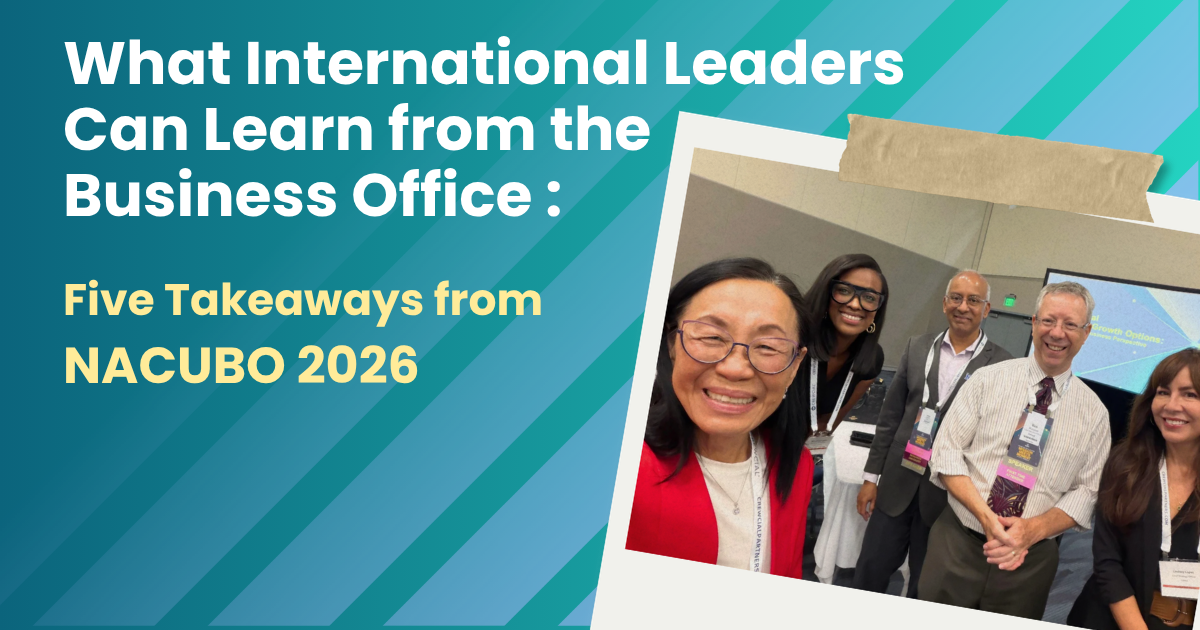
What International Leaders Can Learn from the Business Office

Your chief business officer is navigating rising personnel costs, deferred maintenance, technology investments, enrollment pressure, and limited institutional patience. International enrollment can be part of the answer. Yet many business officers still do not see it that way.

That disconnect was hard to miss at the NACUBO Annual Meeting. Unlike the international student-focused conferences your Intead team typically frequents, introductions at NACUBO often began with budgets, employee counts, bargaining units, and capital obligations. Students entered the conversation later. That observation is not a criticism. It is a reminder that business officers experience the institution through a different set of pressures -- and international leaders gain influence when they understand those pressures and that lens.

Your job: Get your CBO to see international as a revenue center (not a cost center).


Can benchmarking help universities navigate today’s internationalization headwinds?

Yes - but don't take our word for it. Read The PIE News coverage about our new AIEA benchmarking study. 22 institutions have joined, 40 in progress, 100 more evaluating the opportunity. Are you?

Not yet a subscriber?
Get Recruiting Intelligence delivered to your inbox. Smart move.


Last week, we explained that international enrollment has always been a finance strategy. NACUBO 2026 reinforced the point. But the international office has more to offer the business office than a budget request. You can bring a disciplined revenue opportunity, a diversification strategy, and a clearer view of global market risk.

The finance conversation is already happening

Business officers are not waiting for international leaders to enter the room. They are already evaluating new programs, AI investments, auxiliary revenue, cost reductions, partnerships, and the return on nearly every institutional commitment. International enrollment belongs in the room where these conversations are happening.

Often, chief business officers lack information about global recruitment. But here’s the thing: when the international office brings CBOs that critical information, leaders often present the information in a form that does not answer the questions finance leaders are asking.

Market potential, brand visibility, student interest, and competitor activity matter. So do investment horizon, net tuition, program capacity, support costs, downside risk, and clarity on the points at which leadership can adjust course.

That distinction shaped the NACUBO session Intead presented with three institutional leaders: Dr. Jia-Yi Cheng-Levine, Dean of International Affairs and Global Engagement at College of the Canyons; Dr. Tamara T. Cunningham, Associate Vice Chancellor for Global Initiatives and Arts & Campus Activation at University of California, San Diego; and Dr. Balaji Krishnan, Vice Provost for International Affairs and Professor of Marketing at the University of Memphis. Our session, “International Enrollment Growth Options: Three Publics Share Business Perspectives,” examined how three very different public institutions evaluate international student-focused investments.

The range of institutions mattered. A community college, a major research university, and an urban public university do not share the same market position, operating model, or organizational culture. Yet each institution faces the same core questions: Where can internationalization create value that aligns with institutional priorities? How will global investments create financial resilience?

Read on…

Read More
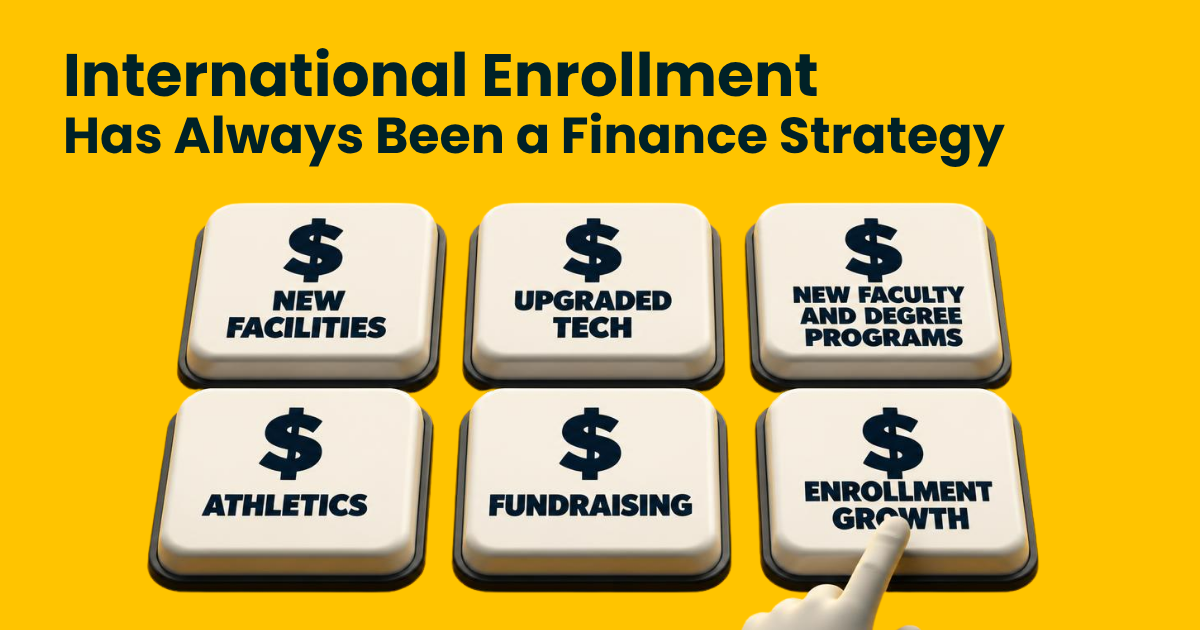
International Enrollment Has Always Been a Finance Strategy

Our regular readers know our devotion to cross-cultural intersections. Today we focus your attention on the financial value of global.

At the NACUBO 2026 Annual Meeting, I spent several days listening to chief business officers talk about the problems consuming higher education: rising personnel costs, deferred maintenance, enrollment pressure, AI investments, student success vs. access, the loss of institutional knowledge as long-serving leaders retire, oh, and changing Federal policies and guidelines.

Important to note: just 13% of CBOs say their institution understands per-student program and activity costs very well as reported in Inside Higher Ed from their annual survey of CBOs. There’s an opportunity for you right there.

You know what did not come up at the conference? International enrollment.


Ready to benchmark your internationalization strategy against your peers?

Find out live. Join Dr. GianMario Besana (DePaul) and Dr. Cheryl Young (Miami University) as they unpack early findings from the AIEA-Intead Internationalization Benchmarking Study.

August 27, 12:30-1:15pm EST. Have you registered yet?

Not yet a subscriber?
Get Recruiting Intelligence delivered to your inbox. Smart move.


Nearly every concern being discussed at NACUBO pointed toward the need for new, sustainable revenue streams. While international enrollment cannot solve every financial challenge facing a college or university, it can become a meaningful part of the solution. And given today’s pressures, international is just as reliable as any other options for revenue-sustainability being evaluated by your leadership.

The larger point is easy to miss amid headlines about visa delays, geopolitics, and fluctuating student demand: international enrollment drives revenue. And that revenue opportunity is not well understood by your business officers. In fact, your CBO needs to hear from you, and this is important: they don’t know that they need to hear from you.

Read on...

Read More

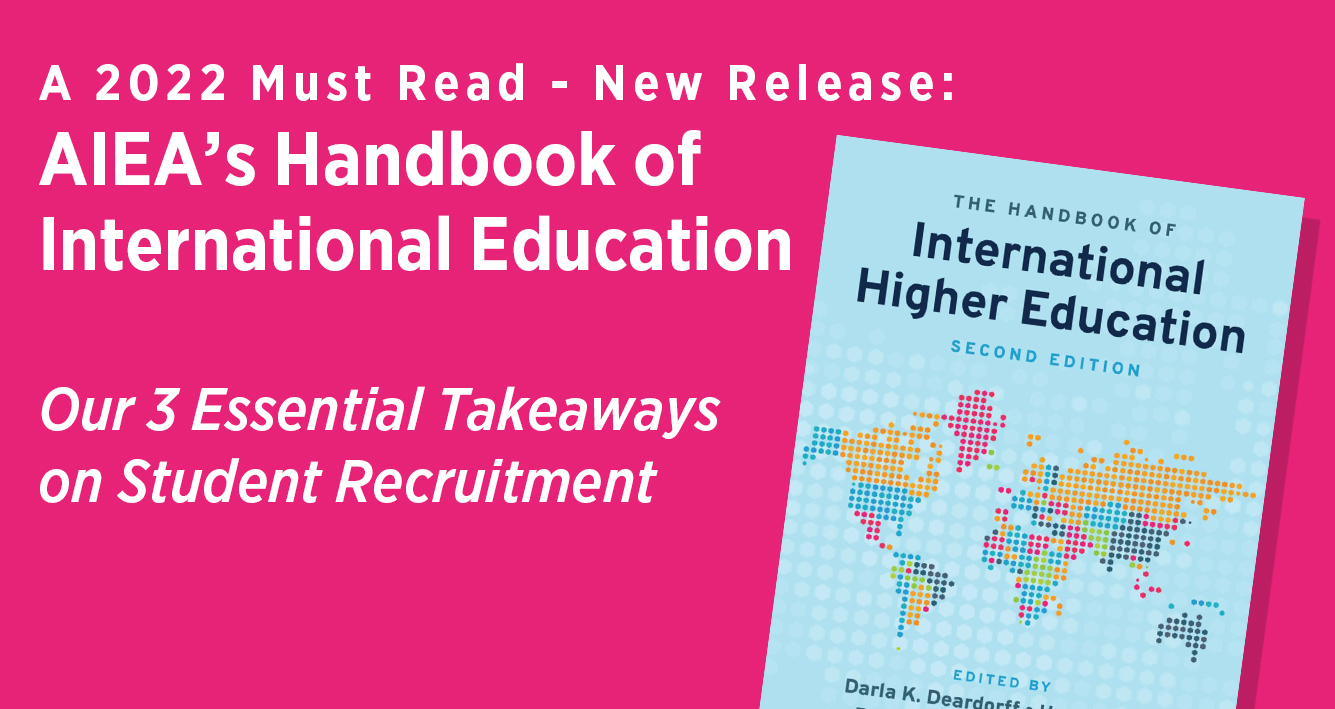
A 2022 Must-Read -- AIEA's Handbook of International Higher Education

In the age of snack-size content, The Handbook of International Higher Education, 2nd Edition is for a hungrier reader.

This deep-dive resource, thoughtfully delivered to all of us by AIEA, provides exceptional context for many of the issues we are all facing now and offers a glimpse of what lies ahead.

The book explores the evolution of student mobility, commercialization of academia, higher ed-tech, the student experience, and more. Collectively we’ve spurred so much change since the handbook first published just a decade ago. Not to mention the issues that have changed us (immigration, social justice, COVID, technology).

Side note: if you’ll be attending the 2022 AIEA conference in New Orleans (Feb 20-23), be in touch and we’ll find time for a coffee and an exchange of ideas.

There’s little doubt that we are in the midst of profound transformation. How we move forward must be informed by where we’ve been. Our colleagues agree international education is vital to an increasingly interconnected world. Yet, even this bedrock is evolving. Once driven by societal cooperation, contribution, and service, there is an undeniable shift toward competition and marketization in higher education. Perceptions and approaches vary depending on where you are in the world and the primary sources of your institution’s funding (i.e., government vs. private).

Read on for our quick summary of what the handbook offers us from a student recruitment point of view. A piece of the higher ed puzzle that is evolving with quickening speed.

Read More

Offering Up Inspiration for DEI

When Vice President Harris said, “Your nation is SO proud of you,” to a group of 20 Frederick Douglass Global Fellows, you could not have found more inspired university students anywhere. Absolutely anywhere. Their eyes said it all.

International education speaks deeply to all of us. And yet it remains inaccessible to so many. What we know is that roughly 6% of US students participating in study abroad are Black. How to make this privilege and opportunity available to many, many more?

Intead’s international team has been deeply honored to work alongside our colleagues at CIEE on an inspired and inspiring project – a concerted effort to bring the opportunity of international education, experiential education, to more BIPOC students. In just a few months, we’ve watched this effort draw pledges from dozens of university presidents who have matched CIEE’s scholarship funding to allow more students to experience the power of international education.

As the Frederick Douglass Global Fellowship barrels forward with applications for 2022 now open, we bring you this bottle of inspiration — a 5 minute film featuring the perspectives and experiences of the 2021 cohort. This will lift your spirits and get you thinking.

To hear Dr. Roslyn Clark Artis, president of Benedict College tell it, this program offers a lot and demands just as much back from the students who participate. Frederick Douglass Global Fellows and Scholars have a responsibility to share what they’ve learned as they become leaders in their chosen fields. To be, as one Frederick Douglass Global Fellow put it, “the first of many.”

We are gratified to see university presidents not just encouraging, but taking real action — signing up to catalyze their DEI initiatives in a valuable and visible way through this program. Will your institution be next? 

Read on to watch the film and hear from these future change-makers. 

Read More

The Biggest Threat to Higher Education: Rising Costs

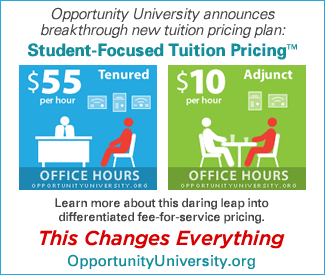
The rising cost of higher education coupled with mounting student debt is the biggest threat to higher education. Though we hope that you chuckled over our April Fool's Day joke (see: Intead Applauds Opportunity U's New Tuition Pricing Model), we approach this challenge in all seriousness. Our young people are being crushed under a mountain of debt. This affects all of us, not just those students with loan payment plans. The economic and social impacts are a national challenge. We need a new approach to the higher education tuition pricing model.

Read More

Intead Applauds Opportunity U’s New Tuition Pricing Model

Don't be the last to learn about Opportunity University's innovative tuition pricing model. This changes everything in higher education.

Read More

Ten Facts - International Student Recruitment in Vietnam: Part II

This is the second installment of a three part series. Click to read Part I.

Read More

Growing Your International Student Population: Sponsored Students

At the recent NAFSA Region VI conference held in Columbus, Ohio I attended a number of interesting and informative sessions. One of the sessions I particularly enjoyed was led by three well-respected and well-versed higher education professionals: Kathy Ice-Wedding (U. of Kentucky), Sandi Lemons (IUPUI) and Daniel Whitmer (Indiana University- Bloomington). Their session titled "Introduction to Working with Sponsored Students" provided a rich array of information that would be helpful to professionals looking to add sponsored students to their international student populations.

Read More