Recruiting Intelligence

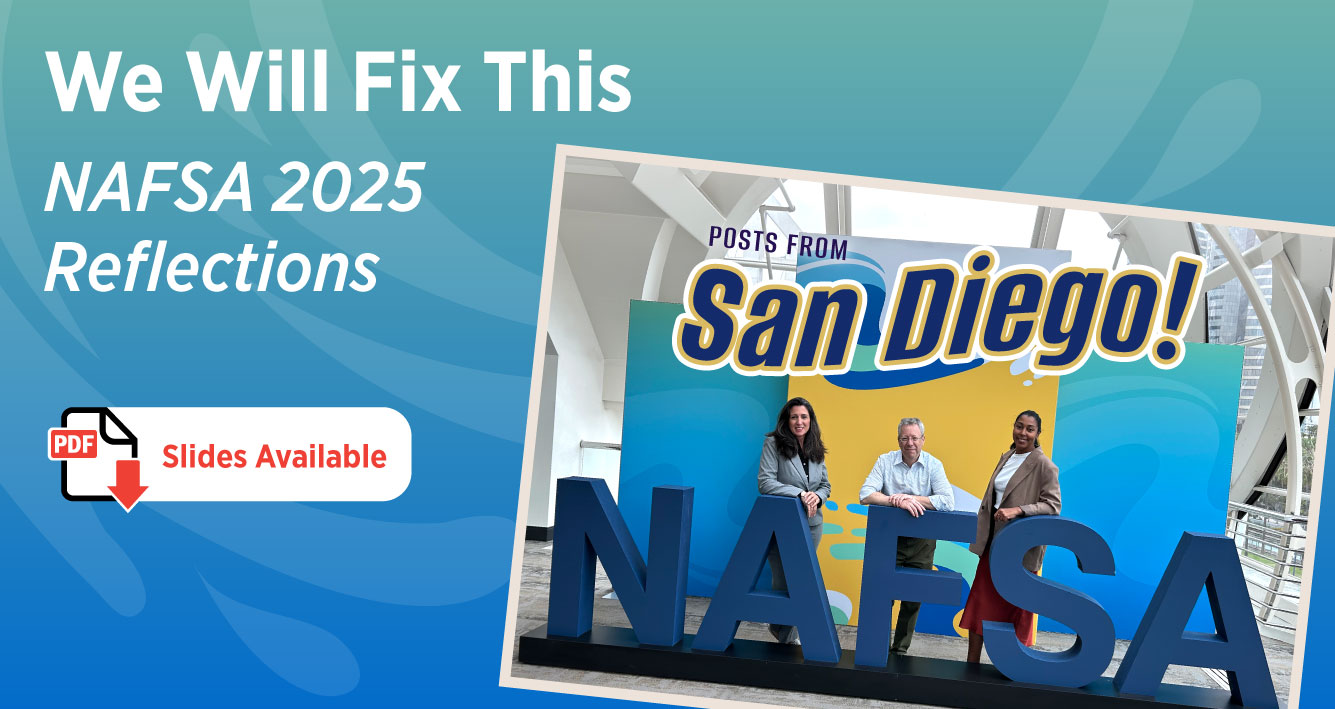
We Will Fix This – NAFSA 2025 Reflections

We all absorbed a few sucker punches at NAFSA 2025. And we experienced all the feels. 

While the White House released a new set of directives to further disrupt international student access to US institutions, NAFSANs gathered and found support amongst each other in San Diego. We ran as a pack (more on that below).

I spent my time at the conference largely with community and institutional leaders who have been down similar paths before. With sighs, eyerolls, and steadfast determination, we assessed what we knew, gave each other hugs, and took to planning for the future.  

As NAFSA CEO Dr. Fanta Aw says, “We do not get to be tired.” 


Meet Intead! 

  • Find us at APLU in NYC in June, NACUBO in DC in July, and NACAC in Columbus in September. Be in touch to share a cup of coffee in person.

Bookmark this: Intead’s Resource Center 
Access 800+ articles, slides decks, reports with relevant content on any topic important to enrollment management and student recruiting.  Check it out.


While many NAFSANs did express a weariness and some sessions had a very somber tone, that feeling was not pervasive. There will continue to be pain along the way, no doubt. Some of us will suffer losses due to the threats and disruptions. Student stress (and worse) is no joke. Fabulous and motivated international students will be denied access. Nevertheless, the dust will settle. Reason will prevail. And our community will fix what is being broken. NAFSA, among other leaders in our field, will be there throughout and after.  

To be clear, no one is giving up the fight.  

We were part of three presentations at NAFSA this year, mostly about career outcomes for international students and about how institutions can use this information to improve enrollment and advocate for our community. Find the link to our data (slides and a report) later in this blog post. 

Read on… 

Read More

The Fiscal Abyss Ahead?


That photo and headline were admittedly clickbait. There are certainly turbulent waters ahead, but no abyss from our point of view. We do have some great fiscal perspective to share here. And awesome photo, right? We took that while attending the AIRC Symposium and ICEF North America Workshop in Niagara, Canada. 

During the AIRC event, Maggie and Ben gave a truly valuable presentation with a new set of Intead slides focused on a data-driven, actionable approach to budgeting for international enrollment efforts. This session and the slides were extremely well received, especially in the currently ambiguous, post-covid student mobility climate.  


Let’s meet in New Orleans @ NAFSA 2024! 

Join one of Intead’s two NAFSA presentations: 

  • ChatGPT and AI: What are the real opportunities for enrollment management? 
    Wed., May 29 @ 1 p.m.
    This one gives you the real-world picture, filtering out all of the smoke and silliness. Featuring David L. Di Maria, Senior International Officer & Associate Vice Provost for International Education at UMBC, and Iliana Joaquin, Senior Digital Marketing Manager at Intead 
  • Groundbreaking Data: International Student Employment After Graduation
    Thurs., May 30 @ 11:30 a.m.
    This one presents unprecedented data about the value of international students after they graduate. Never before research Intead conducted with support from NAFSA and 12 US institutions offers great opportunities to advocate for your internationalization efforts. Featuring Joanna Regulska, Vice Provost and Dean of Global Affairs, UC Davis and Ben Waxman, Intead CEO

Get ahead with soon-to-be-released data from Intead.  

Intead is gearing up to release 3 new proprietary data sets that will change the way your team thinks about international student recruitment in the coming year. Incredibly telling data on international student career aspirations, the companies that hire them, and how the US election figures into international student decisions. More to come at NAFSA 2024. Pre-register to receive the reports as soon as they become available. 


For the past 15 years, the Intead team has been watching the numbers and predicting the future of international student enrollment with accuracy. It was February 2020, as the Chinese government shut down travel in and out of Wuhan and Covid had just begun its rampage though Italy that we were quoted in the Boston Globe pointing to the impending global shut down of international student mobility. Not everyone was happy with our saying so. But we weren’t wrong. 

Our point: we are willing to be bold and make statements that others have every reason to avoid. Someone’s got to feed our industry sober and helpful intel without all the blather. 

So, read on for what we see ahead and will be talking about at the upcoming NAFSA and GMAC conferences. Oh, and to grab our budget planning slides from the AIRC Symposium that will be available here to our blog subscribers for just one week before we move them into our library only available to our Intead Plus subscribers.  

Read More

Did you say something?...I’ve already scrolled on


With the amount of time prospective students spend online, you’d think connecting with them would be easier.  

The average US teen spends 7 hours 22 minutes each day looking at a screen, or 43% of their waking hours, per Exploding Topics. And that’s being conservative – Common Sense stats show teens on screens 8 ½ hours per day outside of school-related screen time. Need confirmation? Just look around your campus at all the students not looking at you, but rather their screens. (Reality check: the rest of us aren’t off the hook as the average person clocks 6 hours 58 minutes of screen time per day, just so you know. So yes, that is where all the time goes!) 

Do you know the average number of phone notifications a US teenager receives each day? We answer that below. Make sure you are sitting down when you read it.

Yet, despite all their screen time, or perhaps because of it, your prospective students are discerning consumers of marketing. If they’ve seen one university ad, they’ve seen a thousand. We’re certain you can relate. We all can. But some messages clearly do get through, and it almost always comes down to creativity, cultural nuance, and an appetite for taking a little risk.

Fun fact for the risk takers: Humor is a tough marketing message to achieve with a broad and diverse audience, but when you get it, it REALLY works. 


The Intead team is gearing up for some amazing presentations and we hope you can join us. 

  • ICEF North America in Niagara, Canada, April 30 - May 3, 2024
  • NAFSA 2024 Annual Conference and Expo in New Orleans, May 28-31, 2024
  • GMAC 2024 Annual Conference in New Orleans, June 19-21, 2024

Let us know if you’ll share a cup of coffee and a conversation about all things global and digital (info@intead.com) 


Take fintech, an increasingly rising "it" program in the eyes of so many STEM-degree seekers, especially those with a bent toward accounting and money-making in general. And rightly so as financial services operations around the world increasingly rely on new technologies to do business. (Shout out to Worcester Polytechnic Institute on its recent fintech doctoral program launch giving students a full-stack (BA>MS>PhD) option in this coveted field. Talk about reading the market!!!)  

Fintech is a huge, booming industry and one that universities with fintech programs are leveraging to draw the attention of prospects. The same can be said for Data Analytics, Cybersecurity, AI, and other “sexy” programs that now drive global and local economies. 

Important note: the counsel that follows here applies to how you message your programs even if you computer sciences are oversubscribed and you are trying to attract students to other options.

We want to promote programs that will draw eyes and pique interest. Highlighting them in your recruitment efforts makes sense. Of course, you know this. And yet somehow marketing that ultimately makes it onto the screen in front of your prospective students’ gaze is so often watered down, generalized speak about “great programs in computer science” or “practical business degrees” or the now far overused, “advance your career.” Ugh. Your prospect just scrolled on.

We know you know exactly what we’re talking about. So often there is a fear of getting too specific. Why mention one computer science program and ignore the others when students need to know there are many amazing degrees from which they can choose?  

Here’s why: you need their attention, and the coveted, interesting, or unusual programs will get it. Not the generalized track that simply prompts the finger flick and scroll right by. 

It’s not just your message you need to consider, it’s also the medium.

95% of US teens now own or have access to a phone per Pew Research. Worldwide, the stats vary (China has the most active smartphone users, followed by India, the US, Indonesia, and Brazil), but it’s safe to say many of your prospective students living outside of the US are on their phones, too. In Sub-Saharan Africa, affordability and access is improving such that there will be 692 million unique mobile users by 2030, 88% of whom will be using smartphones according to lobby group GSMA.

Many of your prospective students will not only be accessing information about your institution via smartphone, but will be completing the entire application process on it as well. Something your international team knows but your domestic team might not be thinking about. 

Marketers and message makers read on for our tips on phone screen engagement tips. Like all good listicles, we’ve got 5 steps to push your team to create effectively... 

Read More

Required: Cultural Nuance in Edu Marketing - 3 Helpful Examples


Cultural nuance is no “nice to have.” It’s a must. Does your current marketing team understand this? Do they have the deep consumer insights needed to attract, recruit, and convert different cultural cohorts? Let’s get into it.  

When we talk about audience segmentation – the customization of content by region or country or academic interest AND country/region – what we’re talking about is the language and metaphors, images, and offers that resonate. We’re talking about deep consumer insight research that enables marketing efforts to move the needle in a competitive marketplace. Without these insights, your colorful examples, imagery, phrases, and language can only take a campaign so far.  

Non-marketers you can roll your eyes if you like. We suggest you take a look at our 3 examples below for a quick look under the hood at how deep market research informs the creative process and produces stronger results. 


Opportunities to Meet In Person 

The Intead team is gearing up for some amazing presentations and we hope you can join us. 

  • The Forum on Education Abroad in Boston, March 21, 2024
  • AIRC Spring Symposium and ICEF North America in Niagara, Canada, April 30 - May 3, 2024
  • NAFSA 2024 Annual Conference and Expo in New Orleans, May 28-31, 2024

Let us know if you’ll share a cup of coffee and a conversation about all things global and digital (info@intead.com) 


As we develop approaches to attract and recruit students to institutions, we carefully consider what they will find relatable and help them make wise decisions. What will capture their attention among the many ads and posts they see online? What phrases will resonate with them as they consider their options – at each point in the decision process (the marketing funnel)?

Essentially, we are trying to figure out what will pause their scroll and prompt the smart click.

Prospects can only follow up with so many offers. In the end, they will apply to somewhere between 5 and 20 institutions. Most will receive 3 to 7 acceptance letters, sometimes more. What will help them make a wise decision for their particular situation? Will the content you create and disseminate influence them to apply and then enroll? 

So many institutions believe their own marketing and put out the most generic messaging because they think the great pool of prospective students will simply find them and connect with them. Some faculty and administrative leaders still believe that "marketing" is unnecessary (or worse) because their institutions are clearly excellent and students will simply find and select them. This point of view persists within the academic community -- marketing as snake oil sales. And hey, there are plenty of marketers out here lacking integrity in their approach, so, we understand the disdain for the marketing field.

To be clear, effective marketing is communication with integrity. Effective marketing helps consumers make wise decisions. Full stop.

Read on to explore the use of motivational language, colorful metaphors, and local language to create marketing campaigns that will attract attention, resonate, inform, and recruit. 

Read More

The Questionable Use of Shortcut Tools – ChatGPT and Templates


Until Threads, ChatGPT was the fastest-growing consumer app in history taking a short 2 months to amass 100 million users. Though Threads’ frenetic growth has tapered (and then some), interest in the AI tool has more than 1.4 billion visitors actively engaged with it each month.  

Today, it’s all about the tools we use that offer us shortcuts to our work as marketers. While ChatGPT is the latest shortcut tool, it is not so different in so many ways from the old school marketing template that saves us time and if misused (like ChatGPT) reduces, even eliminates, our creativity and effectiveness.

On the surface, we can point to a plan well executed, right? Our starting point has already been legitimized based on past performance (ChatGPT or some previously used design or report template). So, it stands to reason that using those tools will produce similar results. Uhm, maybe…

But probably not.

It is basic human nature. Use of shortcut tools often means we slack off on scrutinizing the details of what we are producing. Less scrutiny of what we produce and deliver to the world, less customization of our messaging and content, means we are prone to error. Some of those errors can be hugely damaging.

There goes our credibility with our target audiences.


Opportunities to Meet In Person 

The Intead team is gearing up for some amazing presentations and we hope you can join us. 

  • 2024 AIEA Annual Conference in DC, Feb 18-21, 2024
  • ICEF North America in Niagara Falls, Canada, May 1-3, 2024
  • NAFSA 2024 Annual Conference and Expo in New Orleans, May 28-31, 2024

Let us know if you’ll share a cup of coffee and a conversation about all things global and digital (info@intead.com) 


Looking particularly at ChatGPT, its ability to read and synthesize the entirety of the internet is amazing, staggering. Searching and understanding for complex information and analysis of huge datasets - what a time savings. Useful with even not so complex information. If only it provided reliable results without blending information inappropriately and even fabricating results out of thin air. Recent ads we've heard from AI service providers include the claim, "hallucination-free AI." Uhm, what?

Can you truly promise that? How did we get to a place where you need to promise that? 

When even the experts cannot explain to us how and why AI is producing falsehoods, when we get information that might have completely fabricated results and basic users (non-subject matter experts) cannot identify which pieces of information are accurate and which are not, we are in serious trouble.

Read on for perspective and our actionable what to do checklist. We want to help you, as a marketer, use shortcuts like AI and marketing templates wisely and avoid falling into the banality of functionality – the death knell of any marketing effort and potentially, the killer of a brand's soul. 

Important Note to Readers: This is not another article on how to master ChatGPT prompts to get ‘genius’ responses.  

Read More

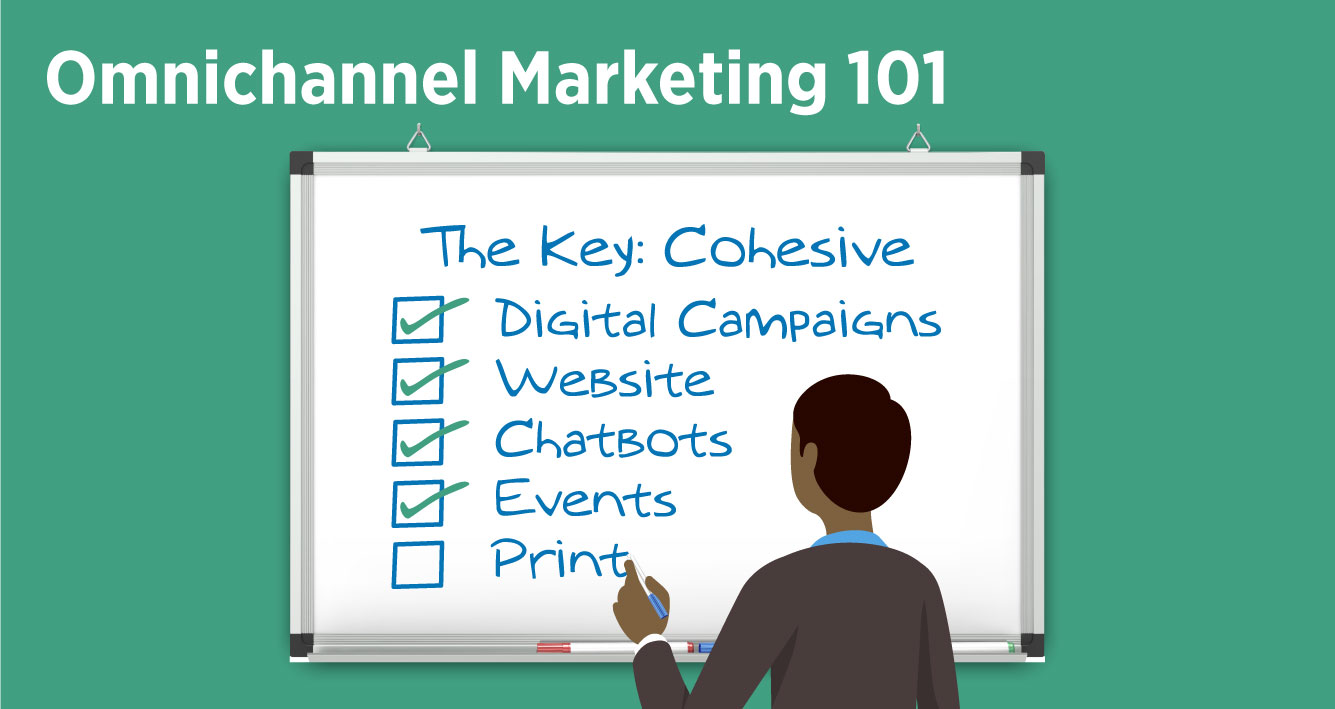
Omnichannel Marketing 101


If something isn’t online, does it even exist? We jest, and yet, without a strong online brand presence, many prospective students and their families really won’t know you exist. Because let's face it, prospective students today are basically born with smartphones in hand and earbuds on. If something isn’t online, it’s next to invisible in their world. 

That’s why institutions across the board have spent the past decade+ ramping up digital marketing budgets, perfecting their Insta image, and all the rest. A recent Washington Post article claims some well-funded universities are spending upwards of $1-2 million per month on digital ad campaigns alone. (Emphasis there on "well-funded!")

While that number is not industry average, most institutions do not have a Barbie budget, that figure is still a clear indication that digital is mission critical to higher ed marketing. No surprise to you or your finance team.  

But here’s the thing. The newest crop of students and their tag-along Gen Alpha siblings are at once more immersed and less smitten with social media. It's certainly no longer novel. Social media is life as they know it and they are adept at downloading ad blockers and avoiding sales pitches. So take note. Authenticity rules, while overproduced and slick messages are generally ignored.  

Our recommendation is to keep honing your digital marketing game, with this caveat in mind: your digital approach works best in tandem with other channels. We are talking out-of-home, print, in-person, and the like. In other words, the best-bet strategy is omnichannel.


We’ll be at AIEA in DC in about 5 weeks and participating in 3 great presentations: 

  • AI for enrollment management  
  • Entrepreneurial leadership in bureaucratic environments 
  • A discussion around International Student Points of Entry and a new publication to be released later in 2024 

And of course, we will be presenting at NAFSA in New Orleans in late May. If you’d like to schedule time to chat over coffee instead of over Zoom, please be in touch (info@intead.com). 


Read on to better understand the importance of omnichannel marketing and how you can use it to engage your target audience and grow your enrollment numbers.  

Read More

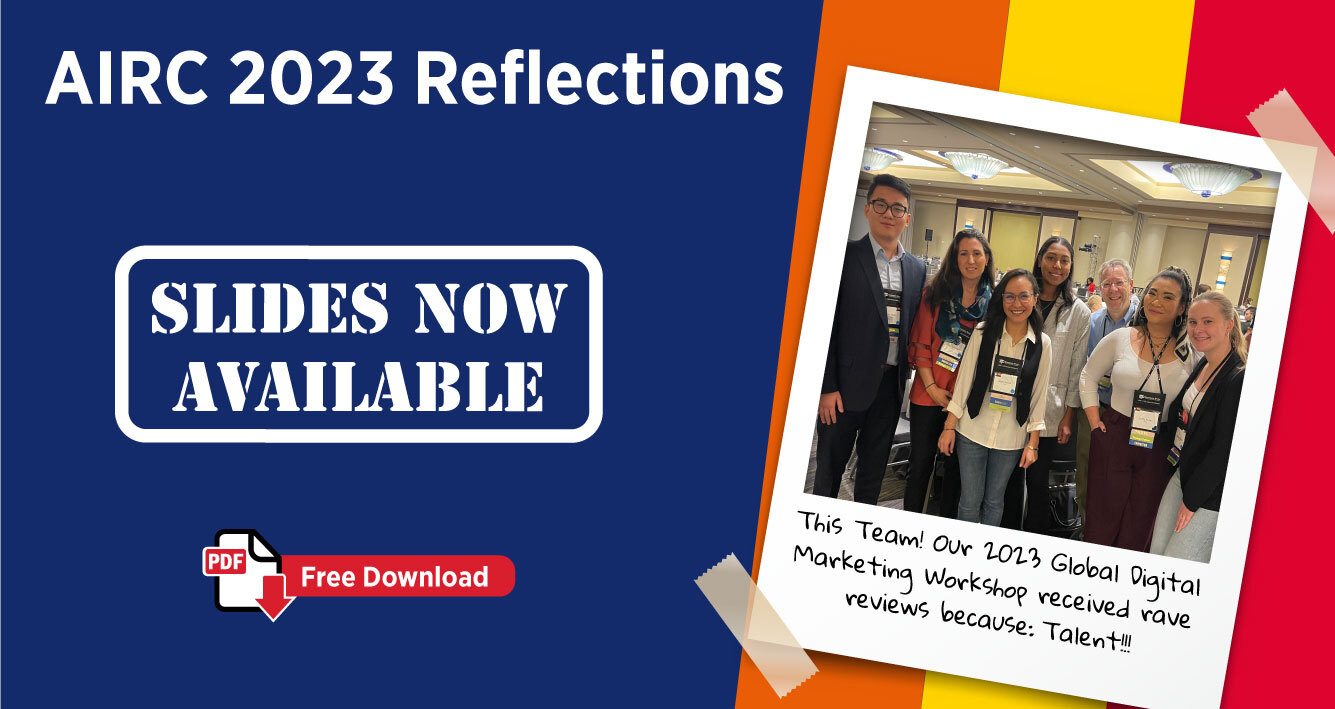
AIRC 2023 Reflections: Slides Now Available


As I headed to Phoenix for the AIRC 2023 conference, I wondered if the window had already closed for education institutions just now considering starting up with commission-based agents as an international student recruitment channel. Happy to tell you, that window has not closed at all.  

Yet, there is a lot to consider for those institutions just starting, and those having been at it for years. 

With the largest AIRC conference to-date (480 attendees), more than 200 first timers attended. Clearly there is demand to learn more about how effective university-agent partnerships work. And having been part of the AIRC community for 14 of their 15-year history, I can tell you that AIRC is one of the best places to learn about international student enrollment growth. 

From sample contracts to efficient agent engagement policies and practices, AIRC’s documentation and counsel are outstanding. This year, 7 members of the Intead team traveled to Phoenix to attend, in part because the learning opportunities and global connections at this conference are among the best in the industry. The other part was the opportunity to share our own expertise with the attendees at our full-day Global Marketing Workshop. That was a hoot. The Intead team just loves this stuff. 


We’ll be at AIEA in DC in about 6 weeks and participating in 3 great presentations: 

  • AI for enrollment management  
  • Entrepreneurial leadership in bureaucratic environments 
  • A discussion around International Student Points of Entry and a new international student-focused publication to be released later in 2024 

And of course, we will be presenting at NAFSA in New Orleans in late May. If you’d like to schedule time to chat over coffee instead of over Zoom, please be in touch (info@intead.com). 


At AIRC 2023, we gave our full-day Global Marketing Workshop with half a day devoted to an interactive lecture on the fundamentals of the strategy that drives a university’s tactical execution. After lunch, we dove into 1:1 consulting with participants to address the group’s self-identified greatest needs.  

It was fascinating to see how our workshop attendees debated and decided amongst themselves what the second half topics should be. Here’s where we ended up: 

  • I need a marketing budget, what do I do to get it approved? 
  • I have a marketing budget. Now what? 
  • Identifying and filling resource gaps 
  • Processes for nurturing and converting leads 
  • Creating authentic and powerful recruitment content 

Do these topics resonate for you? Be in touch and we can share what we know and how we have helped institutions like yours succeed.  

During the AIRC conference, Intead’s Sr. Digital Marketing Manager Iliana Joaquin joined Dr. David DiMaria, SIO at UMBC, for a practical discussion about how AI and ChatGPT are being used today in enrollment management and what we can realistically expect in the next year as AI-driven tools evolve. Short answer – it ain’t there yet, but it very likely will be in the next couple of years. So much more to talk about on this topic. There are definitely some gains that can be made in some areas, but the hype from the vendors is creating so much noise. Very frustrating.

Later at the conference, I ran a session with Vanessa Andrade about staffing challenges that so many institutions are facing today. The discussion about what skills and tasks to hire for and what to outsource was dynamic with so many additions from the folks in the room. This is what we absolutely love about the AIRC conference.

We are making these insightful presentations available to blog subscribers for free. Download them here.

Below we summarize 3 key take-aways from the conference. Please read on… 

Read More

Getting Started with Hootsuite for Student Recruiting

Your prospective students spend nearly 6 hours a day on social media. Doubt their usage will dwindle anytime soon. The good news is you know where you can find your audience. It’s just that wrangling their preferred platforms can feel like a lot.

That’s why we look to social media management tools to help organize our many, many social campaigns. The OG being Hootsuite. A global platform for all platforms, helping you and your team manage accounts from a single dashboard. It’s a really great shepherd for your flock of content. What Hootsuite brings for large institutions ranges from:

  1. Monitoring all social accounts
  2. Scheduling posts in advance
  3. Team Collaboration
  4. Analyzing social media performance  
  5. Targeted Ads
  6. Campaigns 

This Hootsuite primer is a great read for the members of your team tasked with managing all the details. Be sure to pass it along. And do take a minute to check it out for yourself. It’s a quick, practical read. 

This is one of our "Getting Started With..." series to help your team make the most of the student enrollment tech tools out there. Share our glossary of these popular posts with your digital team. And... 

Read on.

Read More

Having Data ≠ Using Data Part 2

Last week’s blog post helped define the data use problem (find Part 1 here). This week, taking us further into what to do about it.

Trust us, you’re not the only team whose data is not living up to its potential. It’s fairly common within teams and business units. It’s an issue of lack of time and/or lack of skills, but a problem worth solving. 

Because, without well-played data, your team is making decisions based on gut reactions and are more likely to participate in group think. That route is often poorly informed and heavily biased. Data informs and confirms. 

Data also drives curiosity. When your brain (or your team) has one of those aha! moments based on data, it craves more. New  market opportunities start to unveil themselves. New approaches to doing the work (operations) emerge. Prospective student enrollment pain-points will become more apparent – and the ramifications of leaving those pain points unresolved. 

Sure, data won’t solve these problems – that’s up to you – but it will help ensure the problems you’re solving are the ones worth pursuing. Data should be the foundation to most of the decisions you make.

Now, we don’t want to overstate it. Data is not magic (though what our data gurus pull out of the hat can feel like it!). It’s simply math. It’s what you do with that math – that’s the magic.  And that’s why every team needs access to digestible data and why self-service data analytics should be a priority for you. It certainly is for us.

This week we offer a process for helping you do just that. It’s a practical 5-step approach that starts with goal-setting and collaboration. Read on.

Read More

Having Data ≠ Using Data Part 1

You only thought you were using data to make smart decisions.

Understanding how to use data to support institutional planning and growth requires talents and skills that are learned and practiced and honed over time. All these tech companies selling tools and platforms into our systems want leadership to believe that all is simple, clear, and that their dashboards will transform your operational planning and decision making. Wondrous growth is just a click or two ahead. If only.

You’ve tried to create a self-serve data buffet for your leadership team so that they can dive in on their own and make informed decisions.

But…what if they’re not?

We mean, you gave your full team access to the tools with loads of features and data reporting. In the realm of marketing, your CRM captures and reports on email open rates, click through rates, conversion rates, and so much more. Your marketing dashboard tools pull data from Facebook’s Business Manager and Google Analytics (with updates to GA4 that your team is scrambling to implement and fine tune as you read this).

We all want to eke every last drop of data from the platforms available to us now.

Truth is, in the battle of data informed decisions vs human nature, human nature usually wins. Reality: creating, viewing, and understanding reports is not as simple as the tech vendors tell you it is.

Many of your leadership team are simply not data people. They may grab some of the data that supports their ideas, but ignore relevant data that would add more insight, nuance, or might even negate their suppositions.

What we have seen over the last decade is that many organizations are assuming their team’s new access to data dashboards and tools will naturally result in effective use of those tools. Often leaders simply don’t prioritize learning the necessary bells and whistles in the midst of other important deadlines. Still others can’t wrap their heads around it. They have other skills that your institution values and data analysis/interpretation is simply not one of them.

Simple test: Your marketing dashboard provides you with your email open rate monthly average. Among your other standard emails last month, on the 10th your team sent a mass email to a newly purchased, cold email list. What is worth reporting on to your leadership team? How can the data available inform your decisions and actions?

Read on to learn more about what self-service data is, why it can be useful, and how to actually make it work for you. (Oh, and we answer the question about the email open rates).

Read More