
Your chief business officer is navigating rising personnel costs, deferred maintenance, technology investments, enrollment pressure, and limited institutional patience. International enrollment can be part of the answer. Yet many business officers still do not see it that way.
That disconnect was hard to miss at the NACUBO Annual Meeting. Unlike the international student-focused conferences your Intead team typically frequents, introductions at NACUBO often began with budgets, employee counts, bargaining units, and capital obligations. Students entered the conversation later. That observation is not a criticism. It is a reminder that business officers experience the institution through a different set of pressures -- and international leaders gain influence when they understand those pressures and that lens.
Your job: Get your CBO to see international as a revenue center (not a cost center).
Can benchmarking help universities navigate today’s internationalization headwinds?
Yes - but don't take our word for it. Read The PIE News coverage about our new AIEA benchmarking study. 22 institutions have joined, 40 in progress, 100 more evaluating the opportunity. Are you?
Not yet a subscriber?
Get Recruiting Intelligence delivered to your inbox. Smart move.
Last week, we explained that international enrollment has always been a finance strategy. NACUBO 2026 reinforced the point. But the international office has more to offer the business office than a budget request. You can bring a disciplined revenue opportunity, a diversification strategy, and a clearer view of global market risk.
The finance conversation is already happening
Business officers are not waiting for international leaders to enter the room. They are already evaluating new programs, AI investments, auxiliary revenue, cost reductions, partnerships, and the return on nearly every institutional commitment. International enrollment belongs in the room where these conversations are happening.
Often, chief business officers lack information about global recruitment. But here’s the thing: when the international office brings CBOs that critical information, leaders often present the information in a form that does not answer the questions finance leaders are asking.
Market potential, brand visibility, student interest, and competitor activity matter. So do investment horizon, net tuition, program capacity, support costs, downside risk, and clarity on the points at which leadership can adjust course.
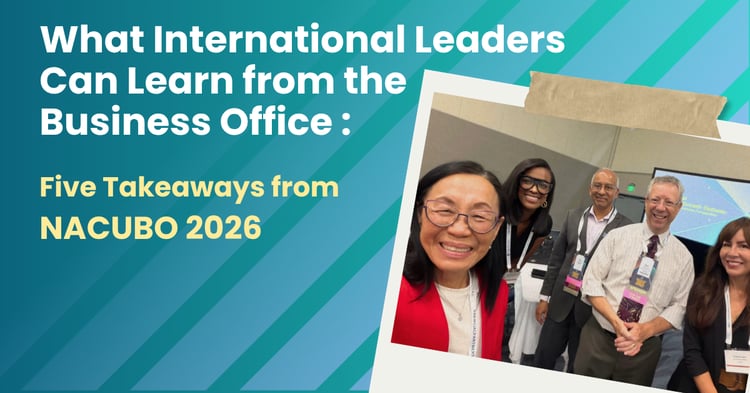
That distinction shaped the NACUBO session Intead presented with three institutional leaders: Dr. Jia-Yi Cheng-Levine, Dean of International Affairs and Global Engagement at College of the Canyons; Dr. Tamara T. Cunningham, Associate Vice Chancellor for Global Initiatives and Arts & Campus Activation at University of California, San Diego; and Dr. Balaji Krishnan, Vice Provost for International Affairs and Professor of Marketing at the University of Memphis. Our session, “International Enrollment Growth Options: Three Publics Share Business Perspectives,” examined how three very different public institutions evaluate international student-focused investments.
The range of institutions mattered. A community college, a major research university, and an urban public university do not share the same market position, operating model, or organizational culture. Yet each institution faces the same core questions: Where can internationalization create value that aligns with institutional priorities? How will global investments create financial resilience?
Read on…
Five NACUBO 2026 takeaways to help international leaders build influence with the business office
- Start with the institution’s problem. An international recruitment plan gains traction when it responds to an existing need: unused program capacity, graduate enrollment pressure, geographic concentration, workforce demand, or a weak revenue forecast. A plan built around the international office’s ambitions alone is easier to postpone or reject.
- Bring ranges rather than promises. Global markets move. Visa policies change. Currencies shift. Competitors enter and leave markets. A credible plan presents conservative, expected, and strong-performance scenarios. It identifies the assumptions behind each and establishes decision points. That approach signals strategic discipline rather than uncertainty.
- Connect international recruitment to the full student pathway. Tuition revenue is only one line in the model. Housing, advising, academic support, career services, retention, and student success determine whether the strategy works financially and institutionally. Show the room that you and your team understand that growth without the right infrastructure creates costs that appear later, which can erode trust.
- Treat relationships as an asset. International enrollment depends on networks that take time to build: recruiting agents, feeder schools, governments, alumni, higher ed academic partners, and local influencers. These relationships rarely fit neatly into a one-year return calculation. Business officers understand long-term assets and investments. International leaders need to describe relationship development in those terms.
- Widen your circle. One of the most useful parts of NACUBO was simply being in a room where the assumptions, language, and concerns differed from those at an international education conference like NAFSA or AIEA. International leaders need more exposure to finance, institutional research, facilities, academic planning, and cabinet-level decision-making. Our recent EdUp International podcast about communicating with CFOs made the same point: influence grows when you understand the audience’s operating reality.
Understanding the business office’s perspective is the first step. The next: putting that approach into practice.
Three next steps
NACUBO did not leave me thinking that international leaders need to become accountants. It left me thinking that we need to become more useful partners to the people carrying the weight of the institution’s financial risk. And trust me, they are feeling that weight right now.
So, next steps:
- Ask for a working conversation with the business office. Do not lead with a funding request. Ask how the institution is modeling revenue, where capacity exists, which costs are rising fastest, and what financial assumptions are shaping the next three to five years. You are gathering information to help you with the next step.
- Build an international proposal in finance terms. Include the investment period, net revenue ranges, staffing and student-support requirements, market concentration, risks, and milestones. Give leadership choices rather than a single all-or-nothing request. Historical enrollment trend data will help here, as will market research that identifies the global regions or cities where your institution has a competitive advantage. Give your leadership strong reasons to believe in your business plan that will support institutional growth (or stabilization).
- Create an institutional ownership group. Bring together finance, academic affairs, enrollment, institutional research, student services, housing, and career services. International enrollment becomes more resilient when those units help design the strategy and share responsibility for the outcome. Developing cross-campus buy-in takes time. Spend that time.
Your business officer may not yet see international enrollment as part of the institution’s revenue portfolio, right now.
You, however, see the opportunity.
Enter the conversation with a clear data-informed business case, a realistic view of risk, and a plan tied to the pressures already keeping institutional leaders awake at night.
Be in touch. We can help.