Recruiting Intelligence

3 Steps to align international student recruitment and marketing

This blog focuses on the alignment of your marketing resources in light of your current recruitment channels and the desired mix of student enrollment channels in the future.  We will focus on the alignment of the geographic, as well as, the marketing channel mix for this analysis. For the purpose of this article and analysis, we are going to exclude other important enrollment criteria such as the ability to pay, English capabilities and academic level and preparedness. 

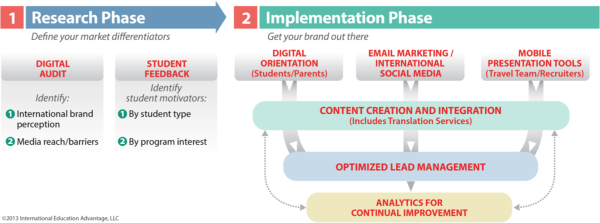
  • Audit your external brand perception, visibility and content
We suggest that you analyze your target recruitment by country to understand your current status within the market environment. Students and parents are anonymous "shoppers" on your website. Despite many other influencing factors such as peer groups, rankings, agents, etc, your web and social media presence -- both controlled by you and other information available about you -- is an important influencer for prospective students. 
Read More

Wanted: New friends for the admissions department

Social media is becoming a must-do activity to generate prospects, nurture them through the admissions process and convert them into enrolled students.

Read More

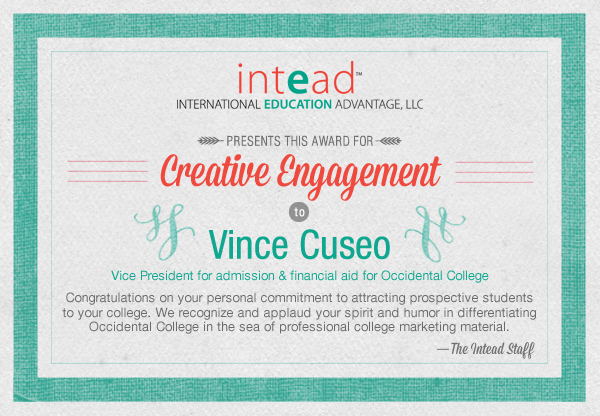
Intead Creative Engagement Award for Occidental College


Read More
Topics: Marketing

Armchair International Student Recruitment - part 2

You are reading an excerpt from our e-book "88 Ways to Recruit International Students"

II. Armchair recruiting

Donโ€™t underestimate what you can accomplish from your office in Dubuque, Syracuse or South Bend.  Even if you are chained to your desk, figuratively we hope, you can pursue numerous recruitment strategies with potentially great payoff.  If your institution is just beginning to explore international recruitment, many of these methods can help you wet your feet in the international sector.  Or if your institution has already made inroads in some markets, these methods can help to cultivate additional regions. Letโ€™s begin. 

Excerpt...........

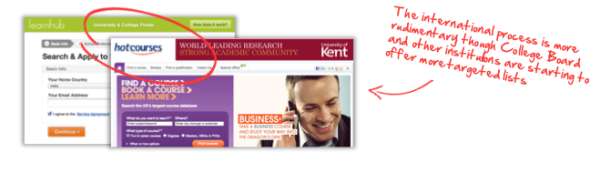
4. Targeted marketing materials for each international market

Read More

Creating International Clout: Offering Degree Programs Abroad

Creating brand recognition abroad when there are so many higher education institutions can be an ongoing challenge for universities. Franklin University in Columbus, Ohio has instituted an exciting and novel approach to building brand awareness, spreading its educational message and educating international students who otherwise wouldn't have the opportunity to attain an American degree. At the 2012 NAFSA Region VI Conference three Franklin University leaders presented their exciting on-location international degree programs. A special thank you to Suzie Arehart, Bridget Banaszak and Tamer Khadre for presenting this information.

Read More

The future of student enrollment - Five Predictions #3 & # 4

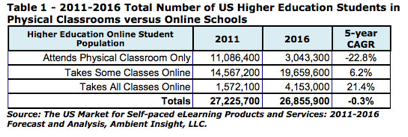
Prediction # 3: The range of programs and teaching channels for universities will increase to include more offline and professional programs as well as auxiliary services.

 We hear a great deal about endangered programs. Philosophy, history and language programs are shutting down due to the lack of students and financial resources. In contrast, I believe that universities will actually offer more, not fewer, services and programs, in more teaching formats, length and channels in the future. Universities will strive to find additional revenue sources. Executive training programs will be just one of many examples. Colleges will want to build a continued relationship with alumni exceeding current alumni fundraising focused activities.

Read More

The future of student enrollment - Five Predictions: #2

Prediction #2: Universities are expanding their marketing to broader geographic areas.

We notice a tendency among our clients to broaden their geographic recruiting area. This broadening is driven by three distinct factors:

Read More

How will student enrollment change - Five Predictions - # 1

Prediction 1: Marketing channels and interactions are dramatically shifting to digital channels.

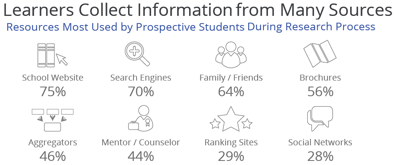
 It's a platitude that our rising high schools students are digital natives and their information gathering behavior is centered on digital activities and channels. College education is by far the biggest investment and purchase decision high school students will have made so far in their lives. Online research, social media interactions and information gathering will be at the center of their research.  The Google Research chart below shows the current resources used by prospective students.  Five of the eight most frequently used resources are digital.

Read More

Five predictions about the future of student recruitment

โ€œIt's tough to make predictions, especially about the future,โ€ as the quote goes by Yogi Barra & Niels Bohr.  I was reminded of this quote as I read an article on trends in liberal arts colleges. "Since 1990, the number of liberal arts schools in the U.S. has dropped from 212 to 130, a 39 percent decrease". This information came from a study by Roger Baldwin from Michigan State University "Are liberal arts colleges disappearing"  The author states that only a handful of colleges have gone out of business, but many have added vocational programs in nursing and business and have changed their focus so dramatically that they no longer retain a liberal arts identity. It's a shift of great magnitude without any major headlines for the outside world to notice. I strongly feel that education will continue to change without dramatic public headlines.

 I want to discuss five predictions and analyze how these changes will affect student recruitment and marketing activities. 

Read More

University marketing and presidential debates-$5 million to go

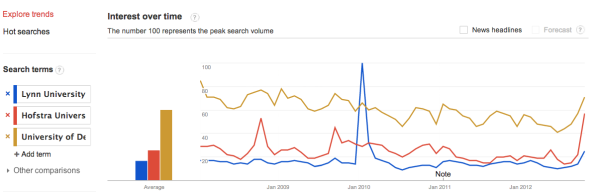
Would you spend $5 million to organize a discussion?   According to media reports*, that's exactly what Lynn University in Florida spent in preparation of holding the last presidential debate between President Obama and Mitt Romney this year.

Read More