Recruiting Intelligence

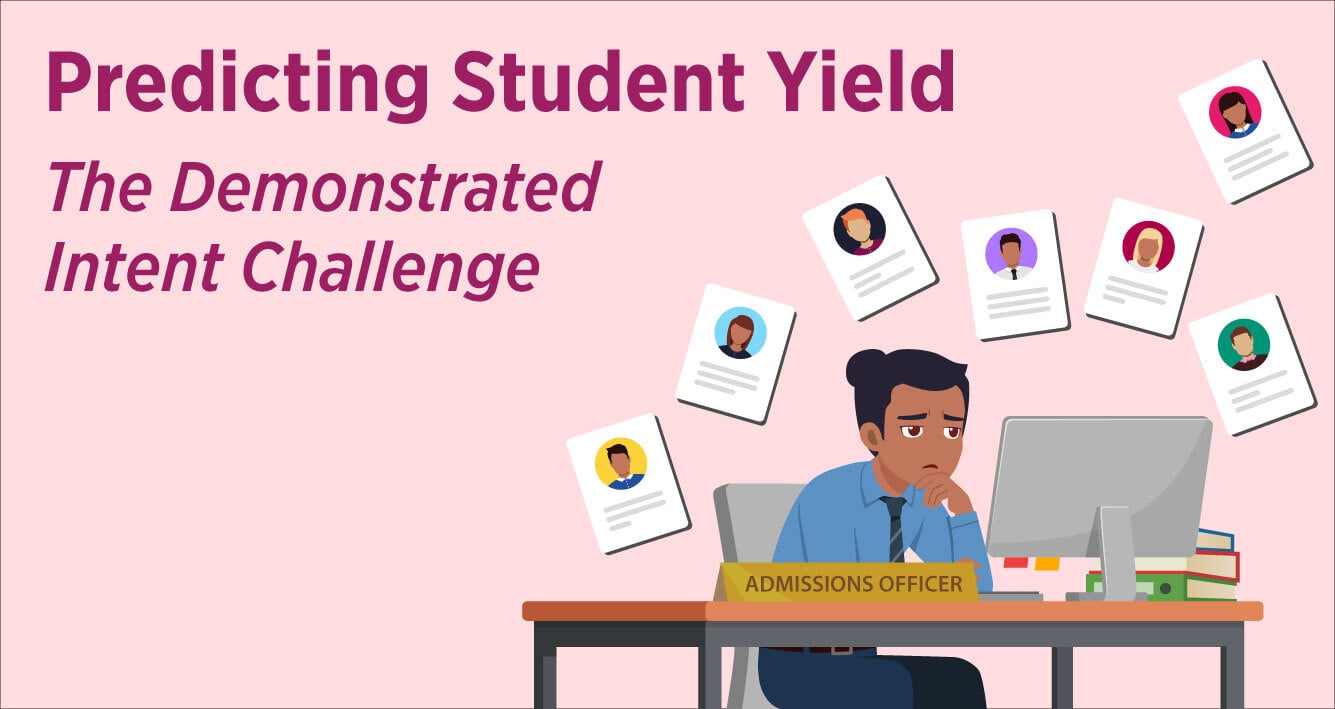
Predicting Student Yield: The Demonstrated Intent Challenge

Unlike most of his peers, my son (it’s Carrie talking here) applied to just two higher ed institutions. He got into both. Accepted both. Put down a deposit on both. Will attend just one. And so, he’s part of the admissions problem.  

Our colleague (and contributor to today’s post) Jon Boeckenstedt, retiring vice provost of enrollment management at Oregon State University, explains it like this: A lot of people think yield is like planting saplings in greenhouses, where your success is highly dependent on things you control, like spacing, soil quality, temperature, water, etc. In fact, yield is more like scattering seeds, where you are hopeful, and you have some ideas of success based on prior years, but in reality, you're at the mercy of factors you have zero control over.  

As an example: Last year, UCLA received 146,276 applications. About 13,114 students or 9% were admitted. For comparison, just 4 years earlier, in 2020, the university had an acceptance rate of 18%. And a decade+ ago in 2010, it was 23%. Go back further to 2000, it was 29%. And wait for it, in 1990, it was just above 40%. A lot has changed in a 30+ years. 

Year 

UCLA Acceptance Rate 

1990 40+%
2000 29%
2010 23%
2020 18%
2024 9%


UCLA is not unique in this way.  


Meet Intead! 

  • Find us at NACUBO in DC in July, and NACAC in Columbus in September. Be in touch to share a cup of coffee in person.

Bookmark this: Intead’s Resource Center 
Access 800+ articles, slides decks, reports with relevant content on any topic important to enrollment management and student recruiting.  Check it out.


Applications have skyrocketed for most institutions. For top-tier universities, this surge makes them even more selective (or rejective) — great for prestige and ranking supposedly, tough for admissions teams and applicants alike. For the majority of institutions, however, the steep rise in applications is just that, a steep rise in applications. Yield is on a different trajectory, and it’s driven by a simple concept: Algebra.  

The rise in applications has dramatically outpaced the increase in college-bound students, and of course, a student can only enroll in one institution, whether they are admitted to two or twenty. This then leads to a big increase in the volume of ibuprofen intake by admissions teams, as predicting the behavior of students is getting harder all the time. While institution leaders continue to demand enrollment results.

Thank goodness for the consistent ibuprofen supply.

We can point to the Common App as the bane of the admissions process. But that’s not really fair. Its advent brought more students into the system, increasing access overall. So, there’s the good. And not every university seeing the surge uses the Common App, and the University of California system is among those that do not.  

The real drivers of the application tsunami: access, competition, and coaching from influencers like school counselors and advisors. There are pros and cons to this situation. Ironically, the unpredictable nature of admissions decisions causes stress, which causes students to hedge their bets and apply to more colleges, which makes the admissions process less predictable. 

For context: 

  • In 2000, the typical applicant applied to three to five institutions.  
  • Today, the average student applies to eight to 12+, simply because they can.  
  • In 1998, when Common App went digital, ~250,000 applications were submitted through it.  
  • In 2024, that number hit 7.3 million – a 2,820% increase. (Yes, they have many more institutions as clients today, but still!)
The problem, of course, isn’t just the mountain of applications (besides, new AI tools are now helping with that to some degree). The problem is predicting yield to land just the right number of students who can bring just the right amount of revenue (and did we mention housing capacity?).   

Read on… 

Read More

AI Built for Admissions?


Think instant granular analysis of transcripts. Think about your ability to identify the specific classes and grades indicating future student success. Think about automatically excluding that A in Phys Ed from the overall GPA calculation.  

For the sake of speed and efficiency, institutions rely on the overall GPA, an SAT score (if submitted), or the presence of AP classes on a transcript. All helpful shortcuts as indicators of future success, to a point. And we’re not going to get into the SAT debate right now, though we have some strong opinions on that one. 

But now, along comes AI and admissions teams are apt to place some hope in the promise of what it can do to streamline unwieldy processes that tend to get in the way of enrollment yield. But there’s so much more edtech can now do. 


Opportunities to Meet the Intead Team 

  • AIEAin March, ASU+GSV in April, and NAFSAin May. We'll be presenting our latest findings with colleagues from Chronicle of Higher Ed, IIE, AIEA, University of Tulsa, University of Memphis, Northeastern, and others. Let us know  if you want to connect at any of these events. 

Bookmark this: Intead’s Resource Center 
Access 800+ articles, slides decks, reports with relevant content on any topic important to enrollment management and student recruiting.  Check it out.


In our last postwe highlighted an edtech venture worth watching – especially if you’re among the AI curious. MyDocs is the brainchild of entrepreneur John Reese, whose name you may recognize from Parchment, the company that moved our industry from paper to digital transcripts (PDFs). That little startup originally founded by John grew up and just sold a year ago for more than $800M (all cash). Now, John is taking admissions capabilities a step further – moving institutions beyond digital transcripts into admissions data processing. And last year, he reached out to the Intead team for product launch support. 

MyDocs uses advanced OCR (optical character reader) and machine learning to evolve the tedious tasks of transcript analysis and processing. With application volumes rising thanks in part to the student efficiency tool Common App (don’t get us started), this new edtech helps smooth a specific task – and frequent bottleneck – in the admissions process. MyDocs' AI-powered platform scans and analyzes digital transcripts (PDFs, JPEGs, photos) to make them both human and machine-readable. 

That means the school of origin and every class, every grade, all become actionable data, instantly. Are you starting to see the possibilities? Oh, and if the transcript happens to be in another language, the tool translates to English. 

You can see why we were excited when John approached us and asked for our help with his entrepreneurial approach to transcript evaluation. The data analysis possibilities got the whole team here buzzing.  

For institutions, this kind of AI assist is more than welcome. One forward-thinking private New England institution we work with recently used this edtech tool to evaluate and process 11,000 applications in a single day. That’s just one anecdote, but the expediency is something to behold for anyone who’s ever managed admissions processes and credential evaluation. 24 hours vs. 1,500 hours (when done by humans). Something to think about. 

On the surface, technology like MyDocs seems like a game-change. Still, a challenge remains: institutions may find they are swimming in data without a clear strategy for leveraging it beyond this singular task of admissions efficiency: accept or reject?  

But, we have ideas. So many ideas. Read on… 

Read More

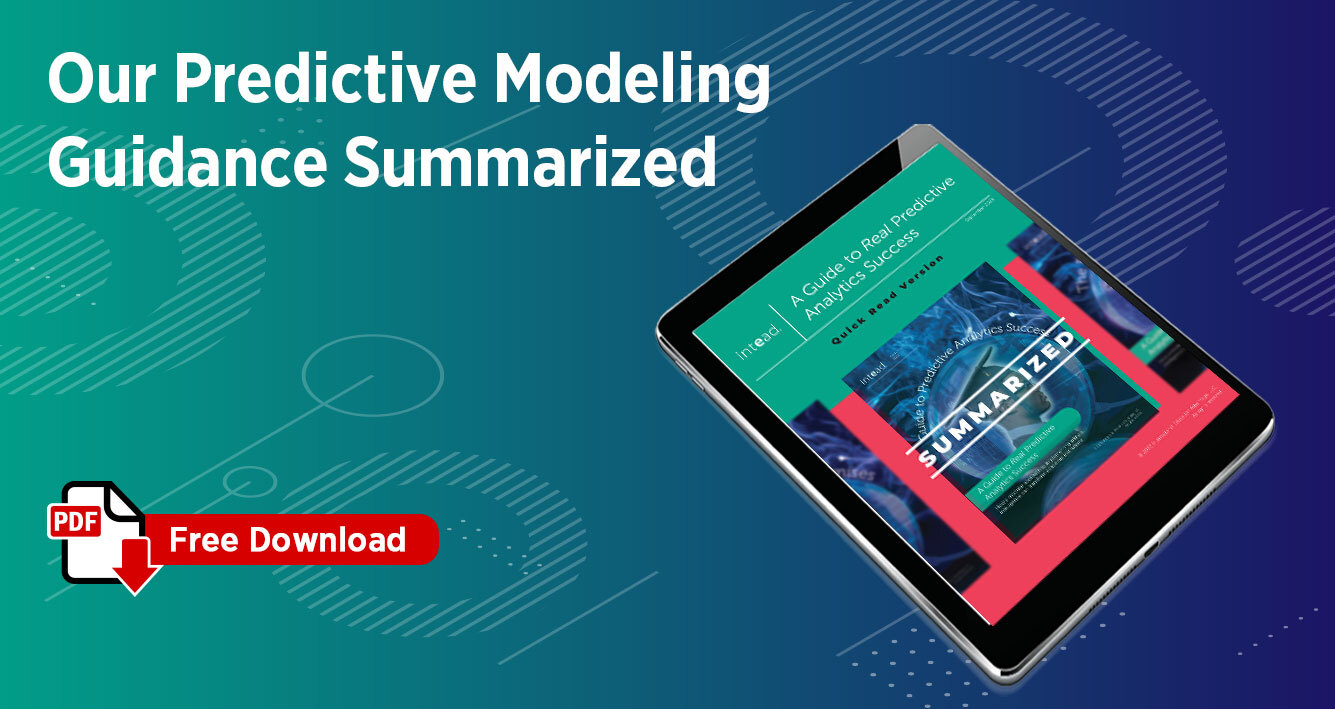
Our Predictive Modeling Guidance Summarized

Does the rise of AI change the value of predictive analytics?    

In 2020 we were all looking for a little predictability and sustainability. In life as well as enrollment. And while the pandemic may be in our rearview mirror, uncertainty remains an unflappable friend. We’re looking at you, enrollment cliff and public opinion polls about the value of higher education.

So, we thought now is a great time to revisit one of our most popular downloads because it’s all about predictability.

We published The End of False Promises: A Guide to Real Predictive Analytics ebook during the height of the pandemic as a tool to help our colleagues understand the role Big Data and Artificial Intelligence can play in enrollment strategies. After all, we know you’re increasingly looking for data to help deliver reliable, cost-effective, and transformational results for your institution. And we’re here to make sure you get what you think you’re paying for.


If you want to chat about how you are building your Fall 2024 strategy or the tactical execution approaches we have found most valuable, Ben and Iliana will be at the NACAC conference presenting alongside our colleagues from AIRC and Middle Tennessee State University on Sept. 22 in Baltimore. Can we schedule a time to chat? Send us an email and coffee's on us! 


About our predictive analytics guide, you will:

  • Decode predictive analytics
  • Access case studies of predictive analytics in action
  • Learn how to dodge prediction pitfalls
  • Get your hands on a vendor vetting checklist
  • And much more

The full guide is available on demand for Intead Plus members, while, you, our blog subscribers, can download a useful 3-page summary for free. Read on for access and a quick primer on what predictive analytics is and is not…

Read More