Recruiting Intelligence

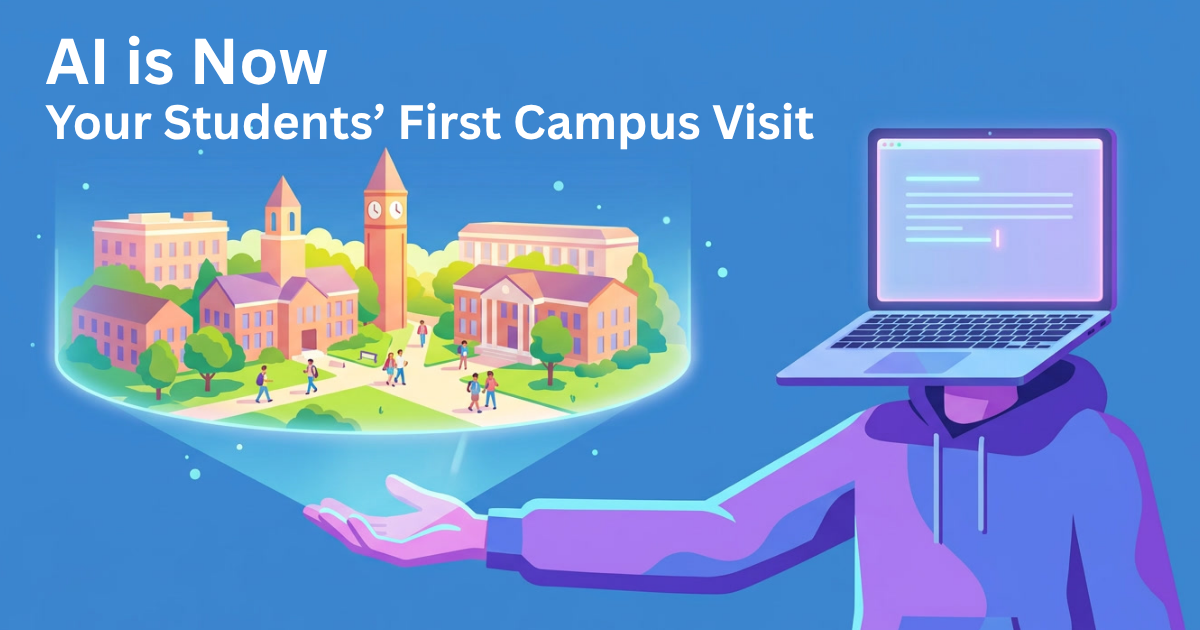
AI is Now Your Students’ First Campus Visit

Students used to learn about universities the old-fashioned way: browsing websites. (How very Millennial of them.)

Soon enough, social media became prospective students’ means of discovery.

Now? Increasingly, students are using AI to identify and evaluate their academic options. Long before they see your website, they have already developed an AI-informed opinion.

We have helpful slides available below from our AIEA session presentation by Balaji Krishnan, Vice Provost at University of Memphis and our own Marketing Analytics Director, Iliana Joaquin.

One SIO told us afterward, “That was the most useful session of the conference.” We’re not surprised. The content shift happening right now isn’t simply about search rankings. It’s about how institutions are being understood in an AI-mediated world.  

To be certain, websites and social media are still incredibly important to student search processes. Even direct mail and out-of-home have their place in the marketing mix. But the truth is AI has quickly become a (The?) go-to research tool for students and their parents.

In case you need stats for confirmation, the Pew Research Center found:

  • ~64% of US teens report using AI chatbots
  • ~ 3 in 10 use them daily for questions, research, and learning

Further research from the Associated Press-NORC Center for Public Affairs Research finds that roughly 60% of US adults have used AI to search for information. This is from July 2025. That number is even higher now. Consider the frequency of your own use of AI tools compared to last year.


Meet Intead! 

  • Today only: Find us at ASU+GSV in San Diego in April, and at NAFSA in Orlando in May. Be in touch to share a cup of coffee in person.

Shape Institution-Agency Partnerships
Join your peers across IEM and complete AIRC’s 15-minute survey about your experience working with recruitment agencies. Participants will receive the resulting report. Deadline: May 1st


If students aren’t using ChatGPT or Claude, Google’s Gemini often steps in as AI gatekeeper. It’s fundamentally reshaping the way students conduct research and what they see when they search online, including about your institution.

And so, AI is now the first campus visit.

Below we offer 3 steps you can take to improve the value of your content for students’ AI searches. And yes, you can try this at home: try an open-ended prompt: “What university is best to become a [fill in career of choice]?”

Read on for the quick notes worth sharing with your marketing and recruitment teams plus access to our slides…  

Read More

AI Built for Admissions?


Think instant granular analysis of transcripts. Think about your ability to identify the specific classes and grades indicating future student success. Think about automatically excluding that A in Phys Ed from the overall GPA calculation.  

For the sake of speed and efficiency, institutions rely on the overall GPA, an SAT score (if submitted), or the presence of AP classes on a transcript. All helpful shortcuts as indicators of future success, to a point. And we’re not going to get into the SAT debate right now, though we have some strong opinions on that one. 

But now, along comes AI and admissions teams are apt to place some hope in the promise of what it can do to streamline unwieldy processes that tend to get in the way of enrollment yield. But there’s so much more edtech can now do. 


Opportunities to Meet the Intead Team  

  • AIEA in March, ASU+GSV in April, and NAFSA in May. We'll be presenting our latest findings with colleagues from Chronicle of Higher Ed, IIE, AIEA, University of Tulsa, University of Memphis, Northeastern, and others. Let us know  if you want to connect at any of these events. 

Bookmark this: Intead’s Resource Center 
Access 800+ articles, slides decks, reports with relevant content on any topic important to enrollment management and student recruiting.  Check it out.


In our last post, we highlighted an edtech venture worth watching – especially if you’re among the AI curious. MyDocs is the brainchild of entrepreneur John Reese, whose name you may recognize from Parchment, the company that moved our industry from paper to digital transcripts (PDFs). That little startup originally founded by John grew up and just sold a year ago for more than $800M (all cash). Now, John is taking admissions capabilities a step further – moving institutions beyond digital transcripts into admissions data processing. And last year, he reached out to the Intead team for product launch support. 

MyDocs uses advanced OCR (optical character reader) and machine learning to evolve the tedious tasks of transcript analysis and processing. With application volumes rising thanks in part to the student efficiency tool Common App (don’t get us started), this new edtech helps smooth a specific task – and frequent bottleneck – in the admissions process. MyDocs' AI-powered platform scans and analyzes digital transcripts (PDFs, JPEGs, photos) to make them both human and machine-readable. 

That means the school of origin and every class, every grade, all become actionable data, instantly. Are you starting to see the possibilities? Oh, and if the transcript happens to be in another language, the tool translates to English. 

You can see why we were excited when John approached us and asked for our help with his entrepreneurial approach to transcript evaluation. The data analysis possibilities got the whole team here buzzing.  

For institutions, this kind of AI assist is more than welcome. One forward-thinking private New England institution we work with recently used this edtech tool to evaluate and process 11,000 applications in a single day. That’s just one anecdote, but the expediency is something to behold for anyone who’s ever managed admissions processes and credential evaluation. 24 hours vs. 1,500 hours (when done by humans). Something to think about. 

On the surface, technology like MyDocs seems like a game-change. Still, a challenge remains: institutions may find they are swimming in data without a clear strategy for leveraging it beyond this singular task of admissions efficiency: accept or reject?  

But, we have ideas. So many ideas. Read on… 

Read More

Finding and Alleviating Admissions Pain Points


Shout out to Q4 for giving us all something to think about. Cue the Chinese expression: "Better to be a dog in times of tranquility than a human in times of chaos." (宁享平安犬生,莫为乱世中人). Yup, got it! Right now, we are those humans, perhaps wishing we were dogs. 

Between the US presidential election and IIE Open Doors data, many of us are recalibrating our approach to 2025. Fortunately, we’ve worked through anti-immigration policies and lackluster international student enrollment numbers before. We’ll weather this. But there is work ahead for all of us.  

So, if you’ve missed a few of our Recruiting Intelligence articles, we understand. This post will catch you right up. 


Opportunities to Meet the Intead Team  

  • AIEA in March, ASU+GSV in April, and NAFSA in May. We'll be presenting our latest findings with colleagues from Chronicle of Higher Ed, IIE, AIEA, University of Tulsa, University of Memphis, Northeastern, and others. Let us know  if you want to connect at of those two events. 

Bookmark this: Intead’s Resource Center 
Access 800+ articles, slides decks, reports with relevant content on any topic important to enrollment management and student recruiting.  Check it out.


Relying on our experience working with a wide range of institutions, public and private, over the past 15 years (and the guidance from David’s book), we have helped admissions leaders identify the admissions pain points that drive students away rather than drawing them closer in. Importantly, this fascinating day-long exercise uncovers opportunities to fix the problems and the improvement measures to track results. Ah yes, some good news. 

Process mapping is a simple idea on the face of it. Like any problem-solving session addressing a complex, multi-layered process, the key to success is getting the right people in the right room to wrestle the right questions. We’re sure you know just what we mean. Practical to downright critical cross-departmental conversations are too few and far between.   

IT, Marketing, Enrollment, Admissions, and faculty (at the graduate level) all play a role. Credential evaluation always comes up as a pain point (more on that in just a bit). Yet, when institutions bring all stakeholders together for one full day to critically examine how their roles interconnect, the clarity is remarkable. We’ve seen even the most efficient teams benefit. And by the end, everyone has a new appreciation for sticky notes and our whiteboard is filled with sound ideas, big and small. 

The litmus test for us is always this: at the end of the day, does everyone see a clear, achievable path forward? From the clear immediate wins to the more time-intensive improvements, a shared vision for a more efficient process will result. That’s the point of process mapping. Read on…  

Read More

Key Takeaways from 3 Student Recruitment Meet Ups

…It goes further than identifying opportunities. You also need to manage them. Perhaps a renewed focus on the mechanics will move the needle more effectively?...

Our full-day workshop at San Diego State University was a truly packed day. After initial conversations about the current student recruitment landscape and the data that informs smart enrollment decisions, we broke into 3 discussion groups talking about recruiting agent management, global digital marketing, and global partners.

Attendees were free to flow from one conversation to the other as our all-star faculty held forth using the Intead Global Marketing Workbook as a guide (available through our Intead Plus subscription). It was fascinating to watch the flow of inquiries and learning throughout the day as attendees tapped the expertise they needed to formulate their global marketing plans.

And we noted the praise for the faculty perspectives gathered. Based on the feedback, participants appreciated the highly productive series of deep conversations with the opportunity for detailed answers to specific marketing/recruitment questions.

We spoke to even more colleagues at the AIRC and ICEF conferences who expressed regret that they were unable to attend our workshop due to timing and work conflicts. If you share that perspective, please let us know. We are evaluating when we might hold this event again, on the East Coast or in other locations. Send us a note. Perhaps we can make this workshop accessible to you.

In the meantime, read on for quick notable ideas from our whirlwind trip westward for AIRC, ICEF, and our workshop in between. You’ll be glad you did.

Read More

The Essential Guide to Implementing a University CRM System

With so much in enrollment management being in flux right now, going back to the basics is important. Managers across the country are looking to their 2021 intake reports and trying to predict spring and fall 2022. Challenging under normal circumstances, right?

So where are those reports coming from and how much is what should be a simple process driving you up a wall?

The more important the task, the more frustrating it is to have a tool that isn’t helping you succeed. For those among us still reviewing excel spreadsheets with enrollment data, we feel your pain.

It’s no surprise that many universities, high schools, and language schools feel incredibly irritated by customer relationship management (CRM) systems that don't meet their needs. We know this is a topic worth discussing in part, because some of our most read blog posts over the past 2 years (Post 1, Post 2, Post 3) are about enrollment managers' user experience with Technolution's #Slate.

If any of this sounds familiar—and if you wish you had more guidance on how to set up a system that will actually help you anticipate what your future enrollment will be—keep on reading.

Read More

Recruiting Intel Digest: The Most Useful Stuff from Q1 2021

Pro tip: If you read only one of our blog posts every few months, make it this one.

Between application reviews and a little thing called budget season, we know you may not have kept up with the weekly posts and resources that we’ve shared here on the Recruiting Intelligence blog over the past few months. And we can’t blame you!

From hosting webinar events in partnership with The Chronicle of Higher Education, and CIEE to publishing a market research report on the new Chinese mindset on US schools, we’ve been pretty busy ourselves.

So, we’ve created the Recruiting Intel Digest, a quarterly roundup post of the resources, downloads, and top insights we’ve published in the last three months which you can view, share, and download all in the span of your next coffee break.

All this with our signature focus on helping you produce stronger enrollment results based on trend data and marketing industry insights. You are so very welcome.

Read on for the latest Intead resources available to you — all in one place. Plus, a preview of what’s coming next…

Read More

Practical EdTech Implementation: Ask Us Anything — Register Now

The roadmap for EdTech implementations a decade ago had a linear feel. There was an expectation of securing a significant tech budget and allocating that to a carefully selected vendor with a 3-5 year plan. There was talk of “flexibility” and integrations. APIs would be built to tie different parts of the legacy systems together or the legacy piece would be replaced outright. The future system was going to be a real game changer.

It rarely worked out as planned…ever. Been there?

Today, replacing aging technology is an entirely different process. We’re eager to share insights into how campuses develop truly flexible systems and integrations with technology that is evolving every 6-12 months.

The technology process today has a heck of a lot more to do with justifying ROI than choosing technology.

Confused? Register for our webinar, "EdTech: The Road Map Has Changed. Successful Implementation Processes Look Like This" tomorrow, February 18th at 2pm Eastern. 

Register Now

Join Intead as we talk about pushing decisive, cross-departmental collaboration at speed and scale like never before. We're talking agility in planning and innovation in technology and digital tools far beyond the usual benchmarks of annual progress in our notoriously slow-moving industry.

There’s a lot of work to do to pull complex technology and analytics projects all together. Best to have some really strong partners.

In the webinar, we’ll be sharing practical advice for successful, cost-effective technology implementations. Implementations that, long-term, produce stabilized and predictable revenue streams for your institution, even in unpredictable times.

You won’t want to miss this

Adding valuable perspective to this Ask Us Anything conversation will be:

  • Seamus Harreys, Vice President, Global Enrollment, CIEE
  • Kerry Salerno, CMO, Babson College

We’ll have plenty of real-world stories and insights to share. Stories about Northeastern University’s amazing growth from 2009 and onward. We’ll talk about technology investment approaches at different size institutions. Stories about vendor selection, technology features, and most importantly, the challenge of getting all of the internal stakeholders aligned. 

Throughout, we will welcome your questions.

Important note: if you can’t attend the event live, your registration will ensure you’re first to receive access to the recorded conversation.

And as a primer for tomorrow’s implementation-focused conversation, how about a free PDF download: “Using Tech to Thrive in a Volatile Time” sharing our 5 key takeaways from our February 4th panel event with The Chronicle of Higher Education and your colleagues from five different institutions.

Read on to access your copy of the 5 key takeaways and to learn how your peer institutions across the country are getting their technology investments right. A quick and helpful read before we dive deeper tomorrow.

Read More

Successful Tech Implementation Processes Look Like This — Register Now


In last week’s virtual event, “Using Tech to Thrive in a Volatile Time”, Chronicle of Higher Education host Ian Wilhelm surveyed attendees with one key question — 

Will the pandemic experience help your institution make better decisions about using technology?

The answer from respondents? A resounding YES.

But what exactly are those decisions? Who’s making them? And most importantly, how will these decisions about technology made now lead to successful implementation and transformational change for your institution down the road?

On Thursday, February 18th at 2pm Eastern, Ben Waxman, CEO of Intead will be leading a follow-up webinar, "EdTech: The Road Map Has Changed. Successful Implementation Processes Look Like This" to further the valuable Chronicle discussion of last week.

Register Now

In this “Ask Us Anything” conversation, we’ll be getting practical, covering all things tactical implementation when it comes to technology on your campus. The key objective? Identifying how successful tech implementation really happens (despite the obstacles) and how you can create that new reality for your students, faculty, and staff. We want to discuss your specific case —wins, challenges, and all.

Adding valuable perspective to the event will be Jesus Trujillo Gomez, Strategic Business Executive for Higher Ed at Google Cloud, as well as other special guests from academic institutions across the country. Get those questions ready.

Registrants will receive access to the recording of this event, so if you can’t attend live, never fear. (And if you want your questions answered but can’t attend — let’s chat.)

And if you missed last week’s “Using Tech to Thrive in a Volatile Time” event, stay tuned in the coming weeks for the Director’s Cut recording, as well as a download of the key takeaways, including our, “6 Insights in 6 Minutes.” Exciting, valuable stuff to come.

Read on for a preview of the keys to tech implementation success. Plus, one of the most common tech myths, debunked.

Read More

Is Flexible Incrementalism the Answer to Student Enrollment Growth?

According to Moody’s reports on the financial pain 4-year institutions are facing, higher ed administrators are managing a host of escalating challenges.

What we know: cutting your way to success has never worked for any institution.

What we want: strategic, incremental investments that pay off.

But which ones will lead to predictable enrollment growth and revenue? Oh, and student success?

There is a guiding light, a process to achieving this kind of success.

With technology playing an increasingly critical role in every aspect of our lives, especially now, academic institutions have recognized the need to accelerate the adoption and development of digitally oriented enrollment processes and education delivery. These moves can reverse enrollment declines and support the quality of education that students and families expect. What we look toward: a smart, agile, and modular approach.

Framed as a modern and flexible model, incremental investments in technology for marketing and student success can align university leadership, administrators and importantly, faculty. CFOs take note, this is a plan for predictable enrollment and revenue streams.

The team delivering on this approach brings deep skills in marketing, enrollment management, and technology to support academic institutions through transformative initiatives carried out incrementally.

The goal is to produce an enrollment management transformation and a re-imagined approach to student success. Affordable marketing and AI-powered technology investments, each with clear transactional wins (think ROI) that justify the process, move the institution through a series of system improvements and enhancements toward the envisioned state. 

We’ve been here before, and we know that transformation is tough at large institutions. Bold and expensive strokes often fail to build the necessary stakeholder buy-in. The result: limited successes, far less than envisioned. 

Incrementalism recognizes that there are common modules every institution will want to address (recruitment, enrollment management, alumni relations, student and career services, etc.). Each institution is different in how and when each valued area blends into the transformation effort.

Read on to view our latest webinar in which I am joined by a panel of excellent guest speakers from Dartmouth, Babson, Northeastern, and Google to discuss how this new approach can pave the way to predictable, affordable, and transformative enrollment results. 

Read More

The End of False Promises

Tracking the macro indicators of market growth and decline is where we were at the start of our journey more than a decade ago. The Intead team defined the global market opportunity for student enrollment in ways we felt others were not seeing. And we published our findings and ideas.

While we in higher education are no strangers to global enrollment shocks, there’s no getting around the reality that the year 2020 and the seismic health, political, and economic shifts have challenged our collective efforts to achieve institutional growth. The student enrollment declines being reported are very real and so many of us are feeling them and anticipating more declines in the near term.

Just this week IIE and the National Student Clearinghouse are providing new data showing how the student market has changed for the worse. These numbers are absolutely worth watching and it all makes for good headlines.

Yet, the team here has moved far beyond those headlines and numbers you are seeing. As we approach each new client engagement, we are focused on where specifically the opportunities lie. Which micro demographic? Age range? Region? Academic program interest? Which market differentiators will be attractive and where? Specifically. Globally and locally.

A wealth of data available to make really smart decisions

Today, there is so much data to analyze to help define the real market opportunities for each institution. Given the harsh market conditions, decisions today will determine which institutions will thrive going forward. In some cases, it is about which ones will simply maintain, forget about thrive. Many are trying to predict the future and with investment in the right tools, that is possible.

"Really?" You ask. "Yes," we reply.

The reality: Your bottom line is more important than ever. Your budget? Smaller than ever. Your enrollment goals? More challenging than ever. Your students? Struggling to succeed.

With so much of this past year being entirely unpredictable, a little confidence in the future would be truly welcome.

Luckily, there is an achievable path forward to predictable and sustainable enrollment growth. We’re talking long-term transformational growth here — those “Aha!” moments that transform your institutional practices and reality for years to come. Interested?

Today we are talking to all of you big picture thinkers.

Enter: Predictive analytics.

We know what some of you may be thinking. Long a buzzword in higher education, predictive analytics strategies often come with a “proceed with caution” label and (valid) concerns about budget, staffing, and implementation.

But we’re here to change all that with our new eBook — The End of False Promises: A Guide to Real Predictive Analytics Success.

In this newest Intead publication, we discuss predictive analytics, past, present, and future, including our vision for a manageable, affordable path to incorporating data- and Artificial Intelligence-powered (AI) solutions throughout the student journey at your institution.

The successful approach we are talking about relies on flexible, incremental investments that produce clear returns. With a trusted partner guiding your institution forward on this journey, the transactional successes add up to transform your entire system for enrollment management and student success.

Read on for a quick-hit predictive analytics crash course and to download your free copy of the new eBook. 

Read More