Recruiting Intelligence

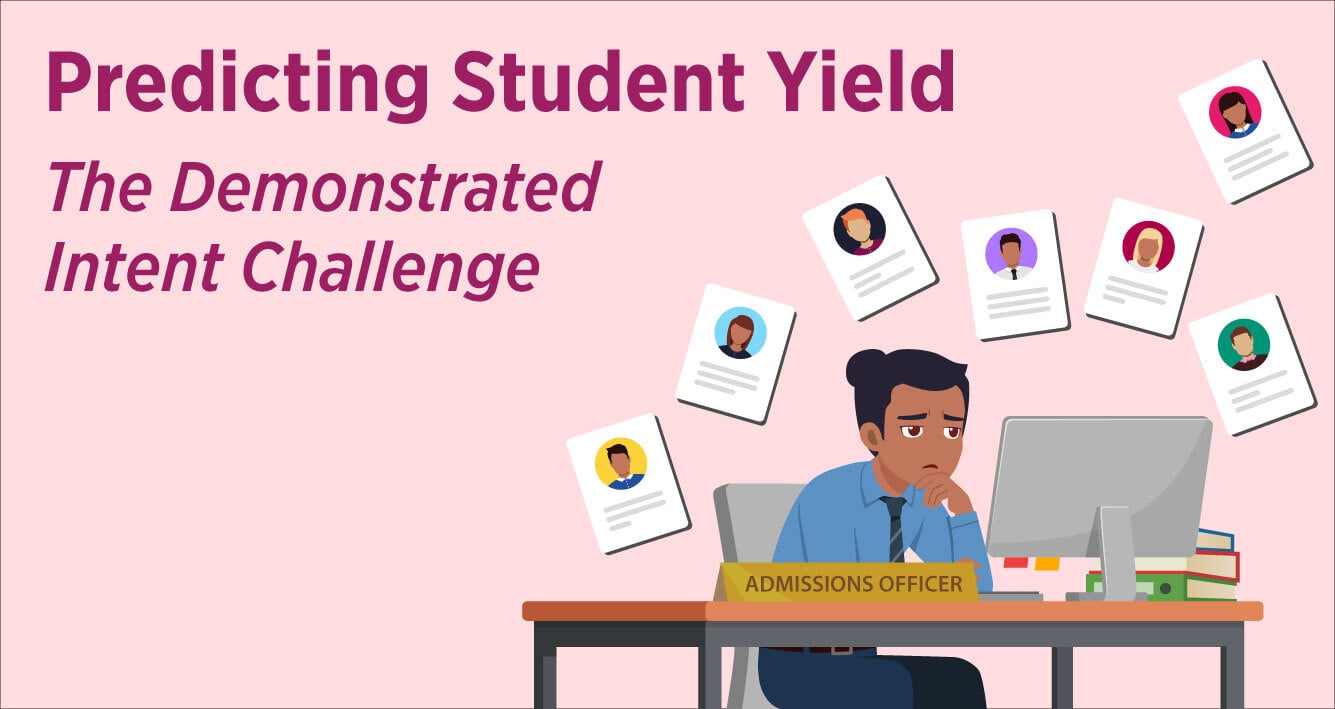
Predicting Student Yield: The Demonstrated Intent Challenge

Unlike most of his peers, my son (it’s Carrie talking here) applied to just two higher ed institutions. He got into both. Accepted both. Put down a deposit on both. Will attend just one. And so, he’s part of the admissions problem.  

Our colleague (and contributor to today’s post) Jon Boeckenstedt, retiring vice provost of enrollment management at Oregon State University, explains it like this: A lot of people think yield is like planting saplings in greenhouses, where your success is highly dependent on things you control, like spacing, soil quality, temperature, water, etc. In fact, yield is more like scattering seeds, where you are hopeful, and you have some ideas of success based on prior years, but in reality, you're at the mercy of factors you have zero control over.  

As an example: Last year, UCLA received 146,276 applications. About 13,114 students or 9% were admitted. For comparison, just 4 years earlier, in 2020, the university had an acceptance rate of 18%. And a decade+ ago in 2010, it was 23%. Go back further to 2000, it was 29%. And wait for it, in 1990, it was just above 40%. A lot has changed in a 30+ years. 

Year 

UCLA Acceptance Rate 

1990 40+%
2000 29%
2010 23%
2020 18%
2024 9%


UCLA is not unique in this way.  


Meet Intead! 

  • Find us at NACUBO in DC in July, and NACAC in Columbus in September. Be in touch to share a cup of coffee in person.

Bookmark this: Intead’s Resource Center 
Access 800+ articles, slides decks, reports with relevant content on any topic important to enrollment management and student recruiting.  Check it out.


Applications have skyrocketed for most institutions. For top-tier universities, this surge makes them even more selective (or rejective) — great for prestige and ranking supposedly, tough for admissions teams and applicants alike. For the majority of institutions, however, the steep rise in applications is just that, a steep rise in applications. Yield is on a different trajectory, and it’s driven by a simple concept: Algebra.  

The rise in applications has dramatically outpaced the increase in college-bound students, and of course, a student can only enroll in one institution, whether they are admitted to two or twenty. This then leads to a big increase in the volume of ibuprofen intake by admissions teams, as predicting the behavior of students is getting harder all the time. While institution leaders continue to demand enrollment results.

Thank goodness for the consistent ibuprofen supply.

We can point to the Common App as the bane of the admissions process. But that’s not really fair. Its advent brought more students into the system, increasing access overall. So, there’s the good. And not every university seeing the surge uses the Common App, and the University of California system is among those that do not.  

The real drivers of the application tsunami: access, competition, and coaching from influencers like school counselors and advisors. There are pros and cons to this situation. Ironically, the unpredictable nature of admissions decisions causes stress, which causes students to hedge their bets and apply to more colleges, which makes the admissions process less predictable. 

For context: 

  • In 2000, the typical applicant applied to three to five institutions.  
  • Today, the average student applies to eight to 12+, simply because they can.  
  • In 1998, when Common App went digital, ~250,000 applications were submitted through it.  
  • In 2024, that number hit 7.3 million – a 2,820% increase. (Yes, they have many more institutions as clients today, but still!)
The problem, of course, isn’t just the mountain of applications (besides, new AI tools are now helping with that to some degree). The problem is predicting yield to land just the right number of students who can bring just the right amount of revenue (and did we mention housing capacity?).   

Read on… 

Read More

5 Lead Nurturing Best Practices for Universities and High Schools

For enrollment management professionals, the next few months are all about watching the applications come in and then pouring everything into nurturing them toward enrollment.

In an ideal world you would personally guide each lead from application to enrollment, but that’s just not feasible for most academic institutions. Instead, you need a strong and efficient lead nurturing strategy to engage your prospects and boost enrollment. (You do have one, right?)

Strong lead nurturing strategies take into account each stage of prospective students’ decision process and gives them relevant information along the way.

In fact, the best strategies anticipate student questions before the student (or parent) even knows they are going to ask them. When you’ve done this work for a long time, you tend to know the general flow of the journey of most consumers.

You see how the family starts with a few obvious questions, learns a few things, and then realizes the next questions that need asking. Not unlike the way students progress in the classroom as they come to understand a subject. Learning is an iterative process of inquiry that builds on itself.

In nurturing students selecting an institution or degree program, you are looking for a meaningful alternative to the one-on-one conversations you wish you could have over the course of the admissions journey. Rather than literally holding each lead’s hand, your role is to champion a rock-solid lead nurturing strategy for your institution.

If you’ll be attending the 2022 AIEA conference in New Orleans (Feb 20-23), be in touch and we’ll find time for a coffee and an exchange of ideas.

To learn the 5 key tactics that will help your team create a lead nurturing strategy that works, read on. This post is a great primer for any recruitment team interested in strengthening enrollment yield.

Read More

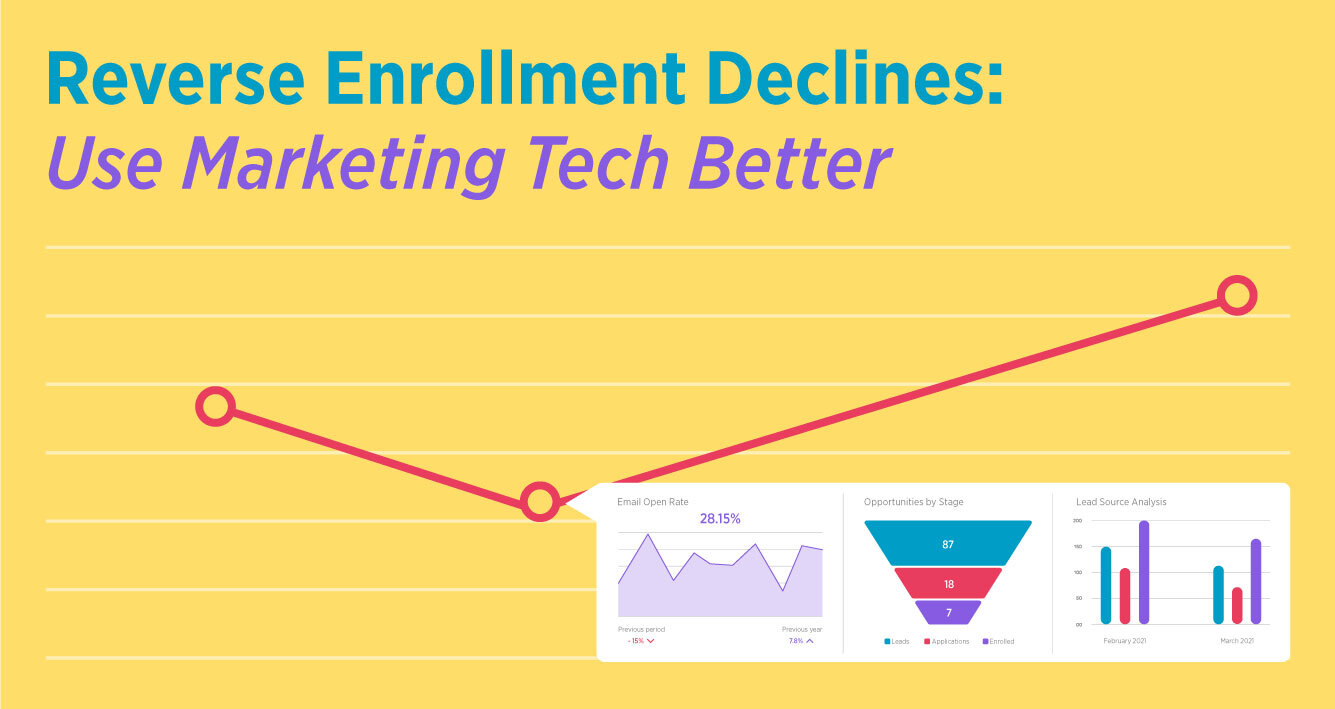
Reverse Enrollment Declines: Use Marketing Tech Better

So many dashboards. So little time.

Where is success hiding? How much investment will it take to achieve our targets?

With student mobility still in a state of flux, all bets are off for your predictive models. Or are they?

Today, we are talking to those with a CRM and marketing automation tools already in place.

Is this you? Your system works well enough and you can see some obvious gaps in functionality and interconnectedness. But you have what you have and there is no immediate opportunity to upgrade or change what you have. So…it is all about using the tools you have, better.

How do we get there? How do we know which features have real value to our operations? How can we use what we know to achieve better results?

We are heading into four wonderful days of interacting with our peers at the AIRC conference in Miami this week. The Intead team will be presenting on innovative ways to use the rising tide of influencer marketing for academia (it’s not going to be what you might think), and we will be presenting on innovative approaches to grad student marketing.

We can’t give enough thanks to our colleagues Toni Jaeger-Fine from Fordham Law School, Ita Duron from Massachusetts College of Health Sciences, and Kirsten Feddersen from Northeastern University all joining us on the dais to share our experiences and ideas. SO many ideas. Testing and confirming marketing approaches that are unique to each institution’s strengths.

Reach out if you would like to share a cup of coffee in Miami!

Read on for our two concrete recommendations for using your marketing tech better.

Read More

Email Marketing for International Recruitment: Part II

This week, we are picking up part two of our discussion on email marketing for international student recruitment. If you haven’t done so already, you can read part one here.

There is so much discussion around whether email is ‘dying’ and whether it is even a viable channel for student recruitment marketing. Our answer is an unwavering yes - until something else supplants it. But that hasn't actually happened yet, despite the yammering. It's all about where and how you use this channel to influence the student decision-making. A strategic approach is important and knowing when and where to use email is essential. 

What we know: don't use email marketing lists as your first touch.

An important reminder: We'll be presenting about all this stuff at the NAFSA conference in May in DC along side Hillary Dostal from Northeastern University. Check out the link below to our session and hit the like and favorite icons if you'll be joining us! You'll get an inside look at some of our latest research.

Join Intead Plus


The email marketing that we conduct and recommend is not “first touch” marketing through list purchases and email blasts, but rather, nurturing campaigns to draw existing leads down through your recruitment funnel. Once built, a carefully crafted and automated email nurturing campaign can move leads to the point of application, without placing additional burdens on your admissions team. They have enough to do, right? 

Let’s jump into how you can implement an effective student recruitment email marketing strategy.

Read More

The Power of List Segmentation Part III: So You Want More Student Applications, Right?

Audience segmentation and digital marketing, this is our third post of our three-part series. Our faithful readers dug into Part I (segmentation and parameters) and Part II (audience motivations) with relish. Today: messengers and lead scoring. Hold onto your hats, right?

This stuff is important— so while our blog series on the topic may end today, we hope you'll keep digging into the topic of audience segmentation. We're here to help. Drop us a line at info@intead.com, or connect with us in-person at the TABS Global Symposium on April 28-30 in Newport, RI.  We'd love to talk with you about how you can use segmentation to up your enrollment game.

Here's the bottom line on audience segmentation. Yes, the process can feel daunting. You have a lot to consider: Which regions do you want to reach? What motivations drive your prospective students? Which messages will be most compelling, and to whom?

There is a ton of strategy to consider and content to develop. Nevertheless, this process is how you get more applications and boost your student yield. We imagine there is some internal pressure to achieve these goals, yes?

Different markets require different approaches. Ignore this reality at your own peril. For example, many institutions simply dump all prospective “international students” into a marketing bucket called “INTERNATIONAL.” We hear it all the time (“Let us show you our ‘international’ recruitment brochure!”) and it still makes us wince.

In today's competitive market, a one-size-fits-all approach simply doesn't cut it. Take the time to segment your audience and implement a marketing plan (message, content, dissemination channel) to each group you are targeting, and success will follow.

Part of doing audience segmentation well is choosing the best messenger at the best time. And another part is having your system set up to indicate or elevate the best leads - AKA lead scoring (those most engaged) so you know where to focus your valuable time and resources.

So without further ado, let's get to it.

Read More