
Recruiting Intelligence

Credentials and Badges: Adding To or Supplanting Degrees?


They say that fifty is the new thirty, but what may be a more reliable maxim is that college is the new high school. It has been true for a while that undergraduate degrees are becoming the minimum standard for employment, as opposed to a high school diploma—a fact that has led to a great uptick in college graduates working for minimum wage.

The trend has continued upward with most incoming college freshmen expecting to earn a master’s degree after graduation. Master’s degrees are now as common as bachelor’s degrees were for most of our parents’ generations. In the U.S., more than 8 percent of the population has one, which is a remarkable 43 percent increase from where that number was in just 2002.

With so many well-educated job seekers, what is setting some graduates apart? Credentials.

Read on for our take on what is driving this trend and some perspective on how dangerous your institution's sluggish pace of establishing new degree and credential options could be.

Read More

EdTech: Coursera’s Role in the 4th Industrial Revolution

Move over, American Inventor Eli Whitney, we’ve come a long way since the cotton gin. We are in the midst of the booming Fourth Industrial Revolution.

Just in case it has been a while since you’ve been in a history classroom, here’s a tiny refresher:

  • First Industrial Revolution—mechanization
  • Second Industrial Revolution—mass production
  • Third Industrial Revolution—automation
  • Fourth Industrial Revolution—cyber systems and networks

If you need to brush up on your history, there’s a course for that on Coursera—the newest EdTech unicorn in the revolution.

Valuable Side Note: boosting conversion rates & measuring communications effectiveness. Our NAFSA session is coming up and we'll be discussing how to improve your digital connections with international prospects. Intead and NEU offer up best practices. Check it out our fun 49 second promo...

Join Intead Plus


But why is Coursera such a big deal in this modern revolution? Read on...

Read More

Motivations of the Highly Motivated: Marketing to International Graduate Students

Did you know that in the United States, first time graduate enrollment grew by 3.5% between fall 2013 and fall 2014? The Council of Graduate Schools’ (CGS) report Graduate Enrollment and Degrees: 2004 to 2014 provides tons of information on graduate study trends. According to the report, “from 2004 to 2014, international students accounted for over two-thirds of the growth in first-time enrollment headcounts at U.S. graduate institutions.” And that first time enrollment figure is 11.2%. So lots of new international students and the vast majority of them at the grad level. Good news for international recruiters, right? We think so!  

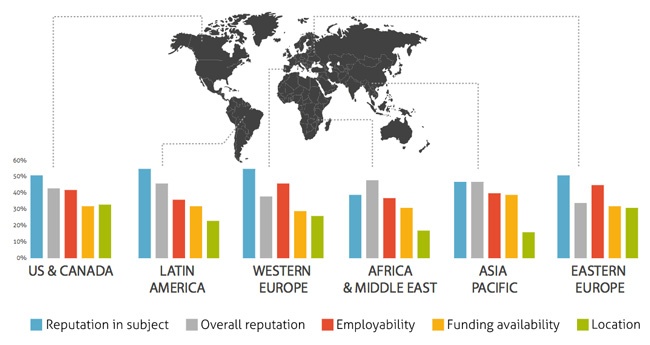
Bottom Line: Graduate students are an important segment of international students to target with your digital marketing and their needs are different than their younger counterparts. Their motivations to study, the programs of interest and the influences for them to choose one program over another all vary. Mostly, they want to know they will get a job with a degree from your program. Similar to undergrad motivations but perhaps iwth a finer point on it.

Importantly, even if your institution is lesser known, you can still market the strengths of a top-tier program to these highly motivated students. They pay attention to that kind of thing within their area of interest. If your marketing efforts to international graduate students are limited in time and budget (whose aren't?), you would do well to focus on these two things: your career outcomes and your highly acclaimed departments and professors. Make sure you are capturing your target audience's attention with messaging they’ll react to.

NAFSA is right around the corner! We will be co-presenting new research with FPPEDUMedia on how current global, economic and political events are impacting students’ plans to study abroad. So, while you are building your schedule for the conference, pencil us in for Wednesday, June 1 at 10AM and schedule a time to chat with us! Actually, use a pen, you really won’t want to miss this one. Trust us!

Read More

International Student Employability: How Do US Universities Stack Up?


It’s that time of year again—graduation! But amidst the accomplishments and excitement there is one thing weighing heavily on your students’ minds: what happens next!?

They have put in the time and effort, secured their degree and are now looking for the next step: a job. But just because graduation only happens once a year, doesn’t mean that’s the only time you should be thinking about your university’s employability data.

Bottom Line: While your website, social media pages, brochures and emails surely highlight all of the best things about your location, campus, programs, professors and activities, are you factoring in your employability data? Students (and their families) are really looking for that bit of security.

So, how exactly does the U.S. stack up in terms of placing students in jobs post-grad? Turns out, pretty well. The U.S. is the most desirable destination for international students. Its’ universities are dominating employability rankings and it has a comparatively low youth unemployment rate. This is the kind of data that can benefit your marketing efforts, whether or not your school is highlighted in the data.

Side Note: Are you going to the NAFSA Conference in Denver? We will be co-presenting with FPPEDUMedia and sharing our latest research on how current global, economic and political events are impacting students’ plans to study abroad—you don’t want to miss this! Set up a time to chat with us while you’re there, we’d love to meet you in person.

Please read on. Emily will share our perspective on employability data and international student recruitment...

Read More