Five years from now what will you be glad you did right now, this year?
IIE here in the US and other prognosticators across the pond who track student mobility have predicted the number of international students in the US and around the world could double by 2030. Some projections suggest upwards of 10M or more globally. We’re not placing any bets on that figure. However…
We’re optimistic about international student numbers and the opportunities ahead in higher education. We’re not banking on 10M+ in the next few years. That’s a bit of a stretch by our measure. But continued growth will come and the question is whether your institution is psychologically capable of weathering the storms and building for the future, or bureaucratically paralyzed and unable to capitalize on the opportunities ahead.
Said simply: Resilient individuals and businesses adapt, leverage their strengths, and pursue opportunities to grow.
Pro Tip: Your academic leadership will value reading this post. (Share button below)
What you do in the coming year will set the stage for the benefits you reap five years from now. Sit on your hands due to fear of the ambiguity that surrounds us, and all those who are acting now will be miles in front of you in 2030. Miles.
Below we offer three specific areas where we think smart institutions and academic leaders will focus their attention in the years ahead to capitalize on future growth opportunities. How many of the three do you think you can help your institution address?
Some context: Back in the day, our industry’s powerhouse forecasters were looking at the global growth of students seeking a foreign education from 2010 through 2016 and said with absolute confidence that there would be 8M+ international students globally by 2020. Maybe you were sitting with me in those conference presentations? Had trends continued on pace, that would have been true. Emphasis on “had trends continued on pace.”
Instead, global factors combined with the US Muslim ban (Trump 1.0) were followed by a global pandemic (COVID 19). Those student numbers (8M+) have yet to pan out. But significant growth has happened - just 20% shy of the projection by 2020. (UNESCO reports 6.4M students globally studying in a country other than their own that year and we are at about 7M today.) Trend predictions are complicated by so many factors. Some might say predictions are truly unpredictable ; -)
Opportunities to Meet the Intead Team
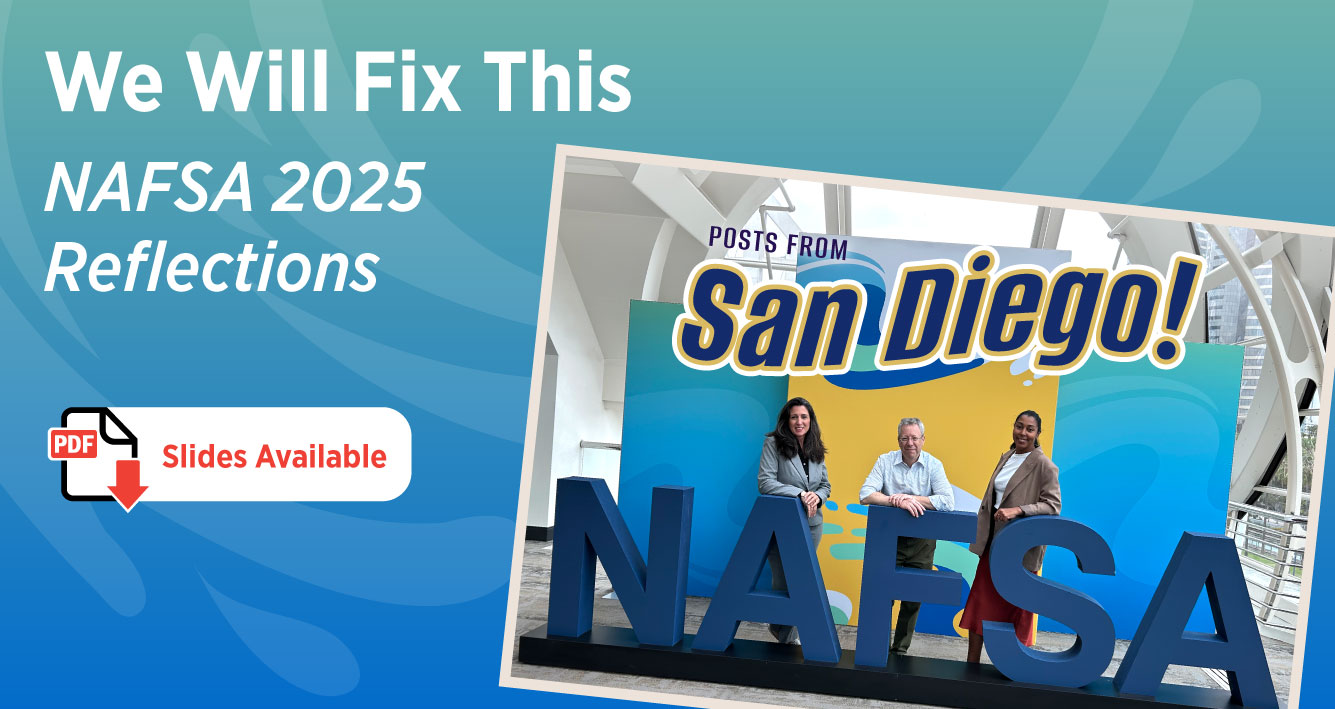
- Look for us at ASU+GSV next week, and NAFSA in May. Let us know if you want to connect at these events.
Bookmark this: Intead’s Resource Center
Access 800+ articles, slides decks, reports with relevant content on any topic important to enrollment management and student recruiting. Check it out.
Here's the thing: there are some human behaviors and economic factors that we feel very confident about. And that helps us understand the world and get a strong sense of what is likely coming our way in the years ahead.
Reality: The US is now grappling with Trump 2.0, which is full of bluster and chaos-inducing pronouncements equivalent to watching an over-the-top World Wrestling Federation pre-fight drama. It’s all designed to draw attention and ramp up excitement for a spectacle. Often, there’s no substance to the bluster, though it consistently delivers pain.
This drama coming from the US White House makes predictions all the more challenging. You need to push past all the obfuscating dry ice smoke machine billows to get at baseline reality.
So yes, despite the chaos surrounding US policies and politics and how that will play out around the world, we have reason to believe international student numbers will rise over time similar to our confidence that the stock market will rise over time. We can’t tell you if the market will be up or down tomorrow or next year, but longitudinally, stocks have gone up since the market’s founding, and international student mobility has gone up as international travel has become more accessible.
Consider this: In 1970, there were 310M airline passengers globally according to the World Bank. In 2024 the figure was 5.2B according to the International Air Transport Association. That’s an indicator of accessibility. Important to note, those figures include domestic and international flyers.
Our belief in future growth of international student mobility primarily comes down to basic consumer (student) behavior trends, like increased usage of international flights (accessibility).
Making the Accessible Visible
Hailing from Hyderabad, Satya Nadella, current CEO and Chairman of Microsoft, earned his engineering master's degree at the University of Wisconsin-Milwaukee in 1990 and his MBA from the University of Chicago’s Booth School of Business in 1997. On the minds of nearly every Indian engineering student today: “If he could do it, so can I.” A lure as strong as it is old.
With the rise of social media since 2010, success stories have proliferated in ways the world has never seen before. Basic human behavior: communicating success builds desire among others (word of mouth referrals drive sales).
Among all those who have not risen to the top of Microsoft, there are millions of former international students who have carved out careers and influential positions, inspiring and encouraging future generations to follow in their footsteps. And hear us when we tell you that your prospective international students are looking for the proven path forward. Without overpromising, your institution needs to tell that story and build confidence in that future.
A graduate student from India attending a private New England university recently told our staff how searching for (and making real connections with) alumni and current students on LinkedIn is what landed her on campus in the US. In her words, she appreciated but generally bypassed the university’s marketing and contacted other international students who had been there, done that. Their stories convinced her to enroll in the institution. Case in point: basic human behavior tied to the advent of internet communication.
What we know: A student who graduated just a few years ago and is now a manager at a major company is immediately relatable to prospective applicants (much more tangible to them than their aspirations to run Microsoft someday). These conversations make the journey feel more attainable.
So, when international alumni share their experiences—whether through personal networks, mentorship, or social media—they reinforce the appeal of studying in the US (or any other country that contributed to their success).
Considering how well your institution leverages its international alumni? Find customized perspective here.
While we believe word-of-mouth marketing will play a role in future international student enrollment growth, there are other factors working in our industry’s favor – namely how institutions are poised to react to the changing market and the pace at which these changes are implemented on your campus. You may be surprised to learn our take on the opportunities ahead. Read on…
Read More