Recruiting Intelligence

Are Saudi Students Key to Your Recruitment Goals?

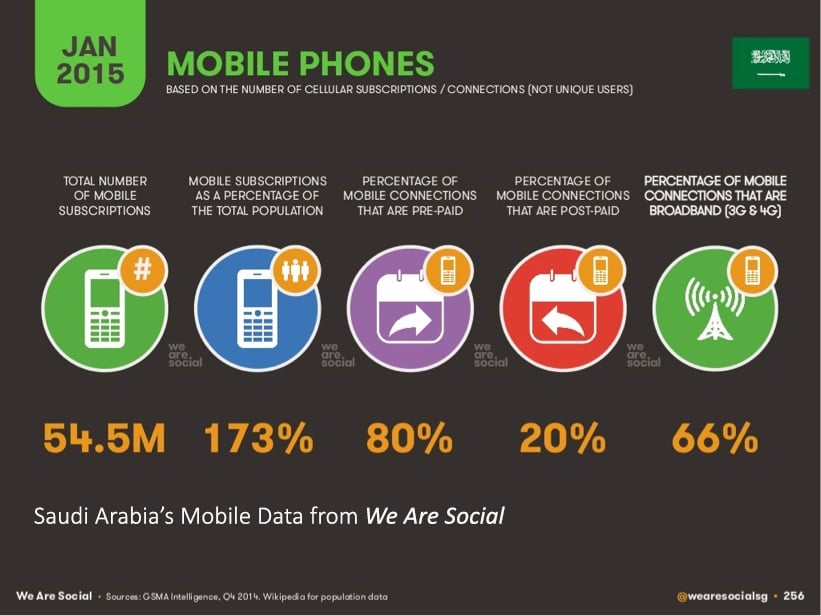
How many mobile devices do you have? You got your cell phone, your tablet… Turns out in Saudi Arabia, a heck of a lot of people have more than one mobile device, too. We Are Social reports that the number of mobile subscriptions as a percent of total population = 173%.

Yes, More mobile subscriptions than there are people! So, we’ll ask you again, as we have in so many of our posts, is your international student recruitment content mobile friendly?

Let’s get to the point of this post: Saudi student recruitment. In the last few years, students from Saudi Arabia have certainly left their mark on international higher education. With the growth of government sponsored scholarship programs, such as the King Abdullah Foreign Scholarship Program (KASP), the number of students from Saudi Arabia studying in the U.S. for the 2014/2015 school year jumped to just about 60,000. That's an 11.2% increase from the previous year, according to the International Institute of Education (IIE). With numbers like these, you should be paying close attention to this market.

And most of you are. Paying attention that is. In our conversations with our colleagues at many institutions, we hear concern. A strong reliance on Saudi Arabian students to help meet recruitment targets might be leaving institutions vulnerable. Not unlike the reliance many schools have on Chinese or Korean students. When the political or economic winds blow, it affects a significant swath of your international student population.

You are not alone in this vulnerability. So we asked Emily, our international blogger, to dig into the international student recruitment scene in the land of Saud and let us know where and how to focus our recruitment efforts. As usual, she did a great job and found some really interesting research.

BOTTOM LINE: Potential changes being enforced by the Saudi Arabian Cultural Mission (SACM), are affecting how many Saudi students are studying abroad and the funding available. However, many Saudi students are able to pay their way, independently. When recruiting in this particular market, it will be essential to brush up on your Saudi cultural knowledge and reach out to prospective students online. Mobile phone apps, YouTube content and targeted landing pages will put you ahead of the competition and help you meet your recruitment goals. There's a lot of information in this post, read on...

Read More


Happy Holidays!

Happy holidays to all of our blog readers!

If you are wondering how that might go in the Volta Region of Ghana where many speak Éwé, you are in luck. As a small display of how interactive stuff can be fun and shareable, please enjoy Intead’s WHEEL OF HOLIDAY FORTUNE.  

And spread the holiday greetings around .

Click the IMAGE  to play. 👉 New Call-to-action

Read More

Puzzling Together Recruitment in Colombia: Part I

As we puzzle together a picture of Latin America, we are fitting Colombia into the mix. In part I of this two-part series, we will take a look at the economy and recent student mobility statistics for Colombian international students. Next week, Part II will focus on English as a second language among other critical recruiting data points.

Now, if you’ve found yourself confused by shifts in recruiting students from Colombia, you aren’t the only one. Large swings in the number of students recruited from Colombia have been common over the last 20 years.

The CIA World Factbook lists the population at about 47 million with more than 17% of the population between the ages of 15 and 24. The growth rate of the middle class is also something to consider. A report from The World Bank in 2012 shows that the middle class had grown by 50% in a decade. These same reports believed that this expansion would be sustainable. With more Colombians able to afford higher education, Colombia became the third largest Latin American source of international students. 

However, economic clouds are beginning to form. In August of this year, Colombia Reports showed the peso hitting record lows against the dollar. The peso is closely tied to oil prices and with oil losing almost a third of its value the Colombian economy has suffered.

Bottom Line: While the number of Colombian international students had been growing because of newfound economic security, they may be harder to rope in now due to the current economic climate. Lack of funds, as well as recent lack of resources to learn English in Colombia, are hampering student mobility. Still, language programs in the country are increasing (more on that next week). With the right academic offerings, there is recruiting potential in this large South American country. Scholarships and messages about overall affordability will go a long way as a recruiting draw. Career opportunities will also be powerful messages.

Our intrepid international blogger, Emily, will now wake us up and help us smell the coffee.

Read More

International Student Recruitment in Cuba

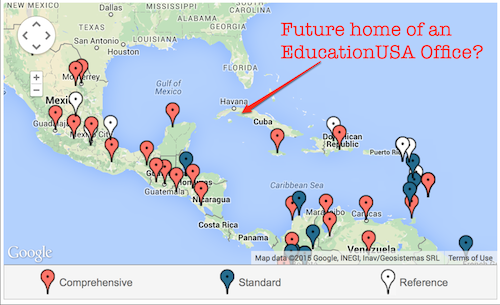
President Barack Obama’s announcement at the end of 2014 that the US would be restoring diplomatic relations with Cuba opened the floodgates for articles and newscasts about what this will mean for US businesses. There are a range of businesses elbowing to enter the Cuban market, but what does this mean for the higher education sector? What will this mean for study abroad programs in Cuba, language schools that see possibility in opening in Cuba, and, in particular, what will renewed diplomatic ties with Cuba mean for Cuban students who seek to attend institutions abroad?

Read More