Recruiting Intelligence

Why We Travel: Making the Most of Student Recruitment Trips


Danger zone of travel: the misperception among your colleagues that your global trip is just another boondoggle.  

It’s a common experience for international student recruitment teams. Jet-setting itineraries make it hard for some travel-hungry colleagues to see your grueling business trip as anything other than a junket. But a junket it is not.  Below we share an 8-point guide to the "why of international travel".

We know images of far-off places seem “luxurious” to those not on your team, which is why so many of you no longer post those photos from your trips on social media. Never mind the 3am (local time) touchdown in Delhi that led to your 7am scramble to the student fair starting in 2 hours where you spent the next 8 hours repeating the same conversation with 122 different students until it was time to cap off the day with a working dinner with your in-country agent. A day lounging at the beach, right?


Our next opportunity to meet! 
NAFSA Region XI, Hartford, CT, Oct 27-29. The Intead team will be there presenting on Admission Process Analysis, Marketing Data Analytics, and Marketing Study Abroad Programs with university partners from our New England region friends from Quinnipiac, Johnson and Wales, Clark, and Emerson. Practical strategies and creative tactics to hit your enrollment targets.  Hope to see you there! 

The Resource Center for Industry Insiders 
Take your challenge of the day and plop it into our search bar. With 800+ publications and our 15 years of weekly blogging, you will find relevant content on any topic important to enrollment management and student recruiting. Check it out.


Here’s the truth. We talk a lot about armchair recruiting and the undeniable advantages of digital marketing around the world. And we stand by that. But for institutions that can afford to, purposeful travel absolutely builds your recruitment strategy in robust ways. We know you agree. But does your provost? 

This week, from-the-field insights on recruitment travel from recent conversations with our SIO colleagues David Di Maria, Ed.D., senior international officer and associate vice provost for international education at UMBC, and Jill Blondin, Ph.D., associate vice provost for global initiatives at Virginia Commonwealth University. Plus, the key conversations that will help you make the most of the travel you do have budgeted. Because you never want to waste a good trip. Read on…  

Read More
Career Success for US-Educated International Students?


Career opportunity is the primary motivating factor for international students. All our research into the international student journey says so. We’ve known this for a long time. If you can demonstrate that your degrees pave a beaten path to positive career outcomes, then you’ve got your prospect’s ear. Not many institutions can back up their promises with data...until now. 

Institutions seem to have had a hard time making the case for bottom line ROI. Sure, there’s the usual “x% employed within 6 months” data every institution flaunts, but what does that really tell a student who’s halfway around the world? Not a whole lot. We’re not saying to nix that stat – definitely keep it – but it’s hardly concrete proof for your prospective students. 

The fact is most institutions simply don’t have the student data on the whole job search process to offer much more. Especially for international students graduating from your specific institution. 

Nor do most institutions have the bandwidth to think it through for the international cohort. But data does exist that can help you uncover a truer and fuller picture of career potential for your international students. It’s a matter of knowing where to look, how to look, how to clean and crunch the data, and then interpret that data appropriately.  

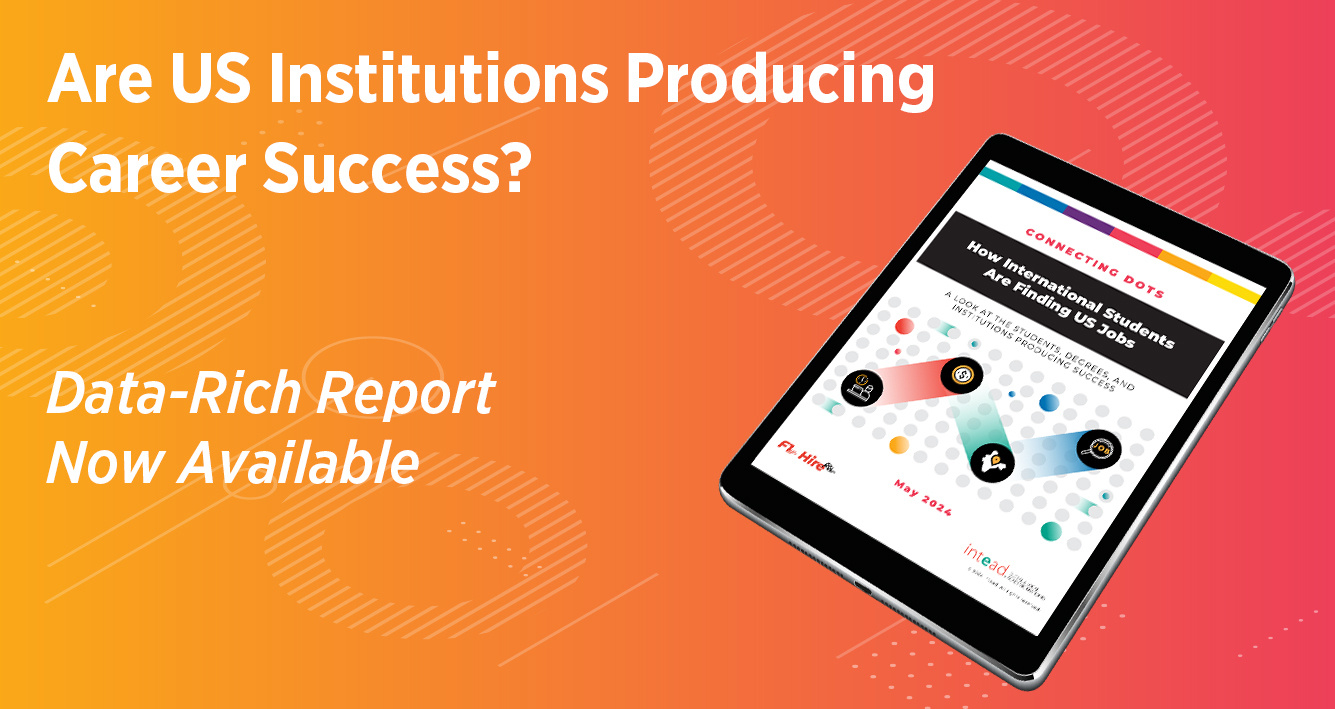
Enter Intead’s analytics team and our colleagues at F1 Hire! On offer to you for download: our first Connecting Dots study, How International Students are Finding US Jobs: A Look at the Students, Degrees, and Institutions Producing Success


Our next opportunities to meet! 

GMAC Annual Conference, New Orleans, June 19 – 21, 2024. Ben will be presenting on how global elections are influencing student mobility. More than just the US presidential election has the power to upend what students will choose to do next.  

EducationUSA, Washington, D.C., July 30-August 1. Ben and Viginia Commonwealth University SIO Jill Blondin will share insights on Navigating Budget Challenges in International Recruitment: Practical Strategies for Every Phase.  

Be in touch! We’ll buy the coffee. 


Our newest dataset focuses on practical next steps for international graduates. The ROI insight they’re really after. And for institutions, our approach to analyzing US Department of Labor data can help your marketing recruitment team stand out at any student fair anywhere in the world. Wanna see how? Read on to download our report... 

Read More

Groundbreaking Data: International Student Employment After Graduation


The NAFSA room was sold out; every seat taken.  

That morning we really weren’t sure what to expect with our session being held in the very furthest room on the 3rd floor of the New Orleans Convention Center. And that convention center is one of the largest we’ve ever seen. Like, you need an Uber to get from one end to the other. 

We could not have been more thrilled with the turn out. What everyone came for: new data, never before collected, on what international students are doing after they earn a US degree. 

What’s been missing from our community’s conversation on the value of US degrees for international students is real ROI. Sure, we talk about ROI: “94% of our students are employed or pursuing advanced degrees 6 months from graduation.” But we’ve never quantified actual ROI...until now.  

Today we’re sharing a preview of new research on the career progress of international students who graduated from US institutions. (The full report will publish later this summer. Be among the first to receive this and 2 other groundbreaking reports by pre-registering. You’ll also get our NAFSA 2024 session slides.)  

This NAFSA research report will be the first of what will become an even deeper analysis based on more research between now and 2025. We want to truly understand what a US degree produces for international students. Is it worth their investment? Is it worth ours? This is data we’ve been wanting to mine for years.   


Our next opportunities to meet! 

GMAC Annual Conference, New Orleans, June 19 – 21, 2024. Ben will be presenting on how global elections are influencing student mobility. More than just the US presidential election has the power to upend what students will choose to do next.  

EducationUSA, Washington, D.C., July 30-August 1. Ben and Viginia Commonwealth University SIO Jill Blondin will share insights on Navigating Budget Challenges in International Recruitment: Practical Strategies for Every Phase.  

Be in touch! We’ll buy the coffee. 


I was extremely honored to have presented our latest research at NAFSA last week alongside Dr. Joanna Regulska, vice provost and dean of global affairs at UC Davis. UC Davis is one of the 12 innovative and forward-thinking institutions participating in this groundbreaking study. 

Our research involved a 22-question survey sent to international students who graduated from our 12 university partners between 2019 and 2023 (see below for the full list). With a 5.3% response rate, 1,797 graduates from 131 countries answered our survey questions. Of these, 1,323 still reside in the US, 474 live elsewhere. 

What we learned will have a direct impact on international student recruitment, as well as offer perspective on US immigration policy. Data informs how we make sense of the world and move forward as a community and a society. The data collected encourages us to understand the value of CPT/OPT to our international students and the US.  

Laid bare: the real outcomes and the positive impact international student graduates are having on the US economy.  

For those of you interested in taking part in our next survey, be in touch at info@intead.com. So many of our higher ed colleagues at the conference raised their hands to evaluate participating in the next research phase of this project. Be a part of that! 

Below we share key takeaways from our research and provide you quick access to the slides from our NAFSA presentation. Read on... 


Read More

It’s Time to Rethink Your ROI - New ‘Late Bloomers’ Insight


Have we been selling ourselves short? A recent working paper by the National Bureau of Economic Research has got us thinking, "Yeah, maybe." 

The not so fine print in “Late Bloomers: The Aggregate Implications of Getting Education Later in Life” is this: the age at which you get your degree matters. The economists found that the younger you are when you get degreed, the stronger your financial return on the investment from that degree. As a result, it may be time to take a closer look at how you present your institution’s ROI.  


Events you won’t want to miss:

Let’s talk international student enrollment at the upcoming AIRC Spring Symposium on April 30 . In-person learning will cover developing, managing, assessing, and sustaining international enrollment focused partnerships. Intead will be presenting on student recruitment marketing budgets – we've got some great new insights to share. Register  today!

And look for us at these other industry events coming around the bend:

  • ICEF North America in Niagara, Canada, May 1-3, 2024
  • NAFSA 2024 Annual Conference and Expo in New Orleans, May 28-31, 2024
  • GMAC 2024 Annual Conference in New Orleans, June 19-21, 2024

The Late Bloomers paper (link below), which looks at university grads beginning with the US 1930 birth cohort onward, also reveals that around 20% of students obtain their 4-year degree after age 30, hence the late bloomer label. A not so insignificant figure, with more than a few not so insignificant implications.  

Sure, the popular notion that university grads are early 20-somethings remains true enough, but the 1-in-5-student stat reveals this belief is not the whole truth – and never was. Turns out the non-traditional student market is significant (you’ve read our series on the non-traditional student advantage, yes?).  

Significant and new with this paper: the understanding that late bloomers’ ROI may not be as strong as once thought. On the flip side, the new data analysis means the ROI for younger grads is even stronger than we believed. Interesting, and worth promoting.  

Other notable findings from the paper: Late bloomers have helped narrow the gender and racial gaps in university enrollment, even despite a widening racial gap among the early university grad set. And, late bloomers account for more than half of the growth in the share of university-educated adults from 1960 to 2019.  

There’s a lot to unpack here, including why we think you may be selling yourself short based on these fresh insights. Read on…we’ll keep it actionable. 

Read More

Calculating Return On Investment

There is so much happening here at Intead this week! We are so excited to share it with you.

First, we are dedicating this week’s blog post to our team member Jen Thayer, (you may know her as the long time manager of this blog), who will be moving on to pursue a new career opportunity at Tufts Health Plan this week. We are so proud of everything Jen has contributed to the growth of this company. She is a very dear colleague and friend, and we know that she will continue to share her positive energy and enthusiasm with the world. Best of luck Jen – we are all cheering you on! 

Next, we are excited to be presenting a webinar: “A Game of Finders Keepers: Finding and keeping the good agents” in partnership with AIRC and Angel Ahmed of GNET-Global Network, Inc. this afternoon, Wednesday September 27th at 1:00 p.m. EST. 

We all know that finding a good international recruitment agent has its challenges, and maintaining the partner relationship isn’t any easier! How do you do it well when faced with different time zones, language barriers, and the need to stand out among the other schools in an agency’s portfolio? We will address these questions and more! Click here to register.

And finally, this week we are considering return on investment in the international recruitment process – how well are you able to track ROI? Good data helps you improve your recruitment, it helps you prove to your campus leadership that your recruitment efforts are worth it, and it shows you where you can improve. 

Finding the right formula for your university can help you answer questions about where you should be focusing your recruiting budget, and where you should be backing away. Read on to see where your institution can make key improvements in measuring ROI…

Read More