
Recruiting Intelligence

The US is Having A New Coke Moment

In 1985, Coca-Cola’s leadership concluded the soft drink needed to change. Sales of nemesis Pepsi were on the rise and thousands of blind taste tests suggested consumers preferred something sweeter. Their answer: New Coke.

So, on April 23 of that year, they unveiled an “improved” formula, giving consumers a new taste, new logo, and a massive new product rollout. Welcome to New Coke. You can imagine the financial investment made.

Almost immediately, consumers revolted. Recorded consumer sentiment:

“Changing Coke is like breaking the American dream, like not selling hot dogs at a ball game.”

“My dearest Coke: You have betrayed me.”

“Millions of dollars worth of advertising cannot overcome years of conditioning. Or in my case, generations. The old Coke is in the blood.”


MEET US AT AIEA 2026!

We'll be presenting:

  • Resilient IEM: A History Lesson for Managing Current Chaos
  • AI: Your Old SEO Approach No Longer Cuts It

Or, be in touch to grab a cup of coffee. We'd love to connect!


That’s just a taste (so to speak) of the feedback Coke received. The company had wanted to re-energize the brand. They clearly energized something!

The company fielded up to 8,000 calls a day from dissatisfied customers and received over 40,000 complaint letters. Imagine if social media had existed then. Sales volume plummeted sending rival Pepsi sales through the roof. In today's dollars, this was roughly a $100M mistake.

Clearly, Coca-Cola got the message. A quick 79 days after New Coke’s launch, the original formula was back in market, rebranded as Coca-Cola Classic. Sales soared beyond previous highs. Consumers didn’t just return; they came back with enthusiasm and loyalty. Within a year, Coca-Cola was outperforming Pepsi more decisively than before. The Coca-Cola brand had emerged stronger than ever.

Why bring this up now?

Because the US is experiencing a New Coke moment all its own. You feel it, too, right?

Read on… 

Read More

From Stasis to Strategy: Enrollment Teams, It’s Time to Act

Churn happens in every setting. Promotions, departures, budget realignment, team and department consolidation.

Disruptive, yes, but hardly unprecedented – a common cycle typically prompted by fiscal changes and then the disruptions ripple out from there. 

And yet, change rarely feels routine. Especially at the scale we are experiencing right now.

Still, your programs need promotion, your Deans have their own priorities, and everyone knows that your important leadership chair is about to turn over (you know the one, right?).

What is an enrollment team to do? Do you launch a new marketing campaign now, or wait? What if today’s A, B, and C priorities become tomorrow’s D, E, and F because the new leader coming in 4 or 5 months will have their own ideas.

And what happens in the meantime as you try to sort it all out? Stasis.  

So often, teams sit on their hard-won budgets, waiting for stability and clarity. An approach, for sure, but not a good one. Doing nothing isn’t leadership (too blunt?) – and doing nothing will do nothing to advance your yield or deliver your next class.

We all know there are legitimate excuses for not hitting your numbers. Yet we see this stasis mode all the time. And yet...

What your enrollment team needs in times of ambiguity: smart bets and clarity. 


Going to AIRC in Atlanta? Let’s connect! 

Join us Dec. 3, 2025, 1 – 4 p.m., for our workshop, Exploring Third-Party Business Models for International Student Recruitment, or any one of our other conference sessions. You are registered, right? 🙂

Or, meet us at:AIEA in DC in February and ASU+GSV in San Diego in April.


How you get to clarity and forward motion: concrete data to identify the opportunities and cut through uncertainty. And importantly, you need stong presentations to build internal support for your plans. 

In this time of seemingly never-ending uncertainty, institutions need leaders who act. Read on for our views on what proactive enrollment leadership looks like… 

Read More

Budgeting Framework for Student Enrollment Projects (and More)


Are you in a position to approve funding requests from others? Or are you the one asking for funds? We have some perspective that can help you either way.

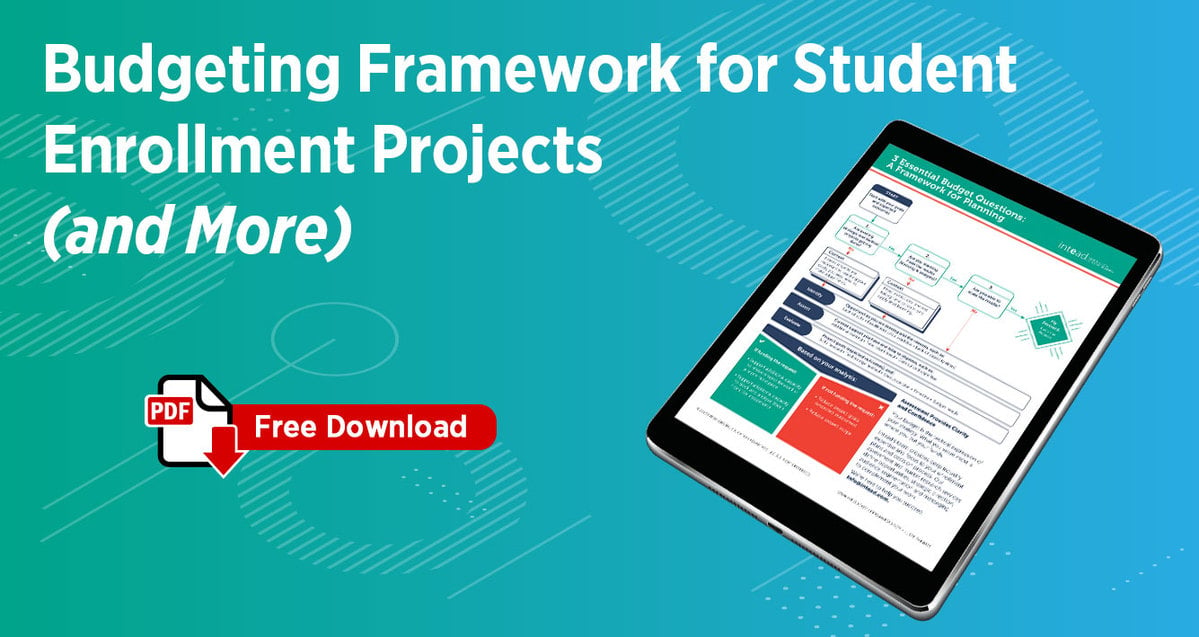
Today, we are offering up a framework for evaluating budget requests based on your ability to achieve defined goals. Just in time for budget season. It's a quick one-pager.

Here's the thing: your budget is more than the sum of its line items - an idea that’s not lost on you. After all, numbers tell stories. Like the dollars that allowed your team to meet international students at the airport. Or, ensured your first-years first connected at your well-planned international student orientation. Or, that scholarship fund that changed yield results. Real stories. Important stories. Made possible, in part, by funds allocated through strategic planning with scarce financial resources. 

Because, where you allocate funds represents what you find most important. In other words: your budget is an expression of your values.

The budgeting framework we offer up today is there to help you conceptualize your budget requests with your goals clearly in mind. Your student-first goals.

Ensuring your budget holds space for these stories, these values, is so important. Because everything from your institution’s mission down to the smallest line item on your Excel spreadsheet should come back to supporting students. All this assumes you have the data that backs up those stories. We are not talking about one-offs and lovely but lonely anecdotes. 

Recently we caught up with our good friend and colleague Dr. Jill Blondin, Associate Vice Provost for Global Initiatives at Virginia Commonwealth University, who by the way was recently named SIO of the Year by IIE (Go Jill!). You may know Jill through the strategic budgeting workshop she runs along with Western Michigan University’s Dr. Paulo Zagalo-Melo, Associate Provost, and Annette Cummins, Assistant Director Global Education and Business Manager. Good news there: Jill and Paulo will be hosting a 2.0 version of their budgeting workshop all about revenue-generating strategies later this year. Watch for updates!  

The perspective Jill offered makes so much sense: “Align your budget with your strategy. Not the other way around.”  

Sage advice because as we all know too well, losing sight of our real goals is all too easy once we get deep into the budgeting weeds. We see numbers and things get tactical fast.  

This is especially true when the dollars we get aren’t the dollars we need. Or think we need. The truth is by keeping our eyes trained on creating a truly student-first experience, international recruitment and student services teams can often accomplish way more than we may at first realize when budget numbers fall flat.  

As Jill said to us, “The international office should not be the alpha and the omega of an international student’s experience.” Indeed, an international office cannot be everything to everyone. Middle ground collaboration is essential. Integrating international students into the full campus experience is the point anyway and your budget should reflect this. More on cross-campus collaboration in another post.  

For today, we offer a quick reboot of our popular “3 Essential Budget Questions: A Framework for Planning.” Use this as a guide to focus and prioritize your annual budget discussions this year.  

Our budget framework asks you to take a step back and reflect on whether your actual results are feeding your goals. This worksheet guidance is yours free for download. As you think through your budget needs and priority projects, keep in mind that you want your budget strategy to reflect your student-first approach.  

Read on to access this useful budgeting tool 

Read More

Finding the 'I' in Team - And other retreat reflections

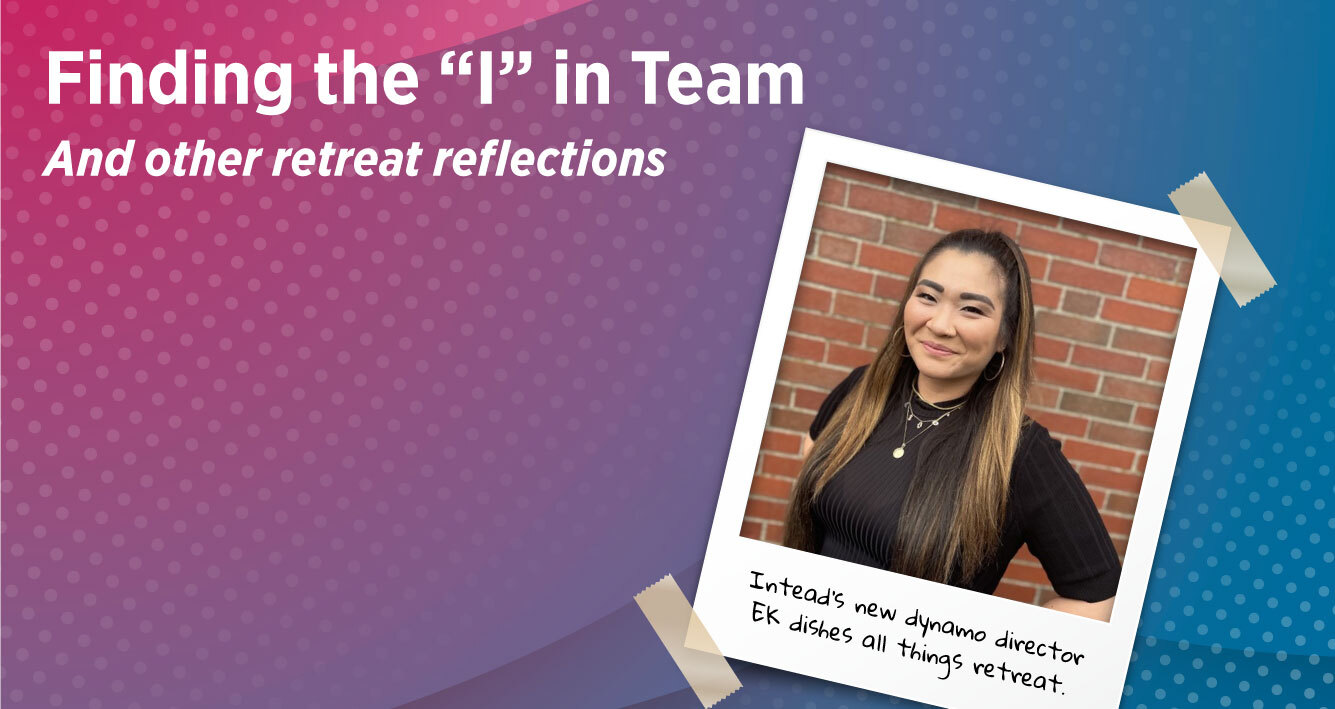
Not to brag, but Intead is a pretty great place to work. When the team gathered at an all-day retreat earlier this fall, I was reminded why I love what I do. I work with some really interesting and insightful people. And the work we choose to engage in is something I’m so proud of.

While Ben and Iliana are presenting at NACAC in Baltimore this week, I'm stepping into the Intead blog to offer some perspective on how you might step back from your day to day and apply some big picture thinking. The Intead team invested some serious and playful energy in a full day off-site retreat to push us all forward. 

I know this tale sounds familiar, so let me back up and be clear as to why it’s anything but, I’m new(ish) here as the marketing communications director, but definitely not new to student-focused marketing or team dynamics.

When you engage with a team that clicks, you know. This is one of those. And our clients notice it, too.

The retreat, led by our fearless leader, who you absolutely do know (Ben, of course!), was an immediate and personal introduction to all the internal members, even those streaming into our Boston-area event from Portugal and India. Until the retreat, I hadn’t actually yet had a chance to sit in one room with everyone on our international marketing team all at once. I’m so glad we took the time to do it. 

It’s amazing how easily the banter flowed regardless of distance. Having worked at tech start-ups and large marketing agencies with global presence alike, I know it requires special effort to make distance and valuable communication work. But here, it’s clear that people are the priority, which makes connecting so much easier and genuinely enjoyable. If you’ve worked with us, then you know just what I mean. And if you haven’t, let us show you!  

The retreat gave us each time, space, and encouragement to explore how we tackle business challenges as individuals as well as a collective. And yes, some of the “business” problems involved linguini and marshmallow. But we got real, too.

Read on for a couple of salient strategic growth recommendations around points of tangency and infinite games. Yes, this relates to your work in enrollment management.

Read More

Spontaneous Learning

I need this couch moved to our second floor sitting area. Clearly this is going to take both of us working in tandem.

“You want to go up first?” You ask.

“Sure,” I say.

I reach for the bottom and the side. You find your handholds as well. We lift in unison.

I need to adjust my grip as I navigate the first stair. You feel the couch shift and adjust accordingly. We make eye contact over the bulky thing and nod to each other. We are innovating as we climb and adapt to the shift in weight and the angle of the couch with each step.

Innovating together in real time. Communicating with words and body language. Collaborating on our way to achieving our goal.

I have to give credit to my friend and colleague Dr. Michael Mascolo, Professor of Psychology at Merrimack College for this metaphor I’m employing. During a recent conversation with Mike, I was making observations about the debate over remote vs. in-office collaboration. We’ve all seen it: the loss of innovation and spontaneous learning when the whole team is working remotely.

As much as we want to leave the commute behind, put a quick load of laundry in after the 9:30am Zoom call is done, even bake a banana bread mid-day, because, why not? Look, I’ve been running virtual teams since 1993 (mmm hmmm, that’s when I started consulting, dinosaur that I am). The power and efficiency of remote work is undeniable.

And yet, and yet…also undeniable is the loss of opportunity for us to learn from each other (even at my dinosauric age, I am learning from the team here). What we all need is much, much more face-to-face interaction – from the fresh graduates entering the workforce to those with decades of experience. We grow and learn together in different ways. We innovate in real time.

Over the past few years, we’ve been growing significantly here at Intead. More universities, high schools, rising edtechs, and established academic providers have been tapping our expertise. So, we’ve been hiring more talent. The talent market has shifted and there are a lot of folks looking for greener pastures right now.

Read on for a bit of perspective that I am surprised far too few current job applicants seem to grasp...

Read More

Would You Like Some Feedback?

Sometimes feedback is well received. Other times, not. Leaders see feedback as invaluable.

In two of our recent, highly-clicked blog posts, we discussed STRATEGY and CULTURE as they relate to academic institutions seeking enrollment growth. Our discussion of enrollment management would be incomplete without a few observations about the need for LEADERSHIP.

When are we leaders?

Leaders come in all forms. Some of us lead organizations, others departments, others a single project. Being a leader has to do with taking ownership of the vision or reason for the work, the people, the process, and the results.

And being a leader has everything to do with the learning. The analysis before, during, and after. And that has a lot to do with feedback. Receptivity to feedback, even when unsolicited is truly important. These are the learning moments with value for those willing to step into a leadership role; a role that requires humility and listening along with confidence and daring.

Read on for a few quick and helpful insights that just may help you take a fresh view of the feedback you are likely getting all the time. There are more gems coming your way than you may realize. Plus, our closing link will bring a smile to your day.

Read More