Recruiting Intelligence

Why International Student Numbers Will Grow

Five years from now what will you be glad you did right now, this year? 

IIE here in the US and other prognosticators across the pond who track student mobility have predicted the number of international students in the US and around the world could double by 2030. Some projections suggest upwards of 10M or more globally. We’re not placing any bets on that figure. However… 

We’re optimistic about international student numbers and the opportunities ahead in higher education. We’re not banking on 10M+ in the next few years. That’s a bit of a stretch by our measure. But continued growth will come and the question is whether your institution is psychologically capable of weathering the storms and building for the future, or bureaucratically paralyzed and unable to capitalize on the opportunities ahead.  

Said simply: Resilient individuals and businesses adapt, leverage their strengths, and pursue opportunities to grow. 

Pro Tip: Your academic leadership will value reading this post. (Share button below)

What you do in the coming year will set the stage for the benefits you reap five years from now. Sit on your hands due to fear of the ambiguity that surrounds us, and all those who are acting now will be miles in front of you in 2030. Miles.   

Below we offer three specific areas where we think smart institutions and academic leaders will focus their attention in the years ahead to capitalize on future growth opportunities. How many of the three do you think you can help your institution address? 

Some context: Back in the day, our industry’s powerhouse forecasters were looking at the global growth of students seeking a foreign education from 2010 through 2016 and said with absolute confidence that there would be 8M+ international students globally by 2020. Maybe you were sitting with me in those conference presentations? Had trends continued on pace, that would have been true. Emphasis on “had trends continued on pace.” 

Instead, global factors combined with the US Muslim ban (Trump 1.0) were followed by a global pandemic (COVID 19). Those student numbers (8M+) have yet to pan out. But significant growth has happened - just 20% shy of the projection by 2020. (UNESCO reports 6.4M students globally studying in a country other than their own that year and we are at about 7M today.) Trend predictions are complicated by so many factors. Some might say predictions are truly unpredictable ; -)


Opportunities to Meet the Intead Team 

  • Look for us at ASU+GSV next week, and NAFSA in May. Let us know  if you want to connect at these events.

Bookmark this: Intead’s Resource Center 
Access 800+ articles, slides decks, reports with relevant content on any topic important to enrollment management and student recruiting.  Check it out.


Here's the thing: there are some human behaviors and economic factors that we feel very confident about. And that helps us understand the world and get a strong sense of what is likely coming our way in the years ahead.  

Reality: The US is now grappling with Trump 2.0, which is full of bluster and chaos-inducing pronouncements equivalent to watching an over-the-top World Wrestling Federation pre-fight drama. It’s all designed to draw attention and ramp up excitement for a spectacle. Often, there’s no substance to the bluster, though it consistently delivers pain. 

This drama coming from the US White House makes predictions all the more challenging. You need to push past all the obfuscating dry ice smoke machine billows to get at baseline reality. 

So yes, despite the chaos surrounding US policies and politics and how that will play out around the world, we have reason to believe international student numbers will rise over time similar to our confidence that the stock market will rise over time. We can’t tell you if the market will be up or down tomorrow or next year, but longitudinally, stocks have gone up since the market’s founding, and international student mobility has gone up as international travel has become more accessible. 

Consider this: In 1970, there were 310M airline passengers globally according to the World Bank. In 2024 the figure was 5.2B according to the International Air Transport Association. That’s an indicator of accessibility. Important to note, those figures include domestic and international flyers. 

Our belief in future growth of international student mobility primarily comes down to basic consumer (student) behavior trends, like increased usage of international flights (accessibility).  

Making the Accessible Visible 

Hailing from Hyderabad, Satya Nadella, current CEO and Chairman of Microsoft, earned his engineering master's degree at the University of Wisconsin-Milwaukee in 1990 and his MBA from the University of Chicago’s Booth School of Business in 1997. On the minds of nearly every Indian engineering student today: “If he could do it, so can I.” A lure as strong as it is old.  

With the rise of social media since 2010, success stories have proliferated in ways the world has never seen before. Basic human behavior: communicating success builds desire among others (word of mouth referrals drive sales).  

Among all those who have not risen to the top of Microsoft, there are millions of former international students who have carved out careers and influential positions, inspiring and encouraging future generations to follow in their footsteps. And hear us when we tell you that your prospective international students are looking for the proven path forward. Without overpromising, your institution needs to tell that story and build confidence in that future. 

A graduate student from India attending a private New England university recently told our staff how searching for (and making real connections with) alumni and current students on LinkedIn is what landed her on campus in the US. In her words, she appreciated but generally bypassed the university’s marketing and contacted other international students who had been there, done that. Their stories convinced her to enroll in the institution. Case in point: basic human behavior tied to the advent of internet communication. 

What we know: A student who graduated just a few years ago and is now a manager at a major company is immediately relatable to prospective applicants (much more tangible to them than their aspirations to run Microsoft someday). These conversations make the journey feel more attainable.

So, when international alumni share their experiences—whether through personal networks, mentorship, or social media—they reinforce the appeal of studying in the US (or any other country that contributed to their success).  

Considering how well your institution leverages its international alumni? Find customized perspective here. 

While we believe word-of-mouth marketing will play a role in future international student enrollment growth, there are other factors working in our industry’s favor – namely how institutions are poised to react to the changing market and the pace at which these changes are implemented on your campus. You may be surprised to learn our take on the opportunities ahead. Read on…

Read More

Recruiting Intel Digest: The Most Useful Stuff from Q4 2024


Shout out to Q4 for giving us all something to think about. Cue the Chinese expression: "Better to be a dog in times of tranquility than a human in times of chaos." (宁享平安犬生,莫为乱世中人). Yup, got it! Right now, we are those humans, perhaps wishing we were dogs.  

Between the US presidential election and IIE Open Doors data, many of us are recalibrating our approach to 2025. Fortunately, we’ve worked through anti-immigration policies and lackluster international student enrollment numbers before. We’ll weather this. But there is work ahead for all of us. 

So, if you’ve missed a few of our Recruiting Intelligence articles, we understand. This post will catch you right up. 


Opportunities to Meet the Intead Team 

  • AIEAin March and NAFSAin May, we'll be presenting our latest findings at both. Want to connect at either event? Let us know.

Bookmark this: Intead’s Resource Center 
Access 800+ articles, slides decks, reports with relevant content on any topic important to enrollment management and student recruiting.  Check it out.


Below, get our latest insights on topics that matter to you, including:  

  • Digital Marketing: The impact of AI on your SEO; Our social algorithms cheat sheet
  • Marketing Strategy: 5 Student recruitment markets worth considering; How to find and use your student career outcome data to recruit; Why personas get a bad rap
  • Industry Reports: CHLOE 9: Strategy Shift -- Institutions Respond to Sustained Online Demand; Trump v Harris -- Student Sentiment Analysis 
  • Conference Highlights: Intead’s notes and slides from AMA Higher Ed, PIE Live Boston, NAFSA XI 

Read on… 

Read More

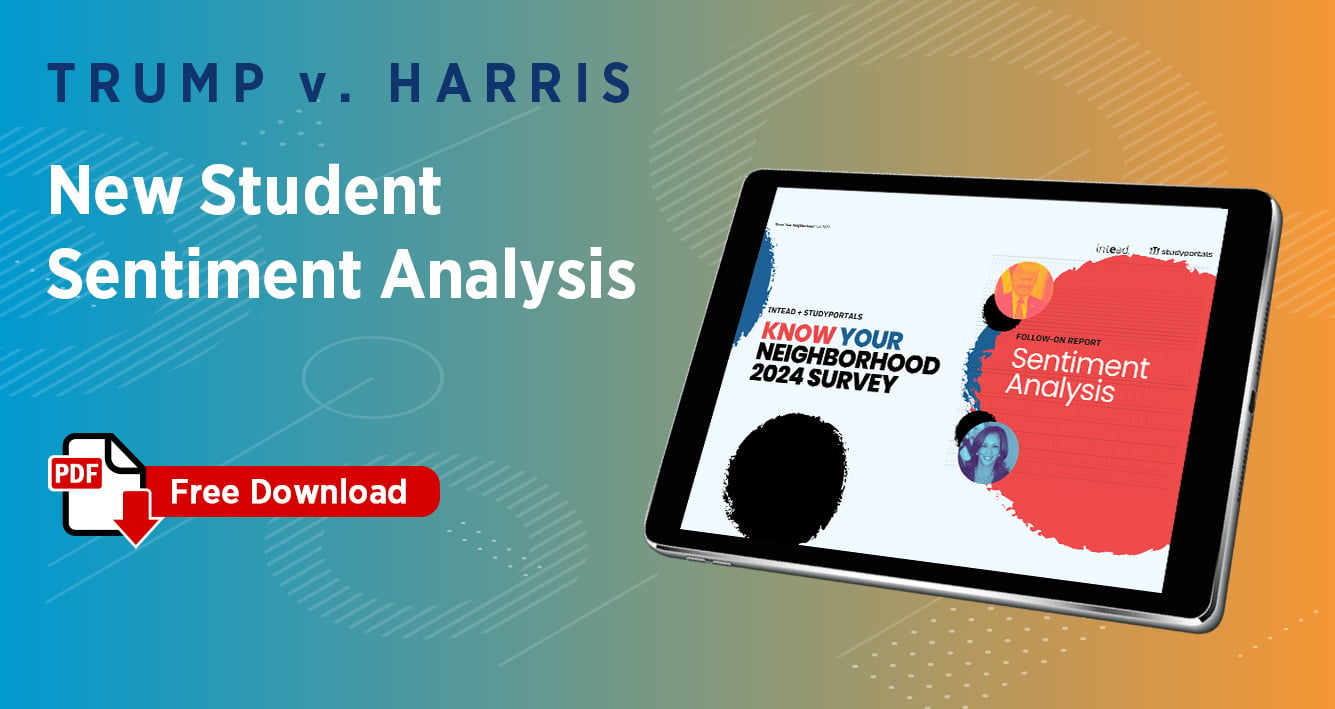
Trump v. Harris: New Student Sentiment Analysis


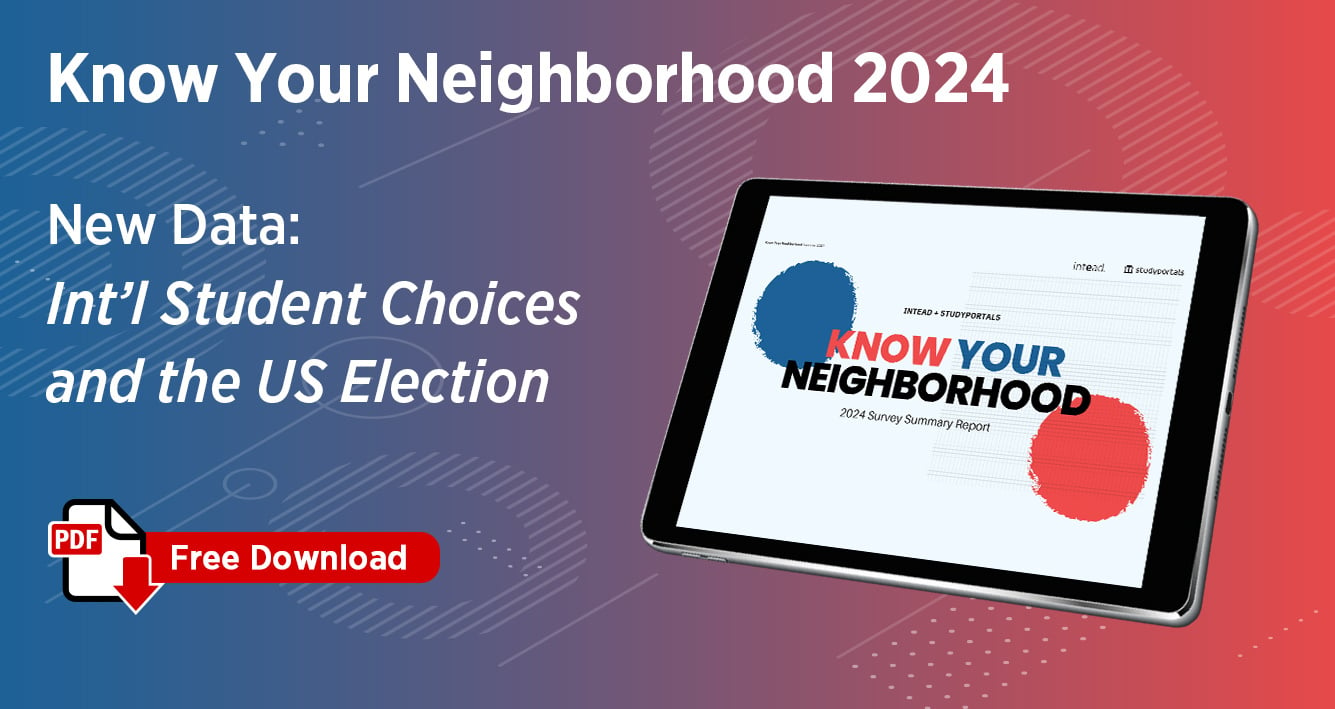
Our new Know Your Neighborhood (KYN) 2024 Student Sentiment Analysis is a follow-on report to our previous US election research published in June. This one provides the nuance behind the stats. And yes, there’s a clear Trump factor with some choice words shared in the student comments.  

Available today, this new research adds depth to our KYN 2024 report issued in partnership with global study choice platform Studyportals. That initial data set was all about factors influencing international students’ decisions to study abroad, including the effect of the US presidential election (Biden vs. Trump at the time). If you missed that phase 1 research, download it for free here. 

Today’s data set, also produced in partnership with our colleagues at Studyportals, presents new findings by looking at the sentiment behind the survey responses. This report adds even more to our findings with results from a new 4-question survey regarding Harris v. Trump (per shift in Democrat ticket). The Harris v. Trump survey, which ran Aug. 12, 2024 – Sept. 9, 2024, was accessible as a banner ad on Studyportals’ website, resulting in 1,028 responses.   


Opportunities to Meet the Intead Team 
- NAFSA Region XI, Hartford, Connecticut, Oct. 27-29, 2024
PIE Live North America, Boston, MA, Nov. 19-20, 2024
- AIRC, Seattle-Bellevue, Washington, Dec. 4-7 -- including our pre-conference global marketing workshop. A full day of Intead global intel (lunch included ; -). Details here. 

Bookmark this: Intead’s Resource Center 
Access 800+ articles, slides decks, reports with relevant content on any topic important to enrollment management and student recruiting.  Check it out.


As you well know, the international student market is a competitive one. The universities that succeed are those that truly understand the consumer in each student segment. So, yes, while the KYN 2024 follow-on report is an interesting read, it also gives insight into the mindset of the international students you’re trying to recruit now. In other words, there’s something to be learned here.  

Read on to download the free report… 

Read More

KYN 2024: What Matters Most to Prospective International Students


Students as consumers and the consumer insights that matter.  

Getting to the mindset of international and domestic students is central to what we do. Last week we unveiled a new study on career pathways for international students seeking US work experience. If you haven’t had a chance to review the report, it’s worth your time. The report provides fresh insights into what a US degree actually produces for international students, offering a new way to quantify the value of your degree for all of those ROI-minded student prospects (and their families).  

This week we shift our focus to other factors that influence international student decisions to study abroad, including how the US presidential election factors into their choices. We did this research back in 2016 (the Trump/Clinton match up). Now we have new student data to compare and, YES! it is fascinating. 

In partnership with global study choice platform Studyportals, we distributed a 13-question survey via email to Studyportals account holders and placed banner ads visible to their website visitors. All told, 2,492 respondents from 106 countries across the globe participated. A significant percentage of responses came from students in African nations.  

There were some real surprises. Spoiler Alert: 2024 is NOT 2016. 


Our next opportunities to meet! 

GMAC Annual Conference, New Orleans, June 19 – 21, 2024. Ben will be presenting TODAY on how global elections are influencing student mobility. More than just the US presidential election has the power to upend what students will choose to do next.  

EducationUSA, Washington, D.C., July 30-August 1. Ben and Virginia Commonwealth University SIO Jill Blondin will share insights on Navigating Budget Challenges in International Recruitment: Practical Strategies for Every Phase.  

Be in touch! We’ll buy the coffee. 


Today, we share the Know Your Neighborhood (KYN) 2024 Survey Summary Report with you – our first post-pandemic addition to the KYN series. Previous KYN full reports are available to Intead Plus members. The 2019 report on emerging markets (Africa and Latin America) still has legs. The others have some still valid nuggets on cultural differences even though they are now 5 to 7 years old. Helpful stuff considering that 50,000+ international students completed our surveys. 

In our latest KYN report, we unlock current insights into the preferences and motivations of prospective international students, including the impact of political fatigue, observations on a possible rise in cynicism, and more. We share observations that suggest these feelings have opened some students to studying in previously avoided countries. And, of course, we get into the influence of families on prospective student decision-making. 

If you’ve been following along these past few weeks, you already know there has been a shift in priorities among international education seekers since our last KYN study done in the midst of and after the wild and surprising 2016 election year. Other than perhaps Karl Rove, no one really thought Mr. Trump would win in 2016. 

At the time, very few (14%) international student respondents said they would be more likely to study in the US should Donald Trump win the election. This go ‘round that number jumps to 30% who say more likely 

Asked another way, in 2016 the majority (54%) said they would beless likely to study in the US should Mr. Trump win. That number dropped considerably in 2024 to 28%. What’s more, 42% this year say it won’t make a difference who wins. It’s just not as important to today’s cohort.  

We connected with so many of you over these stats at NAFSA a few weeks ago (what a week that was!). But, if we didn’t get that chance to chat in person, not to worry. Today’s summary report will give you what you need to know about the current international student mindset. It offers the core quantitative facts from our research as well as our recommendations on how your team may want to react to this news.   

Do, however, stay tuned as our data analysts are still wading through the quite telling qualitative responses. We are getting more insights organized for publication later this summer. (Hey, if you are reading this based on a share from a colleague, be sure to subscribe to our blog!) 

Read on to download our KYN 2024 Survey Summary Report and for 4 key takeaways from the study… 

Read More

Thinking Forward

Are your moments of fear and anxiety your best growth opportunities in costume?

Reality check: some days the fortitude to push forward is harder than others. There is simply so much work to be done.

Still, we are moving forward. Always.

On this morning following the US 2020 election, regardless of the final outcome, the hard work of pushing for learning environments that advance individuals and society takes forward thinking and energy.

We, as a community, do this every day because we know that a diverse student population fosters cultural understanding and personal growth.

We, as the Intead team, supply the expertise and energy to make this happen with all we have in us.

And we know that institutions at the top of the food chain and the bottom do not achieve diverse learning environments easily. Today, the light is shining very clearly on the fact that without proactively addressing student recruitment, enrollment, and support processes, institutions fall into ineffective practices. Worse, practices that can subjugate and demean student segments. Practices that undermine and diminish the very mission statements institutions hold so dear.

Still, we move onward with fortitude and hope for a future in which students and institutions can realize success. 

And while the path to that future might not always be clear, opportunities abound. Read on for our perspective on recognizing those opportunities, including the latest data from Moody's Investors Service and NAFSA that point the way forward. 

Read More

Resource Tip: ICEF Agent Barometer = Expert International Student Intel

Here at Intead, we are always on the hunt for reliable resources and information to help our clients, and favorite blog readers  make better decisions about their recruiting and marketing plans. While the ICEF Monitor Agent Barometer is not new (it’s been published annually since 2007!), it is a great resource of information from people on the ground, working directly with student every day–agents! They can be extremely helpful and reliable sources.

Considering the amount of change in the air here in the U.S., in the U.K. and frankly, a whole lot of other important student-focused regions, having a strong agent network is like having your ear to the ground in all of these regions. Without in-country partners, you are relying on international news sources to tell you what the cultural sentiments are and how economic conditions are changing. Good agents are a great source of current intel.

Bottom Line: The 2016 Agent Barometer survey gathered responses from 1,111 agents in 108 countries. The survey suggests that the U.S. is losing ground as an attractive destination for international students. Finance is less of a concern for students, while the responsiveness of universities is still essential for getting students to your campus.

Another helpful resource to be on the lookout for is "NAFSA's Guide to International Student Recruitment: 3rd Edition" about all things international recruiting coming out in May 2017, and featuring an Intead-written chapter "Effective Marketing Practices for International Student Recruitment: Simplifying the Complexity of Academic Global Branding" on digital marketing strategy and tactics.

Read on for details and links to valuable information sources and our agency evaluation form to support your recruitment plans. You’ll have to read to the end to get all the good stuff! Don’t forget to share it with your team.

Read More

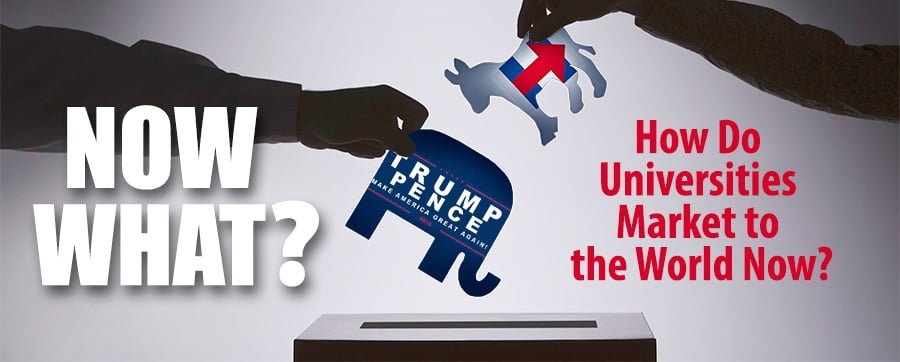
So, How Do We Market US Higher Ed to the World Now?

There is a new political landscape here in the US and in the UK. International student recruiting is facing some new, unexpected challenges.

Brace yourself, this is a long post and an incredibly important topic to all of us. We've tried to give some real food for thought and grist for action. As always, at Intead we try to give you the facts and figures in a concrete way. Strategic thinking that gets you to a tactical plan of action. 

I'm betting there are at least a few other people at your institution you will want to forward this post to if you dive into it. 

So, to get right into it, earlier this year we surveyed more than one million prospective international students thanks to FPPEDUMedia's powerful student database. More than 40,000 students responded immediately - that's some incredible engagement right there.

We asked them how current global, economic and political events are impacting their plans to study abroad. No surprise, our somewhat controversial question around international students' desire to study in the US based on the outcome of the presidential election has suddenly become a hot topic. For a variety of reasons, we didn't really expect to be in this place.

Now that we are, we have some new thinking to do. While the student responses we received were speculative (If someone wins, would you be more or less inclined to...), the responses were dramatically telling, nonetheless.

In case you missed it, 60% of 40,000+ responses said they were less likely to study in the US if Donald Trump were to win the election. That number rises to 80% when you look specifically at responses from Mexico. Now we have your attention, right?

So, how does our messaging to international students’ change now? How can we recruit international students who are wary of US travel and their safety here? How can we make our campuses feel inclusive and welcoming for our current (and future) international students? What about parents?

In the past week, we have discussed these topics with reporters at the New York Times, Chronicle of Higher Education, Hechinger Report, The Pie News, EL Gazette and others. There are many angles to consider.

In an effort to help this thinking, this conversation, move forward with all of our colleagues in academia, we are hosting a webinar later today (Wed., November 16) at 3pm Eastern Time to consider the angles in our new, post-election landscape. We will discuss what all this means for your recruitment and marketing plans. The webinar is complimentary, but limited to 75 seats. By the time you read this, we are likely already full to capacity, so we are looking into hosting another one. Register here to be put on our waiting list.

Dive into this topic in a more substantial way: Meet Us in Miami or San Diego

We will be sharing our global digital marketing insights and discussing ways to move forward in our new political landscape at some upcoming conferences. In December, we will be presenting at the ICEF and AIRC conferences in Miami. In January, we will be hosting the first annual International Student Recruitment Bootcamp (2016 theme: What Works Where) presented in partnership with CGACC. Let us know if you’ll be at any of these conferences–we’d love to chat.

Read on for perspective on how we do that global recruitment thing given the new political landscape…

Read More

U.S. Election Could Significantly Affect Your Enrollment Numbers


Learn more in Room CCC, Mile High Ballroom 4DE TODAY at 10AM.


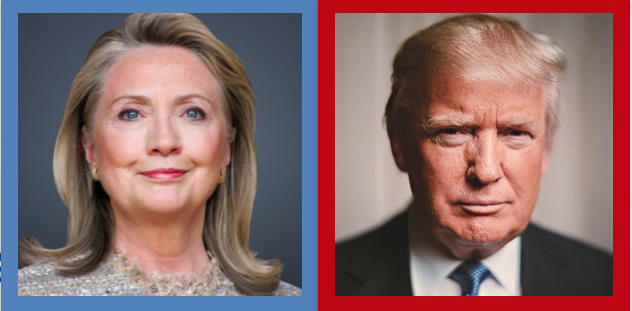
If Hillary Clinton is elected President of the United States, will international student enrollment decline in the U.S.? How about if Donald Trump is elected? Intrigued? We have some data you might want to see.

Today, Intead and FPPEDUMedia will be releasing our latest research results with deep country insights to inform your global marketing campaigns. As you seek to maintain or expand your international student recruiting efforts, our data will be valuable to your decision making – where to invest, which programs to highlight in which countries, what messaging to use.

With FPPEDUMedia’s extensive and global international student database, we are able to identify regional trends and inform our digital marketing plans and investments. A remarkable advantage.

This winter, we sent a survey to 1.2 million prospective international students who have profiles in FPPEDUMedia’s database. We asked them how political and economic turbulence affected their plans to study abroad. We asked questions about what influences their actions that we’ve not seen asked before. And we got some great answers. In fact, we received more than 40,000 answers…in just 7 days. Now that’s engagement!

Want the scoop? Read on...

Read More