Recruiting Intelligence

Groundbreaking Data: International Student Employment After Graduation


The NAFSA room was sold out; every seat taken.  

That morning we really weren’t sure what to expect with our session being held in the very furthest room on the 3rd floor of the New Orleans Convention Center. And that convention center is one of the largest we’ve ever seen. Like, you need an Uber to get from one end to the other. 

We could not have been more thrilled with the turn out. What everyone came for: new data, never before collected, on what international students are doing after they earn a US degree. 

What’s been missing from our community’s conversation on the value of US degrees for international students is real ROI. Sure, we talk about ROI: “94% of our students are employed or pursuing advanced degrees 6 months from graduation.” But we’ve never quantified actual ROI...until now.  

Today we’re sharing a preview of new research on the career progress of international students who graduated from US institutions. (The full report will publish later this summer. Be among the first to receive this and 2 other groundbreaking reports by pre-registering. You’ll also get our NAFSA 2024 session slides.)  

This NAFSA research report will be the first of what will become an even deeper analysis based on more research between now and 2025. We want to truly understand what a US degree produces for international students. Is it worth their investment? Is it worth ours? This is data we’ve been wanting to mine for years.   


Our next opportunities to meet! 

GMAC Annual Conference, New Orleans, June 19 – 21, 2024. Ben will be presenting on how global elections are influencing student mobility. More than just the US presidential election has the power to upend what students will choose to do next.  

EducationUSA, Washington, D.C., July 30-August 1. Ben and Viginia Commonwealth University SIO Jill Blondin will share insights on Navigating Budget Challenges in International Recruitment: Practical Strategies for Every Phase.  

Be in touch! We’ll buy the coffee. 


I was extremely honored to have presented our latest research at NAFSA last week alongside Dr. Joanna Regulska, vice provost and dean of global affairs at UC Davis. UC Davis is one of the 12 innovative and forward-thinking institutions participating in this groundbreaking study. 

Our research involved a 22-question survey sent to international students who graduated from our 12 university partners between 2019 and 2023 (see below for the full list). With a 5.3% response rate, 1,797 graduates from 131 countries answered our survey questions. Of these, 1,323 still reside in the US, 474 live elsewhere. 

What we learned will have a direct impact on international student recruitment, as well as offer perspective on US immigration policy. Data informs how we make sense of the world and move forward as a community and a society. The data collected encourages us to understand the value of CPT/OPT to our international students and the US.  

Laid bare: the real outcomes and the positive impact international student graduates are having on the US economy.  

For those of you interested in taking part in our next survey, be in touch at info@intead.com. So many of our higher ed colleagues at the conference raised their hands to evaluate participating in the next research phase of this project. Be a part of that! 

Below we share key takeaways from our research and provide you quick access to the slides from our NAFSA presentation. Read on... 


Read More
How International Students are Finding US Jobs


No one on the Intead team has participated in an Iron Man competition, but the adrenaline levels we are experiencing make me wonder if preparing three different, compelling, in-depth reports in time for NAFSA next week compares. I'm confirming that no one from our team will be running, biking, or swimming to New Orleans for NAFSA, but we have been running the analytics on some really novel data all related to different aspects of the international student journey. We’re so close to the finish line! 

The work has been exciting, sometimes difficult, and the data is beyond beaten up at this point. The payoff will be so rewarding. We really can’t wait to share all we’ve learned.

Today, we are going to let a few whiskers of one of our cats out of the bag. 


Let’s meet in New Orleans @ NAFSA 2024! 

Join one of Intead’s two NAFSA presentations: 

We’ll be presenting insights in our two valuable Nafsa sessions: 

  • ChatGPT and AI: What are the real opportunities for enrollment management? 
    Wed., May 29 @ 1 p.m. in NOCC, Room 391
    Featuring Dr. David L. Di Maria, SIO & Associate Vice Provost for International Education at UMBC with Iliana Joaquin, Director, Digital Marketing at Intead  
  • Groundbreaking Data: International Student Employment After Graduation
    Thurs., May 30 @ 11:30 a.m. in NOCC, Room 398-399
    Featuring Dr. Joanna Regulska, Vice Provost and Dean - Global Affairs, UC Davis and Nafsa Board Member with Ben Waxman, CEO at Intead 

Be the first to know!  Pre-register to receive Intead’s 2024 proprietary reports as soon as we publish them. 


We are all seeking to understand the global landscape for international students. Our latest research takes a hard look at the US career options and outcomes – key drivers of international student decision-making. Career outcomes are, after all, a central metric for many international students. Our take: not understanding how your institution plays into the US international employment scene puts you at a recruitment disadvantage. 

So, we partnered with our colleagues at F1 Hire to examine both public and proprietary data sets.  

If you’re not familiar with F1 Hire, its web extension, designed for international students in the US, has become the must-have tool for OPT/CPT/H-1B job seekers. Together we analyzed the US Permanent Labor Certification Program (PERM) and H-1B visa application data tracked by the US Department of Labor between 2018-2023. We will be sharing insights into the career pathway options for international students who entered the US workforce upon completing their degrees at US higher ed institutions as well as those who earned their degrees abroad. We reviewed this data against IIE Open Doors stats and proprietary data owned by F1 Hire. 

What we learned was fascinating.  

By drilling into this employment data, we see many ways institutions can use this information as a recruitment tool to demonstrate their success in helping international students find employment.  

An example: Our analysis of F1 Hire’s collection of 1.5 million job opportunities reveals significant disparities in H-1B opportunities relative to the number of international students by state. 

Here’s a sneak peek that surprised us: We found 6.4 H-1B opportunities in New Mexico per international student studying in state compared to just .34 H-1B opportunities in New York per in-state international student. Hello, New Mexico as a student destination! We simply didn't see that coming.

Our full report, which will be available soon, provides keen perspective on: 

  • International student earning potential 
  • Geographic insights (countries and regions) 
  • Industry insights 
  • India-specific insights 
  • Job search insights 

And of course, we offer our take on what this all means for your international student recruitment efforts. 

Read on to register and be among the first to receive our full report. Below, we also share key takeaways from our research… 

Read More

Get Your Students Career Ready. Here's How - Part 2 of 2


Bringing the real world into the classroom is so important to the future of your students. And last week we shared one way Suffolk University is taking action. A sort of ​Career Readiness 101. This week, Career Readiness 201 as we talk about you and offer a helpful career-prep checklist, complete with on-campus practices and recruiter tips, too.  


Opportunities to connect in person and hear our latest market intel:

  • Join us in Paris Nov 8-10 at CIEE's 76th Annual Conference.
  • Join us in Boston Nov 13-15 at PIE News Live.

Let us know if you'll be joining us (info@intead.com).


Like you, the vast majority of students we talk to are playing the long game. Well before they even have a high school diploma, they’re thinking beyond university. They’re smart consumers and they need to know what their hard-earned degree, whatever the field, will mean for them in the market. Never mind that many of them are not sold on a major yet. They’ve been hearing for years about the rising costs of higher education. They understand ROI more than previous generations ever did. And their parents are all about that approach. 

According to the National Center for Education, in 1980, the annual cost of attending university (including tuition, fees, room, and board) was just over $10,000, adjusted for inflation. Fast forward to the 2019-20 academic year, and that that bottom line had ballooned 180 percent to nearly $29,000. This is the story your prospective students have grown up hearing. For decades, everyone, university administrators and families, have been wringing their hands about the rising costs and yet, not a thing has been done about it. 

For families, the reality is they’re looking at an average debt for a four-year Bachelor’s degree of $34,700 per the Education Data Initiative. And while the standard repayment term for federal loans is 10 years, it can take up to 30 or more years for more than a few students to pay off these loans. You can see their concern. 

Some of us optimistically thought the rise of online education would bring costs down and become a reliable source of revenue for universities and a powerful educational avenue for students. The reality: yes, a growing source of revenue, but the cost to produce truly effective online education that carries students forward with all the tools and supports, is fairly pricey to produce. And the low quality stuff really does not achieve the educational outcomes, so students pay for an ineffective degree - a credential that does not meet real-world employer needs. (See our blog post here about the perceived value of online degrees) 

Of course, these are tuition numbers you’ve thought about many times. And they’re all over the news right now as student loan repayments will soon be back on after a long pandemic pause. Smart students want to know the kind of return they’re going to get on their investment, and they’re looking to you to provide an attractive answer. 

So, what is your answer?

Read on for a checklist of essential ways to help ensure your campus helps prep students for the careers they’re hoping higher ed will lead them to. And yes, we’ve included pro-tips for you recruiters. Read on...

Read More

Get Your Students Career Ready. Here's How - Part 1 of 2

Let’s talk about the messaging your institution uses to convince students and families that what you offer has value. Pretty simple stuff, right? Maybe not. You’ll appreciate the helpful checklist that follows in part 2 of this series. Think marketing differentiators in a competitive marketplace. You won’t want to miss it. 


Opportunities to connect in person and hear our latest market intel:

  • Join us in Paris Nov 8-10 at CIEE's 76th Annual Conference.
  • Join us in Boston Nov 13-15 at PIE News Live.

Let us know if you'll be joining us (info@intead.com).


But first a story. 

Ok, so you are up in front of your board of directors presenting your business growth and marketing plan. You and your team have been figuring this out for a while and last night was a late one as you worked together to put the finishing touches on your slides. There were still disagreements among your team, but you settled the issues and felt nervously ready. 

Everyone has a speaking role but some on your team are stronger than others. Some don’t have appropriate clothes to wear for the presentation so they borrow something professional looking from friends. Some sway nervously back and forth and read their slides rather than engage with the very important board members. You realize early on in the presentation that the data presented on slide 7 is wrong. It doesn’t support your final recommendation. Maybe no one will notice. 

It is your Marketing Business class final presentation to a mock board of directors and as first year undergrads, your team is anything but seasoned. Your final grade is riding on how your team performs. 

Every semester for years now, I have had the honor of judging the final marketing analysis presentations of undergraduate students in a marketing business class at Suffolk University. A good friend of mine there teaches the class and gathers a set of judges from the biz to help the students get some real world feedback. Each judging session is as different as the teams presenting. It’s a blast for us, the judges. Nerve racking for the students. 

Recently, the department asked a few of the real-world judges for additional input and it truly impressed me. They wanted to hear from us as employers to understand what we look for in candidates as we hire. What tools should their students know how to use? What business concepts and approaches are critical to us as employers so their graduates will crush the interview?  

That line of questioning is SO important for business programs that often focus so much on esoteric business theory and simplistic case studies while purporting to be all about the real world. As our Intead Advisory Board Member Hillary Dostal, global marketing advisor at Pegasystems, says: There is best practice and then there is actual practice.  

This goes for your team, too. Read on…

Read More

The Non-traditional Student Advantage Part 3: Know Your Competition

If you’ve been following this series on non-traditional students, or paying attention to the shifting student landscape at all, then one thing’s clear: non-traditional students are a valuable growth market. And your competition knows it.

This is part 3 in our 5-part blog series on reaching and enrolling non-traditional students. Links to part 1 and part 2.

Yes, non-traditional students demand more than traditional students. They need flexible schedules, targeted certificates, different student service support, and a strong return on their investment. And institutions are (finally) responding. Is yours?

Five years ago, when we published “Quality. Cost. Convenience. How academic leaders are competing for today’s non-traditional students.” – an e-book available for free to Intead Plus members – there was a lot of speculation about MOOCs (massive open online courses). Would they eat into the non-traditional piece of the pie?

While it’s true that student interest in MOOCs soared during Covid, the actual threat they pose to degree programs is, well, not much.


I love the blend of data, environmental scans, case studies, and basic recommendations that are interwoven in each section. This ebook is excellent for institutions that seek to fine-tune their non-traditional services or begin the process of addressing their needs. It covers the many daunting challenges that universities face when focusing on this student segment. ~ Mary Marquez Bell, retired Vice President for Enrollment Services, SUNY Old Westbury


From what we’ve seen, MOOC students are mostly filling leisure time with these types of programs (rather than pausing other academic pursuits). Typically, MOOC students only engage in the coursework a few hours a week. They really aren’t reaping any financial gains from having taken these courses, either. And, in the end, most are pleasantly surprised they actually learned something. So that’s good – for the student and you!

The more urgent conversation has shifted to involve certificates and credentials, for-profit online colleges and universities, and extension programs. Read on for what you need to know.

Read More

You’re In the Right Place: Predicting the Future of Student Recruiting

The enrollment cliff has everyone a little on edge. People are burned out and frustrated. Leadership is looking for bigger gains in shorter time frames. And traditional students just aren’t showing up in ways they traditionally have.

It’s so clear that higher ed is at an inflection point. Thank the pandemic. Thank technology. The economy and unpredictable job market. The changing student landscape. What you need now more than anything is support. Ideally in the form of a soothsayer to tell you where and how to invest your time, energy, and resources. If only.

Our advice: take a deep breath and read this post.

While soothsayer we may not be, we do have some perspective on what lies ahead. And our record for predicting changes in the market has proven accurate for more than a decade. Long before the recommendations below became standard practice in enrollment management (they all sound so obvious now, right?), we advised colleagues to:

  • Make better use of your CRM (or get one if you don’t have one), and embrace the add on features and API connections that improve tracking and results.
  • Identify staff with the skills you need for each function of the enrollment process. Your creatives are not your meet and greeters and they are not your data analysts. You need all of these skills.
  • Develop your international alumni as global ambassadors. (Most of you are still not doing this).
  • Find reputable commission-based recruiting agents in your target countries and invest time in managing them very carefully.
  • Train your domestic recruitment team in the nuances and needs of international students already studying in the US so they know how to address the important topics (visas, parental concerns, economic realities, etc.)

We know, it’s all old hat now. But a decade ago, very new to international enrollment management teams.

Today we are facing some pretty significant headwinds. Post-pandemic changes to how students evaluate universities. Growing financial pressures facing families. Increasing importance of careers and the ROI of your degrees. Heightened interest in certificates and shorter paths to career growth. Political divisiveness harkening back to the US civil unrest of the 1960s (or 1860s?). Are you factoring social justice including climate activism into your marketing plans?

These factors are all part of the student and parent mindset as they evaluate investments in university level education. The pool of nontraditional students is much larger and more diverse than the shrinking traditional student pool. And yet, the international student pool is one that is growing and projected to grow dramatically in the coming years.

If you’re ignoring any of these market segments, we strongly advise you don’t. Our analysis of and predictions about what influences student decision making, the tools and processes you need in place to be both efficient and effective, this counsel has been spot on for a very long time (our blog records act as our receipts).

You’re in the right place. Read on to be sure you are able to anticipate what is next and what to do about it.

Read More

An OPT Reflection: Starting Points and Destinations

The student journey from one place to another has common elements. It starts with an intense desire to learn and explore. Why else would someone spend so much time, energy, money?

OPT is an essential tool that benefits us all. There is no question. Occasionally, we need to be reminded.

  • As a follow on to the 2021 AIRC conference just completed which is all about creating great learning experiences for students around the world,
  • As our final post for the year (we will take a break and return on January 5, 2022),

Please drink in this optimistic view of how everyone in our field contributes to making the world more connected, stronger, and safer.

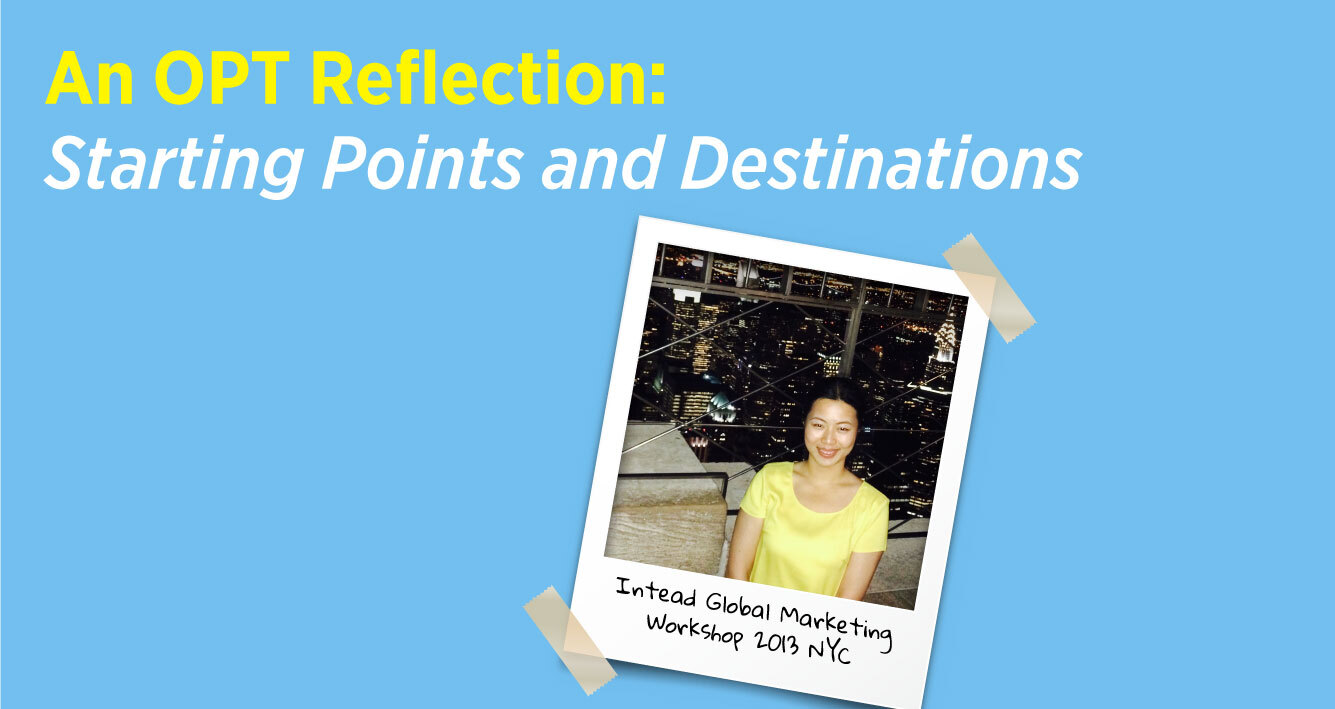
Xi Chen held a very important role at Intead almost a decade ago as the company was in the early stages of making a name for itself. She helped us set our course with a fierce dedication and rare level of talent that set a bar for our future international student interns. We asked her to reflect on what her OPT experience at Intead meant to her. We know how much it meant to us!

In writing about her OPT experience, Xi sent us this quote: "Arriving at one goal is the starting point to another."  ~ John Dewey

Read on to get a first-hand look beautifully shared by Xi Chen. This is all about what you are setting your students up to achieve, personally, and for the world all around us.

Read More