Recruiting Intelligence

Halloween Lessons for International Enrollment Leaders

Intead’s HQ is in Salem, Massachusetts, a city that has built an identity around the Salem Witch Trials, one of the most infamous episodes in American history. Our office sits just a few blocks from where the trials unfolded. A plaque outside our very building marks the site of the Old Witch Gaol (jail), where many of the accused were imprisoned in 1692.

Somewhere over the intervening three centuries, Salem became America’s unofficial Halloween capital. Every October (in fact, throughout the entire year), we’re flooded with costumed visitors from fairies to ghouls. They seek haunted houses, mediums, and the filming locations from Disney’s Hocus Pocus.


Can benchmarking help universities navigate today’s internationalization headwinds?

Yes - but don't take our word for it. Read The PIE News coverage about our new AIEA benchmarking study. 22+ institutions have joined, 40+ in progress, 120+ more evaluating the opportunity. Are you?

Meet Intead! 

Find us at AIRC Annual Conference in Dallas Dec 1-4, and AIEA Annual Conference in DC Feb 15-18. Be in touch to share a cup of coffee in person.


For visitors, Salem is primarily a place to spend a pretty great getaway, immersed in one of the few traditions that invites everyone to be exactly who they want to be, if for a limited time. Home to the very first museum in the country documenting early trade between the US and China, among other marvels, Salem's historical and maritime museums are spectacular.

For those of us who work and live here, our city is just another beautiful spot on Boston’s North Shore, with brick streets, historic houses, and many, many New Age bookshops and crystal proprietors.

After a while, the costumed spectacles fade into the background. The ghost tours and tourist groups become something we walk around on our way to lunch, and the people dressed as ghouls and princesses become just another, if mildly disorienting, part of the morning commute.

Life has a way of evening out, even when the environment around us feels unusually theatrical. The metaphor of dramatic spookiness seems apropos. We’re here to help you move forward with planning and execution, despite the drama all around us in our field.

For years, international enrollment has approached uncertainty as though it were a passing condition; something to navigate before the next period of stability arrived. The past several recruitment cycles suggest a different reality.

Uncertainty is no longer interrupting the work of international enrollment management but becoming a consistent element of the operating environment itself. The more useful question is no longer when things will settle down, but how institutions can continue making good decisions while they don’t.

Read on for a helpful Start, Stop, Continue approach to managing today’s international enrollment environment.

Read More

Bring Your Student Leads Into Focus

Chaos is costly. Clarity is half off.

This truth brought to you by The Economist’s latest flash sale. Sometimes an ad sums up a vibe so neatly. Maybe the ad just caught us at the right moment. (Um, thanks Meta?)

Whether it was the morning coffee or the marketing kitsch, The Economist's attempt to get us to subscribe (we already do) served as a good reminder of the cost of chaos.

Pick your tumult: visa whack-a-mole, Duration of Status policy threats, internal budget cuts, NSF decimation, demographic cliff, you name it. The disruptions of the past 18+ months have cost our industry its equilibrium, individuals their sanity, and certainly some enrollment.

The numbers speak loudly: 97,000 fewer student US visas were awarded last summer, driven largely by a near-monthlong freeze on visa interviews. (Canada, UK, and Australia have similar downbeats). Now, DHS may adjust the “Duration of Status” for F-1 and J-1 visa holders, replacing it with a fixed admission period of up to four years and dimming the luster on some students’ dreams of a US degree. And, if history tells us anything, it won’t be the last disruption our international student hopefuls and enrollment leaders will endure.


Meet Intead! 

  • We're presenting at NACUBO in July along side College of the Canyons, University of Memphis and UC San Diego.  Be in touch to share a cup of coffee in person.

Fight for your Internationalization Program Funding with Data


Despite the continued chaos, we have actual work to do. Handwringing be damned! Students still want to enroll at your institution. Time to busy your team securing the fall cohort by shoring up those leads. This is ground you know well.

Read on for insights from our team, including our latest addition to Intead, Lindsey Lopez, on what to prioritize now to bring your 2026/27 leads into focus and produce your target yield.

Read on…

Read More

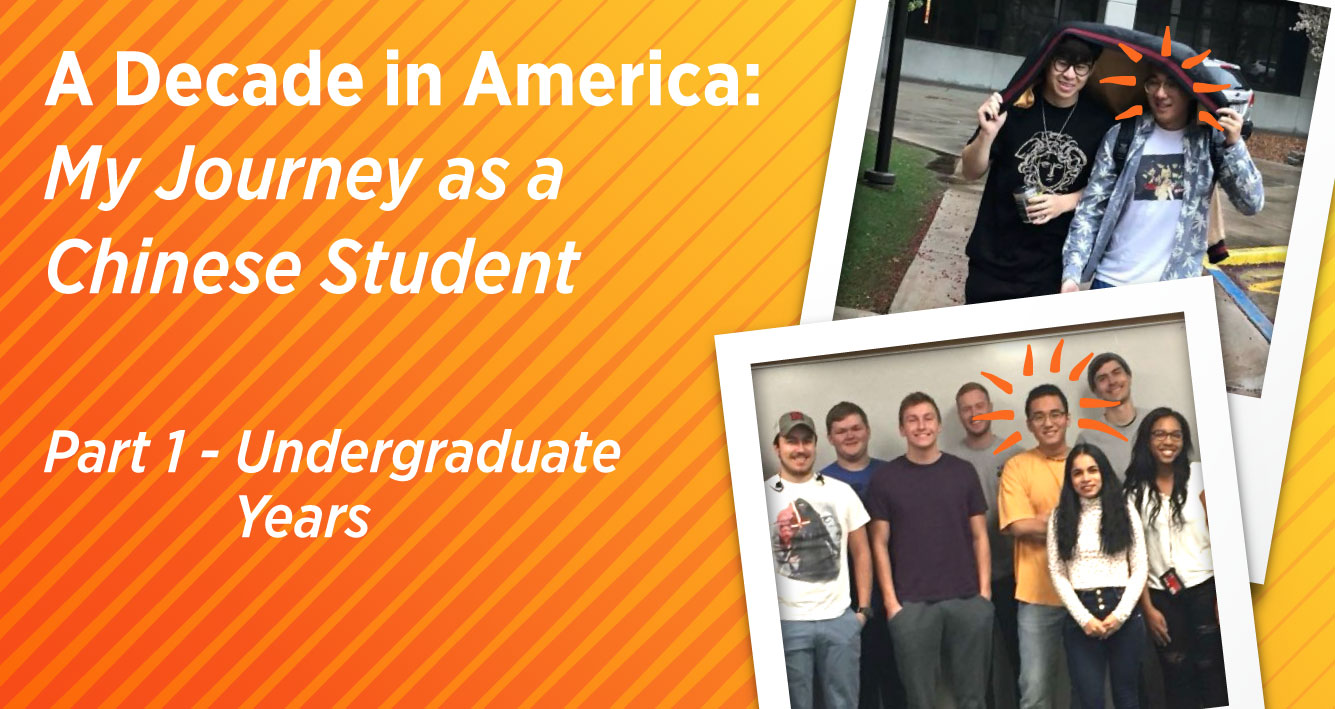
A Decade in America: My Journey as a Chinese Student, Undergrad Years

After a decade of studying, working, and contributing to US higher education, Tianyu Shen has returned to China – a move that mirrors what many Chinese students who studied in America have experienced. As so many countries are revising their policies about who may come and how long they may stay, this recounting of Tianyu’s experience is particularly poignant.

Many of you know Tianyu, the affable, talented Data Analyst who did some amazing work during his time at Intead as a STEM OPT student. Like so many international students, Tianyu’s initial inclination to study abroad was rooted in adventure. His initial thought more than a decade ago: Let’s go to New Zealand! And, like so many others from China, his parents redirected him to the US.

So that was 2015, and at the time, IIE was reporting that US universities were experiencing the highest growth rate in 35 years, with China as the key driver. At the time, the influx of Chinese students in particular helped many US universities launch new academic degree programs that benefited American students as well as international cohorts. Now, in hindsight, analysts point to how the revenue generated by the growth in international students from 2010-2020 gave many institutions the capacity to invest in infrastructure and academic advances that created huge opportunities for the entire campus.

Now, there’s a very different narrative being played out in the US and globally. We wonder where Tianyu’s parents would advise him to go for study abroad if he were starting his journey today.

We think you’ll enjoy his observations about Hollywood movies, and comparisons of Boston, MA to Lincoln, NE.


Meet Intead! 

  • Find us at WIEC in DC in March, and ASU+GSV in San Diego in April. Be in touch to share a cup of coffee in person.

eBook Reboot: 88 Ways to Recruit International Studentsupdated for our times. Your tactical toolkit for the year ahead. Covering all the bases in 10 quick-read chapters. Fosters great ideation discussions with your team as you seek to diversify your recruitment efforts.


Because Tianyu’s experience mirrors that of so many students sitting in US classrooms and working OPT jobs right now, we asked him to take you through his student journey. What is it really like to come to the US still needing to learn English while seeking an adventure? When does the mindset turn toward career? And what did the OPT experience really deliver?

Today, Tianyu offers his perspective on the formative time he spent learning English in Boston and as an international undergrad studying in Nebraska, where he says he spent some of the happiest years of his life. An overview of his more career-focused years as a grad student will come in our next post. Be sure to check back for that. Read on now for his unvarnished take as a recent international student. And please, share with those who are shaping the American higher ed system today…

Read More

From Stasis to Strategy: Enrollment Teams, It’s Time to Act

Churn happens in every setting. Promotions, departures, budget realignment, team and department consolidation.

Disruptive, yes, but hardly unprecedented – a common cycle typically prompted by fiscal changes and then the disruptions ripple out from there. 

And yet, change rarely feels routine. Especially at the scale we are experiencing right now.

Still, your programs need promotion, your Deans have their own priorities, and everyone knows that your important leadership chair is about to turn over (you know the one, right?).

What is an enrollment team to do? Do you launch a new marketing campaign now, or wait? What if today’s A, B, and C priorities become tomorrow’s D, E, and F because the new leader coming in 4 or 5 months will have their own ideas.

And what happens in the meantime as you try to sort it all out? Stasis.  

So often, teams sit on their hard-won budgets, waiting for stability and clarity. An approach, for sure, but not a good one. Doing nothing isn’t leadership (too blunt?) – and doing nothing will do nothing to advance your yield or deliver your next class.

We all know there are legitimate excuses for not hitting your numbers. Yet we see this stasis mode all the time. And yet...

What your enrollment team needs in times of ambiguity: smart bets and clarity. 


Going to AIRC in Atlanta? Let’s connect!  

Join us Dec. 3, 2025, 1 – 4 p.m., for our workshop, Exploring Third-Party Business Models for International Student Recruitment, or any one of our other conference sessions. You are registered, right? 🙂

Or, meet us at:AIEA in DC in February and ASU+GSV in San Diego in April.


How you get to clarity and forward motion: concrete data to identify the opportunities and cut through uncertainty. And importantly, you need stong presentations to build internal support for your plans. 

In this time of seemingly never-ending uncertainty, institutions need leaders who act. Read on for our views on what proactive enrollment leadership looks like… 

Read More

This Moment is Built for SIOs: Bringing International to Campus

SIOs (Senior International Officers) have for years been understaffed and under resourced. As vetting of international students ratchets up and new policies continue to challenge immigration and inclusion, SIOs wonder: what’s next?  

What we know is that our SIO colleagues have been receiving an abundance of well-intended, and often unwanted, emails of concern from their academic peers across the campus. Administrators, deans, and faculty are coming out of the woodwork, asking how the SIO and the institution as a whole are supporting international students. Sidebar comments may also raise concerns about how the institution will meet our future international student enrollment targets.  

SIOs often view the sudden and intense interest in all things international as unnecessary and intrusive. As the questions stream into your inbox your knee jerk reaction may be to push them off.

I can spend all day writing substantiative responses to each of your inquiries. Or I can do my job. Frankly, I’d prefer you simply stayed out of it. Trust me, I know what I’m doing.  


Meet Intead!  

  • Find us at AIRC in Atlanta in December, AIEA in DC in February, and ASU+GSV in San Diego in April. Be in touch to share a cup of coffee in person.

eBook Reboot:  88 Ways to Recruit International Students 2025 update. Your tactical toolkit for the year ahead. Covering all the bases in 10 quick-read chapters. Fosters great ideation discussions with your team.


Of course, you have been staying informed about all the policy changes. And no, you won't provide a summary of the policy changes that are coming in weekly with your multi-faceted plan to address each one, giving appropriate weight to the student, department, and institutional priorities.

Still, you know your colleagues are coming from a good place as they express their dismay. It can be gratifying to establish that these colleagues actually know your office and your role exist! We jest (but only a little). 

Are you seeing the opportunity? 

The SIO’s job is rarely well understood. The international staff swims in different, more complex currents than the larger domestic team. Storm clouds that the domestic team can ignore look entirely different from the SIO's office.  

Just one example: A downturn in oil prices, for instance, can disrupt the finances of students from oil-dependent economies. An economic shift like this rarely impacts domestic students. Is the domestic enrollment marketing team even aware of stuff like that? Likewise, any sudden shift in international currency exchange rates can alter student retention realities overnight. 

Truth is, you’ve been addressing the new realities each time new policies or statements emerge. And you’ve even informed your internal community about your efforts. Have they been listening? 

This really is a golden moment to get leadership across campus in tune to what is going on with international enrollment, international student experience, and overall campus internationalization efforts. It is a golden opportunity to let your colleagues know what their role could and should be.  

Deep breath. Therein lies the opportunity. Read on… 

Read More

Recruiting Intel Digest: The Most Useful Stuff from Q2 2025

…and we thought Q1 was turbulent. The annual NAFSA conference couldn’t have come at a better time. As the White House continued its efforts to reshape US higher ed, our industry was banding together as NAFSA CEO Fanta Aw reminded us that “when the roots are deep, there is no reason to fear the wind.”

Cue a collective deep breath from the audience. We’ve got this; time to dig in. 

Through it all, we’ve been evaluating the news and identifying actionable recommendations. It is a time of continual tactical adaptation to achieve the goal at this point in the year: maintaining or improving yield despite the headwinds.

This post will catch you up on our blogs from Q2 ’25, including: 

  • TRULY VALUABLE TO ALL: Our 2025 ebook reboot of 88 Ways to Recruit International Students 
  • Why online community college is rising for many international student prospects 
  • New NAFSA and Intead-led research on international student employment trends 
  • Revisiting lessons from the past to help shape our response to near-term obstacles in international edu 
  • Our slides from NAFSA 2025 Career Data Presentation (Connecting Dots) 
  • Useful tips on tapping into the digital communication student trend: #studyspo

Read on… 


Meet Intead!  

  • Find us at NACUBO in DC in July, and NACAC in Columbus in September. Be in touch to share a cup of coffee in person.

Bookmark this: Intead’s Resource Center 
Access 800+ articles, slides decks, reports with relevant content on any topic important to enrollment management and student recruiting.  Check it out.


While many NAFSANs did express a weariness and some sessions had a very somber tone, that feeling was not pervasive. There will continue to be pain along the way, no doubt. Some of us will suffer losses due to the threats and disruptions in our field. Student stress (and worse) is no joke. Fabulous and motivated international students will be denied access. Nevertheless, the dust will settle. Reason will prevail. And our community will fix what is being broken.

NAFSA, among other leaders in our field, will be there throughout and after.  

To be clear, no one is giving up the fight.  

We were part of three presentations at NAFSA this year, mostly about career outcomes for international students and how institutions can use this information to improve enrollment and advocate for our community. Find the link to our data (slides and reports) below. 

Read on… 

Read More

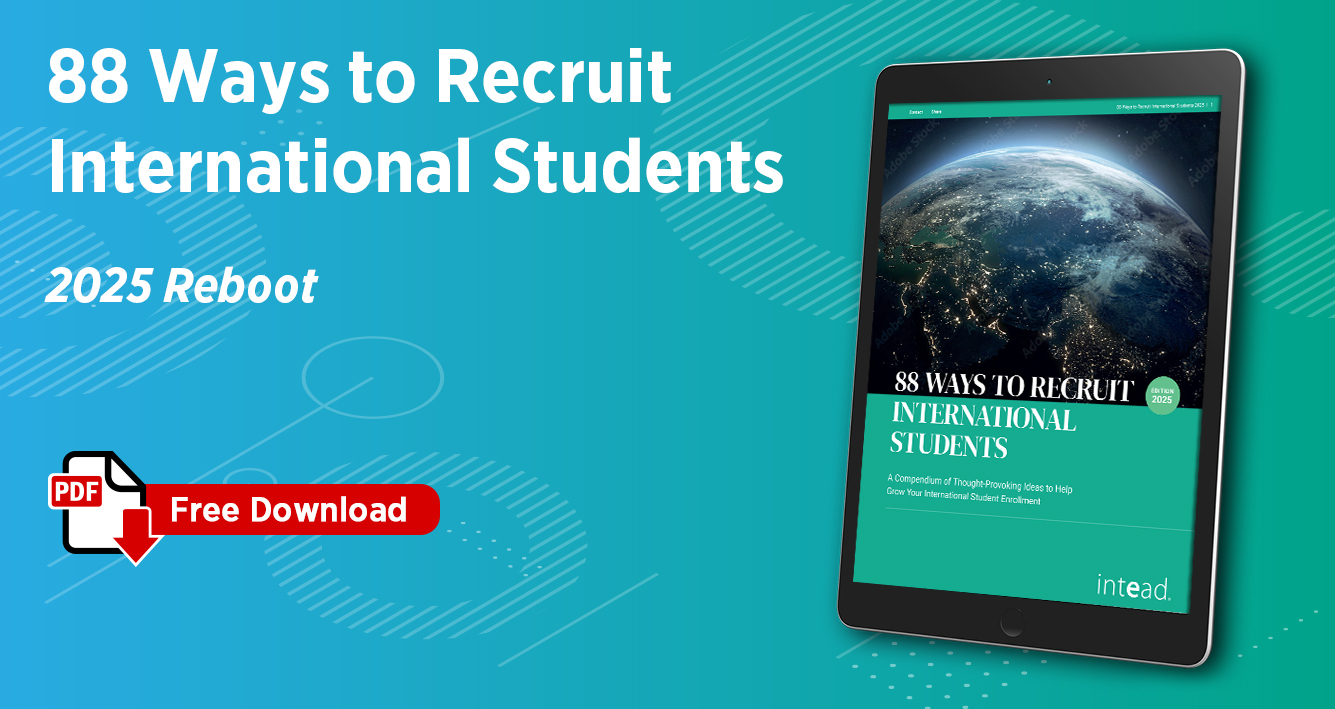
88 Ways to Recruit International Students: 2025 Reboot

Our aim with the original 88 Ways to Recruit International Students, published in 2012, was to create an accessible compendium of international recruitment tactics for edu institutions.  The download took off. At the time of publishing, we were hoping to get 300 downloads. We hit 10X that number in a couple months.  

So successful and widely used by academic and enrollment leaders in 2012-2013, a number of edu service providers in the field (our competitors) started paid search campaigns using our ebook title as their keywords ; -). Digital indicators that we were on to something. 

We have received terrific feedback and suggestions over the years from enrollment leaders. And we owe a debt of gratitude to our original authors, Lisa Cynamon Mayers and Michael Waxman-Lenz for their vision and groundbreaking research to compile our first edition back in the day. Our field has changed with new tools emerging (generative AI), others going away (remember Renren?). 

Currently, in 2025, some of our mainstay data sources (IIE, IPEDS, and EducationUSA) are truncated and under threat of disappearing as we go to press with this edition. Previously unthinkable. Also, potentially making some of our writing in the section called “Recruiting with US Government Support” a bit risky. Hopefully, that does not require an update too soon. 

A truly valuable addition to our latest edition: The intead team has been conducting market research and publishing our findings in our blog for more than a decade. Almost every summarized entry in this edition of 88 Ways has a link taking you to Intead’s deeper analysis of how that particular idea can work along with relevant data. 

So, yeah, you’re welcome.  


Meet Intead!  

  • Find us at APLU in June, NACUBO in July, and NACAC in September. Be in touch to share a cup of coffee in person.

Bookmark this: Intead’s Resource Center 
Access 800+ articles, slides decks, reports with relevant content on any topic important to enrollment management and student recruiting.  Check it out.


Over the years, the Intead team has contributed to the evolution of our field. In 2012, the world was still crawling out of the 2008 market crash. (Remember AIG? Bear Stearns? Credit Default Swaps?) International student enrollment numbers were really starting to climb. And digital marketing was just starting to mature.  

For perspective, the first iPad was released in 2010. In 2012, Facebook had almost 1 billion users. (Today, it has more than 3 billion.) Back then, Renren was very popular and growing as the Chinese Facebook alternative.  

Here’s an interesting digital tidbit: Google Vine launched in January 2013 and died in 2017. TikTok arrived on the scene in 2016 and by October 2018 was the most downloaded app in the US. Today, 3 billion downloads worldwide. 

 So, yeah, it’s been a minute and much has changed.  

Where are we now? In 2025, there are new global threats to the economy, to geopolitical safety, to student mobility. Generative AI is THE hot topic. WeChat is on every Chinese citizen’s phone. WhatsApp (owned by Meta, Facebook’s parent company) is one of the preferred communication tools for 2.75 billion global users (think Southeast Asia, Africa, and Latin America). 

Importantly, there are many, many new enrollment leaders and practitioners out there who are trying to make sense of it all. Enrollment leaders are trying to bring their new hires up to speed with a global perspective. 

That’s no easy task. 

This is where our 88 Ways ebook truly shines: as a resource that helps folks old and new to the field get a quick overview of the many channels, tools, tactics available to help enrollment teams find and recruit relevant pockets of international students around the world. 

The reality that no institution has the resources to market to the entire world prompts smart leaders to evaluate options and focus investments where they have the greatest return value, the greatest potential for success. 

We’ve given 88 Ways a reboot to reflect the current world of enrollment operations and opportunities. We’ve updated the suggestions, retired a few ideas, and offered up new recruitment insights that will no doubt spur worthwhile ideation from your team – whether your institution is US-based or not, this compendium will get you and your team thinking.    

Read on to download our rebooted ebook…

Read More

The Allure of Online Community College for Global Students

For tens of thousands of international students, community college has been the secret to earning an affordable US degree. And the interest is growing. 

The latest numbers out of IIE show 59,315 international students enrolled in US community colleges in 2023/24. This option for international students peaked in 2016/2017 at 96,472. With the pandemic, the total dropped to 49,099 in 2021/22. The latest figure shows a 21% increase since then.

What’s behind the uptick? According to the international students we’ve spoken to in recent months, it comes down to: 

  • Affordability (tuition) 
  • Transferability (credits)
  • Flexibility (study options)

Here’s the thing: Many of these students had never heard of community college until they began researching their options for studying in the US. Yet, once introduced to the idea, they were ready to sign on. 


Meet Intead!  

  • If you’re at NAFSA, let us know! We’d love to connect. Or, find us at APLU in June, NACUBO in July, and NACAC in September.
  • AI and the Future of Student Recruitment. A new webinar all about university recruitment in this dynamic, AICA's Emily Pacheco, Ashley Kern (MeetYourClass, Sightline), Ben Waxman (Intead). Register here.

IIE, UNESCO, the British Council, and other global student mobility evaluators all point to market growth over the next decade. Some of those projections are exceedingly rosy with US international student numbers hitting 2M or more in the next 5 to 10 years. We’re not so sure about that. We’ve seen these kinds of outsized predictions from reputable players before. And they didn’t pan out.  

Nevertheless, our own evaluation of the future is that there will continue to be a significant and growing number of students around the world seeking an international education (see our recent post explaining our thinking).

IIE is absolutely accurate in pointing to the significant capacity (number of seats) available in the US as compared to other common destinations (Canada, UK, Australia, Germany). Which brings us back to purchasing power – the growing number of internationally motivated students from countries around the world who will have the desire will also have less money. We see opportunity in that reality. 

US community colleges, this is your moment, if you are ready for it. Most of you are not.  

One proactive example worth talking about: College of the Canyons. The Intead team has been working closely with this institution which boasts a strong partnership with the University of California system. They use the internationally focused conferences (NAFSA, etc.) to build their network and regularly attend ICEF to connect to and manage a valuable agent network. And they deploy targeted digital campaigns to raise awareness and build the volume of student leads. The digital campaigns support their targeted recruitment travel.  

They do all of this work with a conscious effort to deploy messaging that educates students and their families about the value of community college as a route to a 4-year degree. 

The financial benefits alone are enough to pique prospective students’ interest. Community colleges cost a fraction of what a 4-year institution charges. And, depending on the institution, the ability to transfer credits to a nearby 4-year university to complete a bachelor’s degree is incredibly appealing. After all, these are visa-holding students who’ve already proven their academic capabilities. So, doing the math, many realize this approach to US education significantly cuts the cost of their desired degree while also lowering the barrier to entry for their preferred 4-year program. Win for the students. Win for the community colleges. Win for the 4-year institutions. 

But it’s not just about cost (though a lot of it is). Flexible programming, like online coursework, has opened the door to a wider range of students. Institutions offering international students the chance to start earning credits online before transitioning to on-campus studies are drawing in those who might otherwise hesitate—such as students with limited budgets, those who are still working on their English skills, or those who are simply getting themselves ready for university-level study.  

Take the story of one Taiwanese student we met. We’ll call him Chih-ming (not his real name). He spent his first year earning community college credits online from home. By the time Chih-ming moved to California to complete his associate degree, he had already adapted to the US education system and classroom expectations. This gave him the confidence to focus on adjusting to cultural differences when he arrived, making his transition much smoother. 

For students like Chih-ming, online courses are the bridge to achieving their aspirations, giving them the initial courage to pursue a US degree that will bring them closer to their dream careers. It is a low-risk confidence builder at a time when making the transition to a US university may seem daunting.  

Below we get into the considerations when recruiting (and retaining) international students who see online community college as their way into the US higher ed system. Whether you are an enrollment leader at a community college or a 4-year institution, there is something here for you. Read on...

Read More

Admissions Teams and Resilience. Lessons from the Past.

There’s a reason people look to Netflix as a case study in perseverance. After transforming the video rental landscape – from in-person stores to in-home DVD delivery, then to streaming and producing new video content – Netflix now leads a global shift in how content is created and consumed. Blockbuster was once its biggest rival. Today it’s YouTube. 

Netflix’s journey is marked with notable missteps and market hits. Headlines like “The Year Netflix Almost Died” capture the 2011 fallout when the company lost 800,000 customers and its stock value plummeted nearly 80 percent. Yet, here they are, stronger than ever and global. So, do you have a Netflix subscription? Yeah. Us, too. The company clearly knows how to recover.  

The lesson here: We can survive really rough times if we’re smart about our response to market volatility. Time to focus on the details and control the controllable. 


Opportunities to Meet the Intead Team  

  • Look for us at NAFSA in May, APLU in June, NACUBO in July, and NACAC in September. Let us know  if you want to connect at these events.
  • NEW WEBINAR: AI and the Future of Student Recruitment. All about university recruitment in this dynamic and changing AI environment. AICA's Emily Pacheco, Ashley Kern (MeetYourClass, Sightline), and Ben Waxman (Intead). Free Registration here. June 10, 2025 at 3pm Eastern time.

Bookmark this: Intead’s Resource Center 
Access 800+ articles, slides decks, reports with relevant content on any topic important to enrollment management and student recruiting.  Check it out.


US higher ed is at a pivotal moment as policy develops around the world and potential students consider how best to pursue their own interests.  How we respond now will affect our viability tomorrow and in the years ahead. The good news: history (and Netflix) shows us that recovery is possible. And there are lessons of resilience and recovery from within academia worth looking at as well. 

Take the UK. In 2008, the UK introduced a point-based immigration system and a Post-Study Work (PSW) visa allowing two years of work after graduation. Four years later, PSW was shuttered, causing an immediate decline in international student interest. A self-inflicted wound from Downing Street to the UK higher education system not unlike the international student disruptions being inflicted on US higher ed today. Interestingly, the number of main applicant-sponsored study visas issued only fell to 2008 levels and remained mostly stable until 2016, when numbers began to rise again.  

Even though overall visa numbers fell some universities took action that helped them outperform the sector and beat their own pre-2012 enrollment. Queen’s University Belfast was one with a comprehensive data-informed package of measures, including extensive faculty engagement, scholarship packages, enhanced agent involvement, and a focus on processes to improve the applicant journey. It was a whole institution approach matching strategic investment with operational excellence. They controlled the controllable.    

Then there’s Australia, which saw a steep international student decline a decade ago due to tightened visa scrutiny. Now, they are seeking to limit the number of international students studying in-country each year to 240,000. Canada, too, is currently working through its own hastily decreed cap on incoming international students, self-inflicted just last year.  

In fact, not once during this century have all four major anglophone recruiting countries (US, UK, Australia, Canada) had benevolent student and work visa policies simultaneously. There is almost always one or another imposing self-defeating rules upon themselves. Yet, 2025 brings us to a point where all four of these nations want to limit incoming international students – whether through direct intent or visa policy and rhetoric – rather than smoothing the international student path. It seems some policymakers have lost sight of the direct correlation between economic growth and academic strength (education and research capability). 

This current state is not the first period of stress and difficulty international students and institutions have faced. 

Despite bouts of turbulence, each receiving country continues to see an incoming flow of international students. In our view, it’s reasonable to assume international students will remain motivated to attain a foreign degree and a US degree will remain attractive to a large number of foreign students. So, we pursue what we can control and what can be changed (or challenged) and do so with a mindset that is measured not panicked.  

What does all that mean for your approach to internationalization? 

Read on…  

Read More

Recruiting Intel Digest: The Most Useful Stuff from Q1 2025

News of international student visa’s being revoked and stock market gyrations is all consuming. And rightly so. The White House seems hellbent on sowing chaos on as many levels as possible. In our world of higher ed enrollment and internationalization, international students are looking over their shoulders, unsure of what will happen next. Unfortunately, in the near term, unpredictability is the name of the game and every university administrator’s list of top priorities changes by the day (or the hour).

Harkening back to the stress levels our academic administrators and students experienced during the Covid-19 Pandemic. 

It’s enough to make you want to just turn it all off, hop a flight to Florida, and kick back under a beach umbrella on the sunny shores of the Gulf of America...right?!?  

Sad humor aside, we focus on providing global educational experiences, protecting students from harm, and playing exhausting defense to the chaotic shifts in policies as best we can. And, at the same, time we are playing offense for our institutions. How do we move forward? How do we fortify our international student programs even as our students feel shaken and ask legitimate questions about how and if they can continue to pursue a US education?


Opportunities to Meet the Intead Team  

  • Look for us at NAFSA in May, NACUBO and APLU in June, and NACAC in September. Let us know  if you want to connect at these events.

Bookmark this: Intead’s Resource Center 
Access 800+ articles, slides decks, reports with relevant content on any topic important to enrollment management and student recruiting.  Check it out.


With all the shifting campus priorities and endless breaking news reports, we take our role seriously as a condenser of information and a producer of insights on all things enrollment management. If we are doing our job, we are consistently additive to your work. Many of you likely missed some of our posts this past quarter (we understand!). So today, we offer a summary of the news we shared in Q1 ’25 with links to the articles and resources.   

You’ll find perspective on:  

  • 3 Things to do now, despite the enrollment chaos  
  • AI tools admissions teams will love  
  • How to spot and fix admissions pain points  
  • AIRC & AIEA conference insights 
  • How WPI students are ideating systems to address student mental health  

As an added bonus, at the end of the post, we offer a link to our uplifting April Fools Day post that caught more than a few people off guard. We all need a reminder of the fun life can offer now and again. This one is worth the click. A quick read for a lasting smile.

This quarterly wrap-up is a bit shorter than those in the past per our recent switch to posting every other week - our content optimization guided by our analysis of our reader data. Let us know if our new cadence is working for you.   

Read on…  

Read More