
Recruiting Intelligence

NACAC 2023 Reflections


Most inspiring feature of NACAC ‘23: Angel Perez, NACAC CEO, interviewing Maryland Governor Wes Moore and US Secretary of Education Miguel Cardona in the opening Plenary for 7,000+ attendees. Representation matters.  

This conversation, in the way it was introduced by a power team of NACAC leaders and the dialogue that followed, demonstrates so very much about what we can do to move forward in the face of strong opposition. Bring our unrelenting energy and talent, grounded in the forthright presentation of ideas and ideals. Meet the challenge, whatever it may be, with unwavering, appreciative inquiry. Communicate the vision in ways everyone can understand. 

The conference that followed with all the sessions, networking, and the many interactions showed that NACAC has still got it. And the Baltimore Convention Center people flow worked better than many other large venues we’ve been to. Below we offer additional 2023 Enrollment Trend Observations and the slides from our presentation on the current state of the international enrollment. The data we share offers you an outstanding opportunity to benchmark your own institution against nearly 200 others. 


Opportunities to meet in person:

The Intead team is gearing up for some amazing presentations and we hope you can join us. 

  • CIEE 76th Annual Conference in Paris, Nov 8-10, 2023 
  • PIE News Live in Boston, Nov 13-15, 2023 
  • AIRC Annual Conference – we’ll be offering our full day digital marketing workshop here in Phoenix, Dec 6-9, 2023 
  • ICEF North America Workshop in Miami, Dec 10-13, 2023 

Let us know if you’ll come share a cup of coffee and a conversation about all things global and digital (info@intead.com


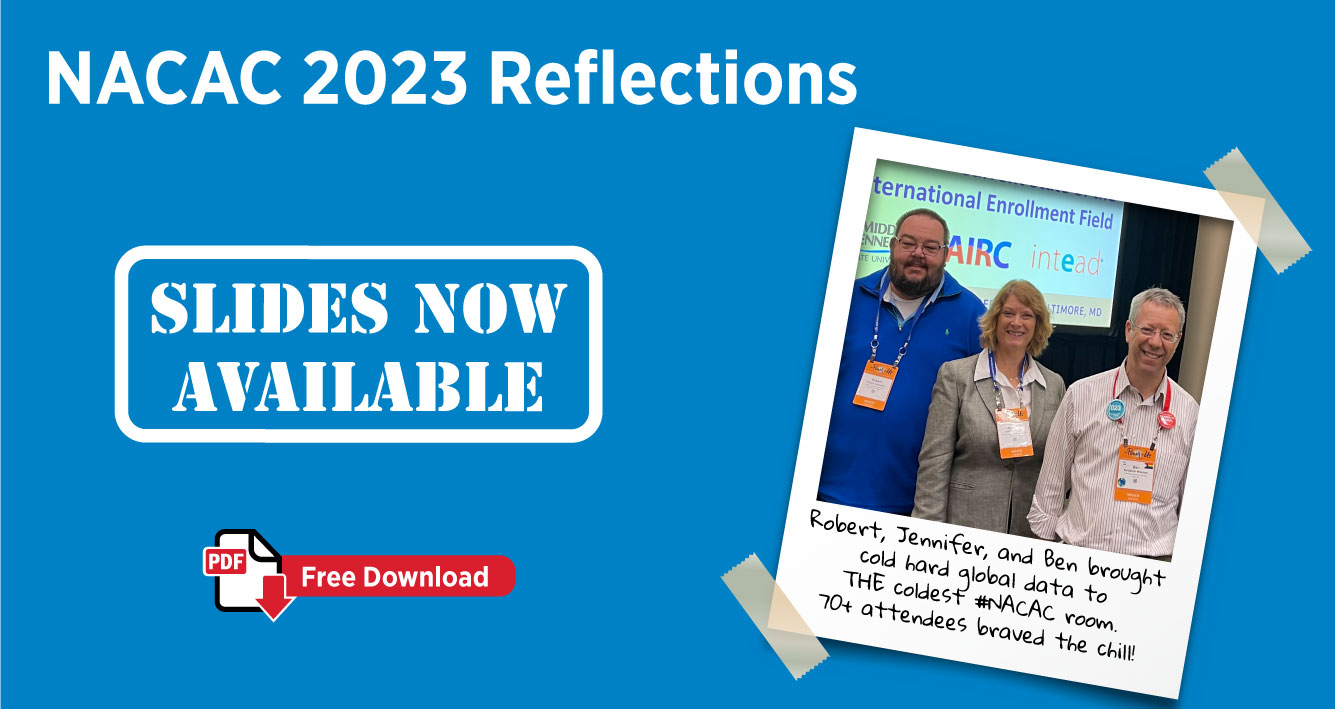
Intead’s presentation at NACAC 2023 with Robert Summers from Middle Tennessee State University and Jennifer Wright from AIRC was, of course, in the furthest most possible session room, and the A/C in the Convention Center seemed to get stronger and stronger the further you got from the entrance. So, we cheered when we saw 70+ attendees actually show up on the distant shores of room 348 and suffer through our data display in near arctic conditions. We thank you all! 

I exaggerate, of course. But it was pretty darn cold. And the data we presented wasn’t exactly warm and fuzzy. It is here and available for download in the link at the end of this blog post. Read on… 

Read More

Recruiting Intel Digest: The Most Useful Stuff from Q3 2023

For an industry that takes a lot of heat for being slow-moving, it sure feels like change is happening fast. You feel it, too, right? The pains of adjustment and growth. We’re learning to get comfortable getting uncomfortable. And we’re all here for it.

This blog, as you know, is one way you can keep up with important topics and industry trends that are propelling higher ed forward. This past quarter, for instance, we weighed in on pivotal topics like the current drivers of Chinese student mobility (hint: keep recruiting!), the integration of predictive modeling (new inescapable buzzword: AI), non-traditional student’s non-traditional needs, the use of agent aggregators, and more.

Of course, you were busy juggling all this progress with bottom line issues like student yield. So, if you didn’t get to all of our posts, we understand. Read on for a summary of the top news from Intead’s “Recruiting Intelligence” blog and click through on those topics that are meaningful to you now.


As we publish this week, NACAC 2023 just wrapped up in Baltimore. Some great opportunities to connect and learn, as always. And some growing and adjustment pains for NACAC as well as they figure out how to serve their members and regional leaders. Some natural frustration there, to be sure. We’ll share the slides from our presentation and more reflections on the gathering in a couple weeks.

Next Up: Join us in Paris Nov 8-10 at CIEE's 76th Annual Conference. Let us know if you'll be there (info@intead.com).


But here, and now, for many of you, we share some great reading while you are traveling the world in search of students while others are setting the recruitment plans in motion back in the office. Read on…

Read More

Yes! You should be in China, but here’s the thing…

Chinese student numbers are sobering. With the latest IIE data showing a 26.1% decline in total U.S. incoming students from China in 2021/22, you and your peers are more than aware. It’s the kind of stat that leaves a mark and prompts questions. 

Has your leadership posed this to you: “Should we be in China at this point?” 

If you regularly follow our blog then you know times like these call for a hard look at market diversification. It is a winning strategy. Your admissions team as well as the campus community stand to gain so much by building a diverse student population. Beyond the diverse, cross-cultural learning that is part of your mission, diversifying where you draw students from offers more financial confidence and reslience to your institution.  

Markets fluctuate. Diverse revenue streams stabilize. 

Today we look at why giving up on Chinese students is not in your best interest, nor is it in theirs. Diversify your market reach, yes. But tamping down your work with prospective Chinese families will limit your opportunities and future success. Maybe especially now. 

This is a blog post we think you'll want to share with other leaders on campus. A question: have you looked at the current youth unemployment rate in China?  


Quick aside: Ben and Iliana will be at the NACAC conference presenting alongside our colleagues from AIRC  and Middle Tennessee State University on September 22 in Baltimore. Can we schedule a time to chat? Coffee's on us! We still have room on our schedules.


For over two decades China has solidly been the top sender of students to the U.S. In 2021 alone this singular cohort added $10.5 billion to the U.S. economy per the U.S. Department of Commerce. And that’s on a down year. Sure, India is expected to surpass China in the not-too-distant future (more on that in an upcoming post), but China will remain a strong market.  

Let’s be clear: giving up on Chinese students during this downturn would be a mistake.  

Here’s the thing, while the declining enrollment of Chinese students in America is so much about the pandemic and politics, it’s the day-to-day reality of this cohort that should get your attention. The volume of students and their interest in a foreign education will continue to produce significant enrollment opportunities. Important that your strategy adapts to the times employing the right programs and messaging.  

Why is there continuing demand for a foreign education among Chinese students and families? Consider these current truths: 

  • High Youth Unemployment Rates: Unemployment in China within the young urban population is stagnating at an ugly 20%. A number so stubborn and bleak that the government recently stopped reporting it altogether. What’s more, 70% of these unemployed are college graduates, according to a recent article in The Economist. Even more troubling, reliable Chinese economists outside the government suggest that the current youth unemployment rate may be more than double the government's previously published figure.
  • The Government’s Get-Tough Response: Xi Jinping’s response to the current sour economy? He tells the young to “eat bitterness” and “seek self-inflicted hardships.” A bitter pill indeed for a generation that has grown up with aspirations of social mobility. After all, China has been more agreeable to private enterprise and other aspects of an open society in recent decades. Significant middle-class growth in China has powered the growth in international education and set a generation of expectations for opportunity. That time appears to be changing, a lot. 
  • Disillusioned and Disaffected: A pervasive sentiment among China’s youth is that, regardless of their efforts, achieving a better quality of life feels increasingly unattainable. Jobs are scarce. Cities are less and less affordable to live in. The once semi-open culture now feels less so. Even marriage is losing its appeal. This cohort is disillusioned and disaffected. The government has cracked down on social media posts that refer to "laying flat," (e.g. slowing down and basically giving up). The younger, unemployed/underemployed segment who are discouraged and laying flat become dependent on their parents (referred to as "bite old") as they feel they have very low or no revenue or career prospects.

Economic and political pressures over the next couple years look to be significant within China. Amid this undeniably challenging time for young Chinese citizens, they have eyes on the world through social media. They see opportunity out there.  

Read on for our take on how to reassess and adapt your strategies to better serve this vital demographic in the near term. And we want you to be prepared to adapt as the pressures within China change as they are surely going to.  

Read More

Release Your Global Entrepreneur Spirit

Those of us with an entrepreneurial spirit and a global network typically see things others don’t. In the enrollment management field, the entrepreneur mindset is an asset, and yet…and yet, if only those in control of the purse understood what we understand about global markets and student motivations. 

The opportunities are there. The need is growing increasingly intense as revenue sources are threatened or declining. The Intead team shares your entrepreneurial enthusiasm and we are here to offer the insights that help you succeed. It’s one reason we connect so well with our university colleagues.   

Now, if only there were an easy way to satisfy your global entrepreneurial instinct while demonstrating recruitment success in such a way as to unequivocally justify your funding requests and get the programs you envision started and growing.  

Ben and Iliana will be at the NACAC conference presenting alongside our colleagues from AIRC on Sept 22 in Baltimore. Can we schedule a time to chat? Coffee's on us!

The simple truth: the root of successful international student recruitment lies in understanding your target markets, connecting with them, and effectively managing them over time. It has to do with simply doing the work as opposed to finding some magical online tool that suddenly produces all the enrollments you ever wanted. (Note the word magical in that last sentence).

To DO the work, you’ll need to take a deep dive into the macro- and micro-economics of what drives student mobility. Sounds more complicated than it is.  

If you’ve been following our blog, then you know we’ve been helping institutions like yours recruit international students for a very long time. Our multi-cultural marketing team, our bandwidth, and the tech systems in place bring focus and produce macro and micro level insights. Oh, and results. See case studies in our resource center here. 

Our work takes a load off our university counterparts who, like you, are being asked to over deliver while being chronically underfunded (and understaffed). We’ve seen what works and what doesn’t, including three common mistakes that will derail any international student recruitment program. Avoid these at all costs. Read on…

Read More

Humanizing the Education Agent

Is it all about the enrollment numbers? Hitting “the number” is the driving force behind so much effort. So much pressure. A growing number of US universities now use education agents. And now, more universities are evaluating agent aggregators. Many have contracts in place with aggregators already and we hope those early adopters take a squinty-eyed, very close look at the results of those contracts.

How many applications? How many enrolled? And the quality of those students throughout the process. Are they succeeding academically?

If you are not familiar, check out our post and a recent (Dec 2022) lively ICEF panel discussion here. Hitting you in the face is a changing student landscape, the pressure to hit your enrollment number, and the agent aggregators who may be able to help, and quickly. Also in your face: the question of trust and integrity.

Some institutions have a hard enough time outsourcing their recruitment to individual agents, even those with third-party accreditation like AIRC. And beyond education agents who also use subagents, agent aggregators are farming out recruitment processes on a massive scale around the world using online platforms to scale the work rapidly. Questions arise as to how well any particular subagent is familiar with your institution, much less whether they are vetted for integrity.

Smart institutions want to know who’s representing their brand on their behalf. Fact: there’s just not enough transparency right now in this student recruitment system.

To be clear, we are in favor of agents. Human agents with whom you can connect directly, vet their talent, train, and guide. Intead has been a strategic partner to AIRC for more than a decade and our team fully supports ICEF’s efforts to bring enrollment leaders together with education agents from around the world. Both organizations push for clearly articulated best practices.

For more insights, check out our webinar with AIRC about the State of the Field. Our Intead Plus subscribers also have access to our ebook on University-Agent Partnership Trend Data and our Agent Management ebook all in our resource library available to all.

What we all know is that the system is less than perfect and students lose out when universities and agents are not doing their jobs with integrity.

Education agents, when brought into the fold as a partner, can be incredibly valuable. The key: partnerships, as in humans supporting other humans. 

Like any relationship, a meaningful partnership is built not bought. Is this even possible with the aggregator trend? Scale brings problems and when folks are lazy (and human beings tend to be), scale can bring disaster.

Look at the agent aggregator model from a simple business process point of view. If a company has 7,000 vetted partner sales offices, that company would need a robust credentialing team to monitor and control for quality. They would have a defined process for maintaining a certain quality of sales office staff hiring, training, work processes, and regular review of results delivered. Consider the level of effort hospitals go through to confirm the credentials and qualifications of their clinicians and physicians who have admitting privileges.

As you consider signing up with an agent aggregator, we highly recommend you ask tough questions about their staffing process, the vetting, and the monitoring. For institutions sharing their brand reputation with these outsource partners, it is buyer beware. Like super beware.

If you are not finding the quality control measures in place on the agent aggregator’s side, that means the quality control must be staffed on your side. Which then starts to beg the question: what are you paying for? Answer: the broad, global connection network. Keep in mind, that is something you can develop yourself in a way that is more targeted and more sustainable over the long term. Many institutions with thousands of international students started that process years ago and rely on their network today.

Not sure how to evaluate or where to start? Drop us a note.

Some of these aggregators are growing fast and coming on strong. They are shaking up the education market and making trusted agencies nervous. There are simply too many subagents operating in anonymity. Anonymity creates opportunities for questionable behavior (and we are being nice with our choice of words here).

 As we all broaden our scope to avoid the US domestic enrollment cliff and fold new target regions into our recruitment strategies, agents have an important role to play. Read on for 3 valuable tips on how to get the most out of this potentially beneficial partnership. Hint: it all comes back to developing trusting relationships with fellow, reliable humans.

Read More

Recruiting Intel Digest: The Most Useful Stuff from Q2 2023

Your summer intake is taking shape and your dreams of a solid fall enrollment are far less murky. At this point, the numbers are fabulous? Frustrating? Fictitious? Let’s go with that first one.

Data-informed actions, whether the data is good or bad, will always help you improve. Our team recently attended three incredible conferences—the AGB, ACE, and NAFSA—and let us tell you, they were like rocket fuel! We soaked it all up and shared the take aways with you. [Find our 2023 Conference Take Aways Here: AIEA, AGB, NAFSA].

Did you catch a glimpse of the perspectives we shared? With so much going on, many of our faithful readers missed a few important ideas here and there. From the fight over the non-traditional student to the data buffet problem, we left no stone unturned.

Not to worry. Scroll down and check out all the news from the previous quarter.

Oh, and one more thing before we dive in—if you are not there already, follow us on LinkedIn. You’ll see our insights as they break from day to day.

Read on.

Read More

Getting Started with Hootsuite for Student Recruiting

Your prospective students spend nearly 6 hours a day on social media. Doubt their usage will dwindle anytime soon. The good news is you know where you can find your audience. It’s just that wrangling their preferred platforms can feel like a lot.

That’s why we look to social media management tools to help organize our many, many social campaigns. The OG being Hootsuite. A global platform for all platforms, helping you and your team manage accounts from a single dashboard. It’s a really great shepherd for your flock of content. What Hootsuite brings for large institutions ranges from:

  1. Monitoring all social accounts
  2. Scheduling posts in advance
  3. Team Collaboration
  4. Analyzing social media performance  
  5. Targeted Ads
  6. Campaigns 

This Hootsuite primer is a great read for the members of your team tasked with managing all the details. Be sure to pass it along. And do take a minute to check it out for yourself. It’s a quick, practical read. 

This is one of our "Getting Started With..." series to help your team make the most of the student enrollment tech tools out there. Share our glossary of these popular posts with your digital team. And... 

Read on.

Read More

Thinking Big Opportunities: NAFSA 2023 Slides

Let’s start with this: our NAFSA 2023 slides are perhaps the most concise and clear educational tool we have produced to-date. When you have 3 strong speakers and just 50 minutes, you really need to focus if you want to get your point across.

Each slide represents far more content and conversations we would love to have with you. During one of our future conference sessions, webinars, or anytime, really, just reach out and let us know you want to chat.

Today we share our biggest takeaways from NAFSA 2023. These are thinking big opportunities.

We were honored to share the dais with Paulo Zagalo-Melo, SIO and Associate Provost at Western Michigan University and Karin Fischer, Senior Writer at Chronicle of Higher Education. Our focus: what kind of data and other information can truly inform our international student decision-making? And we considered the flip side: what information is TBU (True But Useless)?

A bit of foreshadowing: A focus for the Intead team going forward is going to be on international student employment and all we need to do as a community to make that process work better. You’ll see much more on that topic from us over the next year+. We have some amazing partners to help us get you the data and tools you need to improve your institutional approach. Watch this space.

You want answers about valuable vs. TBU data? Check out our NAFSA 2023 slide deck (download link at the bottom of this post.) Yes, we are making you work for it ; -)

Read More

You’re In the Right Place: Predicting the Future of Student Recruiting

The enrollment cliff has everyone a little on edge. People are burned out and frustrated. Leadership is looking for bigger gains in shorter time frames. And traditional students just aren’t showing up in ways they traditionally have.

It’s so clear that higher ed is at an inflection point. Thank the pandemic. Thank technology. The economy and unpredictable job market. The changing student landscape. What you need now more than anything is support. Ideally in the form of a soothsayer to tell you where and how to invest your time, energy, and resources. If only.

Our advice: take a deep breath and read this post.

While soothsayer we may not be, we do have some perspective on what lies ahead. And our record for predicting changes in the market has proven accurate for more than a decade. Long before the recommendations below became standard practice in enrollment management (they all sound so obvious now, right?), we advised colleagues to:

  • Make better use of your CRM (or get one if you don’t have one), and embrace the add on features and API connections that improve tracking and results.
  • Identify staff with the skills you need for each function of the enrollment process. Your creatives are not your meet and greeters and they are not your data analysts. You need all of these skills.
  • Develop your international alumni as global ambassadors. (Most of you are still not doing this).
  • Find reputable commission-based recruiting agents in your target countries and invest time in managing them very carefully.
  • Train your domestic recruitment team in the nuances and needs of international students already studying in the US so they know how to address the important topics (visas, parental concerns, economic realities, etc.)

We know, it’s all old hat now. But a decade ago, very new to international enrollment management teams.

Today we are facing some pretty significant headwinds. Post-pandemic changes to how students evaluate universities. Growing financial pressures facing families. Increasing importance of careers and the ROI of your degrees. Heightened interest in certificates and shorter paths to career growth. Political divisiveness harkening back to the US civil unrest of the 1960s (or 1860s?). Are you factoring social justice including climate activism into your marketing plans?

These factors are all part of the student and parent mindset as they evaluate investments in university level education. The pool of nontraditional students is much larger and more diverse than the shrinking traditional student pool. And yet, the international student pool is one that is growing and projected to grow dramatically in the coming years.

If you’re ignoring any of these market segments, we strongly advise you don’t. Our analysis of and predictions about what influences student decision making, the tools and processes you need in place to be both efficient and effective, this counsel has been spot on for a very long time (our blog records act as our receipts).

You’re in the right place. Read on to be sure you are able to anticipate what is next and what to do about it.

Read More

Mind the Gaps: Managing Student Expectations with Reality

Let’s talk about the gaps between your international students’ expectations of studying in the U.S. and their actual experience. You know, the sort of expectations on which retention is built.

Sure, some of the ideas international students have of what it’s like to study in the U.S. are based on factors beyond your control. But a lot of their anticipation is based on promises – literal and otherwise – made by your institution. It’s now up to you to deliver.


We Are Here at NAFSA 2023: Our presentation with SIO Paulo Zagalo-Melo (Western Michigan University) and Reporter Karin Fischer (Chronicle of Higher Ed) is at 9:30am today (Wed. May 31). A reality check with the data that informs our student recruitment decisions. Hope you'll join us. Be in touch to meet with us during the conference. We'd love to share a cup of coffee and talk all things student: info@intead.com.


To help you deliver on student expectations, we’ve gathered a few key tips worth evaluating and potentially implementing when recruiting and supporting the international students interested in your campus. Hint: it’s all about meeting international students where they’re at. For more perspective on the importance of maintaining a student-first approach see our recent post.

In the meantime, read on for 5 quick ideas on how your institution can narrow the gap between expectations and the reality your international students experience. Recommendation number 5 is likely the most important if you’ve not already done it.

Read More