Recruiting Intelligence

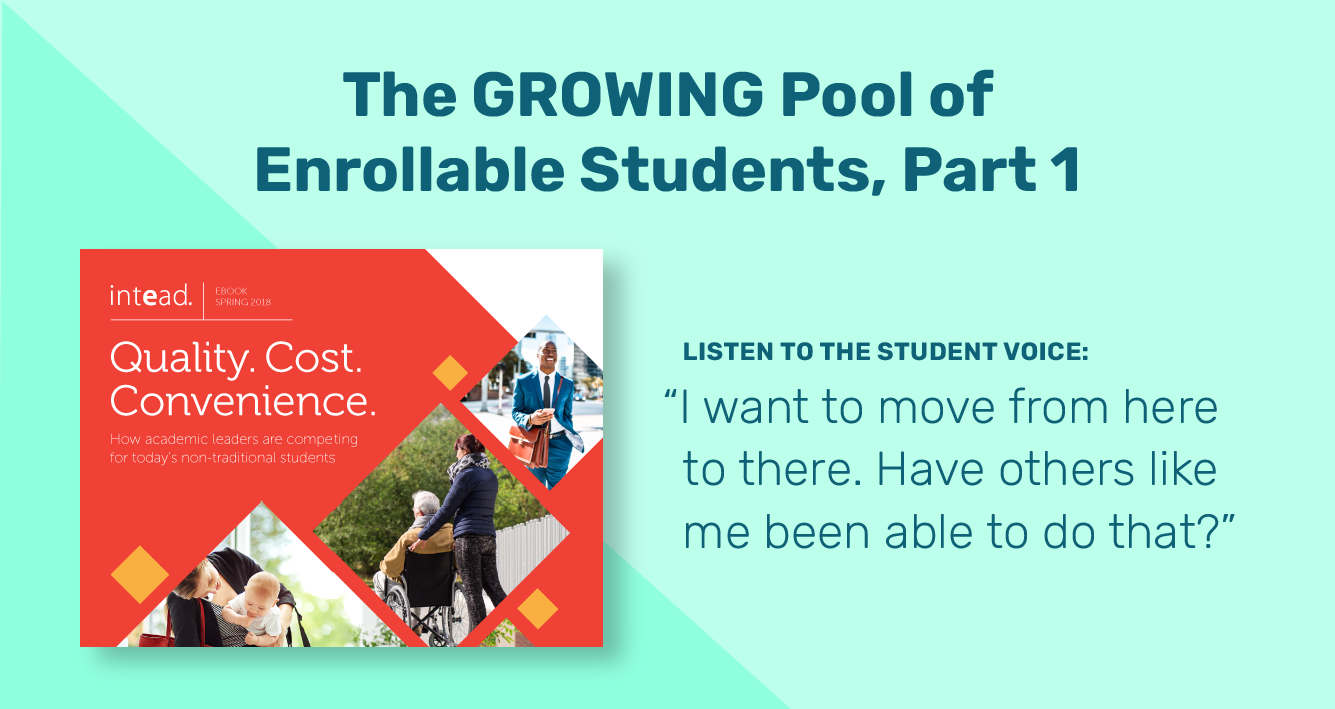
The GROWING Pool of Enrollable Students - Part 1

Despite the dire headlines throughout the academic industry addressing the "looming crisis" and the excellent research on the topic from so many great sources (thank you Chronicle of Higher Ed), the availability of college-ready students is growing at a rapid pace.

How could we say such a thing!!??!?

Everyone knows the pool of high school students is going to fall off a cliff after 2024-2025, right? The demographic trends lines have shown this for years!!! The big academic marketing and analytics firms (you know who we are talking about) are pushing their predictive analytics services as your holy grail and so many institutions are buying into it.

Not so fast! Please, not so fast.

Welcome to our three-part series on Non-Traditional Student Recruitment. You will want to share this one with some key colleagues at your institution. There’s a theme to this series: Be Nimble!

Research and analytics must lead to action and results. And 36 million potential students could be evaluating your institution right now. Do you have the right advisers and team to help you be nimble and capitalize on the opportunity?

A recent comment from a highly experienced senior procurement officer regarding her institution’s contract with Intead, “There is no other company that could do this project for us.”

Listen to the Voice of the Customer

A time of change does require expenditure. Knowing where and how to spend is the key. The big question: Will the board-level advice you are paying for pay off for you?

Answer the bigger question that is actually going to improve your enrollment numbers. It is a question that your audience (students) are asking and you need to be able to answer:

“I want to move from here to there. Have others like me been able to do that?”

Read on for the clear direction for enrollment growth. It is not simple, but it is the future…

Read More

When We Gather, We Improve

I’m here at the Society for Neuroscience annual conference with nearly 28,000 of my best friends who all REALLY appreciate nerd humor. They are wicked smart and doing things that make all of our lives so much better. It's all about the science.

This is a collection of very studious folks from all over the world. More than 40% of SfN’s ~37,000 members hail from countries beyond US borders. And when they all gather to discuss their science, they are representing academic institutions and other research-focused entities from just about everywhere.

Among them are Principal Investigators, post-docs, grad and undergraduate students. And they represent all those institutions where the next set of neuroscience graduates will one day work. Yes, research leads to careers.

There is so much youthful energy here. So many students developing their careers alongside luminaries in the field.

Sitting in on neuroscience lectures is far different than the digital marketing sessions I usually participate in. Soon, I'll be applying my cortex and synaptic activity to student recruitment marketing again -- a much more familiar topic ; -)

This December, the Intead team will be attending the TABS conference on private boarding high schools, ICEF North America and AIRC all about international student recruitment. We hope you will find time to escape your desk and breakroom and join us. We will learn together and improve together. Send us an email if you’d like to find time for a coffee together.

Read on to download our Intead Index on conferences in our field. We’d welcome your input as this index needs updating. Where do you find value when you attend an industry conference? Please let us know by adding to the comments below.

Read More

#EdTech Basic Training: Bootcamps and the Future of Coding

Students are settled into their dorm rooms, pumpkin spice is again a major topic of conversation, and the craziness of the drop/add period is wrapping up. Summer might already feel like a distant memory. But, way back in June—before all of the student orientations, barbecues and beach trips—we spoke about credentialing and badges. One of the non-credit suggestions we made was for universities to offer coding bootcamps in order to help credential their students or alumni.

There are so many ways to engage prospective students at all levels who want to advance their careers. Our Non-Traditional Student e-book Quality. Cost. Convenience. has 9 case studies from your peer institutions. It might be worth a look if you’ve not already downloaded it. The Extended version for Intead Plus members includes three bonus chapters on market segmentation and recruitment strategies.

Read on to take a look at some of the options already out there for these coding bootcamps, and see if they actually make a career difference for students and offer your team an enrollment edge.

Read More

Non-Traditional Students, Public Radio, & You

Ahhh, NPR. What can we say: we’re fans. We’re suckers for Ira Glass’s vocal fry, we still listen to re-runs of Car Talk, and Kai Ryssdal's voice on MarketPlace is always reassuring in volatile times. Yes, we own more than one telethon tote bag.

But the public radio stalwart isn’t simply a source of endless commuting distraction. For the past few months, it’s also become one of our go-to’s for insights into the non-traditional student space, a growing market we’re following closely.

Ready for a new favorite resource to stay on top of your enrollment management game?

Read More

Higher Education is Changing. Are You Keeping Up?

Today on the Recruiting Intelligence blog, we’re excited to broaden the enrollment conversation.

You may have read our guest post a few weeks ago from Dr. David Di Maria about the commonalities between international and non-traditional students.

Most Wednesdays, we cover topics related to international student recruitment. As our readers know, effective international student outreach requires an understanding of two fundamental concepts:

  • The first idea is cheesy, but true: no matter where we’re from, we’re all people with common core desires, fears, and drives. The desire for a safe and enriching environment, fear of isolation or failure, and the drive to succeed in our chosen field are pretty universal.
  • The second concept is the hard part: While we all share the same broad needs, our background does shape the best ways to capture our attention, meet our desires, assuage our anxieties, and encourage our dreams.

Understanding that duality is the key to effectively reaching international students and prompting them to take action (read that as "prompting them to apply"). It’s also the key to reaching another, increasingly important group of students. We’ve been thinking about these learners a lot lately, and we’re jazzed about discussing them here today: “non-traditional students.”

Non-traditional students are the future of education—both international and domestic. This is a group of students that clients are asking about more and more, and a market segment none of us can afford to ignore it.

We’re so certain of this, in fact, that we wrote a whole book about the subject. 

Read More

You Have Your Student Segmentation, Now What?

Student segmentation and predictive modeling are becoming mainstream discussion topics for university administrators. How do you reach, recruit and serve different student segments?

We have once again been reflecting on a report distributed by the Parthenon Group a few years ago that we still find relevant today. Isn't it amazing how strong content can remain relevant over time? This particular study on audience segmentation was called: The Differentiated University. Let's take a look and see what new insights you (and all of us) can take away from this research. 

Read More

Innovative Case Studies in Higher Ed: Learn From Your Peers

Can you hear the clamor? That's enrollment professionals across the US trying to figure out how to fix their graduate enrollment numbers. Oh, and their undergrad numbers too. You've probably already been thinking about where the emerging markets are for higher education as the enrollment trends shift.

The tools we use to segment and engage global student markets are equally applicable to domestic markets here in the US as well. We have a number of international higher ed clients seeking to build awareness in and enrollment from the US market.

The US domestic market is a complicated one, to be sure. As the current international enrollment numbers decline, we are helping both foreign and domestic institutions identify and capture new markets. It's a time of great dynamism. 

Want To Know What Your Peer Institutions Are Doing?

This is why we are talking more and more about "non-traditional" students. Did you know that non-traditional student enrollment is projected to grow 21.7% from 2016-2022? 

A desire to attract these domestic segments (the range of non-traditional students) is transforming the way that many institutions think about their programs, campus life and overarching communications strategy. 

You may have read our guest blog post from a few weeks ago by Dr. David Di Maria, covering the many similarities between the underlying motivations of international and non-traditional students. If not, we highly suggest you check it out here

This week, we want to share with you some personal stories from the people behind institutional brands doing very big things in the field of non-traditional student recruitment. We're willing to bet there are a few people in your own institution (just a few clicks away) who could use these insights.

As always, we encourage you to share this content. And we encourage you to reach out to us and let us know what challenges you are facing. Maybe you can prompt our next research project.

Are you ready? All of these excerpts are taken directly from full-length interviews you can read in our latest e-book, Quality. Cost. Convenience. How Academic Leaders are Competing for Today's Non-Traditional Students. If you enjoy what you read here (or know someone else who might) we invite you to download the full e-book

Let's see what some of your most innovative peers have to say... 

Read More

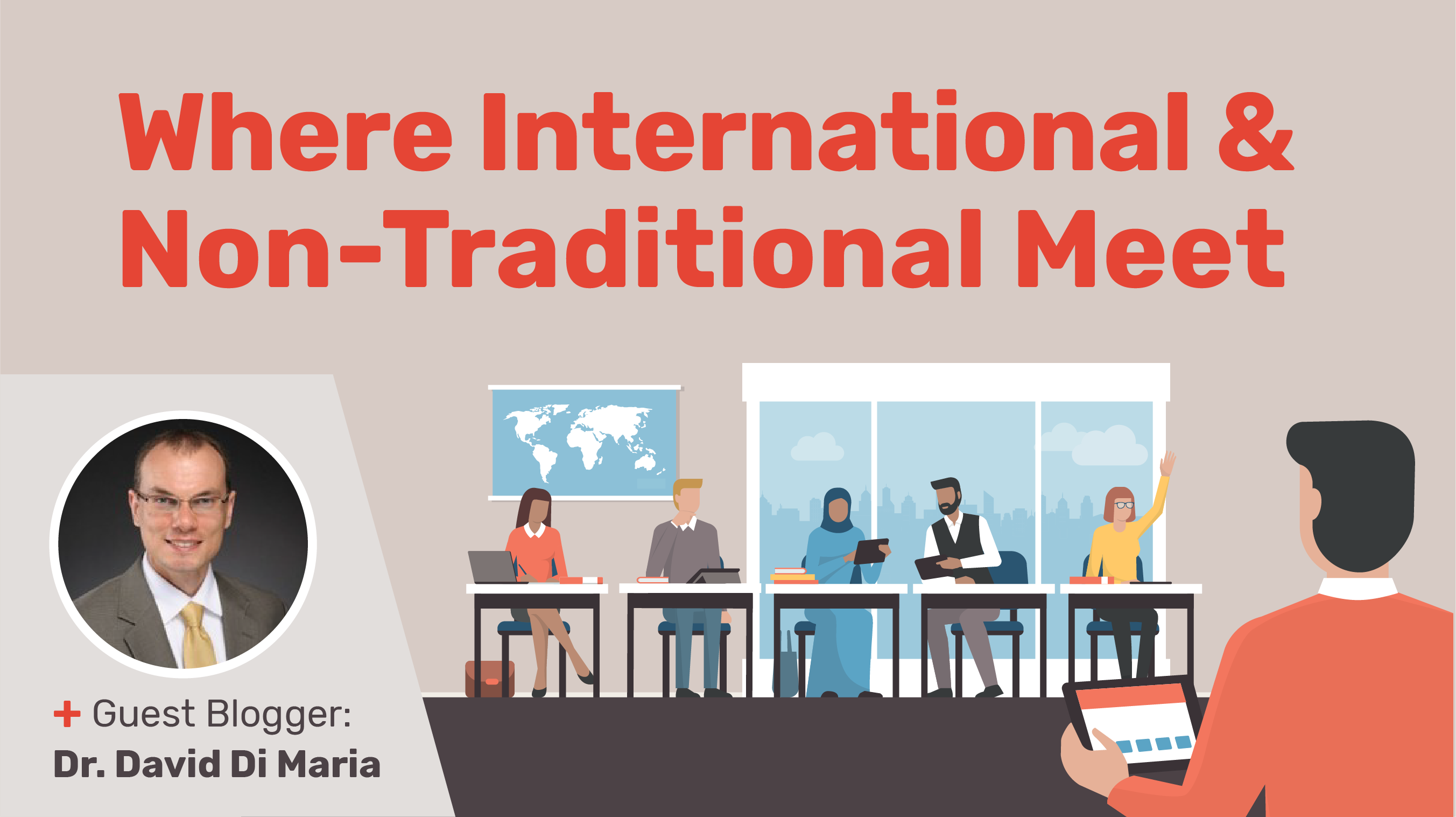
Where International and Non-Traditional Meet

Where International & Non-Traditional Meet

Dr. David L. Di Maria, Associate Vice Provost for International Education, University of Maryland Baltimore County, is a renowned expert on international education. Dr. Di Maria previously served as the President of the American International Recruitment Council (AIRC) and Chair of NAFSA’s International Enrollment Management Knowledge Community. We’re delighted to have him as a guest writer here on the Intead Intelligence blog.

Before you dive into Dr. Di Maria's wisdom, we need to share the opportunity to gain wisdom from one of our other industry's leaders: Karin Fischer, veteran education industry reporter whose stories appear in the Chronicle of Higher Education and the The New York Times will team up with Intead CEO Ben Waxman to explore current political perspectives coming out of China and India. 

Upcoming Intead Webinar: What's Politics Got To Do With It? Depends on Whom You Ask.

This post below is adapted from Dr. Di Maria’s recent piece for The EvoLLLution: How to Make International Learning Opportunities More Accessible to Non-Traditional Learners.


It’s simple: non-traditional students are changing the landscape of higher ed in the U.S.

The typical “traditional” college student is 18-to-24-years-old, living on campus, and financially supported by parents. That archetype is fading into history. More and more, students are…

  • Embarking on degrees while juggling careers, kids, or parents who they support
  • Living off-campus
  • Completing their education online
  • Taking courses part-time

These students are rapidly becoming the new traditional. And yet, they are too often left out of the global learning community.

How do we fix it?

Read More

The Risk of Following vs. The Value of Leading

Reflecting on AIEA conversations and what we are seeing in the field, I find myself thinking about the risk of being a follower and the value of being a strategic leader.

  • Followers see where the crowd is headed and go there without due diligence.
  • Leaders see where the crowd is headed and then check the numbers.

This is important. Increasingly so.

The effort to recruit international students is heating up in the US. The pressure on university administrators is growing. With India and China sending the most students to the US, most newcomers to the field – the universities finally joining the fray and looking to diversify their student body – are turning to these source countries. It can be a mistake.

We are seeing the global education agent network being pressured to produce more students for more campuses. That increased pressure is going to bring us renewed stories of fraud and inappropriate recruiting behavior. We don't want to see anyone caught up in that mess.

It is important, REALLY important, to align your team with talent – the kind of partners who don't cut corners and have your best interests at heart. This field is full of questionable characters, as we all know. Many of us have the scars to prove it.

Following our travels to San Diego for our Annual Student Recruitment Bootcamp and moving on to DC for AIEA, the Intead team is grateful for all of the opportunities to connect face-to-face with you, our colleagues and friends in such a challenging time for our industry. (More on our Bootcamp in a post in March.)  Focusing on AIEA for a moment, we have to thank AIEA's Darla Deardorff for feeding so many of us with great information and wonderful food for a few days in DC. The AIEA conference was well run and well delivered. Informational and so often inspiring.

During the conference, we had the pleasure of giving presentations on enrollment trends with Kaplan International and on US–India university partnerships with Monmouth University and Sannam S4. Both sessions were filled with lively discussion and audience engagement. As always, we shared ideas and had fun learning from each other. Thank you to all who attended! It is always a pleasure.

Read on for more reflections and insights from the conferences and my thoughts on enrollment trends and predictions. 

Read More

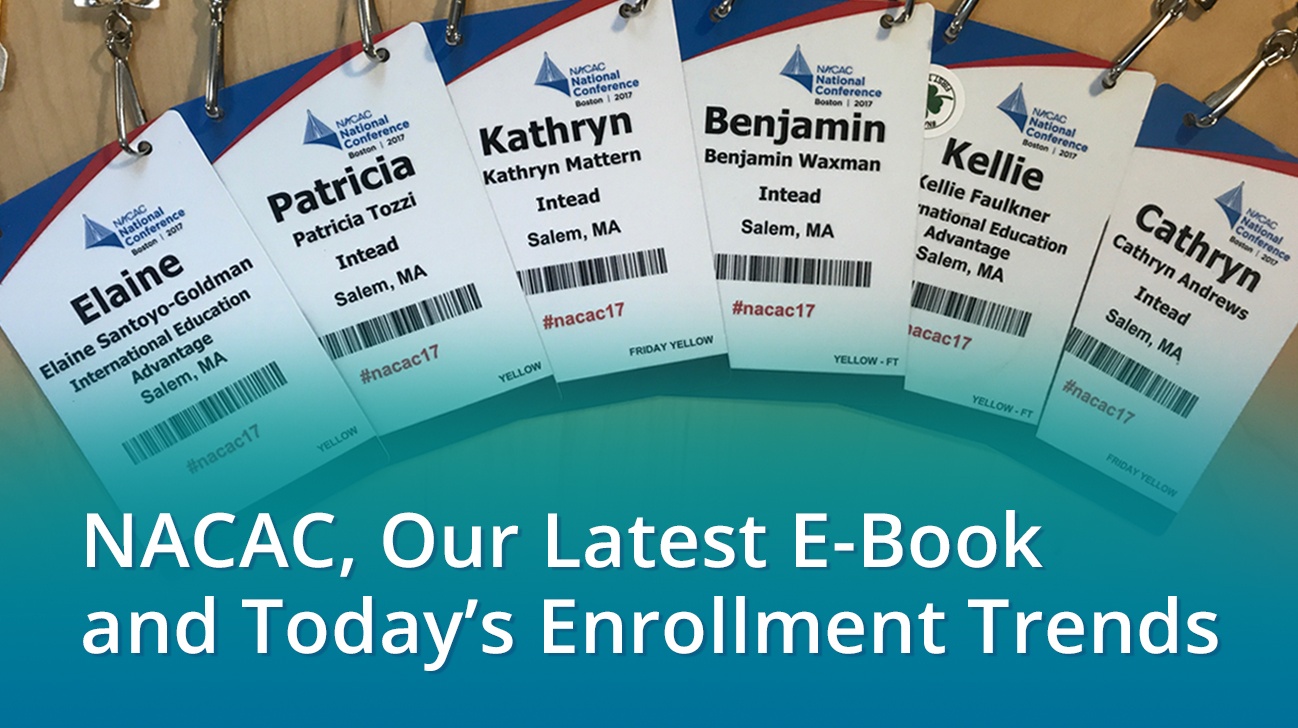
NACAC, Our Latest E-Book and Today’s Enrollment Trends

Last week, Intead presented at the NACAC conference—what an exciting whirlwind! We met so many wonderful experts in the field of recruitment and were able to share our insights with many of your colleagues during our session on international recruitment, hosted with our friends Sundar Kumarasamy (Northeastern University) and Steven Bloom (ACE). We are so thrilled that so many of you made it out to our early morning session!

If you were not able to attend, as our loyal readers, we would like to extend the invitation to register to receive our latest e-book, Quality.Cost.Convenience: Beating the competition for today’s “non-traditional” students before it is released to the public. Read on to secure your copy.

Since the conference, we have been thinking a lot about today’s political environment (isn’t everyone?) and the impact it is having on recent enrollment trends. While we were in Boston, we had so many great conversations about the latest 2017 enrollment data, marketing strategies to combat dips in enrollment and what the future holds. So, this week, we are taking a brief look at research around enrollment trends in the U.S. and U.K., post-Brexit and U.S. presidential election.

Please read on for key data and industry insights (and to register for the new e-book ;-)

Read More