Recruiting Intelligence

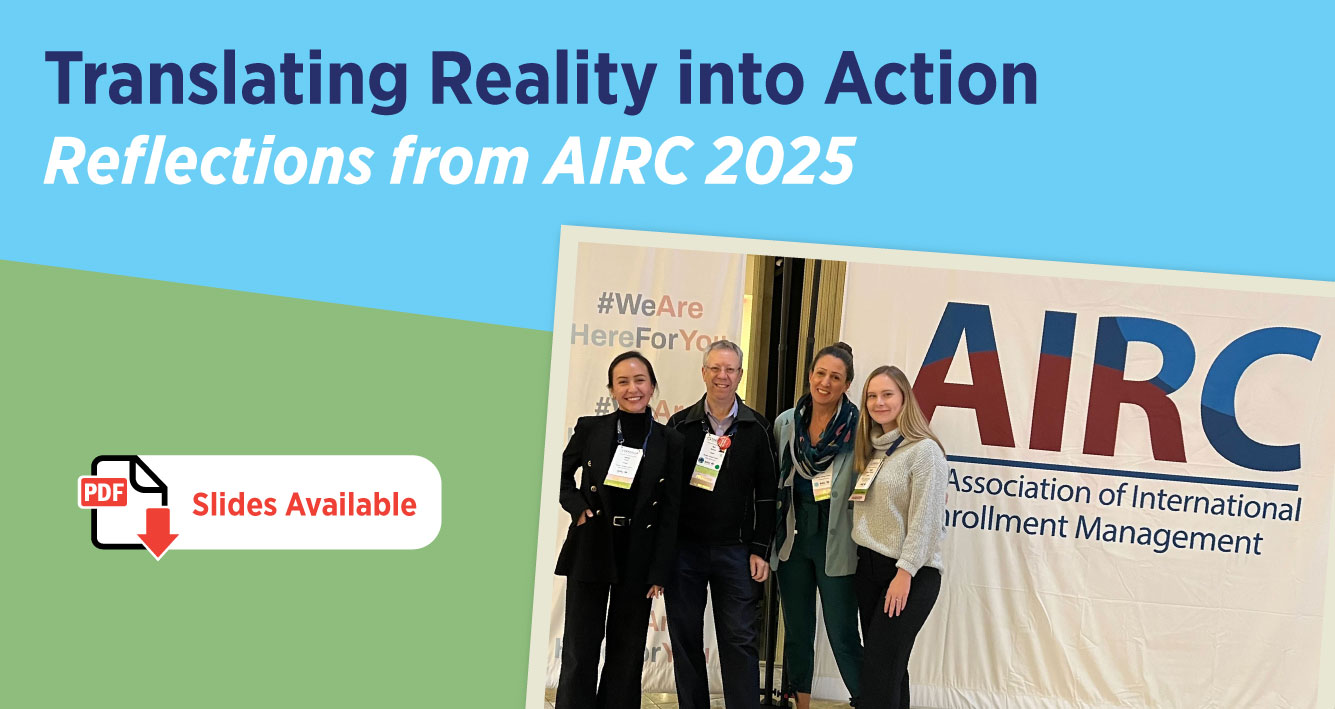
Translating Reality into Action: Reflections from AIRC 2025

Is your leadership happy right now? How about your staff? 

We’re talking to you, enrollment leaders. The conversations we are having consistently are about managing up and managing down. The challenge of leading those around you through significant disruption. 

Your institutional leadership is rightfully worried about the enrollment future (domestic and international). Your staff are rightfully worried that the current climate is a doomsday scenario for academic institutions. There is a lot of job dissatisfaction going around.  

Still, truth is, there have always been times like these. The stressors may be different, the intensity a bit higher, but the anxiety and resulting need for focused work to solve problems are nothing new. 


Meet Intead! 

  • Find us at AIEA in DC in February, WEIC in DC in March, and ASU+GSV in San Diego in AprilBe in touch to share a cup of coffee in person.
eBook Reboot:  88 Ways to Recruit International Students  2025 update. Your tactical toolkit for the year ahead. Covering all the bases in 10 quick-read chapters. Fosters great ideation discussions with your team.


At the AIRC 2025 conference that just recently wrapped in Atlanta, almost all of the presenters and participants ultimately addressed the question of how to talk to institutional leadership and help them to understand the complexities of internationalization –  because most academic leaders are unaware of how the international education community works. 

Helpful slides from one of our sessions are available below. They speak to 6 hesitations leadership leans on when deciding not to invest in international and what you might present to them to modify their perspective. 

But here’s the focus: institutional leaders do not need to know HOW it all works. They simply need to see the value of it and the investment required. To do that, they need to listen to and trust the messenger (that’s you).  

Read on… 

Read More

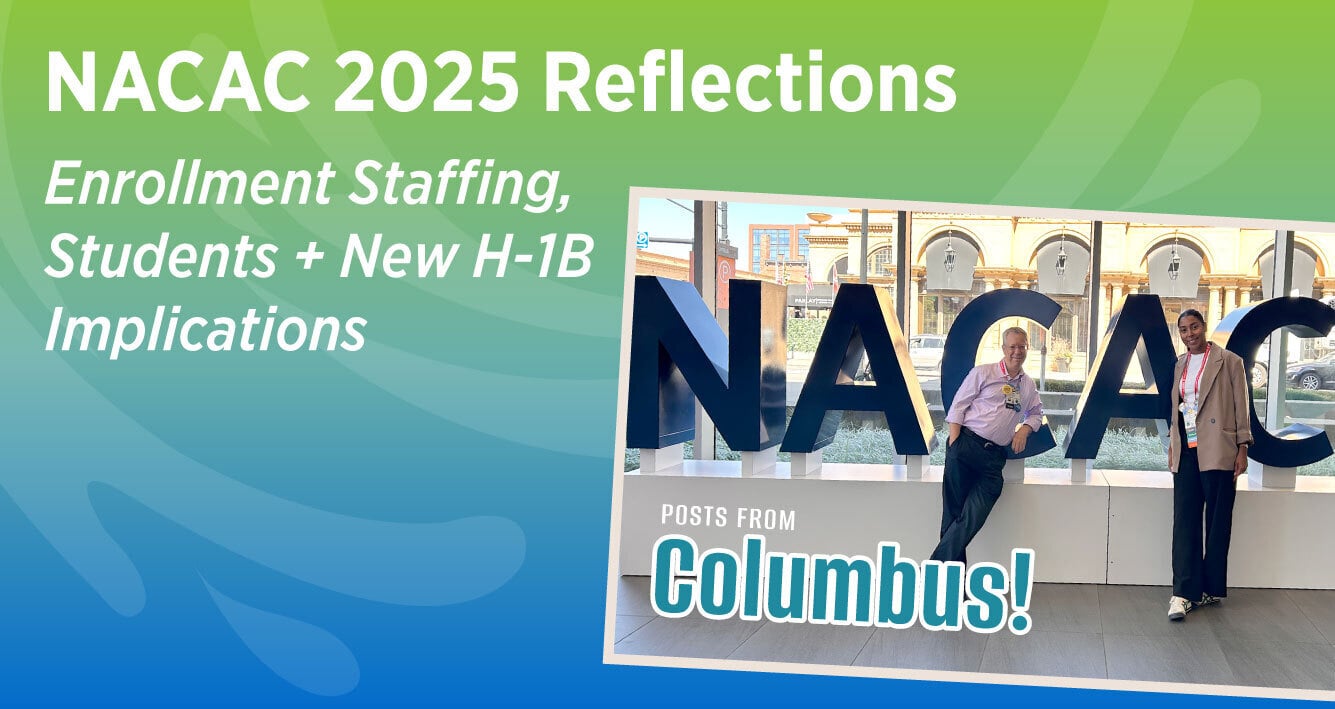
NACAC 2025 Reflections: Students, Staffing, + New H-1B Implications

How far does the data go in helping us develop a strategy? Create a plan? 

Iliana and I took to NACAC in Columbus, Ohio this year. Reveled in hearing Brene Brown talk all things leadership and vulnerability. Participated in the sessions on global and domestic enrollment realities. Wandered the expo hall checking in on colleagues and clients throughout.  

NACAC is such a multi-faceted group of academic leaders paired with the many, many student-facing counselors. The responsibilities of these different facets of higher education are often at odds and that too is on display at every NACAC conference.  

Pro Tip: If you truly want to understand an organization, attend their business meeting and listen to the issues raised (or ignored). Fascinating stuff and the true grist that both slows and drives progress. NACAC, along with the many other associations serving our community, has very well-meaning leaders and members all struggling to figure out how to move forward in aggressively turbulent times. 


Going to AIRC in Atlanta? Let’s connect! 

Join us Dec. 3, 2025, 1 – 4 p.m., for our workshop, Exploring Third-Party Business Models for International Student Recruitment,  or any one of our other conference sessions. You are  registered , right?  🙂

Or, meet us at:AIEA in DC in February and ASU+GSV in San Diego in April.


Kudos to NACAC leadership for never shying away from the hard issues in the face of ever-present financial challenges. Prompts feelings of mad respect for all those who put in the long, fretful hours forging the path forward. Especially now when our fairly recognizable business landscape has morphed into a very strange wilderness. 

The Intead team feels the consistent pressure to deliver actionable insights to our community. Below, we share a few significant takeaways from our NACAC presence. What we’re thinking about:

  • How will chief enrollment officers deliver the enrollment numbers their institutions need?
  • Where will we see universities closing next year?
  • And will the new H-1B fee proposal from the White House support international student mobility to the US? (spoiler alert: Yes!) 

Read on…   

Read More

Everything Has Changed! But Has It?...

During a recent staff meeting, it occurred to us: over the past 15 years the Intead team has given more than 100 conference presentations. That’s a lot of higher edu conferences! And if there’s one theme that runs through them all, it’s change. 

(We like to think another theme running through them all is innovative use of data leading to valuable enrollment insights, but those of you who have been in the sessions can be the judge of that).

Five years ago, Covid “changed everything.” Mask mandates and travel restrictions arrived so suddenly, they still feel within uncomfortable reach. While those disruptions have mostly passed –  some effects stuck. Think: hybrid work, remote classes.  

And yet, at a NAFSA session on enrollment marketing earlier this year, when a fellow attendee remarked with dismay, “My school is doing all the same things we did before Covid. But everything has changed…” We couldn’t help but wonder, has it? 


Meet Intead! 

  • Find us at NACUBO in Phili and NACAC in Columbus in September, NAFSA Reg XI in Springfield in November and AIRC in Atlanta in December. Be in touch to share a cup of coffee in person.

Bookmark this: Intead’s Resource Center 
Access 800+ articles, slides decks, reports with relevant content on any topic important to enrollment management and student recruiting.  Check it out.


From everything we’ve seen, heard, and researched, students still want what they’ve always wanted: a good education, a career on the other side of graduation, meaningful friendships, and some international adventure.

These aspirations persist – despite anti-immigration rhetoric, despite visa complications, despite global uncertainty. Student goals have persisted through 9/11, the 2009 global financial crisis, Brexit, and skyrocketing US tuition. They’ve persisted within Gen X, Millennials, Gen Z, and are showing up in Gen Alpha. 

So yes, some things change (see below). But the fundamentals of what pursuit of education is all about, not so much.

Below we offer a useful one-pager breaking down the steps to building a strategic international enrollment plan. Your colleagues have scooped these up from us during our conference presentations and downloaded them from our website. Helpful perspective as you consider your options and your processes in place (and those desired).

Read on… 

Read More

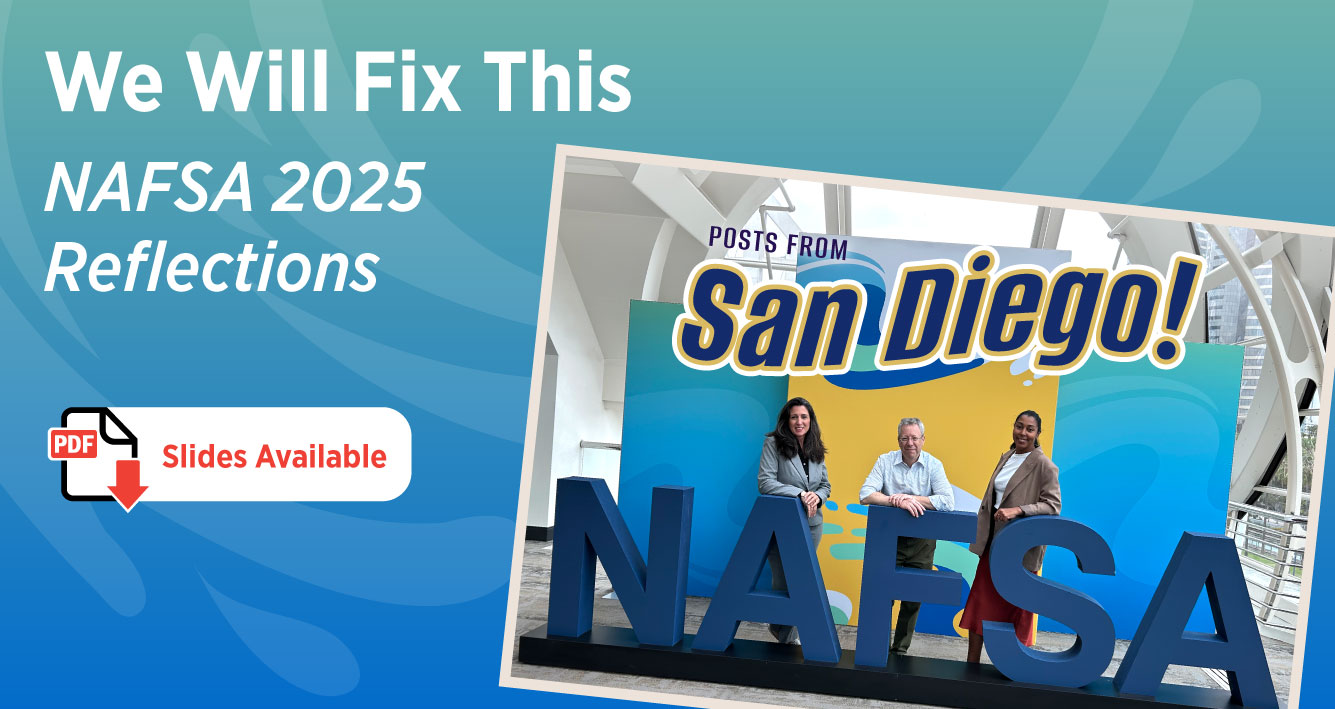
We Will Fix This – NAFSA 2025 Reflections

We all absorbed a few sucker punches at NAFSA 2025. And we experienced all the feels. 

While the White House released a new set of directives to further disrupt international student access to US institutions, NAFSANs gathered and found support amongst each other in San Diego. We ran as a pack (more on that below).

I spent my time at the conference largely with community and institutional leaders who have been down similar paths before. With sighs, eyerolls, and steadfast determination, we assessed what we knew, gave each other hugs, and took to planning for the future.  

As NAFSA CEO Dr. Fanta Aw says, “We do not get to be tired.” 


Meet Intead! 

  • Find us at APLU in NYC in June, NACUBO in DC in July, and NACAC in Columbus in September. Be in touch to share a cup of coffee in person.

Bookmark this: Intead’s Resource Center 
Access 800+ articles, slides decks, reports with relevant content on any topic important to enrollment management and student recruiting.  Check it out.


While many NAFSANs did express a weariness and some sessions had a very somber tone, that feeling was not pervasive. There will continue to be pain along the way, no doubt. Some of us will suffer losses due to the threats and disruptions. Student stress (and worse) is no joke. Fabulous and motivated international students will be denied access. Nevertheless, the dust will settle. Reason will prevail. And our community will fix what is being broken. NAFSA, among other leaders in our field, will be there throughout and after.  

To be clear, no one is giving up the fight.  

We were part of three presentations at NAFSA this year, mostly about career outcomes for international students and about how institutions can use this information to improve enrollment and advocate for our community. Find the link to our data (slides and a report) later in this blog post. 

Read on… 

Read More

Recruiting Intel Digest: The Most Useful Stuff from Q1 2025

News of international student visa’s being revoked and stock market gyrations is all consuming. And rightly so. The White House seems hellbent on sowing chaos on as many levels as possible. In our world of higher ed enrollment and internationalization, international students are looking over their shoulders, unsure of what will happen next. Unfortunately, in the near term, unpredictability is the name of the game and every university administrator’s list of top priorities changes by the day (or the hour).

Harkening back to the stress levels our academic administrators and students experienced during the Covid-19 Pandemic. 

It’s enough to make you want to just turn it all off, hop a flight to Florida, and kick back under a beach umbrella on the sunny shores of the Gulf of America...right?!?  

Sad humor aside, we focus on providing global educational experiences, protecting students from harm, and playing exhausting defense to the chaotic shifts in policies as best we can. And, at the same, time we are playing offense for our institutions. How do we move forward? How do we fortify our international student programs even as our students feel shaken and ask legitimate questions about how and if they can continue to pursue a US education?


Opportunities to Meet the Intead Team 

  • Look for us at NAFSA in May, NACUBO and APLU in June, and NACAC in September. Let us know  if you want to connect at these events.

Bookmark this: Intead’s Resource Center 
Access 800+ articles, slides decks, reports with relevant content on any topic important to enrollment management and student recruiting.  Check it out.


With all the shifting campus priorities and endless breaking news reports, we take our role seriously as a condenser of information and a producer of insights on all things enrollment management. If we are doing our job, we are consistently additive to your work. Many of you likely missed some of our posts this past quarter (we understand!). So today, we offer a summary of the news we shared in Q1 ’25 with links to the articles and resources.   

You’ll find perspective on:  

  • 3 Things to do now, despite the enrollment chaos  
  • AI tools admissions teams will love  
  • How to spot and fix admissions pain points  
  • AIRC & AIEA conference insights 
  • How WPI students are ideating systems to address student mental health  

As an added bonus, at the end of the post, we offer a link to our uplifting April Fools Day post that caught more than a few people off guard. We all need a reminder of the fun life can offer now and again. This one is worth the click. A quick read for a lasting smile.

This quarterly wrap-up is a bit shorter than those in the past per our recent switch to posting every other week - our content optimization guided by our analysis of our reader data. Let us know if our new cadence is working for you.   

Read on… 

Read More

AIEA 2025 Reflections

AIEA rode into town overlapping the Houston Livestock Show and Rodeo in March. You tell me which one brought more excitement and better BBQ? 

The truth: I was down for the whole AIEA thing more than the rodeo. Clearly, I’m not the one to call when you are going out to a raucous party. It’s a character flaw, I know. 

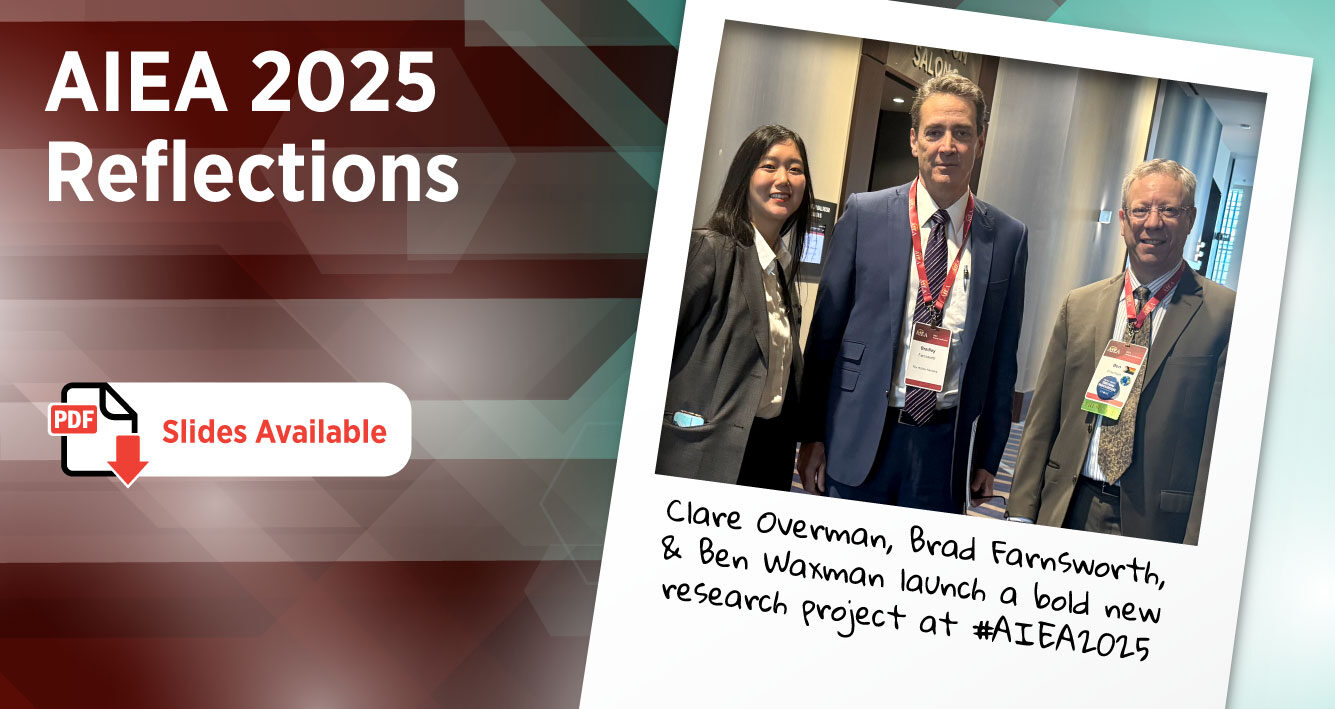
AIEA’s board and their dynamic staff, led by newly minted CEO Clare Overman, delivered exactly what academic leaders and SIOs needed. An opportunity to gather amidst the chaos of the new administration in Washington, DC. An opportunity to fret, consider, and plan.  

Under the heading of planning, our boldest initiative, launched at the conference: a two-year research project in conjunction with AIEA to identify and share the effectiveness of various internationalization office structures. A complex endeavor to be sure. Learn a bit more about it HERE and sign up to stay informed. We are thrilled to be collaborating with former ACE Internationalization Lab leader Brad Farnsworth for this research. 

Those in this field do a whole lot with fairly little support or budget. Shared models and simply thinking together has so much value. The Intead team was honored to share the dais for three very different presentations with colleagues Balaji Krishnan (University of Memphis), Vivian Wang (University of Tulsa), Helen Zhang (Northeastern University), Mirka Martel (IIE), Andrew Chen (FrogHire.ai), and Brad Farnsworth (Fox Hollow Advisory).


Opportunities to Meet the Intead Team 

  • Will you be at ASU+GSV in April or NAFSA in May? Let us know  if you want to connect at these events.  

Bookmark this: Intead’s Resource Center 
Access 800+ articles, slides decks, reports with relevant content on any topic important to enrollment management and student recruiting.  Check it out.


Below, I share a few observations about the conversations at the conference ranging from fundraising from international families (alumni giving) to global partnership development and how that plays with enrollment management and student services. You’ll also find links to our slide decks and an invitation to chat if you’d like more information about our ideas on how your institution can improve in three areas: 

  • Global Partnership Development and Management 
  • International Student Career Placements
  • Internationalization Office Structure and Outcomes

Read on for perspective on the machinations over White House pronouncements and access to our slides… 

Read More

Finding and Alleviating Admissions Pain Points


As student recruitment consultants, higher ed institutions ask us to focus on a range of pain points. We see an increasing number of institutions, driven by global competition, evolving markets, economic pressures, changing immigration policies, and more, seeking strategic realignment of their admissions and enrollment processes. The evolving ed tech marketplace brings new tools and AI to the process adding to the intrigue. Could technology be the critical player to winning the game? Sometimes, yes.  

It was no surprise to us when international enrollment officers packed the room for a presentation on Admission Process Analysis during the most recent AIRC conference. The conversation was led by Steven Boyd of Quinnipiac University and Intead’s Chief Strategy Officer Britt Godshalk who spoke directly to concerns we are hearing straight from enrollment staff. Concerns like: 

  • “We need to know where our best markets are. We have an incredibly high volume of applicants with a very small yield.” 
  • “Sometimes we have enough applications. But how do we make sure students actually enroll?”
  • “I need to figure out how to move from our current enrollment plateau. And I feel like we’ve tried everything.” 
  • “We have a communications coordinator specifically for admissions and I don’t know how to use him."

Sound familiar? You could write a book with the number of times we hear comments like these. In fact, our friend and colleague Dr. David D Maria, SIO and Vice Provost for International Education at UMBC, literally did (find his Achieving More with Less: Lean Management in International Student Office in the NAFSA bookstore – highly recommend).  


Opportunities to Meet the Intead Team 

  • AIEAin March, ASU+GSV in April, and NAFSAin May. We'll be presenting our latest findings with colleagues from Chronicle of Higher Ed, IIE, AIEA, University of Tulsa, University of Memphis, Northeastern, and others. Let us know  if you want to connect at of those two events. 

Bookmark this: Intead’s Resource Center 
Access 800+ articles, slides decks, reports with relevant content on any topic important to enrollment management and student recruiting.  Check it out.


Relying on our experience working with a wide range of institutions, public and private, over the past 15 years (and the guidance from David’s book), we have helped admissions leaders identify the admissions pain points that drive students away rather than drawing them closer in. Importantly, this fascinating day-long exercise uncovers opportunities to fix the problems and the improvement measures to track results. Ah yes, some good news. 

Process mapping is a simple idea on the face of it. Like any problem-solving session addressing a complex, multi-layered process, the key to success is getting the right people in the right room to wrestle the right questions. We’re sure you know just what we mean. Practical to downright critical cross-departmental conversations are too few and far between.   

IT, Marketing, Enrollment, Admissions, and faculty (at the graduate level) all play a role. Credential evaluation always comes up as a pain point (more on that in just a bit). Yet, when institutions bring all stakeholders together for one full day to critically examine how their roles interconnect, the clarity is remarkable. We’ve seen even the most efficient teams benefit. And by the end, everyone has a new appreciation for sticky notes and our whiteboard is filled with sound ideas, big and small. 

The litmus test for us is always this: at the end of the day, does everyone see a clear, achievable path forward? From the clear immediate wins to the more time-intensive improvements, a shared vision for a more efficient process will result. That’s the point of process mapping. Read on…  

Read More

Intead’s Top 10 Blog Posts of 2024: As Chosen by Readers


Here we go again. Entering a new year with a certain trepidation. Recent headlines warning of mass deportations and reeking of transnational skepticism harken back to a pre-pandemic era of not so long ago. The difference this time: we come prepared. This is a road we’ve traveled. So, lace up your long-distance sneakers and let’s get going. 


Opportunities to Meet the Intead Team 

  • AIEAin March and NAFSAin May, we'll be presenting our latest findings at both. Want to connect at either event? Let us know.

Bookmark this: Intead’s Resource Center 
Access 800+ articles, slides decks, reports with relevant content on any topic important to enrollment management and student recruiting.  Check it out.


Despite our wariness of upcoming US, UK, Australian, and Canadian policy changes that are sure to impact our international student community, we are looking forward to 2025. We will find our way forward even despite the incoming US administration's often petty, often chaotic, and consistently unpredictable management style. Sigh.

One important change to how we move forward here at Intead, a resolution if you will, is an adjustment to the cadence of this blog.  

We’ve been publishing Recruiting Intelligence since 2012, on a weekly basis. Our goal has always been, and continues to be, to provide you with deep industry insights that are practical, highly actionable, and meaningful to your day-to-day work. We report on markets, tech tools, recruitment trends, marketing strategy, you name it. If it can improve your enrollment management, we are researching and writing about it.  

This year we are shifting our output slightly by moving to an every-other-week schedule. This shift in cadence is born out of our digital strategy analysis and watching your engagement. Turns out, given our long form content format, not everyone has time to read our posts every week!!!   

OK, obvious, right? What this means in simple terms: our efforts to disseminate meaningful content to as many people as possible is not as effective as it could be with each post. 

By shifting to an every-other-week schedule, our digital team can use social channels more effectively to promote the content we produce. There will be more time for the social algorithms and your clicks and shares to do their work.  

So, long story short, you will still see our longer form musings here, and an increasing presence on social media as we hold true to our goal of providing useful content to industry insiders. Speaking of, we are connected on LinkedIn, right? If not, follow us here 

In the meantime, a quick look back at 2024 through this blog’s top 10 posts as chosen by you, our readers. We were not at all surprised at #1. Read on…  

Read More

Recruiting Intel Digest: The Most Useful Stuff from Q4 2024


Shout out to Q4 for giving us all something to think about. Cue the Chinese expression: "Better to be a dog in times of tranquility than a human in times of chaos." (宁享平安犬生,莫为乱世中人). Yup, got it! Right now, we are those humans, perhaps wishing we were dogs.  

Between the US presidential election and IIE Open Doors data, many of us are recalibrating our approach to 2025. Fortunately, we’ve worked through anti-immigration policies and lackluster international student enrollment numbers before. We’ll weather this. But there is work ahead for all of us. 

So, if you’ve missed a few of our Recruiting Intelligence articles, we understand. This post will catch you right up. 


Opportunities to Meet the Intead Team 

  • AIEAin March and NAFSAin May, we'll be presenting our latest findings at both. Want to connect at either event? Let us know.

Bookmark this: Intead’s Resource Center 
Access 800+ articles, slides decks, reports with relevant content on any topic important to enrollment management and student recruiting.  Check it out.


Below, get our latest insights on topics that matter to you, including:  

  • Digital Marketing: The impact of AI on your SEO; Our social algorithms cheat sheet
  • Marketing Strategy: 5 Student recruitment markets worth considering; How to find and use your student career outcome data to recruit; Why personas get a bad rap
  • Industry Reports: CHLOE 9: Strategy Shift -- Institutions Respond to Sustained Online Demand; Trump v Harris -- Student Sentiment Analysis 
  • Conference Highlights: Intead’s notes and slides from AMA Higher Ed, PIE Live Boston, NAFSA XI 

Read on… 

Read More

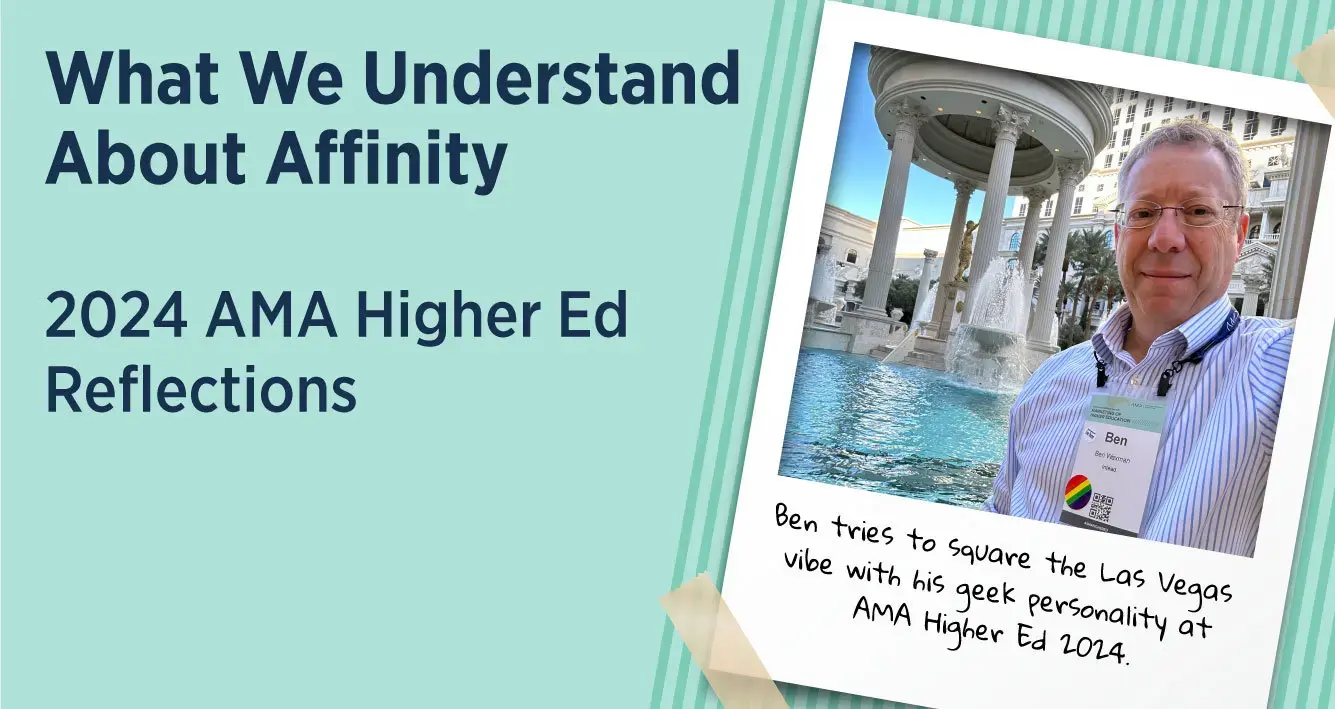
What We Understand About Affinity - AMA Higher Ed Reflections


The opening plenary at the AMA Higher Ed conference by Dr. Steve Robbins was spot on great. With a neuroscientific underpinning, he presented the human desire for inclusivity as a biological need we all share as part of our survival instinct. Playfully using the rivalry between Michigan State and University of Michigan, he pointed out how we make excuses for “insiders” (those in our affinity group). When they exhibit frustrating behavior, we often give them a pass. At the same time, “outsiders” are seen as annoying and exhibiting behavior typical of their group. No pass for them.   


Opportunities to Meet the Intead Team  
  • PIE Live North America, Boston TODAY Look for Ben on stage at the IIE Open Doors: What is the Latest Data Telling Us? session at 2:30 in Grand Ballroom A&B.
  • AIRC, Seattle-Bellevue, Washington, Dec. 4-7 -- including our pre-conference global marketing workshop. A full day of Intead global intel (lunch included ; -). Details here. 
  • AIEA in March and NAFSA in May, we'll be presenting our latest findings at both. Let us know if you want to connect at either of those two events.

Bookmark this: Intead’s Resource Center 
Access 800+ articles, slides decks, reports with relevant content on any topic important to enrollment management and student recruiting.  Check it out.


With 1,800 people in attendance, this year was the AMA Higher Ed’s largest conference attendance yet. And from what the AMA says, that is the largest attendance of any AMA branch conference. People from 14 countries were there. And of the 1,800 attendees, about 430+ US higher ed institutions were represented. 

Dr. Robbins’ approach to introducing and promoting the idea of inclusion to those who may be of the mind that DEI and “woke” perspectives are simply too much to handle is welcome and perhaps the necessary path forward. Since this is the AMA, we are looking at inclusion in light of human (read: consumer) behavior and the importance of understanding this human desire to be part of a group as it relates to student marketing and recruitment. Diversity results from inclusive policies and practices. 

Dr. Robbins discussed the importance of feeling valued within the tribe you join. As a consumer of education or any other product or service, there is an affinity we are aiming to acquire. That connected and valued feeling leads to student retention and marketing concepts of customer lifetime value (think continuing education and alumni engagement). 

He also talked about the opposite effect: when people do not feel welcomed or included. These feelings light up the same pain centers in our brains that physical pain (a slap or a punch) elicits when experienced. And so, when we don’t promote inclusive practices, we are pushing people away and prompting quite literally a painful experience. 

People I talked to at the conference found Dr. Robbin’s talk a welcome and eye-opening presentation. Another aspect of the conference I found valuable: AMA’s use of Topical Idea Exchanges. These gatherings were smaller groups who circled up the chairs and focused on specific topics. The two I attended (one on celebrating and leveraging milestones (think: centennial celebrations), the other on leveraging organic social channels using institutional and senior leader accounts (think: managing chancellor social accounts). Both sessions were well led and filled with smart people who shared ideas and perspective, asked great questions, and overall made networking and information gathering comfortable and valuable. Though, I did hear some mixed reviews on that format from others.

I attended a couple of sessions during the 1-day I had available at the conference. Kerry Salerno, vice president marketing and communications at Babson College and my co-presenter this week at PIE Live in Boston, talked about presenting marketing results to leadership. A great topic, as in, how do you simplify all the marketing information and results in a meaningful way that prompts wise decisions from the top? The short answer: simplify.  

What I most valued in Kerry’s presentation was her candor about how, over the past 6+ years in the position at Babson, she has made a concerted effort to train and adapt her marketing team to embrace a data informed culture. That work is hard and laborious. Having run a marketing agency for more than 30 years now, when I consider all the elements of running a business, the hardest part is always choosing and developing the talent around me to achieve the goals. How do you accommodate all of the personal, professional, and financial goals for each person and align that with company goals?  

It’s a lot. Always. 

Which brings us back to the idea of inclusivity. Who is part of the tribe? How do you help them feel valued? How do you maintain that feeling despite the challenges that your team, your administration, your students will inevitably face over time? Are you taking the time to figure this very difficult stuff out? How strong is your team’s affinity for each other and the work? Read on... 

Read More