Recruiting Intelligence

New Market Entry: Key Benchmarks for Student Recruitment Initiatives

"Where else should we be?"

This question comes up consistently in our workshops, webinars, and client conversations,

The reality: you’ve been wanting to diversify your recruitment efforts for years. Until the pandemic and the latest global political wrangling made recruiting from China problematic, your leadership wouldn’t listen. Now they will and they’re wondering why you hadn’t diversified earlier. 🙄

China and India have always been safe bets for international student recruitment. Of the nearly 1 million international students in the US, 34.7% are from #1 student sender China and 18.3% from #2 India, per the latest Open Doors data. #3 South Korea claims a distant 4.3%.

Despite Covid, these sources of international students in the US remain front and center.

If the majority of your recruitment efforts are focused on China and India, well, we get it. Your leadership team is comfortable investing where they feel safe and is typically fearful of starting something new. These markets are proven and for the most part steady, pandemics notwithstanding. But should all your eggs be in these two baskets?

Of course not.

Relying on only one or two markets for the majority of your international student intake leaves your institution vulnerable to market fluctuations. For most institutions, that strategy does not align with the overarching mission of diversifying your student body. It only aligns with the revenue side of the equation.

Here’s the thing: you relied heavily on those two markets because of the significant challenges of identifying and succeeding in a new market. How do you even do that?

[Side Note: maybe you’ll want to start with our country comparison cheat sheet]

So, let’s suppose you’ve done the market research analysis and you’ve found a new market (or two). How do you know if you’ve selected the right one(s)? How do you evaluate your investments in these new markets since they don’t behave like the markets where you already have experience?

You know it will take patience, too, as most institutions won’t yield real results until 2+ years of targeted recruiting and nurturing. Will your institutional leadership give you enough time to prove the effort? Or will they see the lack of traction after year one and pull the plug? (You’ve seen that before, we know).

This is where identifying effective benchmarks can help you set expectations and make the case for sustained investment.

We’ll be talking about this and so much more at #NAFSA2022 in Denver this month. Be in touch to set up a meeting with us. And please join us for one of our four interactive NAFSA presentations where we are honored to share the dais with our colleagues from Benedict College, San Diego State University, Clark University, Northeastern University, CIEE, ICEF, and GNET.

Read on to learn how you can tell which new markets are a good idea to enter and how to know if early recruitment efforts are likely to create the traction you need over time. Use these benchmarks to create your plan and set leadership expectations.

Read More

Getting Started With Building an Audience

In the higher education space, your institution is competing with so many options that prospective students have. We know that most students attend a university within 50 miles of their home while large state institutions and the elite options have a stronger draw from coast to coast and beyond.

With these realities in mind, today we consider a foundational marketing goal: building a receptive audience so you can nurture prospective students from the point of awareness and inquiry to enrollment, no matter where they reside.

To state the obvious: virtual tours and informational webinars have taken on a bigger role (fewer campus visits), so a robust and engaging digital presence has never been more important to your recruitment process. Has your team evaluated and adjusted your approach to the student journey? Meeting them where they are in each step of their decision-making process?

We’ve offered a number of educational posts on student journey mapping processes you may want to read (for reference: our recent series Tracing the Student Journey Part 1 and Part 2).

We'll be talking about these enrollment management and student recruiting approaches and so much more at #NAFSA22 in just a few weeks. Let us know if you'd like to schedule a coffee with one of our team. We are leading 4 NAFSA sessions this year and one of them received the honor of being selected for live broadcast. Watch this space for details and we hope you can join us.

For now, read on for our top recommendations on how to build an audience online.

Read More

Text Message Marketing for Universities and High Schools

Surveys from Mongoose (a popular SMS provider) tell us that a full 80% of students want to receive text messages from academic institutions. The caveat: they only want messages that matter. No fluff. We get it. We bet you do, too. And, the return on well-executed texts is more than worth the careful content planning effort.

SMS marketing is proving to be a direct, cost-effective way to recruit and retain students. If your institution hasn’t explored SMS marketing, now is the best time to start. It’s a little like the question, “When is the best time to start exercising?” The answer is always, now!

For those of you in the know, Slate added text messaging in early 2020 as one of their marketing features. There’s a reason for that. Important to note that the feature will not allow you to send messages through WhatsApp at this point.

Read on for the answers to Why do it? How to get started? And, what are the best practices for effective execution? The short answer: spot on content drives results.

Read More

The Long and Winding Road Tracing the Student Journey: Part 2

Last week we began tracing the evolving international student journey, with a look at what might help or hinder your relationship with prospects along the way. In short, it’s all about engaging content and great follow-up. But that’s just part of the story.

When marketing to students, we often focus on the information we want to give them, but it’s equally important to consider what information a prospect needs to give you and what steps you need that prospect to take. So let’s explore a few ways to entice students to click that CTA and follow your channels, register for an event, download that guide… You get the idea.

Read on for our next installment reviewing the student journey elements that are so important to the phase we are in right now as application deadlines approach.

Read More

The Long and Winding Road Tracing the Student Journey: Part 1

As we settle into 2022, we can't help but think about journeys – those we've been on and the ones we're embarking on now. Two important processes are staring us in the face right now. One for our prospective students and one for us. In reality, both are for us:

  • Application season
  • Budget planning

As enrollment management professionals, we know the elements of the student journey – from evaluation of the options, to defining the shortlist, applying, and then making the final selection – and all the small stops along the way that influence the student’s ultimate enrollment decision.

When we talk about the student journey, we think about everything we can do from a marketing and communications point of view to put the right information in front of prospective students at just the right time. What is our team doing well? What tools do we have in place? What are we missing? Our answers to these questions speak to both the application season and budget planning process.

If you’ve not yet downloaded our framework for budget planning (1-page chart), you’ll find some helpful insight there. Simple, straightforward steps to clarify your rationale for funding one recruitment project over another.

If you are attending the 2022 AIEA conference in New Orleans (Feb 20-23), be in touch and we’ll find time for a coffee and an exchange of ideas.

Read on for a helpful review of what the student journey is all about given the new twists and turns that the past two years have forced upon all of us.

Read More

Recruiting Intel Digest: The Most Useful Stuff from Q4 2021

Wrapping up 2021 was no easy feat. We’ve seen student enrollment numbers fall, rise, and flatten with the evolving worldwide pandemic that is COVID-19. More than a few in our field are burned out and trying hard to muster the energy to figure out how to bring their students the best experience possible.

We’re right there with you, wherever you are. Time to turn our focus to what we’ve learned from our recent experiences. Settle in for a Q4 wrap up of the info that can help you shape your 2022-23 plans. From strategy to tactics like chatbots and student recruitment platforms we know all of this will be up your ally.

Read on for our quarterly recap of Intead resources available to you — Q4, all in one place.
Read More

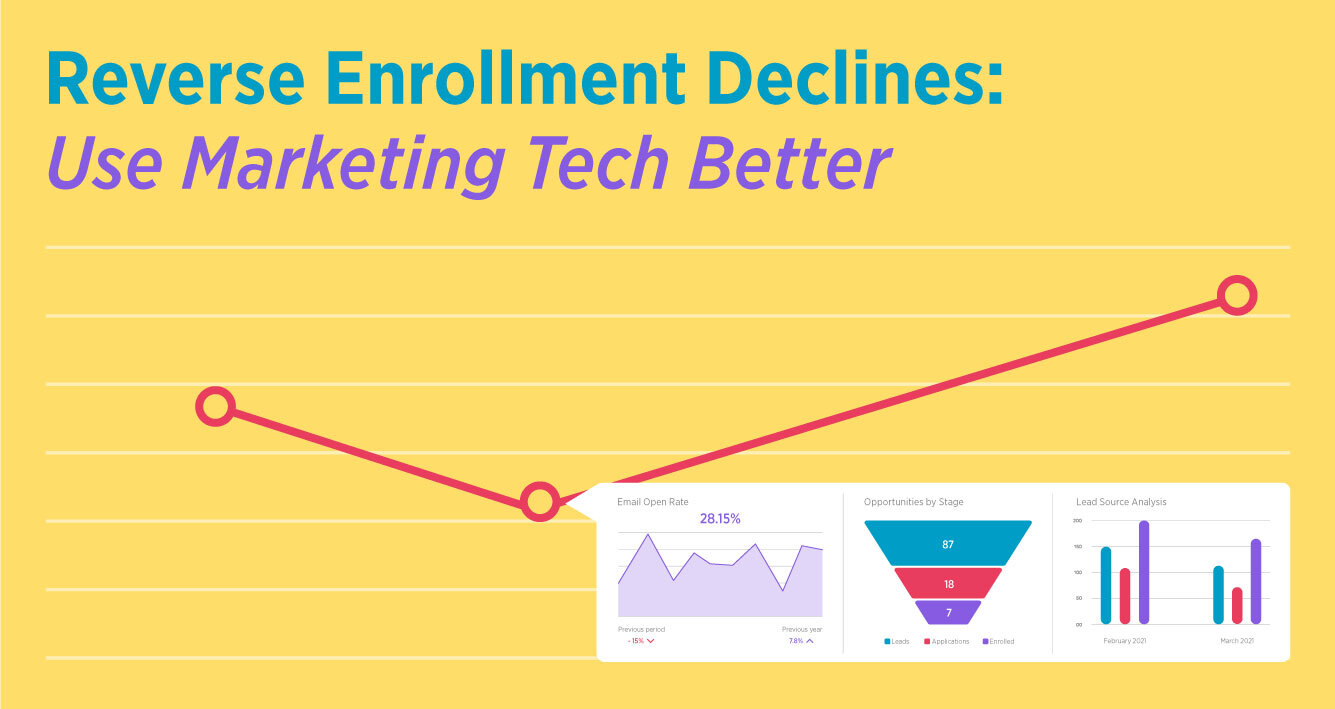
Reverse Enrollment Declines: Use Marketing Tech Better

So many dashboards. So little time.

Where is success hiding? How much investment will it take to achieve our targets?

With student mobility still in a state of flux, all bets are off for your predictive models. Or are they?

Today, we are talking to those with a CRM and marketing automation tools already in place.

Is this you? Your system works well enough and you can see some obvious gaps in functionality and interconnectedness. But you have what you have and there is no immediate opportunity to upgrade or change what you have. So…it is all about using the tools you have, better.

How do we get there? How do we know which features have real value to our operations? How can we use what we know to achieve better results?

We are heading into four wonderful days of interacting with our peers at the AIRC conference in Miami this week. The Intead team will be presenting on innovative ways to use the rising tide of influencer marketing for academia (it’s not going to be what you might think), and we will be presenting on innovative approaches to grad student marketing.

We can’t give enough thanks to our colleagues Toni Jaeger-Fine from Fordham Law School, Ita Duron from Massachusetts College of Health Sciences, and Kirsten Feddersen from Northeastern University all joining us on the dais to share our experiences and ideas. SO many ideas. Testing and confirming marketing approaches that are unique to each institution’s strengths.

Reach out if you would like to share a cup of coffee in Miami!

Read on for our two concrete recommendations for using your marketing tech better.

Read More

Recruiting Intel Digest: The Most Useful Stuff from Q3 2021

No quiet summer here--things have only sped up this quarter as institutions recalibrated their approaches to the ongoing hurdles and opportunities of the pandemic. With innovative thinking and disciplined strategy, your colleagues are tackling the big issues of the fall and considering how to adapt for spring and fall 2022. Today’s post points you to some of the high-performance best practices we’ve shared over the past 3 months to help during these times of uncertainty. 

So, grab a cup of coffee and before you finish it, we know you’ll be sharing links from this Q3 2021 wrap up with your enrollment team and colleagues with the power to make positive change for students around the world.

Read on for our quarterly recap of Intead resources available to you — all in one place. Plus, a preview of what’s coming next. But first:

PARTICIPATE AND LEARN: Opportunities up stay current and up your game:

  • October 5, NAFSA All-Region Summit Session: UMBC and Intead present “0-60 Internationalization” — Register HERE.
  • October 12, AIRC hosted Webinar: Technion Israel Institute of Technology and Intead present “Shifting Student Perspectives: Digital Marketing Now” — Free to AIRC members and $45 for non-members. Register HERE. (If your institution is not an AIRC member, hit us up for a code and we'll see about getting you past the velvet ropes.)
  • IIENetworker fall issue publishes Intead’s 2021 market research on Indian and Chinese student mobility. See below for a link to the magazine full of insights.
Read More

Marketing Culture. What’s Yours?

We’ve all heard about how company culture eats company strategy for lunch, yeah?

Last week, we wrote about how folks often confuse strategy and tactics. And we gave a little side eye to those colleagues among us who use the word “strategy” to appear smart and make others feel less than.

The cheat sheet on that one: replace the word “strategy” or “strategic” with “different” or “differentiation” and you’ll be able to get to the nub of the discussion topic quickly. Strategy has everything to do with position in the marketplace, which means how you stand out and leverage your differences against the competition. Tactics are all about the marketing tools and channels you use to make your institution’s valuable differences shine, be heard, and understood.

But in academic marketing (and virtually every other operation we can think of), how we achieve our strategic differentiation, how we meet our institutional goals, has everything to do with the team we have to do the work (the team that creates and delivers the product).

An interesting observation here: academic institutions really are all the same, right? Sure, there is R1 and R2, public and private, not-for-profit and for-profit, 4-year and 2-year, but these categorizations, when you get down to it, are not that significant, at least at the undergraduate level, right? They are all producing the same thing and in the eyes of the consumer, what is really different? They all have the same administrative and academic departments. And the rankings are a sham anyway, right?

Read on for how to counter that sad and ineffective point of view.

Read More

So That’s Your Strategy?

People look smart when they reference strategy. It elevates any discussion to greater importance as soon as the word strategy enters. Often, it gets others in the room thinking, “Right, maybe I’m not thinking about this strategically.” Followed by the thought, “What exactly would a strategic version of this discussion look like?”

The idea of strategy is often misunderstood. I fully admit, it really can be difficult. I can’t tell you how many discussions I’ve been in where people describe their tactical execution plan as the strategy. 

A simple example of why folks get confused, and I’ll use what we know best, the world of marketing: Your marketing strategy to enroll more students requires great marketing content. Content is a tactic you will employ to achieve your strategic goal. Yet, you will need a content strategy to be successful. So, content is not a tactic. It is a strategy, right? No, it is a tactic in this scenario. A tactic that needs its own strategy.

Oy vey.

Our team, of course, lives in the world of marketing strategy, planning, and execution. Today's post shares some insights into how to simplify the discussion and confirm when you are employing a strategy vs. discussing the tactical execution of any given initiative.

Read on and maybe we can shed some light on how to actually be smart in the discussion, not just look smart.

Read More