Recruiting Intelligence

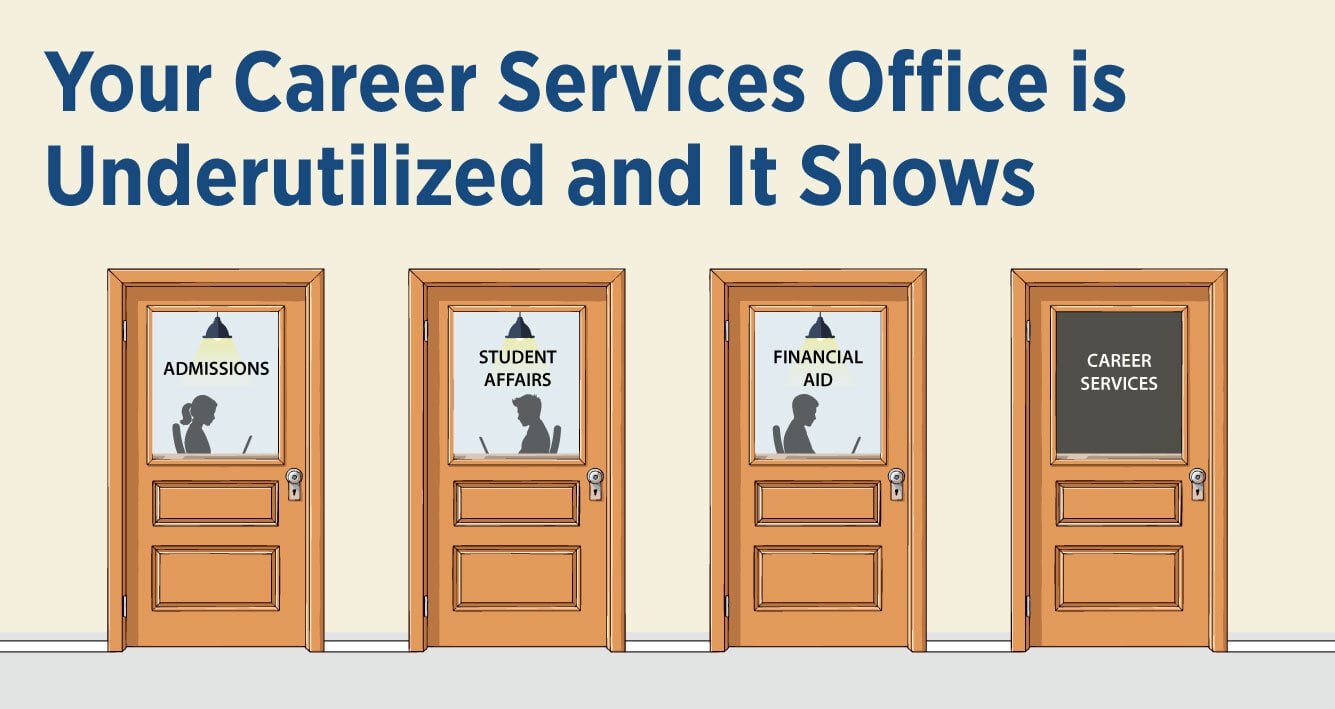
Your Career Services Office is Underutilized and It Shows

It’s well understood that future careers motivate students to pursue higher education. You could ask almost any student – domestic or international – whether career opportunities and outcomes influenced their decision to enroll, and the answer will be yes.   

Take the 2024 State of Higher Education study by Lumina Foundation and Gallup. In it, 84% of respondents cited at least one employment-related reason for pursuing (or potentially pursuing) a degree or credential. Another Gallup study found that students who stopped out were less likely to be motivated by career goals (they were more motivated by general learning) – suggesting that career motivations don’t just drive enrollment – they support retention. 


Meet Intead! 

  • Find us at AIRC in Atlanta in December, AIEA in DC in February, and ASU+GSV in San Diego in AprilBe in touch to share a cup of coffee in person.

eBook Reboot:  88 Ways to Recruit International Students 2025 update. Your tactical toolkit for the year ahead. Covering all the bases in 10 quick-read chapters. Fosters great ideation discussions with your team.


Our own research on the preferences and motivations of international students aligns with this. We suspect your experience does, too. Broader media reports emphasize that domestic families and students are increasingly focused on career outcomes as the justification for the cost of university. International students and families always have been. 

Where we are going with this: the more successful you are at getting students into the careers they want, the more successful you will be at getting students to fill the seats you want.  

And yes, we know you’re already telling prospective students that “95% of your graduates get a job or continue on to an advanced degree after graduation.” That’s no differentiator if everyone is saying it, despite its accuracy. 

This is where Career Services should chime in. Yet, many (read: most) students view Career Services through a lens of “why bother?” Hard to blame them. Help with resume and cover letter writing is too basic and can be provided by ChatGPT. Mock interviews have value, but there’s SO much more these departments could be doing to help students and your institution’s enrollment growth. 

Read on for some interesting data points and our recommendations for improving Career Services with an eye on driving enrollment…  

Read More

International Student Employment Trends After Graduation

What we know: international students have a well-documented and unambiguous impact on the US economy and society. Each year the US is $43+ billion wealthier because of these students. And our classrooms, campuses, and communities benefit from their diverse viewpoints and clear-minded ambitions, keeping our workforce competitive, tech companies growing, and sciences advancing. 

There’s no skirting the fact higher education is in a reactionary period as the White House does all it can to implement short-sighted changes to US higher education (and we’re being generous here with our choice of words). Advocacy has never mattered more. Which makes the release of our latest research – done in collaboration with the great minds at NAFSA and Fox Hollow Advisory – that much more important. 


Opportunities to Meet the Intead Team 

  • Look for us at NAFSA in May, NACUBO and APLU in June, and NACAC in September. Let us know  if you want to connect at these events.
  • Meet us online Tues., May 6, for the next AIRC webinar where Intead CEO Ben Waxman will join Co-panelists Kevin Timlin, Southeast Missouri State University and Manisha Zaveri, Career Mosaic for the expert-led discussion: IEM Student Lifecycle Series: Effective Student Recruitment Strategies.  

Bookmark this: Intead’s Resource Center 
Access 800+ articles, slides decks, reports with relevant content on any topic important to enrollment management and student recruiting.  Check it out.


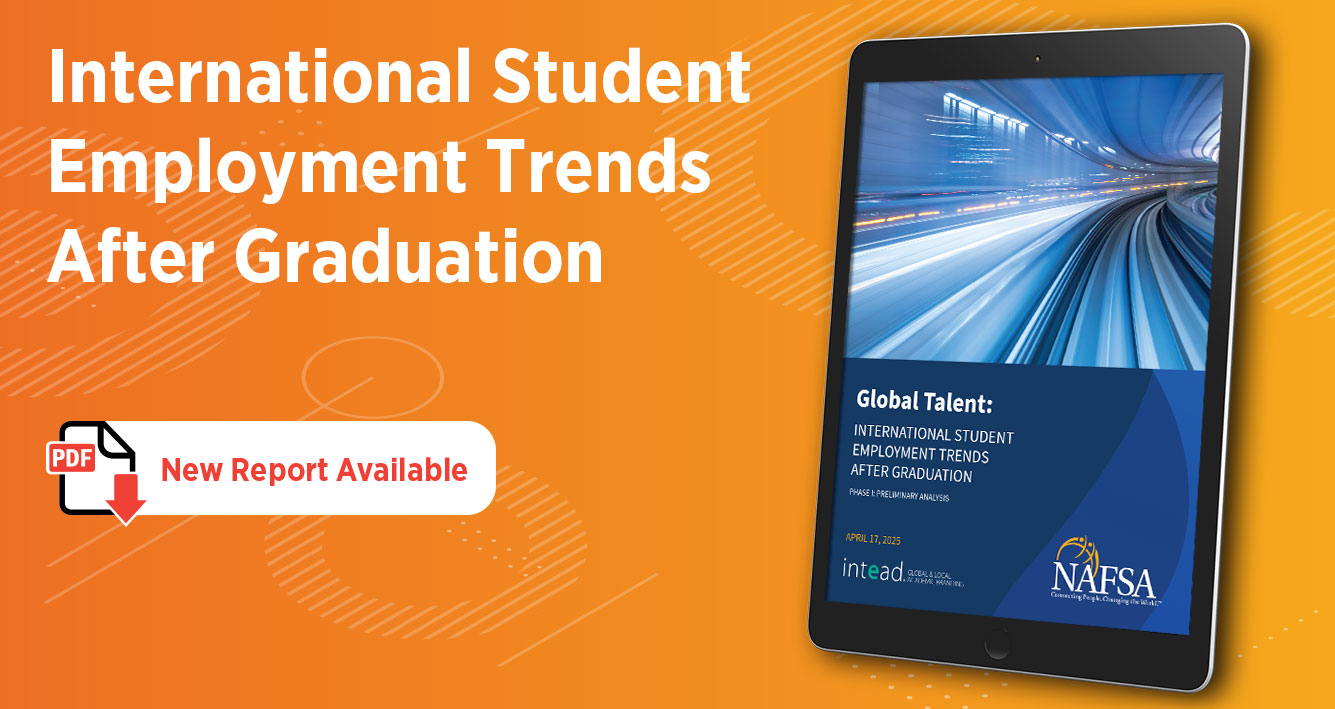
Phase I of Global Talent: International Student Employment Trends After Graduation – released for download today – gives preliminary, yet important findings that will help bolster conversations we’re all having right now. This report goes beyond public data to answer:  

  • What is the longer-term value of attracting and retaining international students to US higher ed institutions?
  • How do international graduates contribute to the US workforce and economy?    

The report analyzes behaviors, motivations, and the economic impact of international students after earning their US degree. Special thanks to each of the following participating institutions:  

  • California State University, San Bernardino
  • Ottawa University 
  • Salem State University 
  • Southern Methodist University 
  • University of California, Davis 
  • University of Houston 
  • University of Kansas 
  • University of North Texas 
  • University of Redlands 
  • University of Texas at Austin 
  • Washburn University 
  • Wichita State University 

This research explores the alignment between US institutions producing international student talent, the US economy, and US job market demands. It’s part of a larger initiative aimed at understanding how US education benefits both international students and the nation. Read on to download the report… 

Read More

Career Success for US-Educated International Students?


Career opportunity is the primary motivating factor for international students. All our research into the international student journey says so. We’ve known this for a long time. If you can demonstrate that your degrees pave a beaten path to positive career outcomes, then you’ve got your prospect’s ear. Not many institutions can back up their promises with data...until now. 

Institutions seem to have had a hard time making the case for bottom line ROI. Sure, there’s the usual “x% employed within 6 months” data every institution flaunts, but what does that really tell a student who’s halfway around the world? Not a whole lot. We’re not saying to nix that stat – definitely keep it – but it’s hardly concrete proof for your prospective students. 

The fact is most institutions simply don’t have the student data on the whole job search process to offer much more. Especially for international students graduating from your specific institution. 

Nor do most institutions have the bandwidth to think it through for the international cohort. But data does exist that can help you uncover a truer and fuller picture of career potential for your international students. It’s a matter of knowing where to look, how to look, how to clean and crunch the data, and then interpret that data appropriately.  

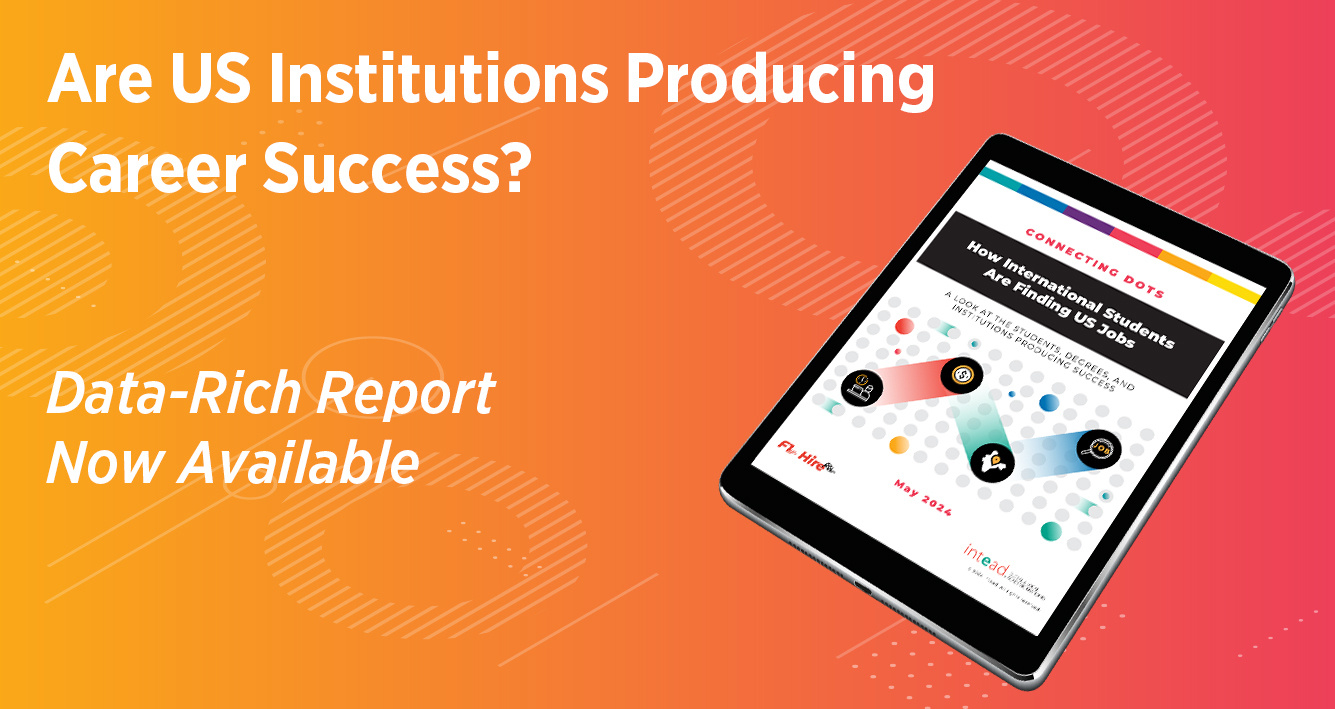
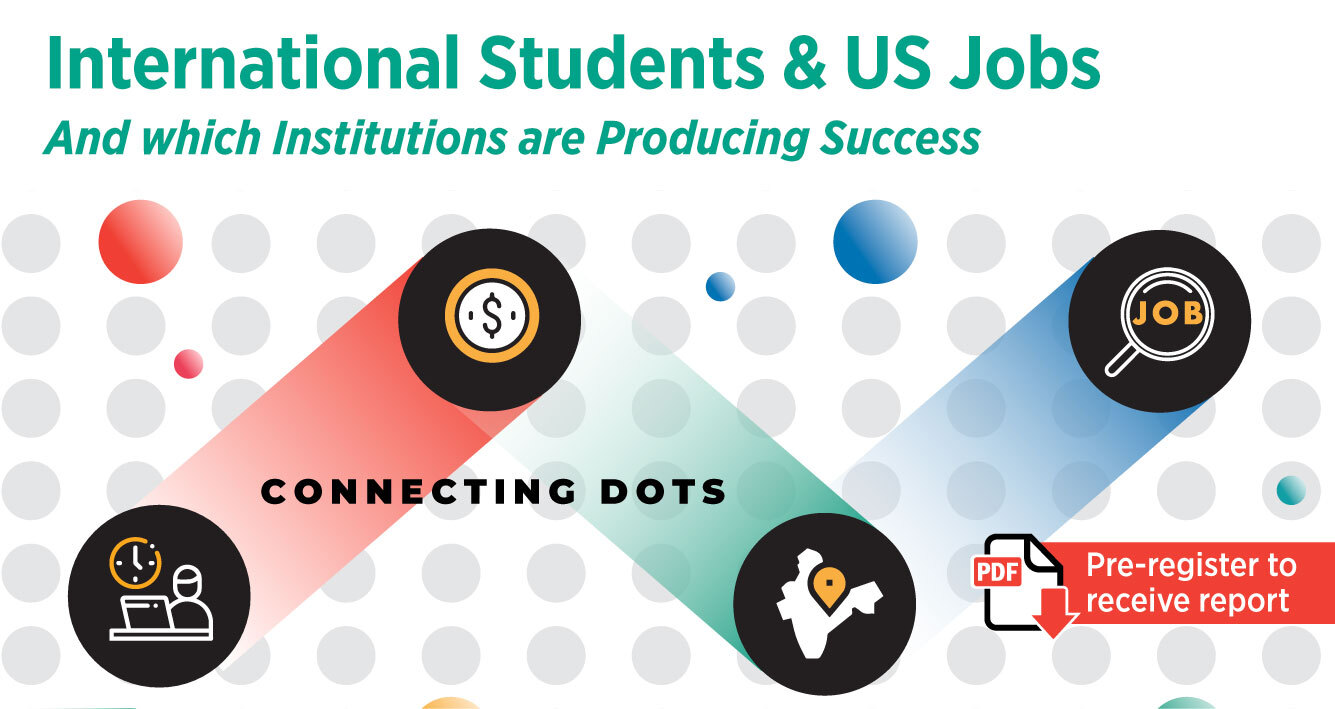
Enter Intead’s analytics team and our colleagues at F1 Hire! On offer to you for download: our first Connecting Dots study, How International Students are Finding US Jobs: A Look at the Students, Degrees, and Institutions Producing Success


Our next opportunities to meet! 

GMAC Annual Conference, New Orleans, June 19 – 21, 2024. Ben will be presenting on how global elections are influencing student mobility. More than just the US presidential election has the power to upend what students will choose to do next.  

EducationUSA, Washington, D.C., July 30-August 1. Ben and Viginia Commonwealth University SIO Jill Blondin will share insights on Navigating Budget Challenges in International Recruitment: Practical Strategies for Every Phase.  

Be in touch! We’ll buy the coffee. 


Our newest dataset focuses on practical next steps for international graduates. The ROI insight they’re really after. And for institutions, our approach to analyzing US Department of Labor data can help your marketing recruitment team stand out at any student fair anywhere in the world. Wanna see how? Read on to download our report... 

Read More

Groundbreaking Data: International Student Employment After Graduation


The NAFSA room was sold out; every seat taken.  

That morning we really weren’t sure what to expect with our session being held in the very furthest room on the 3rd floor of the New Orleans Convention Center. And that convention center is one of the largest we’ve ever seen. Like, you need an Uber to get from one end to the other. 

We could not have been more thrilled with the turn out. What everyone came for: new data, never before collected, on what international students are doing after they earn a US degree. 

What’s been missing from our community’s conversation on the value of US degrees for international students is real ROI. Sure, we talk about ROI: “94% of our students are employed or pursuing advanced degrees 6 months from graduation.” But we’ve never quantified actual ROI...until now.  

Today we’re sharing a preview of new research on the career progress of international students who graduated from US institutions. (The full report will publish later this summer. Be among the first to receive this and 2 other groundbreaking reports by pre-registering here. You’ll also get our NAFSA 2024 session slides.)  

This NAFSA research report will be the first of what will become an even deeper analysis based on more research between now and 2025. We want to truly understand what a US degree produces for international students. Is it worth their investment? Is it worth ours? This is data we’ve been wanting to mine for years.   


Our next opportunities to meet! 

GMAC Annual Conference, New Orleans, June 19 – 21, 2024. Ben will be presenting on how global elections are influencing student mobility. More than just the US presidential election has the power to upend what students will choose to do next.  

EducationUSA, Washington, D.C., July 30-August 1. Ben and Viginia Commonwealth University SIO Jill Blondin will share insights on Navigating Budget Challenges in International Recruitment: Practical Strategies for Every Phase.  

Be in touch! We’ll buy the coffee. 


I was extremely honored to have presented our latest research at NAFSA last week alongside Dr. Joanna Regulska, vice provost and dean of global affairs at UC Davis. UC Davis is one of the 12 innovative and forward-thinking institutions participating in this groundbreaking study. 

Our research involved a 22-question survey sent to international students who graduated from our 12 university partners between 2019 and 2023 (see below for the full list). With a 5.3% response rate, 1,797 graduates from 131 countries answered our survey questions. Of these, 1,323 still reside in the US, 474 live elsewhere. 

What we learned will have a direct impact on international student recruitment, as well as offer perspective on US immigration policy. Data informs how we make sense of the world and move forward as a community and a society. The data collected encourages us to understand the value of CPT/OPT to our international students and the US.  

Laid bare: the real outcomes and the positive impact international student graduates are having on the US economy.  

For those of you interested in taking part in our next survey, be in touch at info@intead.com. So many of our higher ed colleagues at the conference raised their hands to evaluate participating in the next research phase of this project. Be a part of that! 

Below we share key takeaways from our research and provide you quick access to the slides from our NAFSA presentation. Read on... 


Read More

Get Your Students Career Ready. Here's How - Part 2 of 2


Bringing the real world into the classroom is so important to the future of your students. And last week we shared one way Suffolk University is taking action (find that post here). A sort of ​Career Readiness 101. This week, Career Readiness 201 as we talk about you and offer a helpful career-prep checklist, complete with on-campus practices and recruiter tips, too.  


Opportunities to connect in person and hear our latest market intel:

  • Join us in Paris Nov 8-10 at CIEE's 76th Annual Conference.
  • Join us in Boston Nov 13-15 at PIE News Live.

Let us know if you'll be joining us (info@intead.com).


Like you, the vast majority of students we talk to are playing the long game. Well before they even have a high school diploma, they’re thinking beyond university. They’re smart consumers and they need to know what their hard-earned degree, whatever the field, will mean for them in the market. Never mind that many of them are not sold on a major yet. They’ve been hearing for years about the rising costs of higher education. They understand ROI more than previous generations ever did. And their parents are all about that approach. 

According to the National Center for Education, in 1980, the annual cost of attending university (including tuition, fees, room, and board) was just over $10,000, adjusted for inflation. Fast forward to the 2019-20 academic year, and that that bottom line had ballooned 180 percent to nearly $29,000. This is the story your prospective students have grown up hearing. For decades, everyone, university administrators and families, have been wringing their hands about the rising costs and yet, not a thing has been done about it. 

For families, the reality is they’re looking at an average debt for a four-year Bachelor’s degree of $34,700 per the Education Data Initiative. And while the standard repayment term for federal loans is 10 years, it can take up to 30 or more years for more than a few students to pay off these loans. You can see their concern. 

Some of us optimistically thought the rise of online education would bring costs down and become a reliable source of revenue for universities and a powerful educational avenue for students. The reality: yes, a growing source of revenue, but the cost to produce truly effective online education that carries students forward with all the tools and supports, is fairly pricey to produce. And the low quality stuff really does not achieve the educational outcomes, so students pay for an ineffective degree - a credential that does not meet real-world employer needs. (See our blog post here about the perceived value of online degrees) 

Of course, these are tuition numbers you’ve thought about many times. And they’re all over the news right now as student loan repayments will soon be back on after a long pandemic pause. Smart students want to know the kind of return they’re going to get on their investment, and they’re looking to you to provide an attractive answer. 

So, what is your answer?

Read on for a checklist of essential ways to help ensure your campus helps prep students for the careers they’re hoping higher ed will lead them to. And yes, we’ve included pro-tips for you recruiters. Read on...

Read More

Get Your Students Career Ready. Here's How - Part 1 of 2

Let’s talk about the messaging your institution uses to convince students and families that what you offer has value. Pretty simple stuff, right? Maybe not. You’ll appreciate the helpful checklist that follows in part 2 of this series. Think marketing differentiators in a competitive marketplace. You won’t want to miss it. 


Opportunities to connect in person and hear our latest market intel:

  • Join us in Paris Nov 8-10 at CIEE's 76th Annual Conference.
  • Join us in Boston Nov 13-15 at PIE News Live.

Let us know if you'll be joining us (info@intead.com).


But first a story. 

Ok, so you are up in front of your board of directors presenting your business growth and marketing plan. You and your team have been figuring this out for a while and last night was a late one as you worked together to put the finishing touches on your slides. There were still disagreements among your team, but you settled the issues and felt nervously ready. 

Everyone has a speaking role but some on your team are stronger than others. Some don’t have appropriate clothes to wear for the presentation so they borrow something professional looking from friends. Some sway nervously back and forth and read their slides rather than engage with the very important board members. You realize early on in the presentation that the data presented on slide 7 is wrong. It doesn’t support your final recommendation. Maybe no one will notice. 

It is your Marketing Business class final presentation to a mock board of directors and as first year undergrads, your team is anything but seasoned. Your final grade is riding on how your team performs. 

Every semester for years now, I have had the honor of judging the final marketing analysis presentations of undergraduate students in a marketing business class at Suffolk University. A good friend of mine there teaches the class and gathers a set of judges from the biz to help the students get some real world feedback. Each judging session is as different as the teams presenting. It’s a blast for us, the judges. Nerve racking for the students. 

Recently, the department asked a few of the real-world judges for additional input and it truly impressed me. They wanted to hear from us as employers to understand what we look for in candidates as we hire. What tools should their students know how to use? What business concepts and approaches are critical to us as employers so their graduates will crush the interview?  

That line of questioning is SO important for business programs that often focus so much on esoteric business theory and simplistic case studies while purporting to be all about the real world. As our Intead Advisory Board Member Hillary Dostal, global marketing advisor at Pegasystems, says: There is best practice and then there is actual practice.  

This goes for your team, too. Read on…

Read More

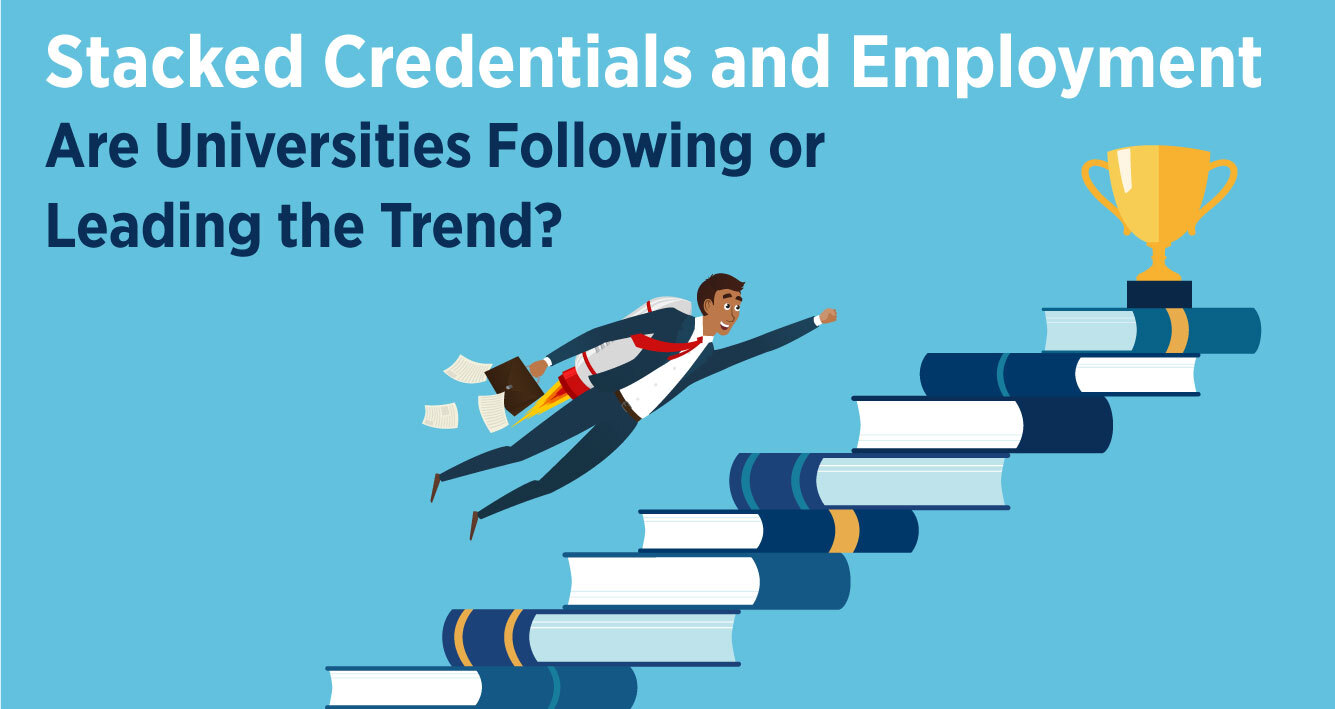
Stacked Credentials and Employment

Your enrollment team is furtively evaluating fast-track routes students can take to achieve career growth. How can we promote a new product that clearly has growing demand when its consumer adoption will reduce demand for our primary revenue source?

With rising tuition (a 30-year drumbeat on that one), and fewer traditional aged students in the pipeline, the pressure to produce new revenue is intense. Repackaging what you already produce in new, bite-size chunks makes so much sense to everyone, right?

Credentials in new formats is not new to the scene, but student adoption is growing in large part because employers have woken up to their value. The Intead team did research on graduate level certificates six years ago for one of our top 50 US institution clients and found global employers were still evaluating whether a certificate was as valuable as a full MBA. Employers were not familiar with the new credential and what it would deliver. In 2023, employers in a highly turbulent job market and in need of talent, have decided. Certificates and stackable credentials work just fine. Let’s GO!

And you are in a position to do something about it.

Data from a relatively recent RAND Corporation report Stackable Credential Pipelines, Evidence on Programs and Earnings Outcomes gives us concrete evidence of value and the direction things are going.

In brief, RAND Corporation partnered with the Ohio Department of Higher Education to build a better understanding of how stackable credential pipelines have played a role in the education and training of individuals in Ohio, a state that has taken a leadership role in developing these types of initiatives. The report itself focuses on three fields: health care, manufacturing and engineering technology (MET), and information technology (IT). There’s a lot of good stuff to glean from the report. We were particularly keen on the ROI data (aka job growth). That is, after all, the name of the game for the vast majority of prospective students these days.

Your traditional revenue stream is taking a hit already. Demand for short-term credentials will continue to grow. If your institution does not develop strength in this educational opportunity, your competitors will (or already have).           

It’s time to align your internal team around this and convince those holding you back. Time is running out. Read on for 4 key takeaways on what the RAND Corporation report has to say about student ROI tied to shorter-term stackable credentials. (You’ll especially appreciate takeaway number 3!!!)    

Read More

Credentials and Badges: Adding To or Supplanting Degrees?


They say that fifty is the new thirty, but what may be a more reliable maxim is that college is the new high school. It has been true for a while that undergraduate degrees are becoming the minimum standard for employment, as opposed to a high school diploma—a fact that has led to a great uptick in college graduates working for minimum wage.

The trend has continued upward with most incoming college freshmen expecting to earn a master’s degree after graduation. Master’s degrees are now as common as bachelor’s degrees were for most of our parents’ generations. In the U.S., more than 8 percent of the population has one, which is a remarkable 43 percent increase from where that number was in just 2002.

With so many well-educated job seekers, what is setting some graduates apart? Credentials.

Read on for our take on what is driving this trend and some perspective on how dangerous your institution's sluggish pace of establishing new degree and credential options could be.

Read More

EdTech: Coursera’s Role in the 4th Industrial Revolution

Move over, American Inventor Eli Whitney, we’ve come a long way since the cotton gin. We are in the midst of the booming Fourth Industrial Revolution.

Just in case it has been a while since you’ve been in a history classroom, here’s a tiny refresher:

  • First Industrial Revolution—mechanization
  • Second Industrial Revolution—mass production
  • Third Industrial Revolution—automation
  • Fourth Industrial Revolution—cyber systems and networks

If you need to brush up on your history, there’s a course for that on Coursera—the newest EdTech unicorn in the revolution.

Valuable Side Note: boosting conversion rates & measuring communications effectiveness. Our NAFSA session is coming up and we'll be discussing how to improve your digital connections with international prospects. Intead and NEU offer up best practices. Check it out our fun 49 second promo...

Join Intead Plus


But why is Coursera such a big deal in this modern revolution? Read on...

Read More

Motivations of the Highly Motivated: Marketing to International Graduate Students

Did you know that in the United States, first time graduate enrollment grew by 3.5% between fall 2013 and fall 2014? The Council of Graduate Schools’ (CGS) report Graduate Enrollment and Degrees: 2004 to 2014 provides tons of information on graduate study trends. According to the report, “from 2004 to 2014, international students accounted for over two-thirds of the growth in first-time enrollment headcounts at U.S. graduate institutions.” And that first time enrollment figure is 11.2%. So lots of new international students and the vast majority of them at the grad level. Good news for international recruiters, right? We think so!  

Bottom Line: Graduate students are an important segment of international students to target with your digital marketing and their needs are different than their younger counterparts. Their motivations to study, the programs of interest and the influences for them to choose one program over another all vary. Mostly, they want to know they will get a job with a degree from your program. Similar to undergrad motivations but perhaps iwth a finer point on it.

Importantly, even if your institution is lesser known, you can still market the strengths of a top-tier program to these highly motivated students. They pay attention to that kind of thing within their area of interest. If your marketing efforts to international graduate students are limited in time and budget (whose aren't?), you would do well to focus on these two things: your career outcomes and your highly acclaimed departments and professors. Make sure you are capturing your target audience's attention with messaging they’ll react to.

NAFSA is right around the corner! We will be co-presenting new research with FPPEDUMedia on how current global, economic and political events are impacting students’ plans to study abroad. So, while you are building your schedule for the conference, pencil us in for Wednesday, June 1 at 10AM and schedule a time to chat with us! Actually, use a pen, you really won’t want to miss this one. Trust us!

Read More