Recruiting Intelligence

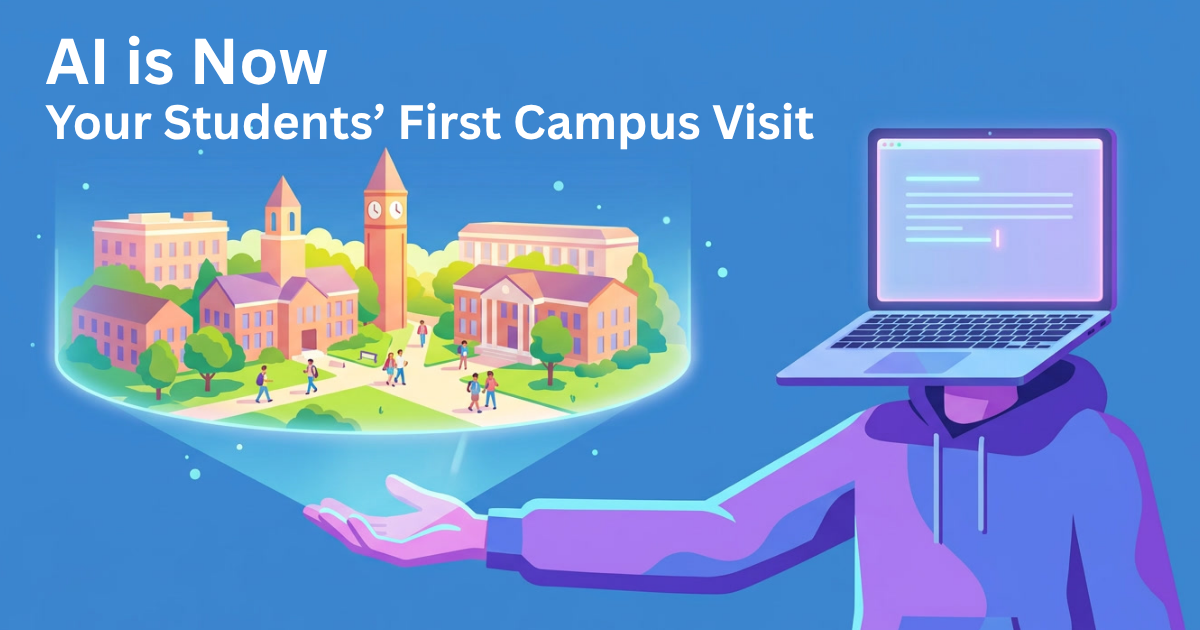
AI is Now Your Students’ First Campus Visit

Students used to learn about universities the old-fashioned way: browsing websites. (How very Millennial of them.)

Soon enough, social media became prospective students’ means of discovery.

Now? Increasingly, students are using AI to identify and evaluate their academic options. Long before they see your website, they have already developed an AI-informed opinion.

We have helpful slides available below from our AIEA session presentation by Balaji Krishnan, Vice Provost at University of Memphis and our own Marketing Analytics Director, Iliana Joaquin.

One SIO told us afterward, “That was the most useful session of the conference.” We’re not surprised. The content shift happening right now isn’t simply about search rankings. It’s about how institutions are being understood in an AI-mediated world.  

To be certain, websites and social media are still incredibly important to student search processes. Even direct mail and out-of-home have their place in the marketing mix. But the truth is AI has quickly become a (The?) go-to research tool for students and their parents.

In case you need stats for confirmation, the Pew Research Center found:

  • ~64% of US teens report using AI chatbots
  • ~ 3 in 10 use them daily for questions, research, and learning

Further research from the Associated Press-NORC Center for Public Affairs Research finds that roughly 60% of US adults have used AI to search for information. This is from July 2025. That number is even higher now. Consider the frequency of your own use of AI tools compared to last year.


Meet Intead!

  • Today only: Find us at ASU+GSV in San Diego in April, and at NAFSA in Orlando in May. Be in touch to share a cup of coffee in person.

Shape Institution-Agency Partnerships
Join your peers across IEM and complete AIRC’s 15-minute survey about your experience working with recruitment agencies. Participants will receive the resulting report. Deadline: May 1st


If students aren’t using ChatGPT or Claude, Google’s Gemini often steps in as AI gatekeeper. It’s fundamentally reshaping the way students conduct research and what they see when they search online, including about your institution.

And so, AI is now the first campus visit.

Below we offer 3 steps you can take to improve the value of your content for students’ AI searches. And yes, you can try this at home: try an open-ended prompt: “What university is best to become a [fill in career of choice]?”

Read on for the quick notes worth sharing with your marketing and recruitment teams plus access to our slides…  

Read More


The Essential Guide to Implementing a University CRM System

With so much in enrollment management being in flux right now, going back to the basics is important. Managers across the country are looking to their 2021 intake reports and trying to predict spring and fall 2022. Challenging under normal circumstances, right?

So where are those reports coming from and how much is what should be a simple process driving you up a wall?

The more important the task, the more frustrating it is to have a tool that isn’t helping you succeed. For those among us still reviewing excel spreadsheets with enrollment data, we feel your pain.

It’s no surprise that many universities, high schools, and language schools feel incredibly irritated by customer relationship management (CRM) systems that don't meet their needs. We know this is a topic worth discussing in part, because some of our most read blog posts over the past 2 years (Post 1, Post 2, Post 3) are about enrollment managers' user experience with Technolution's #Slate.

If any of this sounds familiar—and if you wish you had more guidance on how to set up a system that will actually help you anticipate what your future enrollment will bekeep on reading.

Read More

Practical EdTech Implementation: Ask Us Anything — Register Now

The roadmap for EdTech implementations a decade ago had a linear feel. There was an expectation of securing a significant tech budget and allocating that to a carefully selected vendor with a 3-5 year plan. There was talk of “flexibility” and integrations. APIs would be built to tie different parts of the legacy systems together or the legacy piece would be replaced outright. The future system was going to be a real game changer.

It rarely worked out as planned…ever. Been there?

Today, replacing aging technology is an entirely different process. We’re eager to share insights into how campuses develop truly flexible systems and integrations with technology that is evolving every 6-12 months.

The technology process today has a heck of a lot more to do with justifying ROI than choosing technology.

Confused? Register for our webinar, "EdTech: The Road Map Has Changed. Successful Implementation Processes Look Like This" tomorrow, February 18th at 2pm Eastern. 

Register Now

Join Intead as we talk about pushing decisive, cross-departmental collaboration at speed and scale like never before. We're talking agility in planning and innovation in technology and digital tools far beyond the usual benchmarks of annual progress in our notoriously slow-moving industry.

There’s a lot of work to do to pull complex technology and analytics projects all together. Best to have some really strong partners.

In the webinar, we’ll be sharing practical advice for successful, cost-effective technology implementations. Implementations that, long-term, produce stabilized and predictable revenue streams for your institution, even in unpredictable times.

You won’t want to miss this

Adding valuable perspective to this Ask Us Anything conversation will be:

  • Seamus Harreys, Vice President, Global Enrollment, CIEE
  • Kerry Salerno, CMO, Babson College

We’ll have plenty of real-world stories and insights to share. Stories about Northeastern University’s amazing growth from 2009 and onward. We’ll talk about technology investment approaches at different size institutions. Stories about vendor selection, technology features, and most importantly, the challenge of getting all of the internal stakeholders aligned. 

Throughout, we will welcome your questions.

Important note: if you can’t attend the event live, your registration will ensure you’re first to receive access to the recorded conversation.

And as a primer for tomorrow’s implementation-focused conversation, how about a free PDF download: “Using Tech to Thrive in a Volatile Time” sharing our 5 key takeaways from our February 4th panel event with The Chronicle of Higher Education and your colleagues from five different institutions.

Read on to access your copy of the 5 key takeaways and to learn how your peer institutions across the country are getting their technology investments right. A quick and helpful read before we dive deeper tomorrow.

Read More

Successful Tech Implementation Processes Look Like This — Register Now


In last week’s virtual event, “Using Tech to Thrive in a Volatile Time”, Chronicle of Higher Education host Ian Wilhelm surveyed attendees with one key question — 

Will the pandemic experience help your institution make better decisions about using technology?

The answer from respondents? A resounding YES.

But what exactly are those decisions? Who’s making them? And most importantly, how will these decisions about technology made now lead to successful implementation and transformational change for your institution down the road?

On Thursday, February 18th at 2pm Eastern, Ben Waxman, CEO of Intead will be leading a follow-up webinar, "EdTech: The Road Map Has Changed. Successful Implementation Processes Look Like This" to further the valuable Chronicle discussion of last week.

Register Now

In this “Ask Us Anything” conversation, we’ll be getting practical, covering all things tactical implementation when it comes to technology on your campus. The key objective? Identifying how successful tech implementation really happens (despite the obstacles) and how you can create that new reality for your students, faculty, and staff. We want to discuss your specific case —wins, challenges, and all.

Adding valuable perspective to the event will be Jesus Trujillo Gomez, Strategic Business Executive for Higher Ed at Google Cloud, as well as other special guests from academic institutions across the country. Get those questions ready.

Registrants will receive access to the recording of this event, so if you can’t attend live, never fear. (And if you want your questions answered but can’t attend — let’s chat.)

And if you missed last week’s “Using Tech to Thrive in a Volatile Time” event, stay tuned in the coming weeks for the Director’s Cut recording, as well as a download of the key takeaways, including our, “6 Insights in 6 Minutes.” Exciting, valuable stuff to come.

Read on for a preview of the keys to tech implementation success. Plus, one of the most common tech myths, debunked.

Read More

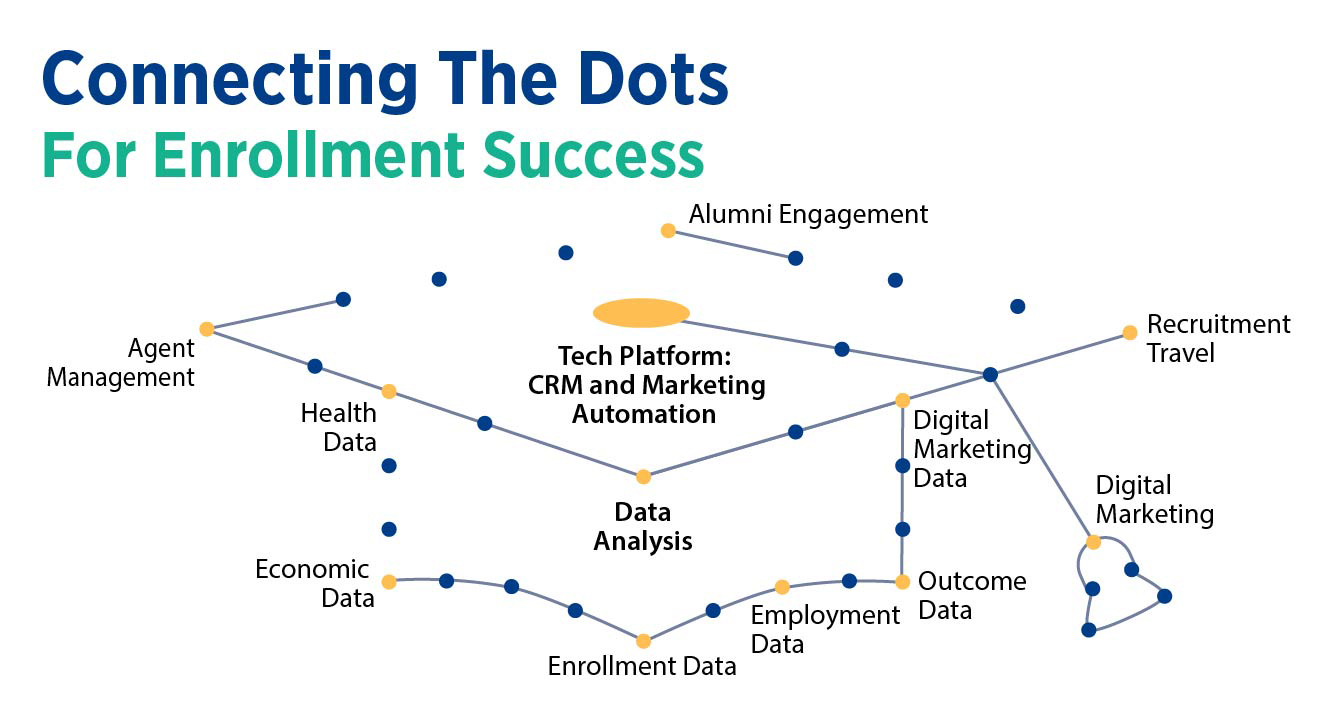
Connecting the Dots for Enrollment Success

Let’s pause for just a minute or two and take a few deep breaths. The pace of all that is going on, right?

With this post, we are going to connect a few dots. Reconfirm the why’s and how’s of what we are doing in the enrollment management arena.

Right now, we see civil unrest around us that is the expression of communities not understanding each other. Lack of cultural understanding, lack of connection, lack of empathy, all leading to severe consequences. This is an age-old struggle and we, in the education sector, pour our hearts into changing the underlying factors that contribute to the mess we find ourselves in.

Getting our work right really does matter. Education IS such a huge part of moving our communities in the right direction.

For most of us, maybe all of us, recent events make it crystal clear why we do this: every mind opened, every cultural connection built, is a win.

To achieve loftier goals, the academic institution must remain economically viable. And we need the students to enroll.

We know, looking ahead, more dramatic change is coming as we navigate various immigration decrees and virus news. We’ve all been working really hard to maintain the pace and make smart decisions. So, let’s just pause and reflect for a moment and connect some dots.

In short, the process is: view the data, assess the tools, make a plan, execute. Sounds simple, right ; -)

Our Intead Plus library of recruitment content and worksheets has supported so many. It’s out there if you need it. Below we review our process with some helpful lists to get you thinking, considering.

This is such an important time to plan and act.

Often, as the team here begins our projects with a new client, institutional leaders apologize for the many silos across their campuses that hold information and work far too independently. We are often tasked with gathering the necessary information and bringing as much unity to the siloed teams as possible.

Deep breath.

And again.

Getting our important work done the best way: There are so many approaches and so many adjustments that are necessary as circumstances and the people involved shift. All of our talents for listening, embracing and connecting ideas, all of this is needed from all of us.

There are underlying processes to how we do enrollment marketing that are essential and consistently required regardless of the circumstances. These processes adapt as situations change. 

Knowing where your processes stand, and which dots might need more attention has real value. Read on and consider whether your enrollment management system’s dots are functioning holistically.

Read More

Can Bootcamps Go to University?

Thinking about tech bootcamps as a new revenue stream? We are.

If you've not already read last weeks post about Full On Armchair Recruiting with clear and supported guidance on what comes next for student enrollment, student experience and student services, well, we highly recommend it ; -)  We've received a fair number of emails from your peers who found the advice highly valuable as they make plans for fall 2020 and beyond.

Here's the thing: given anticipated and imminent enrollment drops, new revenue sources are going to be really important.

With all the changes happening now and coming down the pike for academia, we want to continue to look forward and point the way for how your institution demonstrates its value and hopefully finds new revenue sources. Turns out, in this environment, thinking about new revenue streams has suddenly taken on a fevered pitch. That's a good thing. We LOVE innovation.

You and your colleagues have likely talked about the quick-hit education providers cropping up in the form of coding bootcamps. We’ve been keeping an eye on these burgeoning businesses ourselves. After all, they’ve been sprouting like weeds over the past eight or so years.

Their aim is to teach practical skills to nontraditional students looking to enter or change careers or move up the professional ladder. Courses tend to use project-based learning to cover topics like full-stack web development, digital marketing, data analytics, UX/UI design, cybersecurity, cryptocurrency, blockchain and more.

Universities have seen this as a threat to their engineering and IT offerings. But are they truly threats?

Within the past few months, Michigan State University, George Washington University and the University of Toronto School of Continuing Studies each announced their own tech bootcamp (or fintech) programs. There are others taking this direct competitive approach.

The trick for many universities is that their infrastructure is not necessarily set up to provide continuous, short-run programs. One challenge for bootcamps is that their administrative infrastructure is slim and stuggles to support scaled growth. They also struggle with credibility. Will their certificates have value for the graduates over time?

Can you see where we’re going with this?

There’s an opportunity for a symbiotic relationship that can benefit students, local economies and your respective programs. Enrollment marketing, take note! Read on.

Read More

Full On Armchair Student Recruiting Has Arrived

We're coining a new phrase here: COVID Caveat. As in, “Yes, I’ll join your Zoom meeting next Tuesday morning…COVID Caveat.”

There’s so much change that we are all facing right now. It's hard to predict what will happen this Tuesday, much less this fall. Still, there is a bunch of data out there that, taken together, makes a clear case for what this fall will look like for academia.

The information below is seriously valuable to your enrollment planning. And technology will play such a huge role. Thankfully, the tools are available to take your student recruiting entirely digital until everyone is traveling again and recruitment fairs are back in business -- Digital Student Orientation, anyone?

Look, China, 4 months into this thing, has yet to re-open any universities due to concerns about bringing people together from many places. If you want to travel (business or pleasure) between Shanghai and Beijing, you have a 14-day quarantine before you can move about the new city. As leaders, we need to be thinking about the near-term and much farther out. And we need data from many sources to make good decisions. 

Your students will not be showing up on campus this fall. Below we provide the data and thinking that justifies that radical thought. We are demonstrating the broad and deep industry insight that the Intead team brings to our clients every day, along with the ability to execute on the plans.

Our primary take away: putting all your classes online is simply not enough if you want to compete with all the options students will be considering this fall. How and what you use to attract, nurture and then deliver an education to your students online needs to improve, a lot, and fast.

From our point of view, when you boil it all down (and maybe spritz it with some bleach spray), these are your essential imperatives:

  1. Deliver on your education mission to your students, your community and the world, and
  2. Maintain a student enrollment base that allows you to continue to operate.

You're going to need to be versatile and act fast. The only way large organizations pull that off is by hiring smaller, nimble agencies. You know this, but you can ask your business professors for confirmation based on case studies.

Read on for how we think this all plays out in the near-term and longer-term and what we think you ought to be doing about it. Quickly.

Read More

Is Your .edu Part of The IT Crowd?

A few years back, the business world faced an onslaught of new domain extensions. Companies formerly satisfied with their .com addresses suddenly had new options to choose from: .info, .biz, and the like. Even .cool made the scene. 

While the gold standard for academic sites has always been .edu, alternatives such as .college, .degree, .education, and .university present a new, distinctly 21st century challenge: how can you protect your institution from copycat sites?

More importantly, is it just brand management at stake, or does the availability of these domain names put your students’ privacy and online safety at risk?

There seem to be more #EdTech issues emerging every month. We're here to help make some sense of it all. When it comes to protecting your institution’s digital footprint in today’s ever-changing tech landscape, a bit of research and a thoughtful game plan can save you a great deal of headache. Today, we look at these digital hazards and make some concrete recommendations. Read on. 

Read More

Breaking the Ice: What’s New with EdTech Accelerators?

Our calendar is full of conferences and events where we’re presenting on the latest education, recruitment, and EdTech trends. And if you’re familiar with these conference circuits, that means you’re also familiar with the mixing and mingling time. From coffee breaks to cocktail hours, and maybe even the line for the bathroom (hey, you never know where you’ll cross paths with a potential new contact), the networking opportunities are everywhere.

If you’d like to schedule some time to chat with us at your next conference stop, let us know HERE, and don’t hesitate to say hello if you spot one of us in line for the cheese and crackers.

And because you really shouldn't always lead your conversation starter with, “How about this weather we’re having?”, it’s important to have a few relevant industry soundbites in your back pocket to break the ice.

So, what’s a go-to hot topic right now that shows you are both worldly and in the know?

This just in from Singapore: there’s a new model for EdTech accelerators.

Read on to find out what’s happening in the EdTech acceleration space, how it is changing, and what might be coming soon to a cocktail hour conversation near you.

Read More

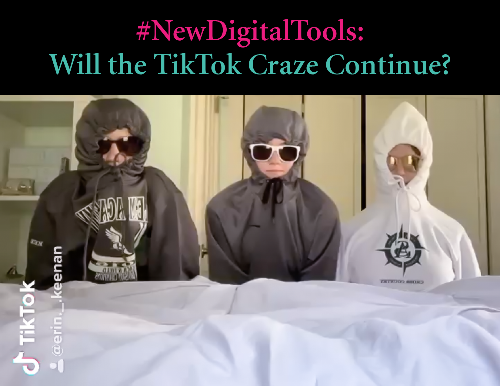
#NewDigitalTools: Will the TikTok Craze Continue?

Remember Farmville? This one game grew to $200M USD in revenue! Now, not so much.

Remember Google Vine as short-form video? Kinda faded away with the advent of Instagram video.

So now, we consider TikTok and wonder, how long will this one last? This one is sophisticated and is already valued at more than $1B USD. This new marketing channel is powerful as long as you have the creative talent to use it.

The rule is: creative content rules. Period.

And the reason we are talking about it is that your target audience is spending a bunch of time there right now. The image above is captured from my 17-year-old niece's TikTok account. She is a content creator there and she and her friends have a great deal of fun (and spend way too much time) in and on TikTok. 

So, about TikTok...in May, we wrote about the growth of Chinese EdTech and what opportunities that presented. As of last year, Chinese startups received over 50 percent of all global capital invested in EdTech. This year, of the top six EdTech unicorns—private companies worth more than $1 billion—all but one was Chinese.

With the largest population in the world, China is automatically the greatest educational market. With a population of over 1.4 billion, there’s a market of more than 283 million students. With 17 million new babies born a year in China, this pattern isn’t slowing down.

Outside of the educational realm, tech is still booming in China, and one platform from China is now the most valuable startup in the world. What might this have to do with connecting you to those potential students in China—or anywhere for that matter?

Read on…

Read More