Recruiting Intelligence

Predicting Student Yield: The Demonstrated Intent Challenge

Unlike most of his peers, my son (it’s Carrie talking here) applied to just two higher ed institutions. He got into both. Accepted both. Put down a deposit on both. Will attend just one. And so, he’s part of the admissions problem.  

Our colleague (and contributor to today’s post) Jon Boeckenstedt, retiring vice provost of enrollment management at Oregon State University, explains it like this: A lot of people think yield is like planting saplings in greenhouses, where your success is highly dependent on things you control, like spacing, soil quality, temperature, water, etc. In fact, yield is more like scattering seeds, where you are hopeful, and you have some ideas of success based on prior years, but in reality, you're at the mercy of factors you have zero control over.  

As an example: Last year, UCLA received 146,276 applications. About 13,114 students or 9% were admitted. For comparison, just 4 years earlier, in 2020, the university had an acceptance rate of 18%. And a decade+ ago in 2010, it was 23%. Go back further to 2000, it was 29%. And wait for it, in 1990, it was just above 40%. A lot has changed in a 30+ years. 

Year 

UCLA Acceptance Rate 

1990 40+%
2000 29%
2010 23%
2020 18%
2024 9%


UCLA is not unique in this way.  


Meet Intead! 

  • Find us at NACUBO in DC in July, and NACAC in Columbus in September. Be in touch to share a cup of coffee in person.

Bookmark this: Intead’s Resource Center 
Access 800+ articles, slides decks, reports with relevant content on any topic important to enrollment management and student recruiting.  Check it out.


Applications have skyrocketed for most institutions. For top-tier universities, this surge makes them even more selective (or rejective) — great for prestige and ranking supposedly, tough for admissions teams and applicants alike. For the majority of institutions, however, the steep rise in applications is just that, a steep rise in applications. Yield is on a different trajectory, and it’s driven by a simple concept: Algebra.  

The rise in applications has dramatically outpaced the increase in college-bound students, and of course, a student can only enroll in one institution, whether they are admitted to two or twenty. This then leads to a big increase in the volume of ibuprofen intake by admissions teams, as predicting the behavior of students is getting harder all the time. While institution leaders continue to demand enrollment results.

Thank goodness for the consistent ibuprofen supply.

We can point to the Common App as the bane of the admissions process. But that’s not really fair. Its advent brought more students into the system, increasing access overall. So, there’s the good. And not every university seeing the surge uses the Common App, and the University of California system is among those that do not.  

The real drivers of the application tsunami: access, competition, and coaching from influencers like school counselors and advisors. There are pros and cons to this situation. Ironically, the unpredictable nature of admissions decisions causes stress, which causes students to hedge their bets and apply to more colleges, which makes the admissions process less predictable. 

For context: 

  • In 2000, the typical applicant applied to three to five institutions.  
  • Today, the average student applies to eight to 12+, simply because they can.  
  • In 1998, when Common App went digital, ~250,000 applications were submitted through it.  
  • In 2024, that number hit 7.3 million – a 2,820% increase. (Yes, they have many more institutions as clients today, but still!)
The problem, of course, isn’t just the mountain of applications (besides, new AI tools are now helping with that to some degree). The problem is predicting yield to land just the right number of students who can bring just the right amount of revenue (and did we mention housing capacity?).   

Read on… 

Read More

Recruiting Intel Digest: The Most Useful Stuff from Q2 2025

…and we thought Q1 was turbulent. The annual NAFSA conference couldn’t have come at a better time. As the White House continued its efforts to reshape US higher ed, our industry was banding together as NAFSA CEO Fanta Aw reminded us that “when the roots are deep, there is no reason to fear the wind.”

Cue a collective deep breath from the audience. We’ve got this; time to dig in. 

Through it all, we’ve been evaluating the news and identifying actionable recommendations. It is a time of continual tactical adaptation to achieve the goal at this point in the year: maintaining or improving yield despite the headwinds.

This post will catch you up on our blogs from Q2 ’25, including: 

  • TRULY VALUABLE TO ALL: Our 2025 ebook reboot of 88 Ways to Recruit International Students 
  • Why online community college is rising for many international student prospects 
  • New NAFSA and Intead-led research on international student employment trends 
  • Revisiting lessons from the past to help shape our response to near-term obstacles in international edu 
  • Our slides from NAFSA 2025 Career Data Presentation (Connecting Dots) 
  • Useful tips on tapping into the digital communication student trend: #studyspo

Read on… 


Meet Intead! 

  • Find us at NACUBO in DC in July, and NACAC in Columbus in September. Be in touch to share a cup of coffee in person.

Bookmark this: Intead’s Resource Center 
Access 800+ articles, slides decks, reports with relevant content on any topic important to enrollment management and student recruiting.  Check it out.


While many NAFSANs did express a weariness and some sessions had a very somber tone, that feeling was not pervasive. There will continue to be pain along the way, no doubt. Some of us will suffer losses due to the threats and disruptions in our field. Student stress (and worse) is no joke. Fabulous and motivated international students will be denied access. Nevertheless, the dust will settle. Reason will prevail. And our community will fix what is being broken.

NAFSA, among other leaders in our field, will be there throughout and after.  

To be clear, no one is giving up the fight.  

We were part of three presentations at NAFSA this year, mostly about career outcomes for international students and how institutions can use this information to improve enrollment and advocate for our community. Find the link to our data (slides and reports) below. 

Read on… 

Read More

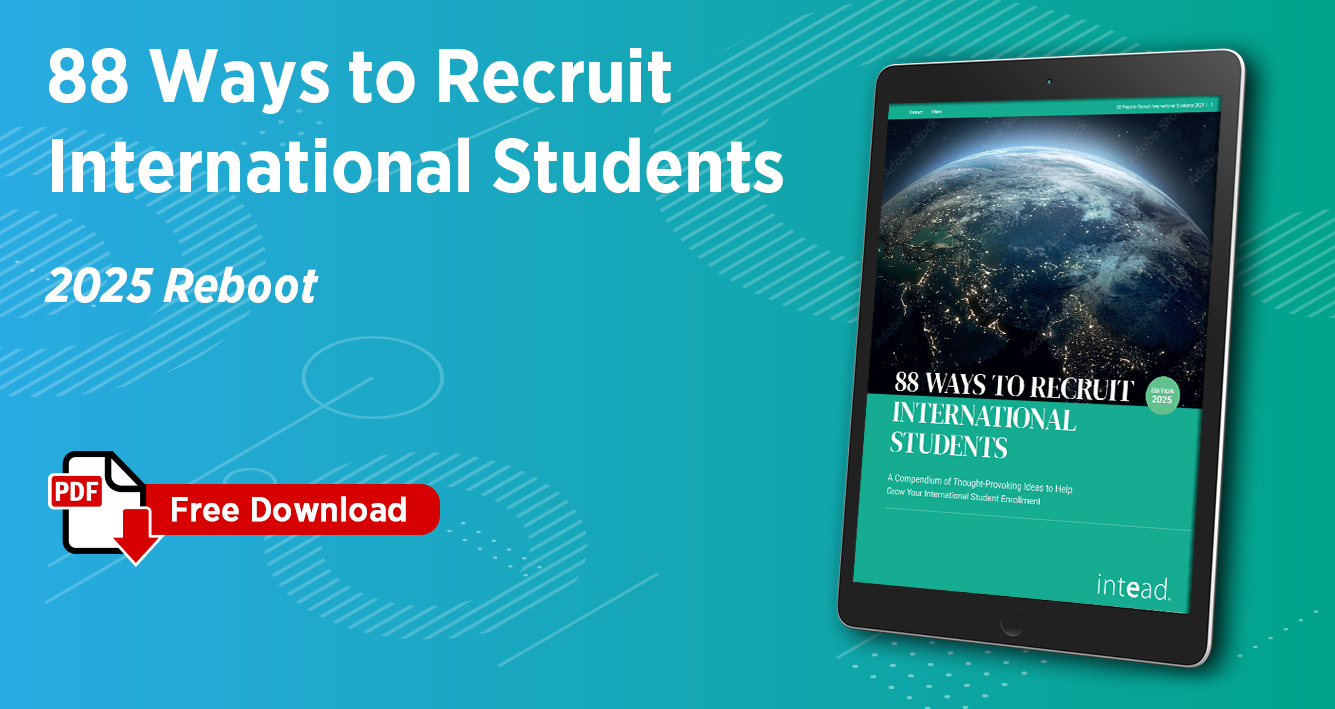
88 Ways to Recruit International Students: 2025 Reboot

Our aim with the original 88 Ways to Recruit International Students, published in 2012, was to create an accessible compendium of international recruitment tactics for edu institutions.  The download took off. At the time of publishing, we were hoping to get 300 downloads. We hit 10X that number in a couple months.  

So successful and widely used by academic and enrollment leaders in 2012-2013, a number of edu service providers in the field (our competitors) started paid search campaigns using our ebook title as their keywords ; -). Digital indicators that we were on to something. 

We have received terrific feedback and suggestions over the years from enrollment leaders. And we owe a debt of gratitude to our original authors, Lisa Cynamon Mayers and Michael Waxman-Lenz for their vision and groundbreaking research to compile our first edition back in the day. Our field has changed with new tools emerging (generative AI), others going away (remember Renren?). 

Currently, in 2025, some of our mainstay data sources (IIE, IPEDS, and EducationUSA) are truncated and under threat of disappearing as we go to press with this edition. Previously unthinkable. Also, potentially making some of our writing in the section called “Recruiting with US Government Support” a bit risky. Hopefully, that does not require an update too soon. 

A truly valuable addition to our latest edition: The intead team has been conducting market research and publishing our findings in our blog for more than a decade. Almost every summarized entry in this edition of 88 Ways has a link taking you to Intead’s deeper analysis of how that particular idea can work along with relevant data. 

So, yeah, you’re welcome.  


Meet Intead! 

  • Find us at APLU in June, NACUBO in July, and NACAC in September. Be in touch to share a cup of coffee in person.

Bookmark this: Intead’s Resource Center 
Access 800+ articles, slides decks, reports with relevant content on any topic important to enrollment management and student recruiting.  Check it out.


Over the years, the Intead team has contributed to the evolution of our field. In 2012, the world was still crawling out of the 2008 market crash. (Remember AIG? Bear Stearns? Credit Default Swaps?) International student enrollment numbers were really starting to climb. And digital marketing was just starting to mature.  

For perspective, the first iPad was released in 2010. In 2012, Facebook had almost 1 billion users. (Today, it has more than 3 billion.) Back then, Renren was very popular and growing as the Chinese Facebook alternative.  

Here’s an interesting digital tidbit: Google Vine launched in January 2013 and died in 2017. TikTok arrived on the scene in 2016 and by October 2018 was the most downloaded app in the US. Today, 3 billion downloads worldwide. 

 So, yeah, it’s been a minute and much has changed.  

Where are we now? In 2025, there are new global threats to the economy, to geopolitical safety, to student mobility. Generative AI is THE hot topic. WeChat is on every Chinese citizen’s phone. WhatsApp (owned by Meta, Facebook’s parent company) is one of the preferred communication tools for 2.75 billion global users (think Southeast Asia, Africa, and Latin America). 

Importantly, there are many, many new enrollment leaders and practitioners out there who are trying to make sense of it all. Enrollment leaders are trying to bring their new hires up to speed with a global perspective. 

That’s no easy task. 

This is where our 88 Ways ebook truly shines: as a resource that helps folks old and new to the field get a quick overview of the many channels, tools, tactics available to help enrollment teams find and recruit relevant pockets of international students around the world. 

The reality that no institution has the resources to market to the entire world prompts smart leaders to evaluate options and focus investments where they have the greatest return value, the greatest potential for success. 

We’ve given 88 Ways a reboot to reflect the current world of enrollment operations and opportunities. We’ve updated the suggestions, retired a few ideas, and offered up new recruitment insights that will no doubt spur worthwhile ideation from your team – whether your institution is US-based or not, this compendium will get you and your team thinking.   

Read on to download our rebooted ebook…

Read More

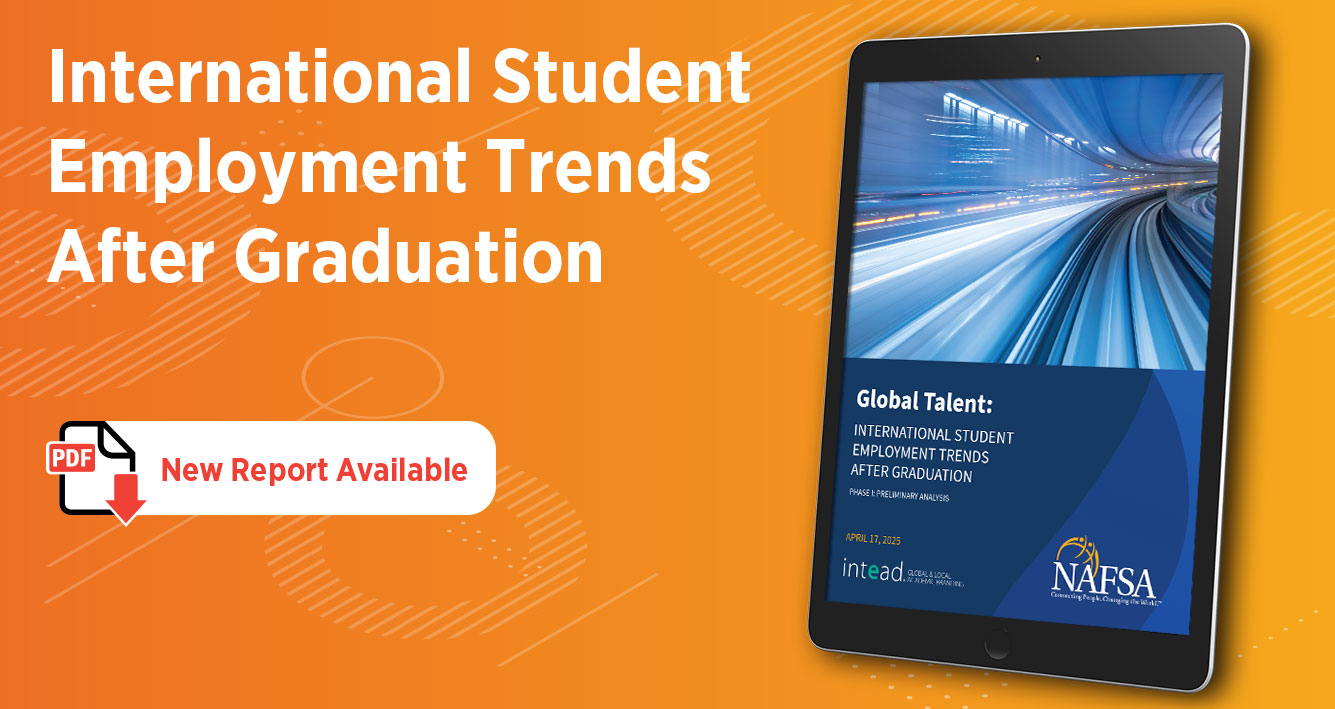
International Student Employment Trends After Graduation

What we know: international students have a well-documented and unambiguous impact on the US economy and society. Each year the US is $43+ billion wealthier because of these students. And our classrooms, campuses, and communities benefit from their diverse viewpoints and clear-minded ambitions, keeping our workforce competitive, tech companies growing, and sciences advancing. 

There’s no skirting the fact higher education is in a reactionary period as the White House does all it can to implement short-sighted changes to US higher education (and we’re being generous here with our choice of words). Advocacy has never mattered more. Which makes the release of our latest research – done in collaboration with the great minds at NAFSA and Fox Hollow Advisory – that much more important. 


Opportunities to Meet the Intead Team 

  • Look for us at NAFSA in May, NACUBO and APLU in June, and NACAC in September. Let us know  if you want to connect at these events.
  • Meet us online Tues., May 6, for the next AIRC webinar where Intead CEO Ben Waxman will join Co-panelists Kevin Timlin, Southeast Missouri State University and Manisha Zaveri, Career Mosaic for the expert-led discussion: IEM Student Lifecycle Series: Effective Student Recruitment Strategies.  

Bookmark this: Intead’s Resource Center 
Access 800+ articles, slides decks, reports with relevant content on any topic important to enrollment management and student recruiting.  Check it out.


Phase I of Global Talent: International Student Employment Trends After Graduation – released for download today – gives preliminary, yet important findings that will help bolster conversations we’re all having right now. This report goes beyond public data to answer:  

  • What is the longer-term value of attracting and retaining international students to US higher ed institutions?
  • How do international graduates contribute to the US workforce and economy?    

The report analyzes behaviors, motivations, and the economic impact of international students after earning their US degree. Special thanks to each of the following participating institutions:  

  • California State University, San Bernardino
  • Ottawa University 
  • Salem State University 
  • Southern Methodist University 
  • University of California, Davis 
  • University of Houston 
  • University of Kansas 
  • University of North Texas 
  • University of Redlands 
  • University of Texas at Austin 
  • Washburn University 
  • Wichita State University 

This research explores the alignment between US institutions producing international student talent, the US economy, and US job market demands. It’s part of a larger initiative aimed at understanding how US education benefits both international students and the nation. Read on to download the report… 

Read More

Do You Know #Studyspo?

Studying up on the latest digital trends in higher ed? We have one that may surprise you but it is certainly familiar to your student intern.  

We’re talking about Studyspo: the trend turning study time into scroll-worthy content.


Opportunities to Meet the Intead Team 

  • Look for us at NAFSA in May, NACUBO and APLU in June, and NACAC in September. Let us know  if you want to connect at these events.

Bookmark this: Intead’s Resource Center 
Access 800+ articles, slides decks, reports with relevant content on any topic important to enrollment management and student recruiting.  Check it out.


In recent years, every nook of the internet—from Pinterest boards to TikTok stories—has gained noteworthy momentum in helping students build connective digital spaces and communities where students share life hacks and ideas with each other. And now, students are convening on these platforms even more frequently—even to study. 

Studyspo, a blending of “study” and “inspiration,” involves students sharing posts, videos, hashtags, and the like, to show how they’re studying. Generating noteworthy digital engagement, Studyspo is, indeed, trending.  

The hashtag #Studyspo has been used in over 1,011,091 posts on Instagram, with an average of 12 new posts per hour. On average, these posts receive 106 “likes” and 2 comments each, indicating moderate engagement. Other related hashtags frequently used alongside #studyspo include #studygram, which has garnered over 13 million posts, #studying with around 6.7 million posts, and #studymotivation with about 3.5 million posts.  

More of the same can be seen on Tumblr, where hashtags related to studying and similar topics (like #studyblr) also enjoy substantial popularity. For example, #studyblr has over 500,000 posts, showing that the study-related community on Tumblr is incredibly active.  

But, trends they are fleeting. How do you know when to jump on the social media fad train (and hashtag) and when to happily let it pass you by? Let’s get into it. Read on…

Read More

English Language Programs as Enrollment Barometers


English language programs (ELP) are a barometer for future enrollment trends. Canaries in the coal mine if you will. When participation is strong, your upcoming application season will likely also be strong. On the other hand, a drop in participation can foreshadow a similar fate for near-term enrollment. (source: see pandemic) 

Understanding the health of this academic niche makes a lot of sense, especially for those tasked with program development or international student recruitment, which is why we so appreciate the efforts of EnglishUSA and their partners BONARD and Pearson Test of English, for their work on the recently published Annual Report on English Language Programs in the USA 2023. The report offers insights helpful to edu institutions across the board. And in this, their second annual report, they offer good news: ELP enrollment is up.

A special thanks to Cheryl Delk-Le Good for bringing this report to our community.

The analysis of the canaries gives us the signposts we all want. The countries where ELP numbers are up give us perspective on where it might make sense to focus our international student recruitment investments.


Our next opportunity to meet! 
NAFSA Region XI, Hartford, CT, Oct 27-29. The Intead team will be there presenting on Admission Process Analysis, Marketing Data Analytics, and Marketing Study Abroad Programs with university partners from our New England region friends from Quinnipiac, Johnson and Wales, Clark, and Emerson. Practical strategies and creative tactics to hit your enrollment targets.  Hope to see you there! 

PIE Live North America, Boston, MA, Nov 19-20. We will be talking about our analysis of career success data and how institutions can use that data to improve recruitment initiatives around the world. Our powerhouse co-presenters: Kerry Salerno, Chief Marketing Officer, Babson College and Andrew Chen, CEO, F1 Hire.

Bookmark this: Intead’s Resource Center 
Take your challenge of the day and plop it into our search bar. With 800+ publications and our 15 years of weekly blogging, you will find relevant content on any topic important to enrollment management and student recruiting. Check it out.


According to the EnglishUSA report, the global English language teaching sector continues to recover and is now 77% of its 2019 student numbers, signaling a positive trend in overall postsecondary enrollment. In the US, the recovery rate was 69% – lower, but still positive.   

Compare this to US institutions as a whole. While all enrollment (domestic + international) is still down 800,000 students from 2019 numbers per the National Student Clearinghouse, solid gains have been made to rebuild enrollment. The latest IIE data on international students in the US (2022/23) indicates that numbers have reached 98% of the 2019/20 levels.  

On a global scale, the EnglishUSA report shows 1.1 million students in 2023 took an English language course in one of eight major destinations – Australia, Canada, Ireland, Malta, New Zealand, South Africa, the UK, and US.  Among these, the US was the third most popular country, hosting 13% of the students, falling in line behind the UK and Australia. And that 13% added up to over $1.7 billion in direct economic impact to the US economy. Education is a solid export for the US. 

These numbers just scratch the surface of the nuanced report, which offers perspective on preferred course types, recruitment channels, visa challenges, more on the economic impact of ELP students, and other valuable insights.  

With students back on campus, we know you’re busy. So, today a quick overview of the stats we found particularly interesting as global marketers. Read on… 

Read More

Yes, You Should be in Vietnam, but here’s the thing…


With the very real concern of declining domestic enrollment numbers, US institutions are right to broaden their recruitment strategies, including their international reach. Thinking beyond traditional student markets, like China and India, is old news by now.  You’ve diversified your draw and Vietnam has been on your list, right?

Don’t get us wrong, China remains an important market and neighboring India is clearly a recruitment stronghold. Learn more about these sending countries in recent posts here (China) and here (India). Today, we focus on Vietnam and why this country offers value to institutions looking at best practices and diversification in their international student draw. 

When we run our global marketing workshops, more than a majority of the institutions attending identify Vietnam as a student market they've targeted as a growth opportunity. The competition for students coming from Vietnam is only growing.


We’ll be at AIEA in DC in about 4 weeks and participating in 3 great presentations: 

  • AI for enrollment management  
  • Entrepreneurial leadership in bureaucratic environments 
  • A discussion around International Student Points of Entry and a new publication to be released later in 2024 

And of course, we will be presenting at NAFSA in New Orleans in late May. If you’d like to schedule time to chat over coffee instead of over Zoom, please be in touch (info@intead.com). 


According to the latest numbers from Vietnam’s Ministry of Education and Training (MOET), approximately 190,000 Vietnamese students study abroad, the majority focusing on post-secondary institutions. That was for the 2019-20 academic year, though it appears the numbers are as strong or better today. Globally, Vietnam ranks as a top 10 sender of outbound student mobility per the ICEF Monitor. 

The majority of these students head to South Korea or Japan for university. Depending on who you ask, either 66,000 Vietnamese students studied in South Korea in 2022 per Capstone Education or just over 37,000 according to Korea Educational Development Institute. Less disputed are Japan’s numbers, which Study Japan puts at 49,000 incoming Vietnamese students in 2021. 

The third most popular destination is the US, hosting nearly 22,000 Vietnamese students in 2022-23 per the latest IIE Open Doors data. A distant third, yes, but considering the literal distance (8000+ miles between LA and Ho Chi Minh City as the crow flies), the numbers are encouraging. The reasons for choosing a US education we most often hear when speaking with Vietnamese students: 

  • A US degree is strong 
  • Classroom instruction encourages creativity and develops critical thinking 
  • Soft skills are taught 
  • Access to a multinational job market

That all makes sense from a prospective student perspective. But, why should your institution choose to actively recruit in Vietnam? What might make these students interested in your institution? And will it be a worthwhile effort for your institution’s enrollment growth? 

Below we share 3 big reasons why we find Vietnam a top student source for markets around the world and offer an insider’s take on the Vietnamese student mindset. To shape our thinking, we tapped our long-time colleague Hien Dao, founder and CEO of Golden Path Academics Vietnam, a Hanoi-based program that preps Vietnamese students for global academic and professional environments. She’s a great resource for any Vietnamese student recruitment initiative. Read on for insights. 

Read More

Intead’s Top 10 Blog Posts of 2023: Chosen by Readers


2023 ushered in some much-needed numbers. Enrollment rose among undergraduate (+2.1%) and graduate (+0.7%) students. And while freshmen enrollment trended downward (-3.6%), interest in shorter-term credentials was on the rise (+9.9%). All this per National Student Clearinghouse figures. 

Likewise, IIE Open Doors data showed a 12% increase of incoming international students in 2022-23. And the more up-to-date SEVIS data indicated 2023 fall enrollment maintained this welcomed momentum. All good news in aggregate. As we parse all these data sets, there are interesting findings and nuanced opportunities to be sure. 

Yet, all news was not good. The chaos of the world at large continued to make its way onto campuses across the nation. Safety continues to be a growing concern, and your prospective students and their families are unsure what to make of it. More admissions inquiries shift from campus life to safety and mental health support services. Also important to note: social justice activities influence an increasing number of applicants. 

In the midst of it all, we do our best to use this blog to weigh in on topics that matter to enrollment teams like yours. So, it’s always interesting for us to look back and see which posts were your faves for most valuable content from the year. There are always a few surprises. 

In 2023, there was a ton of interest in all things internationalization – especially around how student activity in India and China is changing. But that’s not all.

We were told our posts on student career prep, social media trends, and budgeting framework were also really helpful. So, with that, we share our top 10 posts from 2023, as chosen by you, our readers. Plus our staff pick for the most valuable post of 2023. If you missed any of these top pieces, you’ll want to read on…  

Read More

NACAC 2023 Reflections


Most inspiring feature of NACAC ‘23: Angel Perez, NACAC CEO, interviewing Maryland Governor Wes Moore and US Secretary of Education Miguel Cardona in the opening Plenary for 7,000+ attendees. Representation matters.  

This conversation, in the way it was introduced by a power team of NACAC leaders and the dialogue that followed, demonstrates so very much about what we can do to move forward in the face of strong opposition. Bring our unrelenting energy and talent, grounded in the forthright presentation of ideas and ideals. Meet the challenge, whatever it may be, with unwavering, appreciative inquiry. Communicate the vision in ways everyone can understand. 

The conference that followed with all the sessions, networking, and the many interactions showed that NACAC has still got it. And the Baltimore Convention Center people flow worked better than many other large venues we’ve been to. Below we offer additional 2023 Enrollment Trend Observations and the slides from our presentation on the current state of the international enrollment. The data we share offers you an outstanding opportunity to benchmark your own institution against nearly 200 others. 


Opportunities to meet in person:

The Intead team is gearing up for some amazing presentations and we hope you can join us. 

  • CIEE 76th Annual Conference in Paris, Nov 8-10, 2023 
  • PIE News Live in Boston, Nov 13-15, 2023 
  • AIRC Annual Conference – we’ll be offering our full day digital marketing workshop here in Phoenix, Dec 6-9, 2023 
  • ICEF North America Workshop in Miami, Dec 10-13, 2023 

Let us know if you’ll come share a cup of coffee and a conversation about all things global and digital (info@intead.com


Intead’s presentation at NACAC 2023 with Robert Summers from Middle Tennessee State University and Jennifer Wright from AIRC was, of course, in the furthest most possible session room, and the A/C in the Convention Center seemed to get stronger and stronger the further you got from the entrance. So, we cheered when we saw 70+ attendees actually show up on the distant shores of room 348 and suffer through our data display in near arctic conditions. We thank you all! 

I exaggerate, of course. But it was pretty darn cold. And the data we presented wasn’t exactly warm and fuzzy. It is here and available for download in the link at the end of this blog post. Read on… 

Read More

Recruiting Intel Digest: The Most Useful Stuff from Q1 2023

That feeling when you recognize your passport stamps are indicators of future success – for you, and your future international students.

With all that 2023 travel and recruitment planning (so great to be back at it!), you may have missed some of our student recruitment analysis from Q1.

We’ll be in DC at the ACE annual conference in just a couple weeks and then we are planning some great things for NAFSA at the end of May. Can we connect with you at one of these events? Let us know.

We’ve summarized Q1 2023 right here to keep you up to speed. And we were heavy on the highly valuable downloadable resources this quarter. Go ahead, click where the insights grab you.

Read on...

Read More