Recruiting Intelligence

AI Affects Your SEO - But not in the ways you think


Is AI affecting my SEO? One among a legion of questions surfacing since generative AI went mainstream. But it’s one we’re fielding a lot, so let’s get into it.   

First, the basics. SEO, or search engine optimization, is how you optimize your website content to up the odds that search engines like Google will rank your webpages high on their results pages. The goal is to appear as the top result for relevant search queries. You’re likely more than familiar with the concept.  

You may also know that search engines have been utilizing AI for years. It’s what helps them understand the meaning and intent of a search query – a function known as semantic search, which uses machine learning and natural language processing to help Google and other search tools understand what users are searching for.   

So, it’s not AI, per se, that’s got marketers worried. It’s generative AI.  


Opportunities to Meet the Intead Team 
- American Marketing Assn Higher Ed, Las Vegas, NV, Nov. 10-13, 2024
- PIE Live North America, Boston, MA, Nov. 19-20, 2024
- AIRC, Seattle-Bellevue, Washington, Dec. 4-7 -- including our pre-conference global marketing workshop. A full day of Intead global intel (lunch included ; -). Details here. 

Bookmark this: Intead’s Resource Center 
Access 800+ articles, slides decks, reports with relevant content on any topic important to enrollment management and student recruiting.  Check it out.


There’s a concern circulating that ChatGPT will become people’s first-stop search engine. Or that when people use Google, its Gemini content will usurp any hard-won top-ranking SEO results.   

We’ll put it this way: Do not worry. Do, however, get informed on how to use generative AI to boost your SEO. Really.

Our recommendation: share this post with your Search Engine Optimization team and get around a table and talk it through. Below, we suggest some helpful discussion prompts to get the conversation going.

Read on… 

Read More

From Cannibal to Friend: More Campus Leaders Wake Up to Market Demand


Increased demand for online learning is forcing institutions to rethink their approach to programming. 

You likely read that line in a news article a decade ago. But it is news once again. 

Consider this: 69% of chief online learning officers (COLOs) surveyed this year reported prioritizing online versions of on-campus courses, and 65% said they are prioritizing online equivalents of degree programs.  

These significant stats unveiled in the Changing Landscape of Online Education (CHLOE) report, CHLOE 9: Strategy Shift: Institutions Respond to Sustained Online Demand, produced by Quality Matters, Eduventures, and Educause, reveal just how far our industry has come.  

For the past decade, a common hesitation among campus leaders resisting change was the legit and long-held idea that online courses of on-campus offerings risk cannibalizing campus student enrollments. That concern has given way to the notion that these virtual programs may instead attract new audiences. Have we achieved win, win?  

And what of the potential for Online Program Managers (OPMs) in all of this? 


Opportunities to Meet the Intead Team 
- American Marketing Assn Higher Ed, Las Vegas, NV, Nov. 10-13, 2024
-
PIE Live North America, Boston, MA, Nov. 19-20, 2024
- AIRC, Seattle-Bellevue, Washington, Dec. 4-7 -- including our pre-conference global marketing workshop. A full day of Intead global intel (lunch included ; -). Details here. 

Bookmark this: Intead’s Resource Center 
Access 800+ articles, slides decks, reports with relevant content on any topic important to enrollment management and student recruiting.  Check it out.


It’s obvious that the pandemic dramatically accelerated online edu investment. Now, a few semesters past the pandemic's throes, demand for online learning remains high, particularly from students – though a greater number of faculty appreciate it, too. And obviously, institution leaders are paying attention. Thankfully the mood is also shifting from emergency response to long-term sustainability, hastening more meaningful cross-campus discussions on implementation, support, and strategy.  

The CHLOE 9 report adds depth to the conversations we’re all having about online education: investment priorities, pricing approaches, points of friction, third-party services (oh, those OPMS!), and a handful of other key topics worth consideration. Not least among them: Are the participants (faculty and students) simply phoning it in? In other words, does the convenience of remote learning still achieve the desired learning outcomes? And yes, we all feel the learning outcomes slipping.

And for you, what impact does this report have on your recruitment strategy? Read on…  

Read More

Why Personas Get a Bad Rap


Imagine a mid-size, private university, call it Opportunity University, gearing up for a recruitment push in Vietnam – a new target market for the institution. Excited by the potential and the green light from the provost, the nimble international recruitment team of two assembles a marketing campaign targeting what they assume to be their typical international prospects: high school students motivated to get a liberal arts education at a US institution that will lead to future career success.  

The standard international student profile, right? (Wrong, but we’ll get to that.) Running on a tight budget and timeline, they repurposed a campaign strategy that had previously proven successful with the Indian market (a dominant source of students for their computer science graduate programs). The response, however, was not what they had hoped.

The errors of this somewhat exaggerated story highlight a critical marketing misstep: relying on shallow persona development. Not thinking this stuff through can lead to serious marketing misses. Anyone who takes a simple bullet list of traits and runs with it (high school student, career-minded, uses WhatsApp, seeking international education) is not taking their role as marketer seriously.  

Personas often get a bad rap from jaded marketers who have seen the process based on simplistic stereotypes and then relied on as a holy grail. We hear you! We are not seeking Hollywood stereotypes here.

But well considered personas do align your broader marketing team so that your communications speak with a consistent integrity to each potential student segment. Well-crafted personas are all about internal team alignment around a common voice and marketing approach.


Opportunities to Meet the Intead Team 
- NAFSA Region XI, Hartford, Connecticut, Oct. 27-29, 2024
PIE Live North America, Boston, MA, Nov. 19-20, 2024
- AIRC, Seattle-Bellevue, Washington, Dec. 4-7 -- including our pre-conference global marketing workshop. A full day of Intead global intel (lunch included ; -). Details here. 

Bookmark this: Intead’s Resource Center 
Access 800+ articles, slides decks, reports with relevant content on any topic important to enrollment management and student recruiting.  Check it out.


Unlike the fictitious Opportunity University, institutions that think critically and dive deep into student persona analysis understand that the development of multidimensional profiles is foundational to successful student recruitment strategies. They get that personas, when thoughtfully crafted, can anchor the entire marketing team around a coherent, effective, audience-centered strategy. It’s a north star for guiding marketing tactic selection, content development, design, student interactions, and marketing execution which includes selecting recruitment channels. 

The process of creating marketing personas itself helps dissect the complex student decision-making process by considering the target audience’s lifestyle, challenges, media consumption habits, and underlying motivations. It is so much more than a surface demographic dig. What you uncover during the process can lead to really compelling marketing that will resonate with your prospects because you will have firm insights into their mindset, influencers, and ultimately, their choices.  

On more than one occasion we’ve seen the persona discovery process actually lead to market retreat because the more intimate understanding made it clear the audience and programs on offer weren’t a good fit after all. Better to find out in the early stages than committing to a no-win grind. A sort of check and balance of your strategy. 

Complex persona development is the kind of thing large consumer packaging companies are so good at. During one of our internal innovation sessions the Intead team got into a discussion about how understanding your audience plays out. One quick case study was P&G’s “Thank You, Mom” campaign from the 2012 Olympics (London). If you don’t recall what we’re talking about, see the link below. Let us know your reaction. Tip: grab tissues first.  

So much emotion, and yet, all they were selling was laundry detergent and other basic goods. They knew exactly who their target audience was and why they used their products. And no, it wasn’t to simply keep clothes clean. The tagline lays it out, "It takes someone strong to make someone strong. Thank you, Mom." Suddenly, I have this urge to buy Tide. But I digress… 

The lesson here is the student journey to your institution is so much more complex and life altering. Just imagine what a thoughtful, well-understood persona could do for your student recruitment. Read on for our tips (pass them on to your team) … 

Read More

5 Student Recruitment Markets Worth Considering


The US continues to be a top destination for international students. As other anglophile countries find new reasons to limit their student intake (we’re looking at you Canada, Australia, and UK), there is still competition for student attention. Now is no time for US institutions to rest on their laurels.  

The macro numbers around student mobility are always interesting. But the fact is that each institution has tremendous potential in any given market if it plays its unique cards well.  

It starts with market intelligence, understanding your consumer, their motivations, influencers, and how the unique attributes of your institution relate to those consumer insights. There are questions you and your recruitment team are asking: 

  • Are you reaching the right prospective international students?  
  • Are your markets diversified enough? Targeted enough?  
  • How do you know if you are doing all of this well? 

Opportunities to Meet the Intead Team 
- NAFSA Region XI, Hartford, Connecticut, Oct. 27-29, 2024
PIE Live North America, Boston, MA, Nov. 19-20, 2024
- AIRC, Seattle-Bellevue, Washington, Dec. 04-07, 2024 -- including our pre-conference global marketing workshop. A full day of Intead global intel (lunch included ; -). Details here. 

Bookmark this: Intead’s Resource Center 
Access 800+ articles, slides, reports with relevant content on any topic important to enrollment management and student recruiting.  Check it out.


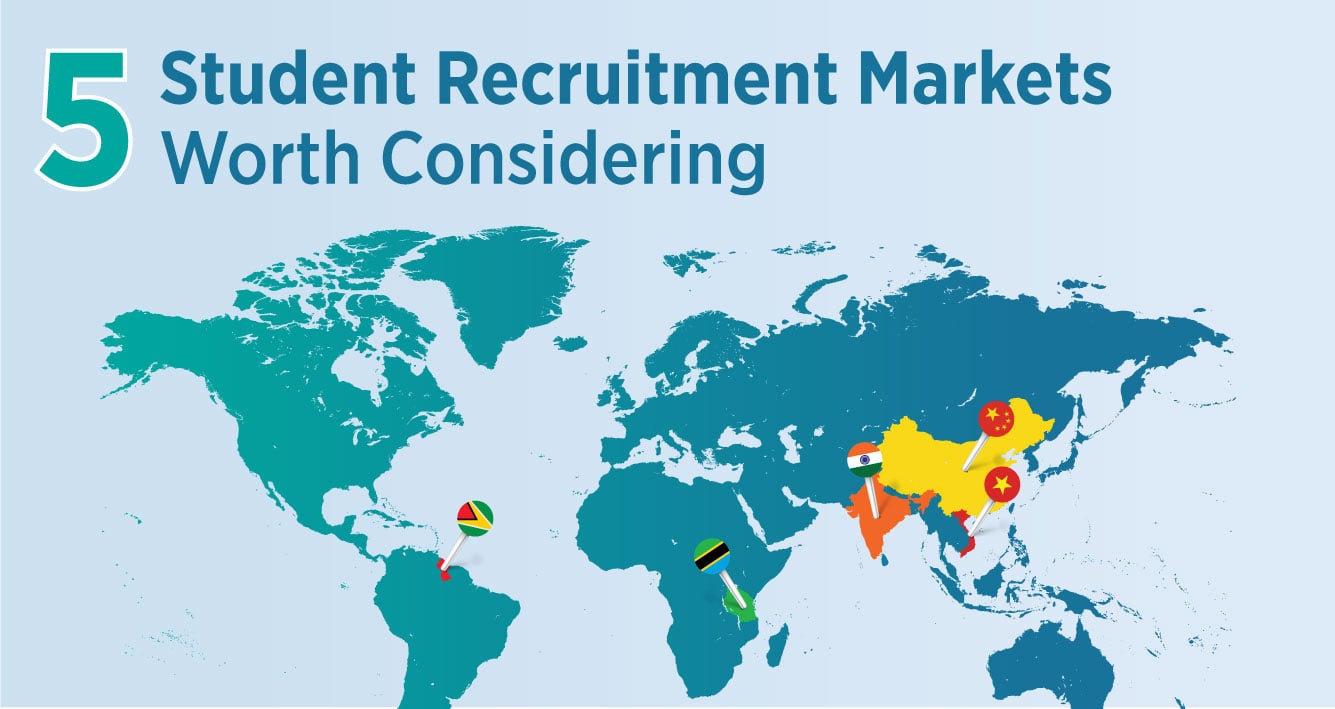
Over the past year we’ve offered insights into regions we think are well worth watching on 3 continents – China, India, Vietnam, Tanzania, Guyana. Each of these countries offers something interesting for international student recruiters to think about. All won’t be right for every institution, but each are right for some.  

Read on to understand how we’re thinking about these markets and to link to our more in-depth articles each one.  

Read More

International Students Seek US Jobs: How You Can Help


The plight of your visa-seeking international grads may best be summed up in this quote, “Given the choice between a prostate exam and sponsoring a work visa, hiring managers will probably choose the former.”  

Zeke Hernandez, a Wharton School professor and author of The Truth About Immigration, gave us a good chuckle with that one when we read it in an August 2024 issue of The Economist. It’s funny because it’s true as the meme goes.   

In an analysis done by ed tech company F1 Hire, only 1.6% of the 1.5 million job postings analyzed had sponsorship-friendly language in the job description. This research was part of Intead’s Connecting Dots report How International Students are Finding US Jobs, published in May. If you haven’t seen it yet, find it here. Our analysis of US Department of Labor data and proprietary data from F1 Hire offers job market insights you won’t find anywhere else. 


Opportunities to Meet the Intead Team 
- NAFSA Region XI, Hartford, Connecticut, Oct. 27-29, 2024
PIE Live North America, Boston, MA, Nov. 19-20, 2024
- AIRC, Seattle-Bellevue, Washington, Dec. 4-7 -- including our pre-conference global marketing workshop. A full day of Intead global intel (lunch included ; -). Details here. 

Bookmark this: Intead’s Resource Center 
Access 800+ articles, slides, reports with relevant content on any topic important to enrollment management and student recruiting.  Check it out.


Understanding career pathways for international students is an increasingly necessary topic for those of us who advocate for and work on behalf of this valuable and important student population. In fact, 84% of international students cite career advancement as their top motivator for studying abroad. And >99% believe it’s why their families want them to study abroad (source: Intead’s Know Your Neighborhood 2024 report).  

But it’s so much more than that. These bright, highly skilled students are a crucial part of the economy. As pointed out in a recent Economist article, immigrants account for 14% of the US population yet are responsible for 36% of the country’s total innovation. It makes sense why. They bring not just knowledge, but new ideas, perspectives, and networks that help shape their work environments. Global perspectives, ideas, and connections benefit everyone.  

At Intead we need only look up from our own desks to see the positive impact of multinational teams (and to our case studies for bottom-line proof of results). We expect many of you are fortunate enough to work in similar environments. We are all better for it as individuals. Our work product is stronger as well.  

The Biden Administration offered a bit of good news for international students earlier this year when they issued guidance making it easier for foreign graduates of American academic institutions to get work authorization. But it’s a small gesture that will likely have minimal impact. Still, we welcome the forward motion. 

Read on for ways your institution can improve career connections for your students... 

Read More

LinkedIn for Edu Marketing? - Career-Minded Students Say Yes!


All recruitment conversations with students lead to careers.  

Disagree? Convince us otherwise.

When prospective students ask about your top programs, they’re really inquiring about their career paths. Questions about student outcomes? They’re assessing their post-degree job prospects. Asking about your institution’s rankings? They are assessing how your degree will play on their CV as they apply for jobs. Inquiring about alumni connections? Clearly thinking about their career network. Calculating your institution’s ROI? All about grads’ salaries. 

Look to our recent Know Your Neighborhood (KYN) survey where a full 84% of respondents view career advancement as their primary motivation for studying abroad. Over 99% will tell you this is also their family’s top reason for pushing them forward. So, career opportunities matter – a whole lot. 

Which begs the question: If prospective students are thinking about careers so much and you have a thoughtful, creative (not stale) social media presence (you do, right?), then wouldn’t it make sense to weave LinkedIn, the top social media platform for the career-minded, into your marketing strategy? Especially when it comes to your graduate programs. More reasons? Consider your referral sources including your alumni network and adjacent target audiences like high school counselors and consulate staff. Turns out, LinkedIn is where these folks live and the platform could be a great place for your institution to connect with a career-minded (read as "less playful") tone. 


Opportunities to Meet the Intead Team 
- NAFSA Region XI, Hartford, Connecticut, Oct. 27-29, 2024
PIE Live North America, Boston, MA, Nov. 19-20, 2024
- AIRC, Seattle-Bellevue, Washington, Dec. 4-7, 2024

Bookmark this: Intead’s Resource Center 
Access 800+ articles, slide decks, reports with relevant content on any topic important to enrollment management and student recruiting.  Check it out.


The latest data from LinkedIn shows its network boasts over 1 billion registered users from 200 countries and regions worldwide. That said, per We Are Social, only 1 in 3 (or somewhere between 330 – 350 million) are active on a monthly basis. This is not Tik Tok! Still the numbers are high enough to matter and much more audience targeted. Within these data you can also find 136,000 schools listed. Yours is likely among them.

Impressive numbers overall, though at some point these supersized stats can feel a bit meaningless. That's why we write about them - unearthing sense from the writhing mess that is social media.

The following numbers may be more tangible for your recruitment work: 50.6% of LinkedIn users worldwide are between the ages of 25 and 34; 24.5% are 18 to 24 (Statista). Further, it’s the 4th most used social platform among our KYN respondents (prospective international students), falling in line behind #1 Facebook, #2 YouTube, and #3 Instagram. Where they use other platforms for entertainment, connecting with friends, and yes, research, they turn to LinkedIn with far more specific tasks in mind. It's all about career opportunities. Perhaps your case for building a LinkedIn recruitment strategy is beginning to take shape.  

Fact is, institutions like yours are increasingly using LinkedIn as a recruitment tool. Its professional focus and networking capabilities make it useful for connecting with career-oriented prospects, particularly those seeking higher degrees, as well as alumni who are arguably your ultimate word of mouth advocates. Not sure if you’re getting the most out of your institution’s account? We’ll tell you how.

This post is a great read for those involved in the details of your social media execution as well as those trying to evaluate the value of the platform in your overall strategy. Be sure to forward it along to the right folks on your team. Read on… 

Read More

English Language Programs as Enrollment Barometers


English language programs (ELP) are a barometer for future enrollment trends. Canaries in the coal mine if you will. When participation is strong, your upcoming application season will likely also be strong. On the other hand, a drop in participation can foreshadow a similar fate for near-term enrollment. (source: see pandemic) 

Understanding the health of this academic niche makes a lot of sense, especially for those tasked with program development or international student recruitment, which is why we so appreciate the efforts of EnglishUSA and their partners BONARD and Pearson Test of English, for their work on the recently published Annual Report on English Language Programs in the USA 2023. The report offers insights helpful to edu institutions across the board. And in this, their second annual report, they offer good news: ELP enrollment is up.

A special thanks to Cheryl Delk-Le Good for bringing this report to our community.

The analysis of the canaries gives us the signposts we all want. The countries where ELP numbers are up give us perspective on where it might make sense to focus our international student recruitment investments.


Our next opportunity to meet! 
NAFSA Region XI, Hartford, CT, Oct 27-29. The Intead team will be there presenting on Admission Process Analysis, Marketing Data Analytics, and Marketing Study Abroad Programs with university partners from our New England region friends from Quinnipiac, Johnson and Wales, Clark, and Emerson. Practical strategies and creative tactics to hit your enrollment targets.  Hope to see you there! 

PIE Live North America, Boston, MA, Nov 19-20. We will be talking about our analysis of career success data and how institutions can use that data to improve recruitment initiatives around the world. Our powerhouse co-presenters: Kerry Salerno, Chief Marketing Officer, Babson College and Andrew Chen, CEO, F1 Hire.

Bookmark this: Intead’s Resource Center 
Take your challenge of the day and plop it into our search bar. With 800+ publications and our 15 years of weekly blogging, you will find relevant content on any topic important to enrollment management and student recruiting. Check it out.


According to the EnglishUSA report, the global English language teaching sector continues to recover and is now 77% of its 2019 student numbers, signaling a positive trend in overall postsecondary enrollment. In the US, the recovery rate was 69% – lower, but still positive.   

Compare this to US institutions as a whole. While all enrollment (domestic + international) is still down 800,000 students from 2019 numbers per the National Student Clearinghouse, solid gains have been made to rebuild enrollment. The latest IIE data on international students in the US (2022/23) indicates that numbers have reached 98% of the 2019/20 levels.  

On a global scale, the EnglishUSA report shows 1.1 million students in 2023 took an English language course in one of eight major destinations – Australia, Canada, Ireland, Malta, New Zealand, South Africa, the UK, and US.  Among these, the US was the third most popular country, hosting 13% of the students, falling in line behind the UK and Australia. And that 13% added up to over $1.7 billion in direct economic impact to the US economy. Education is a solid export for the US. 

These numbers just scratch the surface of the nuanced report, which offers perspective on preferred course types, recruitment channels, visa challenges, more on the economic impact of ELP students, and other valuable insights.  

With students back on campus, we know you’re busy. So, today a quick overview of the stats we found particularly interesting as global marketers. Read on… 

Read More

Why We Travel: Making the Most of Student Recruitment Trips


Danger zone of travel: the misperception among your colleagues that your global trip is just another boondoggle.  

It’s a common experience for international student recruitment teams. Jet-setting itineraries make it hard for some travel-hungry colleagues to see your grueling business trip as anything other than a junket. But a junket it is not.  Below we share an 8-point guide to the "why of international travel".

We know images of far-off places seem “luxurious” to those not on your team, which is why so many of you no longer post those photos from your trips on social media. Never mind the 3am (local time) touchdown in Delhi that led to your 7am scramble to the student fair starting in 2 hours where you spent the next 8 hours repeating the same conversation with 122 different students until it was time to cap off the day with a working dinner with your in-country agent. A day lounging at the beach, right?


Our next opportunity to meet! 
NAFSA Region XI, Hartford, CT, Oct 27-29. The Intead team will be there presenting on Admission Process Analysis, Marketing Data Analytics, and Marketing Study Abroad Programs with university partners from our New England region friends from Quinnipiac, Johnson and Wales, Clark, and Emerson. Practical strategies and creative tactics to hit your enrollment targets.  Hope to see you there! 

The Resource Center for Industry Insiders 
Take your challenge of the day and plop it into our search bar. With 800+ publications and our 15 years of weekly blogging, you will find relevant content on any topic important to enrollment management and student recruiting. Check it out.


Here’s the truth. We talk a lot about armchair recruiting and the undeniable advantages of digital marketing around the world. And we stand by that. But for institutions that can afford to, purposeful travel absolutely builds your recruitment strategy in robust ways. We know you agree. But does your provost? 

This week, from-the-field insights on recruitment travel from recent conversations with our SIO colleagues David Di Maria, Ed.D., senior international officer and associate vice provost for international education at UMBC, and Jill Blondin, Ph.D., associate vice provost for global initiatives at Virginia Commonwealth University. Plus, the key conversations that will help you make the most of the travel you do have budgeted. Because you never want to waste a good trip. Read on…  

Read More

Is Your Content Functional but Vibeless?


So, my oldest child joined us for dinner out the other night. She dressed with her usual flair, all yellow and brown this time. And she ordered herself a drink to match – some cocktail concoction that apparently took a cue from her hues. I had never ordered a drink to match my look before, so I asked her what I should get. Her response: "Dad, I have no idea. Your look is functional but vibeless – jeans with a black fleece. How about a Miller Lite?" 

Absolutely loved that line: functional but vibeless. How common is that situation in the marketing/communications world? Consider all of the functional but vibeless emails we receive. You probably can’t consider them. They’re all just so forgettable.  


Our next opportunity to meet! 
NAFSA Region XI, Hartford, CT, Oct 27-29. The Intead team will be there presenting on Admission Process Analysis, Marketing Data Analytics, and Marketing Study Abroad with university partners from our New England region friends from Quinnipiac, Johnson and Wales, Clark, and Emerson. Practical strategies and creative tactics to hit your enrollment targets.  Hope to see you there! 

The Resource Center for Industry Insiders 
Take your challenge of the day and plop it into our search bar. With 800+ publications and our 15 years of weekly blogging, you will find relevant content on any topic important to enrollment management and student recruiting.  Valuable perspective and data on topics you care about. From agent-university partnerships to predictive modeling and CRM efficiency, to new market development, our Resource Center has you covered. Check it out.


Examples of what we mean:

→ Dear inquiring student, 

Thank you so much for submitting your application. We note you are still missing one document. Blah, blah, blah…our deadline is approaching. 

Thanks, Vibeless University Admissions Team 

---

→ Dear admitted student, 

Let us introduce you to all of the really great student associations you could join here at Vibeless U! When you arrive, you should look into one. Oh, and here’s a fun picture … 

Sincerely, Vibeless University Admissions Team 


All function, no form, low response rate, immediately forgotten. Instantly deletable. 

Taking time, tapping consumer insights from your current students, injecting creativity, tracking the metrics to figure out what works, what converts. These are the activities that produce results. These are the activities that will share your institution’s true vibe far and wide. 

Every communication you have with students and prospective students, matters. It’s how you connect with them. Correction: It’s how you stay connected. Retention is as important as recruitment.

Today, we offer the three golden rules to creating a lead nurturing campaign that’s got the function you need and that all important vibe. We think this post will be really helpful for your team members tasked with the nuts-and-bolts details of your institution’s prospective student outreach.

Important to communicating vibe: the order you present your messaging matters by region and student type. Is affordability your first hook? Career opportunity? Environmental justice? Academic prowess? All important content areas. Different student segments will click on one or another topic at different points in their decision-making process. THAT is what consumer insight research confirms for you as you use your content to improve application rates and yield.

Share this one with the right folks on your team and, read on 

Read More

Are You Ready for an International Alumni Strategy?


Cue the confetti. A new guide for international education practitioners just hit the bookshelves.

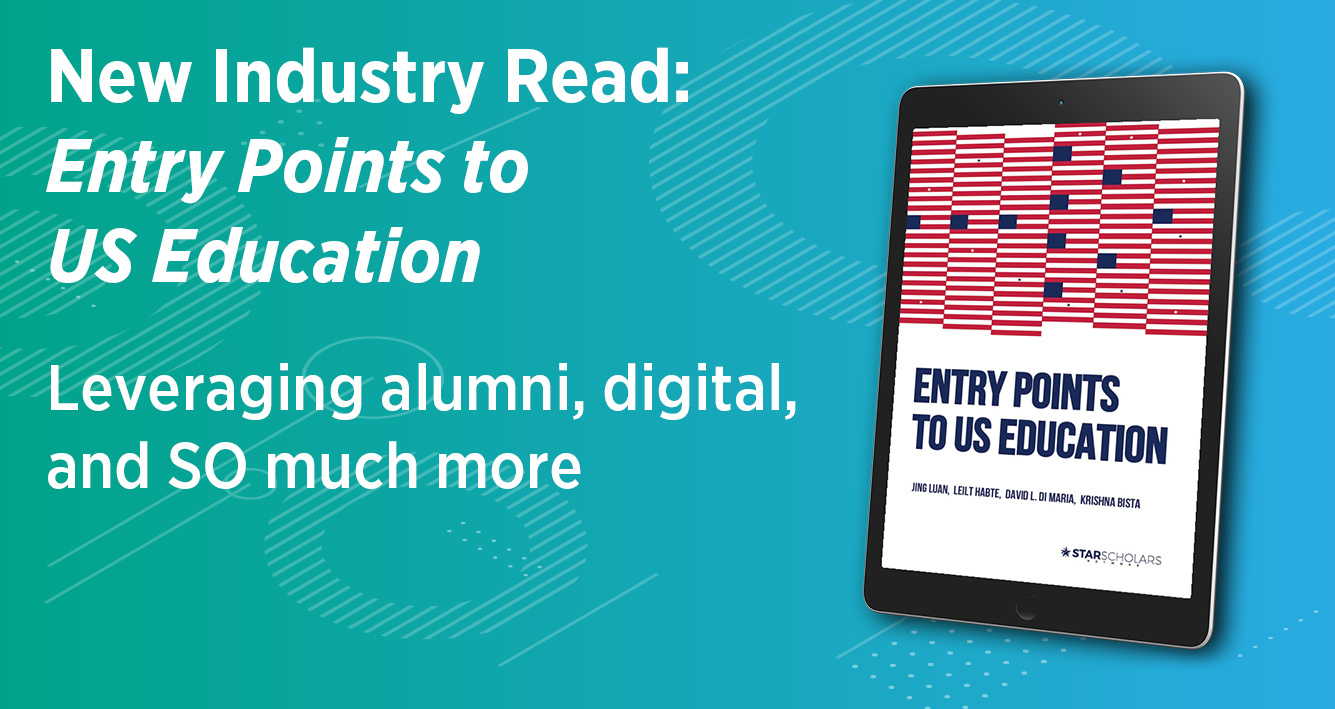
Produced by Star Scholars and filled with analysis and counsel from luminaries in our field, you'll want to grab a copy (link to purchase below). With thanks to editors Dr. Jing Luan, Leilt Habte, J.D., Dr. David Di Maria, and Dr. Krishna Bista, and too many amazing chapter contributors to list here, this book packs a punch.

We were honored to participate by contributing a chapter on how to Leverage International Student Alumni in your student recruitment efforts and another chapter on Using Digital Marketing for International Student Recruitment. Below, we will be talking about your international alumni and serving up a really nice interactive tool offering guidance based on where you are at with your alumni program.

We could not have provided the clear and actionable content without the leadership of our friend and colleague, Dr. Gretchen Dobson with the depth of her work in this area.

The value of your international alumni cannot be understated. Few ready-made resources can connect as quickly and honestly with prospective international students, making them feel understood and welcome. This is about helping them connect with what is real and tangible based on a degree from your institution. Yet, for many institutions, tapping into this network remains on the to-do list. It’s one of those great ideas that remains underutilized. Blame resources, blame poorly maintained databases, blame, well, you know exactly what we are talking about.  

Of course, your institution has strong institutional support for building and maintaining a robust domestic alumni network. All the while, the relative importance and financial value of international students are often overlooked. In some cases, 7% of the total student population being international represents as much as 30% of total tuition revenue. A good idea to do that math for your institution if you have not already. Yet our institutional infrastructure remains lopsided, heavy on domestic alumni, light (or non-existent) on international alumni despite what they can contribute.


Our next opportunities to meet! 

EducationUSA Forum, Washington, D.C., July 30-August 1. Ben and Virginia Commonwealth University SIO Jill Blondin will share insights on Navigating Budget Challenges in International Recruitment: Practical Strategies for Every Phase.  

Be in touch! We’ll buy the coffee. 


In Entry Points to US Education: Accessing the Next Wave of Growth, our chapter on international student alumni management is a great read for any enrollment leader looking to justify the costs associated with building a stronger connection to international alumni. It delves into the motives behind such an effort, including: 

  • Brand awareness 
  • Reputation management 
  • Recruitment 
  • Employability 
  • Global connections 
  • Public diplomacy 
  • Financial resource  

At the end of the chapter, we offer the link to an interactive questionnaire designed to assist international student recruitment teams in evaluating their ability to deploy alumni ambassadors. This simple 8-question form provides customized recommendations based on your responses.Today this tool is available to Recruiting Intelligence blog readers (even if you don’t purchase the book. But really, purchase the book!) Read on to check out the evaluation form… 

Read More