Recruiting Intelligence

Career Success for US-Educated International Students?


Career opportunity is the primary motivating factor for international students. All our research into the international student journey says so. We’ve known this for a long time. If you can demonstrate that your degrees pave a beaten path to positive career outcomes, then you’ve got your prospect’s ear. Not many institutions can back up their promises with data...until now. 

Institutions seem to have had a hard time making the case for bottom line ROI. Sure, there’s the usual “x% employed within 6 months” data every institution flaunts, but what does that really tell a student who’s halfway around the world? Not a whole lot. We’re not saying to nix that stat – definitely keep it – but it’s hardly concrete proof for your prospective students. 

The fact is most institutions simply don’t have the student data on the whole job search process to offer much more. Especially for international students graduating from your specific institution. 

Nor do most institutions have the bandwidth to think it through for the international cohort. But data does exist that can help you uncover a truer and fuller picture of career potential for your international students. It’s a matter of knowing where to look, how to look, how to clean and crunch the data, and then interpret that data appropriately.  

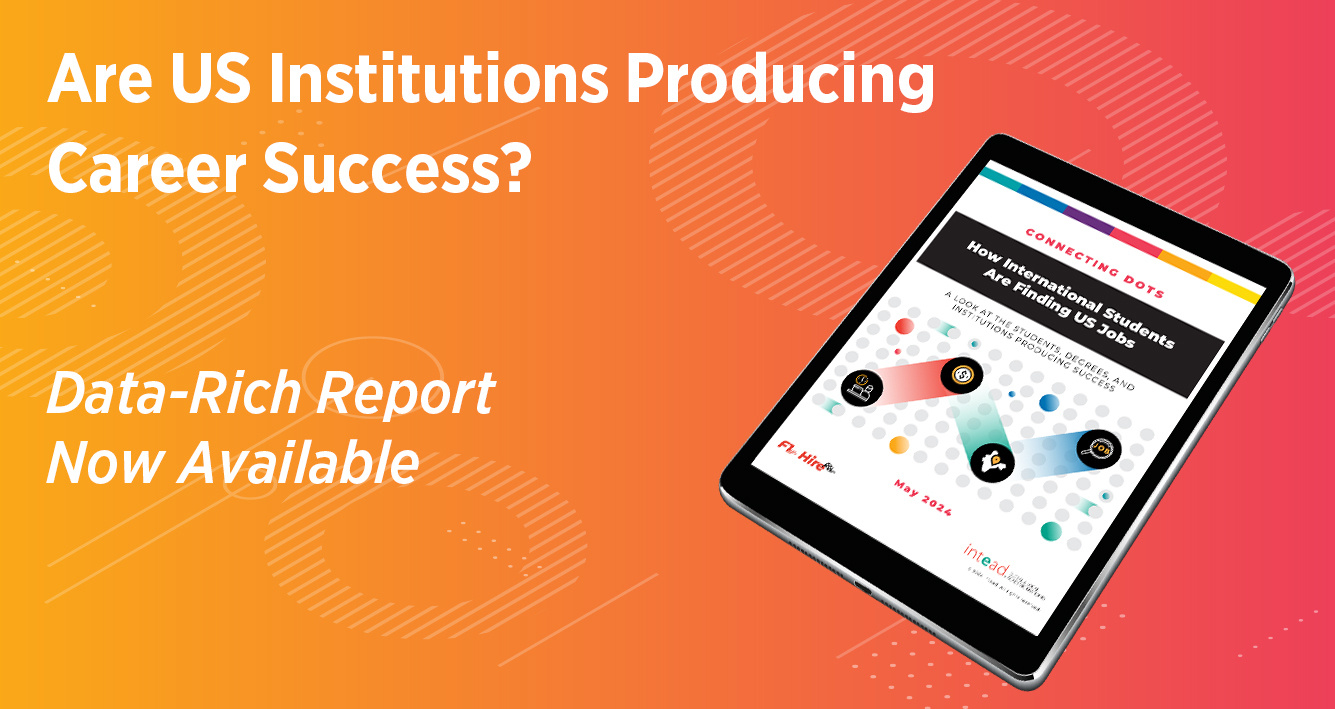
Enter Intead’s analytics team and our colleagues at F1 Hire! On offer to you for download: our first Connecting Dots study, How International Students are Finding US Jobs: A Look at the Students, Degrees, and Institutions Producing Success


Our next opportunities to meet! 

GMAC Annual Conference, New Orleans, June 19 – 21, 2024. Ben will be presenting on how global elections are influencing student mobility. More than just the US presidential election has the power to upend what students will choose to do next.  

EducationUSA, Washington, D.C., July 30-August 1. Ben and Viginia Commonwealth University SIO Jill Blondin will share insights on Navigating Budget Challenges in International Recruitment: Practical Strategies for Every Phase.  

Be in touch! We’ll buy the coffee. 


Our newest dataset focuses on practical next steps for international graduates. The ROI insight they’re really after. And for institutions, our approach to analyzing US Department of Labor data can help your marketing recruitment team stand out at any student fair anywhere in the world. Wanna see how? Read on to download our report... 

Read More
Groundbreaking Data: International Student Employment After Graduation


The NAFSA room was sold out; every seat taken.  

That morning we really weren’t sure what to expect with our session being held in the very furthest room on the 3rd floor of the New Orleans Convention Center. And that convention center is one of the largest we’ve ever seen. Like, you need an Uber to get from one end to the other. 

We could not have been more thrilled with the turn out. What everyone came for: new data, never before collected, on what international students are doing after they earn a US degree. 

What’s been missing from our community’s conversation on the value of US degrees for international students is real ROI. Sure, we talk about ROI: “94% of our students are employed or pursuing advanced degrees 6 months from graduation.” But we’ve never quantified actual ROI...until now.  

Today we’re sharing a preview of new research on the career progress of international students who graduated from US institutions. (The full report will publish later this summer. Be among the first to receive this and 2 other groundbreaking reports by pre-registering. You’ll also get our NAFSA 2024 session slides.)  

This NAFSA research report will be the first of what will become an even deeper analysis based on more research between now and 2025. We want to truly understand what a US degree produces for international students. Is it worth their investment? Is it worth ours? This is data we’ve been wanting to mine for years.   


Our next opportunities to meet! 

GMAC Annual Conference, New Orleans, June 19 – 21, 2024. Ben will be presenting on how global elections are influencing student mobility. More than just the US presidential election has the power to upend what students will choose to do next.  

EducationUSA, Washington, D.C., July 30-August 1. Ben and Viginia Commonwealth University SIO Jill Blondin will share insights on Navigating Budget Challenges in International Recruitment: Practical Strategies for Every Phase.  

Be in touch! We’ll buy the coffee. 


I was extremely honored to have presented our latest research at NAFSA last week alongside Dr. Joanna Regulska, vice provost and dean of global affairs at UC Davis. UC Davis is one of the 12 innovative and forward-thinking institutions participating in this groundbreaking study. 

Our research involved a 22-question survey sent to international students who graduated from our 12 university partners between 2019 and 2023 (see below for the full list). With a 5.3% response rate, 1,797 graduates from 131 countries answered our survey questions. Of these, 1,323 still reside in the US, 474 live elsewhere. 

What we learned will have a direct impact on international student recruitment, as well as offer perspective on US immigration policy. Data informs how we make sense of the world and move forward as a community and a society. The data collected encourages us to understand the value of CPT/OPT to our international students and the US.  

Laid bare: the real outcomes and the positive impact international student graduates are having on the US economy.  

For those of you interested in taking part in our next survey, be in touch at info@intead.com. So many of our higher ed colleagues at the conference raised their hands to evaluate participating in the next research phase of this project. Be a part of that! 

Below we share key takeaways from our research and provide you quick access to the slides from our NAFSA presentation. Read on... 


Read More

How International Students are Finding US Jobs


No one on the Intead team has participated in an Iron Man competition, but the adrenaline levels we are experiencing make me wonder if preparing three different, compelling, in-depth reports in time for NAFSA next week compares. I'm confirming that no one from our team will be running, biking, or swimming to New Orleans for NAFSA, but we have been running the analytics on some really novel data all related to different aspects of the international student journey. We’re so close to the finish line! 

The work has been exciting, sometimes difficult, and the data is beyond beaten up at this point. The payoff will be so rewarding. We really can’t wait to share all we’ve learned.

Today, we are going to let a few whiskers of one of our cats out of the bag. 


Let’s meet in New Orleans @ NAFSA 2024! 

Join one of Intead’s two NAFSA presentations: 

We’ll be presenting insights in our two valuable Nafsa sessions: 

  • ChatGPT and AI: What are the real opportunities for enrollment management? 
    Wed., May 29 @ 1 p.m. in NOCC, Room 391
    Featuring Dr. David L. Di Maria, SIO & Associate Vice Provost for International Education at UMBC with Iliana Joaquin, Director, Digital Marketing at Intead  
  • Groundbreaking Data: International Student Employment After Graduation
    Thurs., May 30 @ 11:30 a.m. in NOCC, Room 398-399
    Featuring Dr. Joanna Regulska, Vice Provost and Dean - Global Affairs, UC Davis and Nafsa Board Member with Ben Waxman, CEO at Intead 

Be the first to know!  Pre-register to receive Intead’s 2024 proprietary reports as soon as we publish them. 


We are all seeking to understand the global landscape for international students. Our latest research takes a hard look at the US career options and outcomes – key drivers of international student decision-making. Career outcomes are, after all, a central metric for many international students. Our take: not understanding how your institution plays into the US international employment scene puts you at a recruitment disadvantage. 

So, we partnered with our colleagues at F1 Hire to examine both public and proprietary data sets.  

If you’re not familiar with F1 Hire, its web extension, designed for international students in the US, has become the must-have tool for OPT/CPT/H-1B job seekers. Together we analyzed the US Permanent Labor Certification Program (PERM) and H-1B visa application data tracked by the US Department of Labor between 2018-2023. We will be sharing insights into the career pathway options for international students who entered the US workforce upon completing their degrees at US higher ed institutions as well as those who earned their degrees abroad. We reviewed this data against IIE Open Doors stats and proprietary data owned by F1 Hire. 

What we learned was fascinating.  

By drilling into this employment data, we see many ways institutions can use this information as a recruitment tool to demonstrate their success in helping international students find employment.  

An example: Our analysis of F1 Hire’s collection of 1.5 million job opportunities reveals significant disparities in H-1B opportunities relative to the number of international students by state. 

Here’s a sneak peek that surprised us: We found 6.4 H-1B opportunities in New Mexico per international student studying in state compared to just .34 H-1B opportunities in New York per in-state international student. Hello, New Mexico as a student destination! We simply didn't see that coming.

Our full report, which will be available soon, provides keen perspective on: 

  • International student earning potential 
  • Geographic insights (countries and regions) 
  • Industry insights 
  • India-specific insights 
  • Job search insights 

And of course, we offer our take on what this all means for your international student recruitment efforts. 

Read on to register and be among the first to receive our full report. Below, we also share key takeaways from our research… 

Read More

Did you say something?...I’ve already scrolled on


With the amount of time prospective students spend online, you’d think connecting with them would be easier.  

The average US teen spends 7 hours 22 minutes each day looking at a screen, or 43% of their waking hours, per Exploding Topics. And that’s being conservative – Common Sense stats show teens on screens 8 ½ hours per day outside of school-related screen time. Need confirmation? Just look around your campus at all the students not looking at you, but rather their screens. (Reality check: the rest of us aren’t off the hook as the average person clocks 6 hours 58 minutes of screen time per day, just so you know. So yes, that is where all the time goes!) 

Do you know the average number of phone notifications a US teenager receives each day? We answer that below. Make sure you are sitting down when you read it.

Yet, despite all their screen time, or perhaps because of it, your prospective students are discerning consumers of marketing. If they’ve seen one university ad, they’ve seen a thousand. We’re certain you can relate. We all can. But some messages clearly do get through, and it almost always comes down to creativity, cultural nuance, and an appetite for taking a little risk.

Fun fact for the risk takers: Humor is a tough marketing message to achieve with a broad and diverse audience, but when you get it, it REALLY works. 


The Intead team is gearing up for some amazing presentations and we hope you can join us. 

  • ICEF North America in Niagara, Canada, April 30 - May 3, 2024
  • NAFSA 2024 Annual Conference and Expo in New Orleans, May 28-31, 2024
  • GMAC 2024 Annual Conference in New Orleans, June 19-21, 2024

Let us know if you’ll share a cup of coffee and a conversation about all things global and digital (info@intead.com) 


Take fintech, an increasingly rising "it" program in the eyes of so many STEM-degree seekers, especially those with a bent toward accounting and money-making in general. And rightly so as financial services operations around the world increasingly rely on new technologies to do business. (Shout out to Worcester Polytechnic Institute on its recent fintech doctoral program launch giving students a full-stack (BA>MS>PhD) option in this coveted field. Talk about reading the market!!!)  

Fintech is a huge, booming industry and one that universities with fintech programs are leveraging to draw the attention of prospects. The same can be said for Data Analytics, Cybersecurity, AI, and other “sexy” programs that now drive global and local economies. 

Important note: the counsel that follows here applies to how you message your programs even if you computer sciences are oversubscribed and you are trying to attract students to other options.

We want to promote programs that will draw eyes and pique interest. Highlighting them in your recruitment efforts makes sense. Of course, you know this. And yet somehow marketing that ultimately makes it onto the screen in front of your prospective students’ gaze is so often watered down, generalized speak about “great programs in computer science” or “practical business degrees” or the now far overused, “advance your career.” Ugh. Your prospect just scrolled on.

We know you know exactly what we’re talking about. So often there is a fear of getting too specific. Why mention one computer science program and ignore the others when students need to know there are many amazing degrees from which they can choose?  

Here’s why: you need their attention, and the coveted, interesting, or unusual programs will get it. Not the generalized track that simply prompts the finger flick and scroll right by. 

It’s not just your message you need to consider, it’s also the medium.

95% of US teens now own or have access to a phone per Pew Research. Worldwide, the stats vary (China has the most active smartphone users, followed by India, the US, Indonesia, and Brazil), but it’s safe to say many of your prospective students living outside of the US are on their phones, too. In Sub-Saharan Africa, affordability and access is improving such that there will be 692 million unique mobile users by 2030, 88% of whom will be using smartphones according to lobby group GSMA.

Many of your prospective students will not only be accessing information about your institution via smartphone, but will be completing the entire application process on it as well. Something your international team knows but your domestic team might not be thinking about. 

Marketers and message makers read on for our tips on phone screen engagement tips. Like all good listicles, we’ve got 5 steps to push your team to create effectively... 

Read More

New to WhatsApp Business? Yup, we got you! - Part 2


If you’re on the fence about WhatsApp, know this: Meta’s goal is to make WhatsApp a household name, whether it is to shop, chat, or stay on top of news and events. That from a recent New York Times article. In it, Will Cathcart, head of WhatsApp confirms what we are already seeing, that the conversation has moved from ‘WhatsApp is the app I use outside the US when I travel,’ to something much more mainstream in the US. Below, we get detailed and actionable about what this means to you.

Word from Apptopia confirms as much. Its numbers show WhatsApp’s daily active users grew by 9% in the US last year, with 50% of these users chatting daily on the app, 78% weekly. Aside from Meta’s interest in cementing this app as the singular messaging tool among consumers worldwide, pundits point to a variety of reasons for the uptick in the US – the preference for messaging versus emailing, the preference for closed-group messaging rather than social media blasts, the increase in post-pandemic international travel, and the app’s ease of use for business communication just to name a few. 


Events you won’t want to miss:

Let’s talk international student enrollment at the upcoming AIRC Spring Symposium on April 30. Intead will be presenting on student recruitment marketing budgets – we've got some great new insights to share. Register today!

The Intead team is gearing up for some amazing presentations at: 

  • ICEF North America in Niagara, Canada, May 1-3, 2024
  • NAFSA 2024 Annual Conference and Expo in New Orleans, May 28-31, 2024
  • GMAC 2024 Annual Conference in New Orleans, June 19-21, 2024

Let us know if you’ll share a cup of coffee and a conversation about all things global and digital (info@intead.com)


Those who readlast week’s post know how we feel. (Get to it!). It just makes so much sense for universities to have a Business WhatsApp account, especially those who work with international students. And now, we believe, for domestic markets, too. Check out our handy, quick-hit, 11-step check list.

Just like last week, this post is the kind of thing you might want to share with your enrollment team and prompt a discussion at the next team meeting. How would you adapt our recommendations to your particular situation (CRM, staff structure, enrollment pipeline, etc.)?

If you are going to be using WhatsApp, we strongly recommend you puppeteer these communications from a WhatsApp Business account. We got into the meat and potatoes of setting these accounts up last week. Now, let’s get to dessert, aka best use practices. Read on… 

Read More

New to WhatsApp Business? Yup, we got you! - Part 1


What’s up with WhatsApp is a question we find ourselves answering a lot lately, especially when talking about student recruitment. And it is a bit more for international students than domestic, though this blog is useful intel for both. As a teaser, more than 100 billion messages are sent each day on WhatsApp. Yes, that was 100 billion per day! We have more eye popping stats below. 

An important messaging tool because it works across countries, many institutions have been using personal WhatsApp accounts that are attached to a single phone number. That works, but as far as standard operating procedures go, that’s a bit flimsy.  

WhatsApp, a Meta company for 10 years now, has an answer called WhatsApp Business. That too has been around awhile (WhatsApp Business launched in 2018), but it’s just been a bit cumbersome for many overly busy international offices to onboard. And many of their domestic student recruitment counterparts have taken a why-bother approach. 

Our take: it’s time to bite the bullet – it’s easier than you think – and set up a WhatsApp Business account that can be managed from a desktop (see our quick hit 11-step process). We concede that it can be time consuming, but there are just so many benefits to having a verified account on behalf of your institution that we think it’s worth your while.   


Events you won’t want to miss:

Let’s talk international student enrollment at the upcoming AIRC Spring Symposium on April 30. Intead will be presenting on student recruitment marketing budgets – we've got some great new insights to share. Register today!

The Intead team is gearing up for some amazing presentations at: 

  • ICEF North America in Niagara, Canada, May 1-3, 2024
  • NAFSA 2024 Annual Conference and Expo in New Orleans, May 28-31, 2024
  • GMAC 2024 Annual Conference in New Orleans, June 19-21, 2024

Let us know if you’ll share a cup of coffee and a conversation about all things global and digital (info@intead.com) 


This is exactly the kind of stuff so many of you read our blog for, right? What is the time investment? What is the upside? How do I set my enrollment management systems up for success?   

So, let’s get right to it. Read on to learn why WhatsApp is proving to be a good tool for many student recruiters right now – international and domestic – and how to go about setting up your business account. We’ll make it easy for you, as always. And yes, this is one of those posts you’ll want to share with your team (link at bottom) and discuss in the next team meeting. 

Read More

It’s Time to Rethink Your ROI - New ‘Late Bloomers’ Insight


Have we been selling ourselves short? A recent working paper by the National Bureau of Economic Research has got us thinking, "Yeah, maybe." 

The not so fine print in “Late Bloomers: The Aggregate Implications of Getting Education Later in Life” is this: the age at which you get your degree matters. The economists found that the younger you are when you get degreed, the stronger your financial return on the investment from that degree. As a result, it may be time to take a closer look at how you present your institution’s ROI.  


Events you won’t want to miss:

Let’s talk international student enrollment at the upcoming AIRC Spring Symposium on April 30 . In-person learning will cover developing, managing, assessing, and sustaining international enrollment focused partnerships. Intead will be presenting on student recruitment marketing budgets – we've got some great new insights to share. Register  today!

And look for us at these other industry events coming around the bend:

  • ICEF North America in Niagara, Canada, May 1-3, 2024
  • NAFSA 2024 Annual Conference and Expo in New Orleans, May 28-31, 2024
  • GMAC 2024 Annual Conference in New Orleans, June 19-21, 2024

The Late Bloomers paper (link below), which looks at university grads beginning with the US 1930 birth cohort onward, also reveals that around 20% of students obtain their 4-year degree after age 30, hence the late bloomer label. A not so insignificant figure, with more than a few not so insignificant implications.  

Sure, the popular notion that university grads are early 20-somethings remains true enough, but the 1-in-5-student stat reveals this belief is not the whole truth – and never was. Turns out the non-traditional student market is significant (you’ve read our series on the non-traditional student advantage, yes?).  

Significant and new with this paper: the understanding that late bloomers’ ROI may not be as strong as once thought. On the flip side, the new data analysis means the ROI for younger grads is even stronger than we believed. Interesting, and worth promoting.  

Other notable findings from the paper: Late bloomers have helped narrow the gender and racial gaps in university enrollment, even despite a widening racial gap among the early university grad set. And, late bloomers account for more than half of the growth in the share of university-educated adults from 1960 to 2019.  

There’s a lot to unpack here, including why we think you may be selling yourself short based on these fresh insights. Read on…we’ll keep it actionable. 

Read More

Required: Cultural Nuance in Edu Marketing - 3 Helpful Examples


Cultural nuance is no “nice to have.” It’s a must. Does your current marketing team understand this? Do they have the deep consumer insights needed to attract, recruit, and convert different cultural cohorts? Let’s get into it.  

When we talk about audience segmentation – the customization of content by region or country or academic interest AND country/region – what we’re talking about is the language and metaphors, images, and offers that resonate. We’re talking about deep consumer insight research that enables marketing efforts to move the needle in a competitive marketplace. Without these insights, your colorful examples, imagery, phrases, and language can only take a campaign so far.  

Non-marketers you can roll your eyes if you like. We suggest you take a look at our 3 examples below for a quick look under the hood at how deep market research informs the creative process and produces stronger results. 


Opportunities to Meet In Person 

The Intead team is gearing up for some amazing presentations and we hope you can join us. 

  • The Forum on Education Abroad in Boston, March 21, 2024
  • AIRC Spring Symposium and ICEF North America in Niagara, Canada, April 30 - May 3, 2024
  • NAFSA 2024 Annual Conference and Expo in New Orleans, May 28-31, 2024

Let us know if you’ll share a cup of coffee and a conversation about all things global and digital (info@intead.com) 


As we develop approaches to attract and recruit students to institutions, we carefully consider what they will find relatable and help them make wise decisions. What will capture their attention among the many ads and posts they see online? What phrases will resonate with them as they consider their options – at each point in the decision process (the marketing funnel)?

Essentially, we are trying to figure out what will pause their scroll and prompt the smart click.

Prospects can only follow up with so many offers. In the end, they will apply to somewhere between 5 and 20 institutions. Most will receive 3 to 7 acceptance letters, sometimes more. What will help them make a wise decision for their particular situation? Will the content you create and disseminate influence them to apply and then enroll? 

So many institutions believe their own marketing and put out the most generic messaging because they think the great pool of prospective students will simply find them and connect with them. Some faculty and administrative leaders still believe that "marketing" is unnecessary (or worse) because their institutions are clearly excellent and students will simply find and select them. This point of view persists within the academic community -- marketing as snake oil sales. And hey, there are plenty of marketers out here lacking integrity in their approach, so, we understand the disdain for the marketing field.

To be clear, effective marketing is communication with integrity. Effective marketing helps consumers make wise decisions. Full stop.

Read on to explore the use of motivational language, colorful metaphors, and local language to create marketing campaigns that will attract attention, resonate, inform, and recruit. 

Read More

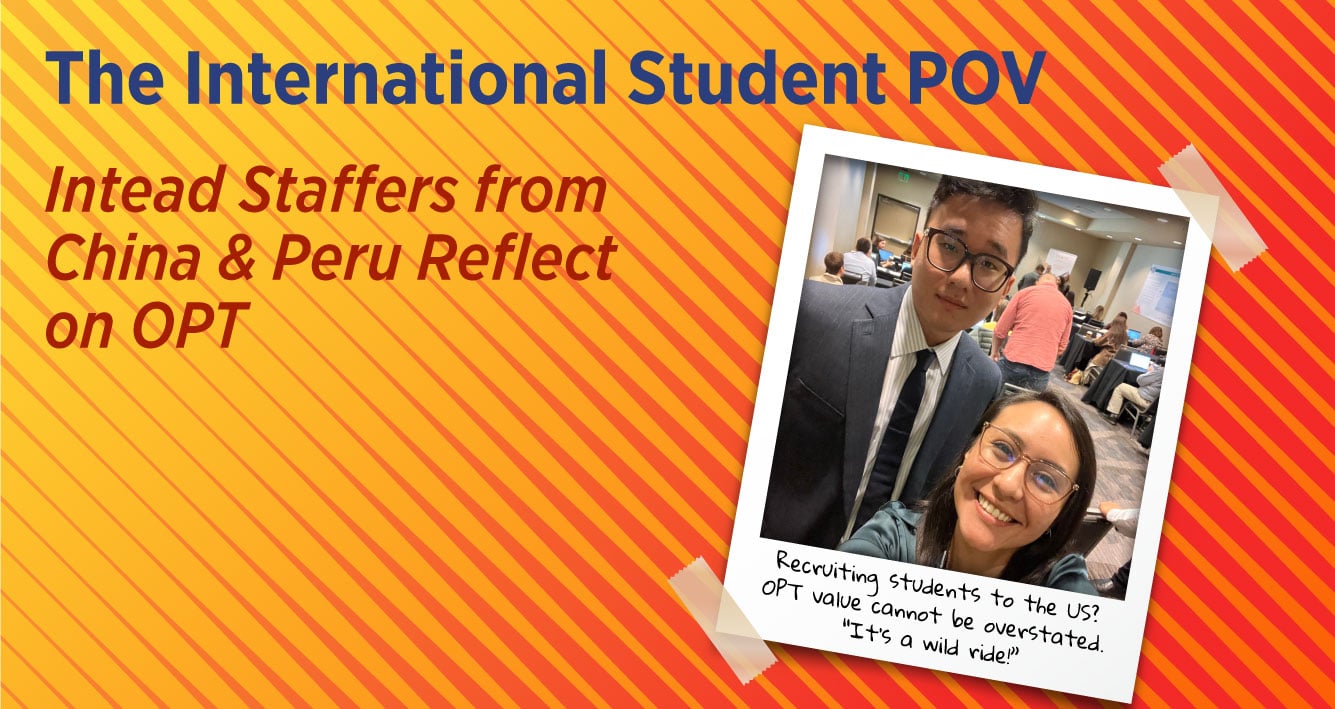
The International Student POV...Intead Staffers Reflect on OPT


Tianyu Shen is a business analyst from China. Isabel Aucca is a digital campaign manager from Peru. These two members of the Intead team, both on STEM OPT programs through Northeastern University and Hult International Business School respectively, have amazing stories as international students, travelers, explorers, and knowledge workers here in the US.

Many of you already know Tianyu and Isabel through the conferences they attend for Intead and the work they do with our network. If you haven’t had that pleasure, be sure to introduce yourself to them at an upcoming industry conference (AIEA, NAFSA, AIRC, ICEF, etc.) These two super talents bring their skills to our work in their respective fields (market research, business and data analytics, digital campaigns development and optimization, and competitor analyses) along with incredibly valuable international perspectives.

Their comments below will quickly give you a sense of what it is like to be in their shoes and understand a bit more about what drives them. And since so many of you work to create fulfilling experiences for international students, we thought we’d use this platform to share words that will surely resonate with you and your team.


Opportunities to Meet In Person 

The Intead team is gearing up for some amazing presentations and we hope you can join us. 

  • AIRC Spring Symposium in Niagara, Canada, April 30, 2024
  • ICEF North America in Niagara, Canada, May 1-3, 202
  • NAFSA 2024 Annual Conference and Expo in New Orleans, May 28-31, 2024

Let us know if you’ll share a cup of coffee and a conversation about all things global and digital (info@intead.com) 


As you read the perspective below, consider what it is that drove their decisions to study and work outside of their home countries. Note the courageous decisions they made and the personality traits that are likely common to many of the international students you are seeking. It is these kinds of personal reflections that inform larger marketing strategies and help us create truly engaging content to attract future international students to our institutions.

Tianyu, who grew up in China, attended an English language institute in Boston before earning his undergrad degree from the University of Nebraska-Lincoln and then his master’s at Northeastern University. As excellent as this background is, it does not provide andy indication of the genuinely joyful, energetic, and thoughtful person he is.

What he has to say about where he is now: “It’s human nature. When you receive something and people support you, you want to give back. For me, I feel so grateful for all of the education I received. It’s life-changing. And I’m grateful for all the people who helped me out along the way. Now, working at Intead I can help others who are standing where I once stood. I’m so thankful.”

The feeling is absolutely mutual.

Isabel, an undeniable dynamo from Peru who speaks three languages (Spanish, Portuguese, and English), earned her undergrad from the Universidad del Pacifico in Lima and her master’s from Hult International Business School in Massachusetts.

“Arriving at a place like Intead, it’s the purpose they have, it’s the type of company where you can be hands-on in every project – all of varying client scopes – and so many different ways to engage with the work. On one project I wear a digital hat, another I’m focused on research, and on others I get to be really creative about the overall marketing plan. That sets personalities like me up for success."

Isabel absolutely does her part to set us (and that means you) up for success, as well.

Following our recent #AIRC2023 full-day digital marketing workshop in December, both Isabel and Tianyu independently posted to LinkedIn about their experience helping others learn their craft during the workshop. This post brings their reflections to you.

Read on…

Read More

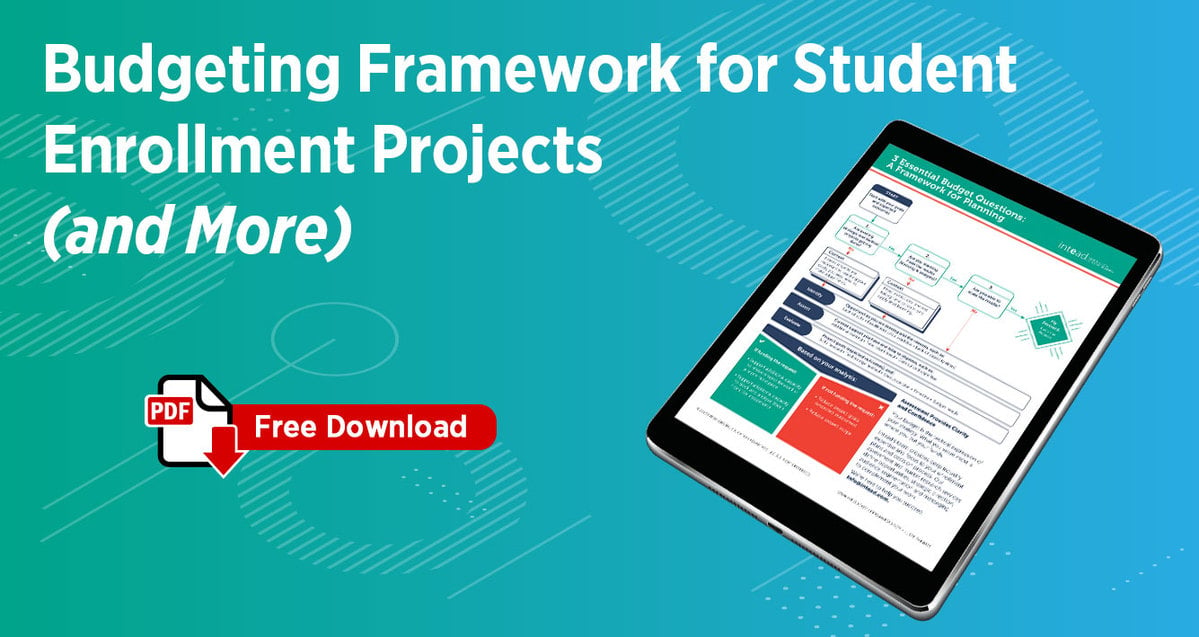
Budgeting Framework for Student Enrollment Projects (and More)


Are you in a position to approve funding requests from others? Or are you the one asking for funds? We have some perspective that can help you either way.

Today, we are offering up a framework for evaluating budget requests based on your ability to achieve defined goals. Just in time for budget season. It's a quick one-pager.

Here's the thing: your budget is more than the sum of its line items - an idea that’s not lost on you. After all, numbers tell stories. Like the dollars that allowed your team to meet international students at the airport. Or, ensured your first-years first connected at your well-planned international student orientation. Or, that scholarship fund that changed yield results. Real stories. Important stories. Made possible, in part, by funds allocated through strategic planning with scarce financial resources. 

Because, where you allocate funds represents what you find most important. In other words: your budget is an expression of your values.

The budgeting framework we offer up today is there to help you conceptualize your budget requests with your goals clearly in mind. Your student-first goals.

Ensuring your budget holds space for these stories, these values, is so important. Because everything from your institution’s mission down to the smallest line item on your Excel spreadsheet should come back to supporting students. All this assumes you have the data that backs up those stories. We are not talking about one-offs and lovely but lonely anecdotes. 

Recently we caught up with our good friend and colleague Dr. Jill Blondin, Associate Vice Provost for Global Initiatives at Virginia Commonwealth University, who by the way was recently named SIO of the Year by IIE (Go Jill!). You may know Jill through the strategic budgeting workshop she runs along with Western Michigan University’s Dr. Paulo Zagalo-Melo, Associate Provost, and Annette Cummins, Assistant Director Global Education and Business Manager. Good news there: Jill and Paulo will be hosting a 2.0 version of their budgeting workshop all about revenue-generating strategies later this year. Watch for updates!  

The perspective Jill offered makes so much sense: “Align your budget with your strategy. Not the other way around.”  

Sage advice because as we all know too well, losing sight of our real goals is all too easy once we get deep into the budgeting weeds. We see numbers and things get tactical fast.  

This is especially true when the dollars we get aren’t the dollars we need. Or think we need. The truth is by keeping our eyes trained on creating a truly student-first experience, international recruitment and student services teams can often accomplish way more than we may at first realize when budget numbers fall flat.  

As Jill said to us, “The international office should not be the alpha and the omega of an international student’s experience.” Indeed, an international office cannot be everything to everyone. Middle ground collaboration is essential. Integrating international students into the full campus experience is the point anyway and your budget should reflect this. More on cross-campus collaboration in another post.  

For today, we offer a quick reboot of our popular “3 Essential Budget Questions: A Framework for Planning.” Use this as a guide to focus and prioritize your annual budget discussions this year.  

Our budget framework asks you to take a step back and reflect on whether your actual results are feeding your goals. This worksheet guidance is yours free for download. As you think through your budget needs and priority projects, keep in mind that you want your budget strategy to reflect your student-first approach.  

Read on to access this useful budgeting tool 

Read More