Recruiting Intelligence

Predicting Student Yield: The Demonstrated Intent Challenge

Unlike most of his peers, my son (it’s Carrie talking here) applied to just two higher ed institutions. He got into both. Accepted both. Put down a deposit on both. Will attend just one. And so, he’s part of the admissions problem.  

Our colleague (and contributor to today’s post) Jon Boeckenstedt, retiring vice provost of enrollment management at Oregon State University, explains it like this: A lot of people think yield is like planting saplings in greenhouses, where your success is highly dependent on things you control, like spacing, soil quality, temperature, water, etc. In fact, yield is more like scattering seeds, where you are hopeful, and you have some ideas of success based on prior years, but in reality, you're at the mercy of factors you have zero control over.  

As an example: Last year, UCLA received 146,276 applications. About 13,114 students or 9% were admitted. For comparison, just 4 years earlier, in 2020, the university had an acceptance rate of 18%. And a decade+ ago in 2010, it was 23%. Go back further to 2000, it was 29%. And wait for it, in 1990, it was just above 40%. A lot has changed in a 30+ years. 

Year 

UCLA Acceptance Rate 

1990 40+%
2000 29%
2010 23%
2020 18%
2024 9%


UCLA is not unique in this way.  


Meet Intead! 

  • Find us at NACUBO in DC in July, and NACAC in Columbus in September. Be in touch to share a cup of coffee in person.

Bookmark this: Intead’s Resource Center 
Access 800+ articles, slides decks, reports with relevant content on any topic important to enrollment management and student recruiting.  Check it out.


Applications have skyrocketed for most institutions. For top-tier universities, this surge makes them even more selective (or rejective) — great for prestige and ranking supposedly, tough for admissions teams and applicants alike. For the majority of institutions, however, the steep rise in applications is just that, a steep rise in applications. Yield is on a different trajectory, and it’s driven by a simple concept: Algebra.  

The rise in applications has dramatically outpaced the increase in college-bound students, and of course, a student can only enroll in one institution, whether they are admitted to two or twenty. This then leads to a big increase in the volume of ibuprofen intake by admissions teams, as predicting the behavior of students is getting harder all the time. While institution leaders continue to demand enrollment results.

Thank goodness for the consistent ibuprofen supply.

We can point to the Common App as the bane of the admissions process. But that’s not really fair. Its advent brought more students into the system, increasing access overall. So, there’s the good. And not every university seeing the surge uses the Common App, and the University of California system is among those that do not.  

The real drivers of the application tsunami: access, competition, and coaching from influencers like school counselors and advisors. There are pros and cons to this situation. Ironically, the unpredictable nature of admissions decisions causes stress, which causes students to hedge their bets and apply to more colleges, which makes the admissions process less predictable. 

For context: 

  • In 2000, the typical applicant applied to three to five institutions.  
  • Today, the average student applies to eight to 12+, simply because they can.  
  • In 1998, when Common App went digital, ~250,000 applications were submitted through it.  
  • In 2024, that number hit 7.3 million – a 2,820% increase. (Yes, they have many more institutions as clients today, but still!)
The problem, of course, isn’t just the mountain of applications (besides, new AI tools are now helping with that to some degree). The problem is predicting yield to land just the right number of students who can bring just the right amount of revenue (and did we mention housing capacity?).   

Read on… 

Read More

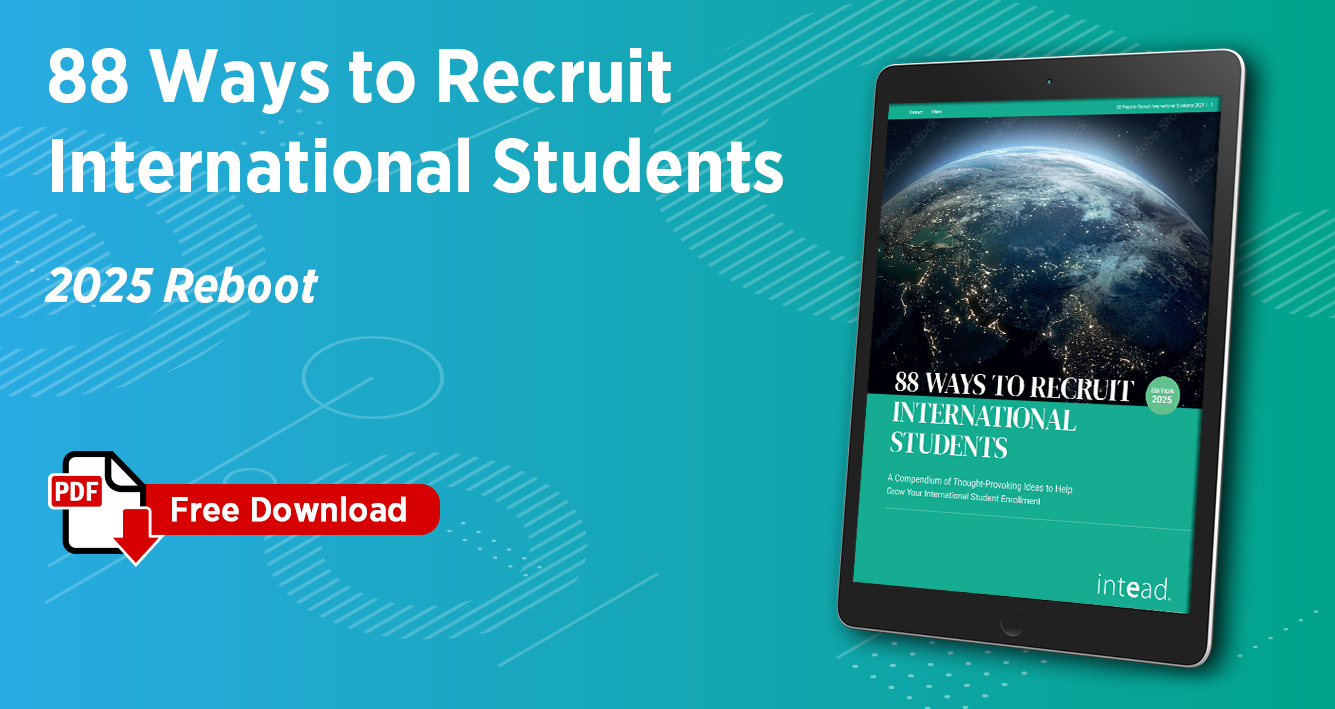
88 Ways to Recruit International Students: 2025 Reboot

Our aim with the original 88 Ways to Recruit International Students, published in 2012, was to create an accessible compendium of international recruitment tactics for edu institutions.  The download took off. At the time of publishing, we were hoping to get 300 downloads. We hit 10X that number in a couple months.  

So successful and widely used by academic and enrollment leaders in 2012-2013, a number of edu service providers in the field (our competitors) started paid search campaigns using our ebook title as their keywords ; -). Digital indicators that we were on to something. 

We have received terrific feedback and suggestions over the years from enrollment leaders. And we owe a debt of gratitude to our original authors, Lisa Cynamon Mayers and Michael Waxman-Lenz for their vision and groundbreaking research to compile our first edition back in the day. Our field has changed with new tools emerging (generative AI), others going away (remember Renren?). 

Currently, in 2025, some of our mainstay data sources (IIE, IPEDS, and EducationUSA) are truncated and under threat of disappearing as we go to press with this edition. Previously unthinkable. Also, potentially making some of our writing in the section called “Recruiting with US Government Support” a bit risky. Hopefully, that does not require an update too soon. 

A truly valuable addition to our latest edition: The intead team has been conducting market research and publishing our findings in our blog for more than a decade. Almost every summarized entry in this edition of 88 Ways has a link taking you to Intead’s deeper analysis of how that particular idea can work along with relevant data. 

So, yeah, you’re welcome.  


Meet Intead! 

  • Find us at APLU in June, NACUBO in July, and NACAC in September. Be in touch to share a cup of coffee in person.

Bookmark this: Intead’s Resource Center 
Access 800+ articles, slides decks, reports with relevant content on any topic important to enrollment management and student recruiting.  Check it out.


Over the years, the Intead team has contributed to the evolution of our field. In 2012, the world was still crawling out of the 2008 market crash. (Remember AIG? Bear Stearns? Credit Default Swaps?) International student enrollment numbers were really starting to climb. And digital marketing was just starting to mature.  

For perspective, the first iPad was released in 2010. In 2012, Facebook had almost 1 billion users. (Today, it has more than 3 billion.) Back then, Renren was very popular and growing as the Chinese Facebook alternative.  

Here’s an interesting digital tidbit: Google Vine launched in January 2013 and died in 2017. TikTok arrived on the scene in 2016 and by October 2018 was the most downloaded app in the US. Today, 3 billion downloads worldwide. 

 So, yeah, it’s been a minute and much has changed.  

Where are we now? In 2025, there are new global threats to the economy, to geopolitical safety, to student mobility. Generative AI is THE hot topic. WeChat is on every Chinese citizen’s phone. WhatsApp (owned by Meta, Facebook’s parent company) is one of the preferred communication tools for 2.75 billion global users (think Southeast Asia, Africa, and Latin America). 

Importantly, there are many, many new enrollment leaders and practitioners out there who are trying to make sense of it all. Enrollment leaders are trying to bring their new hires up to speed with a global perspective. 

That’s no easy task. 

This is where our 88 Ways ebook truly shines: as a resource that helps folks old and new to the field get a quick overview of the many channels, tools, tactics available to help enrollment teams find and recruit relevant pockets of international students around the world. 

The reality that no institution has the resources to market to the entire world prompts smart leaders to evaluate options and focus investments where they have the greatest return value, the greatest potential for success. 

We’ve given 88 Ways a reboot to reflect the current world of enrollment operations and opportunities. We’ve updated the suggestions, retired a few ideas, and offered up new recruitment insights that will no doubt spur worthwhile ideation from your team – whether your institution is US-based or not, this compendium will get you and your team thinking.   

Read on to download our rebooted ebook…

Read More

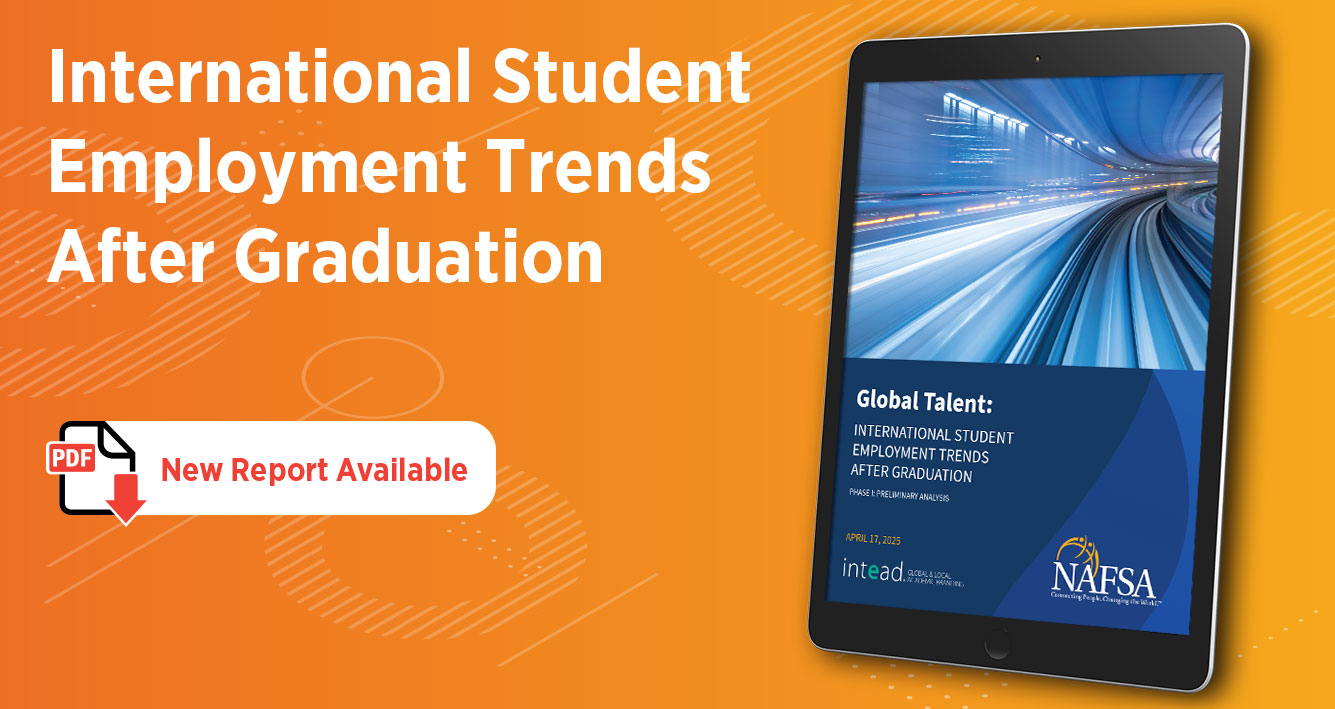
International Student Employment Trends After Graduation

What we know: international students have a well-documented and unambiguous impact on the US economy and society. Each year the US is $43+ billion wealthier because of these students. And our classrooms, campuses, and communities benefit from their diverse viewpoints and clear-minded ambitions, keeping our workforce competitive, tech companies growing, and sciences advancing. 

There’s no skirting the fact higher education is in a reactionary period as the White House does all it can to implement short-sighted changes to US higher education (and we’re being generous here with our choice of words). Advocacy has never mattered more. Which makes the release of our latest research – done in collaboration with the great minds at NAFSA and Fox Hollow Advisory – that much more important. 


Opportunities to Meet the Intead Team 

  • Look for us at NAFSA in May, NACUBO and APLU in June, and NACAC in September. Let us know  if you want to connect at these events.
  • Meet us online Tues., May 6, for the next AIRC webinar where Intead CEO Ben Waxman will join Co-panelists Kevin Timlin, Southeast Missouri State University and Manisha Zaveri, Career Mosaic for the expert-led discussion: IEM Student Lifecycle Series: Effective Student Recruitment Strategies.  

Bookmark this: Intead’s Resource Center 
Access 800+ articles, slides decks, reports with relevant content on any topic important to enrollment management and student recruiting.  Check it out.


Phase I of Global Talent: International Student Employment Trends After Graduation – released for download today – gives preliminary, yet important findings that will help bolster conversations we’re all having right now. This report goes beyond public data to answer:  

  • What is the longer-term value of attracting and retaining international students to US higher ed institutions?
  • How do international graduates contribute to the US workforce and economy?    

The report analyzes behaviors, motivations, and the economic impact of international students after earning their US degree. Special thanks to each of the following participating institutions:  

  • California State University, San Bernardino
  • Ottawa University 
  • Salem State University 
  • Southern Methodist University 
  • University of California, Davis 
  • University of Houston 
  • University of Kansas 
  • University of North Texas 
  • University of Redlands 
  • University of Texas at Austin 
  • Washburn University 
  • Wichita State University 

This research explores the alignment between US institutions producing international student talent, the US economy, and US job market demands. It’s part of a larger initiative aimed at understanding how US education benefits both international students and the nation. Read on to download the report… 

Read More

Why International Student Numbers Will Grow

Five years from now what will you be glad you did right now, this year? 

IIE here in the US and other prognosticators across the pond who track student mobility have predicted the number of international students in the US and around the world could double by 2030. Some projections suggest upwards of 10M or more globally. We’re not placing any bets on that figure. However… 

We’re optimistic about international student numbers and the opportunities ahead in higher education. We’re not banking on 10M+ in the next few years. That’s a bit of a stretch by our measure. But continued growth will come and the question is whether your institution is psychologically capable of weathering the storms and building for the future, or bureaucratically paralyzed and unable to capitalize on the opportunities ahead.  

Said simply: Resilient individuals and businesses adapt, leverage their strengths, and pursue opportunities to grow. 

Pro Tip: Your academic leadership will value reading this post. (Share button below)

What you do in the coming year will set the stage for the benefits you reap five years from now. Sit on your hands due to fear of the ambiguity that surrounds us, and all those who are acting now will be miles in front of you in 2030. Miles.   

Below we offer three specific areas where we think smart institutions and academic leaders will focus their attention in the years ahead to capitalize on future growth opportunities. How many of the three do you think you can help your institution address? 

Some context: Back in the day, our industry’s powerhouse forecasters were looking at the global growth of students seeking a foreign education from 2010 through 2016 and said with absolute confidence that there would be 8M+ international students globally by 2020. Maybe you were sitting with me in those conference presentations? Had trends continued on pace, that would have been true. Emphasis on “had trends continued on pace.” 

Instead, global factors combined with the US Muslim ban (Trump 1.0) were followed by a global pandemic (COVID 19). Those student numbers (8M+) have yet to pan out. But significant growth has happened - just 20% shy of the projection by 2020. (UNESCO reports 6.4M students globally studying in a country other than their own that year and we are at about 7M today.) Trend predictions are complicated by so many factors. Some might say predictions are truly unpredictable ; -)


Opportunities to Meet the Intead Team 

  • Look for us at ASU+GSV next week, and NAFSA in May. Let us know  if you want to connect at these events.

Bookmark this: Intead’s Resource Center 
Access 800+ articles, slides decks, reports with relevant content on any topic important to enrollment management and student recruiting.  Check it out.


Here's the thing: there are some human behaviors and economic factors that we feel very confident about. And that helps us understand the world and get a strong sense of what is likely coming our way in the years ahead.  

Reality: The US is now grappling with Trump 2.0, which is full of bluster and chaos-inducing pronouncements equivalent to watching an over-the-top World Wrestling Federation pre-fight drama. It’s all designed to draw attention and ramp up excitement for a spectacle. Often, there’s no substance to the bluster, though it consistently delivers pain. 

This drama coming from the US White House makes predictions all the more challenging. You need to push past all the obfuscating dry ice smoke machine billows to get at baseline reality. 

So yes, despite the chaos surrounding US policies and politics and how that will play out around the world, we have reason to believe international student numbers will rise over time similar to our confidence that the stock market will rise over time. We can’t tell you if the market will be up or down tomorrow or next year, but longitudinally, stocks have gone up since the market’s founding, and international student mobility has gone up as international travel has become more accessible. 

Consider this: In 1970, there were 310M airline passengers globally according to the World Bank. In 2024 the figure was 5.2B according to the International Air Transport Association. That’s an indicator of accessibility. Important to note, those figures include domestic and international flyers. 

Our belief in future growth of international student mobility primarily comes down to basic consumer (student) behavior trends, like increased usage of international flights (accessibility).  

Making the Accessible Visible 

Hailing from Hyderabad, Satya Nadella, current CEO and Chairman of Microsoft, earned his engineering master's degree at the University of Wisconsin-Milwaukee in 1990 and his MBA from the University of Chicago’s Booth School of Business in 1997. On the minds of nearly every Indian engineering student today: “If he could do it, so can I.” A lure as strong as it is old.  

With the rise of social media since 2010, success stories have proliferated in ways the world has never seen before. Basic human behavior: communicating success builds desire among others (word of mouth referrals drive sales).  

Among all those who have not risen to the top of Microsoft, there are millions of former international students who have carved out careers and influential positions, inspiring and encouraging future generations to follow in their footsteps. And hear us when we tell you that your prospective international students are looking for the proven path forward. Without overpromising, your institution needs to tell that story and build confidence in that future. 

A graduate student from India attending a private New England university recently told our staff how searching for (and making real connections with) alumni and current students on LinkedIn is what landed her on campus in the US. In her words, she appreciated but generally bypassed the university’s marketing and contacted other international students who had been there, done that. Their stories convinced her to enroll in the institution. Case in point: basic human behavior tied to the advent of internet communication. 

What we know: A student who graduated just a few years ago and is now a manager at a major company is immediately relatable to prospective applicants (much more tangible to them than their aspirations to run Microsoft someday). These conversations make the journey feel more attainable.

So, when international alumni share their experiences—whether through personal networks, mentorship, or social media—they reinforce the appeal of studying in the US (or any other country that contributed to their success).  

Considering how well your institution leverages its international alumni? Find customized perspective here. 

While we believe word-of-mouth marketing will play a role in future international student enrollment growth, there are other factors working in our industry’s favor – namely how institutions are poised to react to the changing market and the pace at which these changes are implemented on your campus. You may be surprised to learn our take on the opportunities ahead. Read on…

Read More

Cracking the Student Success Code

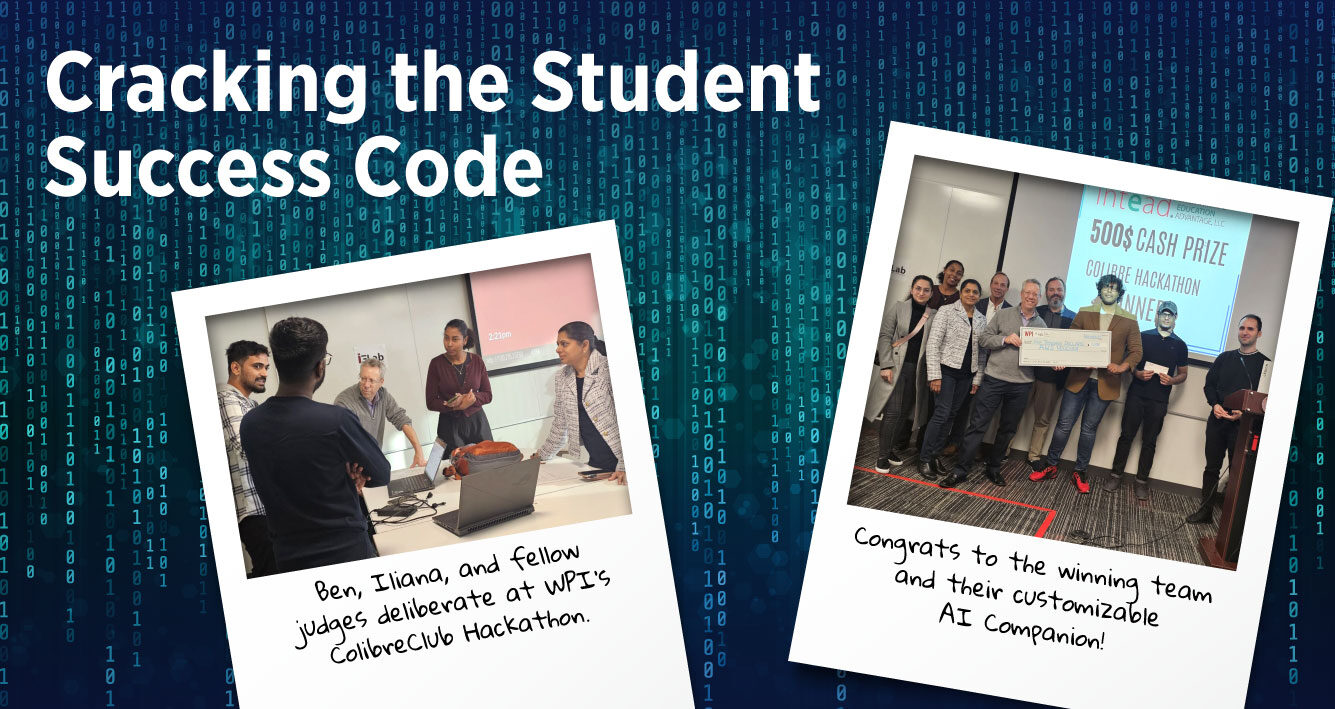
Grad students Poorajith Sasikumar Thenmozhi and Anurag Bansal needed a problem to solve. As founding members of ColibreClub, a student-led organization at Worcester Polytechnic Institute Business School, they were gearing up for their inaugural student hackathon and were in search of a real-world problem statement their competitors could sink their teeth into. 

That’s when the Business School’s Assistant Dean Sandhya Balasubramanian stepped in. Sandhya a friend and colleague of ours reached out to the Intead team to see if we had ideas. Our answer: Always! 

Trend watchers and challenge seekers, we didn’t take long to share one of the many higher ed research topics that interest us in the area of student success. Prior to and through the Covid-19 Pandemic, we watched student mental health concerns grow dramatically. We also noted that issue rising on the list of major worries being carried by university presidents and provosts.   


Opportunities to Meet the Intead Team 

  • Our AIEAstint ends today as we turn our focus to ASU+GSVin April, and NAFSA in May. Let us know  if you want to connect at these events.  

Bookmark this: Intead’s Resource Center 
Access 800+ articles, slides decks, reports with relevant content on any topic important to enrollment management and student recruiting.  Check it out.


Data underlines the urgency. Sallie Mae’s How America Completes College 2024 report on undergraduate barriers to graduation reveals 42% of at-risk students who consider leaving school do so for reasons involving motivation and mental health issues. When asked what resources would have helped them stay, 30% said more mental health resources/support.  

In our work with academic institutions, we’ve seen such a range of responses on campuses that make services available to students in different ways and importantly, help students become aware of and access those services in different ways as well. 

Assurances to help individuals who are struggling academically/mentally/physically are part and parcel of student communications. You know as well as we do that prospective students and their parents care a lot about this topic so including it in your recruitment materials has become routine. For some families, wanting to know about academics and sports top the list as they evaluate an institution. At some point, a growing number of parents worry about whether their kid, as mature as they are, is going to have the support services they need to succeed, including mental health services. 

So, the Intead team has been thinking a lot about actual accessibility, or lack thereof, of these types of programs. Some universities promote the services and access far more than others. Are they living up to their promises to students? Are there innovative ways to improve both student communication and accessibility? The WPI student hackathon tackled these questions with gusto!

Read on...

Read More

AI Built for Admissions?


Think instant granular analysis of transcripts. Think about your ability to identify the specific classes and grades indicating future student success. Think about automatically excluding that A in Phys Ed from the overall GPA calculation.  

For the sake of speed and efficiency, institutions rely on the overall GPA, an SAT score (if submitted), or the presence of AP classes on a transcript. All helpful shortcuts as indicators of future success, to a point. And we’re not going to get into the SAT debate right now, though we have some strong opinions on that one. 

But now, along comes AI and admissions teams are apt to place some hope in the promise of what it can do to streamline unwieldy processes that tend to get in the way of enrollment yield. But there’s so much more edtech can now do. 


Opportunities to Meet the Intead Team 

  • AIEAin March, ASU+GSV in April, and NAFSAin May. We'll be presenting our latest findings with colleagues from Chronicle of Higher Ed, IIE, AIEA, University of Tulsa, University of Memphis, Northeastern, and others. Let us know  if you want to connect at any of these events. 

Bookmark this: Intead’s Resource Center 
Access 800+ articles, slides decks, reports with relevant content on any topic important to enrollment management and student recruiting.  Check it out.


In our last postwe highlighted an edtech venture worth watching – especially if you’re among the AI curious. MyDocs is the brainchild of entrepreneur John Reese, whose name you may recognize from Parchment, the company that moved our industry from paper to digital transcripts (PDFs). That little startup originally founded by John grew up and just sold a year ago for more than $800M (all cash). Now, John is taking admissions capabilities a step further – moving institutions beyond digital transcripts into admissions data processing. And last year, he reached out to the Intead team for product launch support. 

MyDocs uses advanced OCR (optical character reader) and machine learning to evolve the tedious tasks of transcript analysis and processing. With application volumes rising thanks in part to the student efficiency tool Common App (don’t get us started), this new edtech helps smooth a specific task – and frequent bottleneck – in the admissions process. MyDocs' AI-powered platform scans and analyzes digital transcripts (PDFs, JPEGs, photos) to make them both human and machine-readable. 

That means the school of origin and every class, every grade, all become actionable data, instantly. Are you starting to see the possibilities? Oh, and if the transcript happens to be in another language, the tool translates to English. 

You can see why we were excited when John approached us and asked for our help with his entrepreneurial approach to transcript evaluation. The data analysis possibilities got the whole team here buzzing.  

For institutions, this kind of AI assist is more than welcome. One forward-thinking private New England institution we work with recently used this edtech tool to evaluate and process 11,000 applications in a single day. That’s just one anecdote, but the expediency is something to behold for anyone who’s ever managed admissions processes and credential evaluation. 24 hours vs. 1,500 hours (when done by humans). Something to think about. 

On the surface, technology like MyDocs seems like a game-change. Still, a challenge remains: institutions may find they are swimming in data without a clear strategy for leveraging it beyond this singular task of admissions efficiency: accept or reject?  

But, we have ideas. So many ideas. Read on… 

Read More

Finding and Alleviating Admissions Pain Points


Shout out to Q4 for giving us all something to think about. Cue the Chinese expression: "Better to be a dog in times of tranquility than a human in times of chaos." (宁享平安犬生,莫为乱世中人). Yup, got it! Right now, we are those humans, perhaps wishing we were dogs. 

Between the US presidential election and IIE Open Doors data, many of us are recalibrating our approach to 2025. Fortunately, we’ve worked through anti-immigration policies and lackluster international student enrollment numbers before. We’ll weather this. But there is work ahead for all of us.  

So, if you’ve missed a few of our Recruiting Intelligence articles, we understand. This post will catch you right up. 


Opportunities to Meet the Intead Team 

  • AIEAin March, ASU+GSV in April, and NAFSAin May. We'll be presenting our latest findings with colleagues from Chronicle of Higher Ed, IIE, AIEA, University of Tulsa, University of Memphis, Northeastern, and others. Let us know  if you want to connect at of those two events. 

Bookmark this: Intead’s Resource Center 
Access 800+ articles, slides decks, reports with relevant content on any topic important to enrollment management and student recruiting.  Check it out.


Relying on our experience working with a wide range of institutions, public and private, over the past 15 years (and the guidance from David’s book), we have helped admissions leaders identify the admissions pain points that drive students away rather than drawing them closer in. Importantly, this fascinating day-long exercise uncovers opportunities to fix the problems and the improvement measures to track results. Ah yes, some good news. 

Process mapping is a simple idea on the face of it. Like any problem-solving session addressing a complex, multi-layered process, the key to success is getting the right people in the right room to wrestle the right questions. We’re sure you know just what we mean. Practical to downright critical cross-departmental conversations are too few and far between.   

IT, Marketing, Enrollment, Admissions, and faculty (at the graduate level) all play a role. Credential evaluation always comes up as a pain point (more on that in just a bit). Yet, when institutions bring all stakeholders together for one full day to critically examine how their roles interconnect, the clarity is remarkable. We’ve seen even the most efficient teams benefit. And by the end, everyone has a new appreciation for sticky notes and our whiteboard is filled with sound ideas, big and small. 

The litmus test for us is always this: at the end of the day, does everyone see a clear, achievable path forward? From the clear immediate wins to the more time-intensive improvements, a shared vision for a more efficient process will result. That’s the point of process mapping. Read on…  

Read More

Need Better Results? Consider These 12 Options


We’re going to state the obvious and break it down. Because it seems some of your colleagues may need to hear this. Better coming from us than you.  Helpful perspective: historical data tell us that 30% to 40% of all US institutions see declining international enrollment in any given year. So, for your consideration...

First: If you are not seeing the enrollment results you want, something must change to produce new outcomes. (Someone wise has said: insanity is repeatedly doing the same thing and expecting different results. Apparently, it wasn’t Albert Einstein. Nevertheless, it holds up).   

Second: If you want to increase university enrollment fast, you’re going to have to put real money into the process. You’re likely going to continue doing what you already do because even though you are seeing diminishing returns, you can’t afford to lose them. So, new funds must be added to the existing budget.   

All obvious, right? Well, it seems folks need to hear it. But we have more to share here to help you get the numbers ... 


Opportunities to Meet the Intead Team 

  • AIRC, Seattle-Bellevue, Washington, Dec. 4-7, 2024. Our team is here now with 3 powerful sessions on budgeting, pathways, and streamlining admissions processes. Come find us. 
  • AIEA, Houston, Texas, March 02-05, 2025
  • NAFSA Annual, San Diego, CA,  May 27-30, 2025

Bookmark this: Intead’s Resource Center 
Access 800+ articles, slides decks, reports with relevant content on any topic important to enrollment management and student recruiting.  Check it out.


Third: If you cannot access additional funds, you will have to cut something you are currently doing and reallocate those funds. If your leadership is of the innovative risk-taker mindset, you can stop doing some of your current, less effective things and put that money into the new thing. Your stronger results will be slow to materialize, and your leadership needs to stay the course (not pull the funding) when fabulous new results do not magically appear in year one. To maintain internal support, you must track your activity and report on the results along the way.

What you want with all the tracking is your ability to provide your leadership with the confidence that there is learning and progress going on that will lead to stronger results in the next couple of years. Know that your leadership is facing down a whole lot of criticism including daggers from across campus trying to remove your funding. The dagger throwers are expecting your plans to fail.  

Fourth (getting into the details): You have options when you think about innovating to produce new, stronger results. We review 12 primary recruiting options when we run our conference workshops on student recruiting. Today we take a quick look at each tactic with a careful eye on cost and flexibility.

Read on for our 12 recruitment option tips and perspective… 

Read More

Understanding Social Media Algorithms for Student Recruitment


Despite what our writers like to think, it’s not all about content. Digital marketing is also about math. Social media runs on numbers after all. Since we just presented at PIE Live in Boston last week, we are pretty sure there is a pun about the value of pi and algorithms here somewhere.   

While marketers don’t need to build the algorithmic equations that power social media platforms, understanding how they work, or rather the intent of why they work, does matter.  


Opportunities to Meet the Intead Team

  • AIRC, Seattle-Bellevue, Washington, Dec. 4-7 -- including our pre-conference global marketing workshop. A full day of Intead global intel (lunch included ; -). Details here.
  • AIEA in March and NAFSA in May, we'll be presenting our latest findings at both. Let us know if you want to connect at either of those two events.

Bookmark this: Intead’s Resource Center 
Access 800+ articles, slides decks, reports with relevant content on any topic important to enrollment management and student recruiting.  Check it out.


Social media algorithms evaluate and prioritize user behavior. These algorithms, a set of rules and signals that rank content, are proprietary and organize social feeds based on user interaction. Each algorithm aims to create highly relevant, interesting content for individual users, which is of course the crux of our society’s love-hate relationship with this addictive medium.  

Today we dive into the intent behind the feeds of 5 top platforms so you can better fit and filter the content you’re pushing out to prospective students. We break down how algorithms differ across major social media platforms (TikTok, Instagram, Facebook, LinkedIn, and X). You’ll want your team to keep this post handy when thinking on your social media marketing strategy. Read on…

Read More

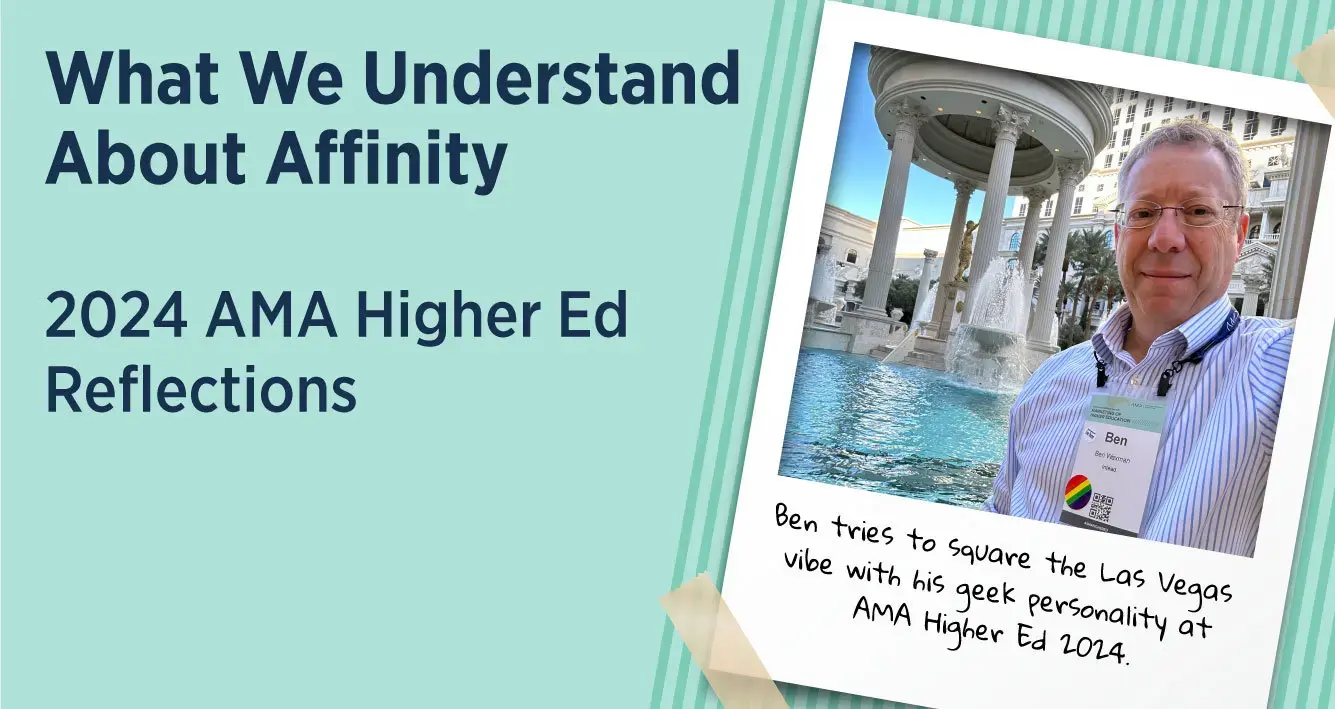
What We Understand About Affinity - AMA Higher Ed Reflections


The opening plenary at the AMA Higher Ed conference by Dr. Steve Robbins was spot on great. With a neuroscientific underpinning, he presented the human desire for inclusivity as a biological need we all share as part of our survival instinct. Playfully using the rivalry between Michigan State and University of Michigan, he pointed out how we make excuses for “insiders” (those in our affinity group). When they exhibit frustrating behavior, we often give them a pass. At the same time, “outsiders” are seen as annoying and exhibiting behavior typical of their group. No pass for them.   


Opportunities to Meet the Intead Team  
  • PIE Live North America, Boston TODAY Look for Ben on stage at the IIE Open Doors: What is the Latest Data Telling Us? session at 2:30 in Grand Ballroom A&B.
  • AIRC, Seattle-Bellevue, Washington, Dec. 4-7 -- including our pre-conference global marketing workshop. A full day of Intead global intel (lunch included ; -). Details here. 
  • AIEA in March and NAFSA in May, we'll be presenting our latest findings at both. Let us know if you want to connect at either of those two events.

Bookmark this: Intead’s Resource Center 
Access 800+ articles, slides decks, reports with relevant content on any topic important to enrollment management and student recruiting.  Check it out.


With 1,800 people in attendance, this year was the AMA Higher Ed’s largest conference attendance yet. And from what the AMA says, that is the largest attendance of any AMA branch conference. People from 14 countries were there. And of the 1,800 attendees, about 430+ US higher ed institutions were represented. 

Dr. Robbins’ approach to introducing and promoting the idea of inclusion to those who may be of the mind that DEI and “woke” perspectives are simply too much to handle is welcome and perhaps the necessary path forward. Since this is the AMA, we are looking at inclusion in light of human (read: consumer) behavior and the importance of understanding this human desire to be part of a group as it relates to student marketing and recruitment. Diversity results from inclusive policies and practices. 

Dr. Robbins discussed the importance of feeling valued within the tribe you join. As a consumer of education or any other product or service, there is an affinity we are aiming to acquire. That connected and valued feeling leads to student retention and marketing concepts of customer lifetime value (think continuing education and alumni engagement). 

He also talked about the opposite effect: when people do not feel welcomed or included. These feelings light up the same pain centers in our brains that physical pain (a slap or a punch) elicits when experienced. And so, when we don’t promote inclusive practices, we are pushing people away and prompting quite literally a painful experience. 

People I talked to at the conference found Dr. Robbin’s talk a welcome and eye-opening presentation. Another aspect of the conference I found valuable: AMA’s use of Topical Idea Exchanges. These gatherings were smaller groups who circled up the chairs and focused on specific topics. The two I attended (one on celebrating and leveraging milestones (think: centennial celebrations), the other on leveraging organic social channels using institutional and senior leader accounts (think: managing chancellor social accounts). Both sessions were well led and filled with smart people who shared ideas and perspective, asked great questions, and overall made networking and information gathering comfortable and valuable. Though, I did hear some mixed reviews on that format from others.

I attended a couple of sessions during the 1-day I had available at the conference. Kerry Salerno, vice president marketing and communications at Babson College and my co-presenter this week at PIE Live in Boston, talked about presenting marketing results to leadership. A great topic, as in, how do you simplify all the marketing information and results in a meaningful way that prompts wise decisions from the top? The short answer: simplify.  

What I most valued in Kerry’s presentation was her candor about how, over the past 6+ years in the position at Babson, she has made a concerted effort to train and adapt her marketing team to embrace a data informed culture. That work is hard and laborious. Having run a marketing agency for more than 30 years now, when I consider all the elements of running a business, the hardest part is always choosing and developing the talent around me to achieve the goals. How do you accommodate all of the personal, professional, and financial goals for each person and align that with company goals?  

It’s a lot. Always. 

Which brings us back to the idea of inclusivity. Who is part of the tribe? How do you help them feel valued? How do you maintain that feeling despite the challenges that your team, your administration, your students will inevitably face over time? Are you taking the time to figure this very difficult stuff out? How strong is your team’s affinity for each other and the work? Read on... 

Read More