
Recruiting Intelligence

EdTech Goes Collaborative: Social Learning Platforms

First Marketing Question Today: Making better decisions based on gathered and distilled information -- Isn’t that the skill education is seeking to instill in all of us as we grow and advance through life?
 
Second Marketing Question Today: To whom do you turn for help with important decisions? Put another way, who are your influencers?
 
Main Message Today: You don't want to be that institution that gets the comment, "Huh! We don't have that," when all the students are home on break.
 
After recognizing the opportunities in EdTech, Unibuddy has grabbed the reigns and created a program that allows current students to discuss the merits of their universities with prospective students. The benefit: students in the college-seeking process are able to authentically hear the pros and cons of different universities from their peers and are able to make an informed decision.
 
Peer-to-peer support is an essential part of the human experience. Peers, colleagues and mentors
provide support in many forms today and it is increasingly digital. Sure, the shared cup of coffee and conversation at a table in some quiet corner has its draw and advantages. But really, digital has taken over the advice department.
 
In our continuing series exploring EdTech, we are looking into social learning platforms
and how they are providing your students (and you) with new ways to move forward. It is the power of collective wisdom.
 
This is going to be good!
 
We touched on these highly-visible resources in this blog in March, discussing learning
management systems (LMS) and social learning platforms.
 
We’re pretty confident you’ve already checked in on at least one social media platform today before even reading this. As you know, your students are spending their days Snapchatting, Instagraming, WhatsApping, WeChatting, (and some even Facebooking! - they might admit that one grudgingly ; -), in an effort to stay connected. Most of their interactions on their device of choice is peer-to-peer. Social learning platforms provide the same type of connection, but the focus is on students, teachers, parents, and alumni interacting to learn, collaborate and get creative with a goal in mind...less mindless, more directed.
 
What’s all this mean to you and your institution? What does it mean for student recruitment and student retention? (Read on...)
Read More

Internationalization: This Is How We Do It

With a tip of the hat to Montell Jordan and his old school hip hop (“This Is How We Do It”), today we are pleased to give you a prime example of how you target an audience and reach them through great PR content.

Admittedly, we are a bit biased on this one.

We are talking about Intead’s co-founder Michael Waxman-Lenz who is now Acting CEO of the Technion Society, the fundraising arm of The Technion-Israel Institute of Technology.

In his new role, Michael is responsible for getting the word out about how Technion flourishes and all the great things Technion the institute continues to achieve. An enviable, global institution based in Haifa, Israel with partnerships with Shantou University in Shantou, China and Cornell Tech in New York City, among other internationalization initiatives, Technion’s work in so many areas demonstrates exactly why we all believe so strongly in the value of international student mobility.

The pace of advancement on a global scale, the interchange of knowledge, the cross-cultural idea generation, and the bonds that develop as we gather together with common goals -- these are all front and center for the institutions, like Technion, that embrace academic internationalization.

Recently, Michael published an article in JNS (Jewish News Syndicate) providing us all with a concrete examples of how Technion’s international network of faculty, researchers and students produces world-changing results.

Read on for this clear example of “How We Do It!” or how we should all do it…

Read on…

Read More

#NewDigitalTools: Will the TikTok Craze Continue?

Remember Farmville? This one game grew to $200M USD in revenue! Now, not so much.

Remember Google Vine as short-form video? Kinda faded away with the advent of Instagram video.

So now, we consider TikTok and wonder, how long will this one last? This one is sophisticated and is already valued at more than $1B USD. This new marketing channel is powerful as long as you have the creative talent to use it.

The rule is: creative content rules. Period.

And the reason we are talking about it is that your target audience is spending a bunch of time there right now. The image above is captured from my 17-year-old niece's TikTok account. She is a content creator there and she and her friends have a great deal of fun (and spend way too much time) in and on TikTok. 

So, about TikTok...in May, we wrote about the growth of Chinese EdTech and what opportunities that presented. As of last year, Chinese startups received over 50 percent of all global capital invested in EdTech. This year, of the top six EdTech unicorns—private companies worth more than $1 billion—all but one was Chinese.

With the largest population in the world, China is automatically the greatest educational market. With a population of over 1.4 billion, there’s a market of more than 283 million students. With 17 million new babies born a year in China, this pattern isn’t slowing down.

Outside of the educational realm, tech is still booming in China, and one platform from China is now the most valuable startup in the world. What might this have to do with connecting you to those potential students in China—or anywhere for that matter?

Read on…

Read More

Out of Africa, Part 3: International Study Across Africa & Foreign Investment

This is our third and final installment in our series about international student recruitment opportunities in Africa. In case you haven’t been with us since the beginning, Part 1 was about the emerging online learning opportunities in Africa, and Part 2 was about African student mobility and study in the U.S.

This week, we are focusing on international study within the continent and how some countries are trying to harness that student mobility for their own gain. With any marketing plan it is always important to understand the larger environment and other consumer options.

Our Intead Plus BookShelf Subscription gives you access to our Global Marketing Worksheets helping you plan your approach to entering any new region or market. We use these worksheets when giving our workshops at various conferences to help you create realistic budgets and timelines, targeted messaging and overall marketing plans. 

As we noted in Parts 1 & 2 of this series, foreign investment and economies are on the rise in Africa, along with the population. The continent is expected to have 2.8 billion people by 2060, roughly 40 percent of the world’s total.

Those people will need to be educated, and the rise in demand for tertiary education has begun. The sub-Saharan enrollment from 1970-2013 grew 4.3 percent annually, as compared to the global average of 2.8 percent, according to the World Bank.

Many African students are turning to universities outside of their home countries—and many of them are still staying within the continent. Let’s look at what is going on and what you need to know about China and India before you start recruiting from Africa…

(Read on)

Read More

Out of Africa, Part 2: African Students Studying Abroad

Last week, we spoke about the emerging online learning opportunities in Africa.  This week, we are focusing on international study, both areas that have expanded because of a college-aged population boom across the African continent.

Foreign investment and economies are on the rise along with the population. The continent is expected to have 2.8 billion people by 2060, roughly 40 percent of the world’s total.

Those people will need to be educated, and the rise in demand for tertiary education has begun. The sub-Saharan enrollment from 1970-2013 grew 4.3 percent annually, as compared to the global average of 2.8 percent, according to the World Bank.

U.S. universities have made large efforts to recruit international students in Asia, but as mentioned in our 2016 blog series on recruiting students from Africa, African nations are a boon of potential students that have barely been touched with marketing efforts.

Currently, the continent has a population of 1.2 billion people, 60 percent of which are under the age of 25 (720 million). To really drive that number home, 29 out of 30 of the world’s countries with the youngest populations are in Africa.

If you didn’t check these posts out last week, see our previous posts: Overall Student Trends in Africa, Recruiting Students from Nigeria, Recruiting Students from Kenya, plus this post on Africa’s tech hubs.

How can U.S. institutions use this population growth to their advantage? We've got the data and tips to point you in the right direction.

And, for even more recruitment advice, check out Intead Plus and our new, more affordable Bookshelf Membership.

Read on…

Read More

Out of Africa, Part 1: Online Learning Across the Continent

Universities from Moscow to Los Angeles and everywhere in between have a growing interest in student mobility within the African continent. As political tensions grow and visa practices shift, more and more conversations in our industry turn to the question of diversification of student sources.

Frankly, the comment, “I’m concerned that we are too reliant on China,” has been hanging in the air for about a decade. But now, NOW, SIOs and those above them are taking this concern far more seriously.

Long post today. Those who persevere will be rewarded with valuable tips. Promise.

It is important to note the growth of online learning platforms that are expanding everywhere. A recent Intead blog post discussed the growth of Coursera and EdX, which primarily serve U.S. users. Across the Atlantic and the Pacific, there has been a rise in the use of online platforms as well. There are many factors to consider as you think about diversifying your sources of students.

Intead is offering full access to our global market research including our oh-so-helpful ebook on recruiting non-traditional students, now available through a more affordable Intead Plus subscription called Intead Plus Bookshelf. All the market research access and none of the custom Google Analytics Report. Just offering you more options. Take a moment to check it out.

Pro Tip: Your subscription to Intead Plus is institution wide. Anyone internal to your organization can tap our resources through your institutional subscription.

Now, let’s step back just a bit for perspective and then dive in deeper over the next three weeks to consider how diversifying your student sources in Africa can work. We hope you’ll stick with us for this three-part blog series and pass it on to your colleagues.

As always, our posts help you convey to others in your institution a broader understanding of what you are trying to achieve and the challenges you face. And they help you set your plans in motion. 

Read on…

Read More

Welcome to Vietnam: A Look at Student Mobility

During the 2017-2018 academic year, the enrollments of new international students in U.S. higher education fell for the second year in a row, dropping by 6.6 percent.

There’s definitely one country that hasn’t received the memo: Vietnam.

The number of Vietnamese students in U.S. colleges and universities has steadily increased over the last decade.

What is next in terms of student mobility from Vietnam? Let’s explore what has influenced this student mobility as well as glance at what the education system is like for those at home and what changes may lay in store.

And if you want to know more about student mobility and other global market trends, we have an entire resource library to offer. Check out all of the material you could have access to with Intead Plus and our new, more affordable Bookshelf Membership.

We use the data and perspective shared in this blog to support our thinking about which degree programs have the most value to this set of prospective students and how best to position our clients to leverage the opportunities out there.

Our mantra: each global market needs its own targeted marketing plan and approach.

(Read on)

Read More

Chinese EdTech Growth Is an Opportunity for You

Beijing is famous for many things: roast duck, Tiananmen Square, The Forbidden City, The Temple of Heaven, and most recently, EdTech.

Beijing has the highest concentration of EdTech startups in the world, with a whopping 3,000 companies. Not only is there a staggering number of these businesses, but many have a remarkable earning capability, contributing to a multi-billion-dollar national industry.

Chinese EdTech is something to think about as we head toward the international event that is Nafsa in DC this year. If you are going, please let us know (info@intead.com). We have some brand new industry research about student-to-student counseling to share and it is pretty significant. Be in touch and you'll be the first to know! 

And come to our Nafsa session on digital marketing best practices (we're talking about micro-conversions with one of our favorite stars Hillary Dostal from Northeastern University - see below). With Ben and Hillary presenting, there's always a great mix of practical information and entertainment value. This will not be a snoozer ppt-show. 

So why is Chinese EdTech important to you? Seems distant and inaccessible, right?

The swift rise of Chinese EdTech could serve as a blueprint for growing global digital learning, but there are some unique secrets to China’s success. And there are some university promotion and recruiting opportunities that only the savvy will leverage. Interested? Read on...

Read More

Getting Ahead of the Boom: Collegiate Virtual Reality

Last February, we talked about the intense and growing competition within the EdTech industry and new ways of delivering educational content, like the immersive learning experiences of augmented reality and virtual reality. These simulative experiences as of 2017 garnered $3.1 billion in investments, and those numbers are set to grow.

Read More

Begin With Assessment

You are tasked with so many competing priorities. When do you take the time to step back and confirm your plans are aligned with your goals? When do you take the time to develop new plans to achieve new goals?

Sure, you carve out something you are calling a "retreat" to address these ideas with your colleagues, but if you are like most, you go into those retreats feeling a bit less prepared than you'd like to be. And do you have the data to back up the decisions you need to make?

Important note: You're going to want to share this one with your team. Great tips follow.

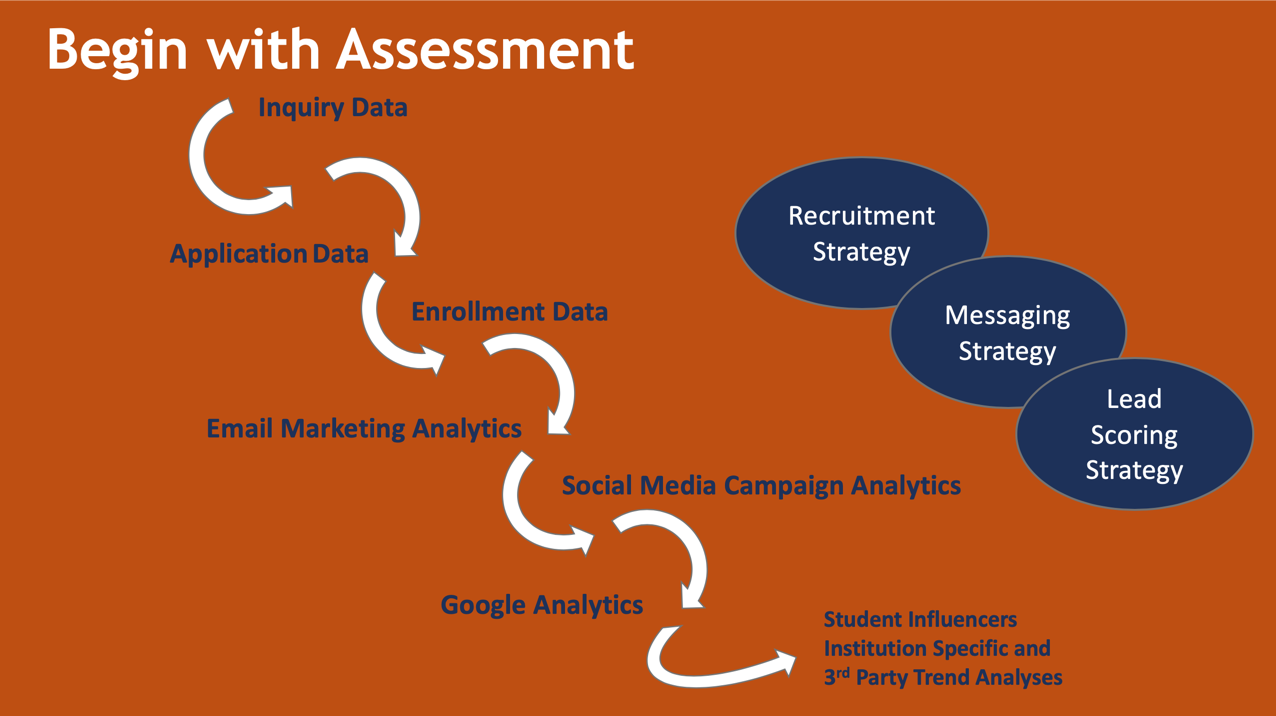
Begin with Assessment

We understand. And Intead is often called in to wrangle a bunch of data to the ground and identify the insights that are right there waiting for you, if you had time to analyze and reflect.

Each institution we work with is data challenged. You are not alone. However, there is a lot that your institution collects, though it is probably kept in different silos.

Wouldn’t it be nice to have that all pulled together, reviewed by knowledgeable experts and have the hard-hitting report that filters out the noise, focuses on the opportunities, and helps you make smart decisions…backed by data?

Read on...

Read More