
Recruiting Intelligence

The Non-traditional Student Advantage Part 4: Born This Way or Transformed?

Growth-minded institutions are taking a long, hard look at their approach to non-traditional students. 

This is part 4 in our 5-part blog series on reaching and enrolling non-traditional students. Here are links to part 1, part 2, and part 3.

Truth is, courting and supporting non-traditional students has been part of the mix for decades. Most institutions of higher learning have embraced this broad swath of students. For some, the non-traditional market segment was part of their original focus. We think of them as “born this way.” For others, they are demonstrating market adaptability. We call these institutions “transformed.”  

 Which type is your institution? 

 Both have strengths to embrace and challenges to overcome. 


This ebook provides a very comprehensive look at non-traditional students. Many adult learners think that they are too late, too old, and will not fit in. In reality, there are more non-traditional students than traditional pursuing their education. Marketing to this audience is challenging as they are often working full-time and may lack the confidence to go back to school. This book offers real strategies that we should all consider.  ~ Dr. Richard Carter, Associate Vice President for Global Engagement at University in South Alabama 


Read on to take a closer look at these two roads to an institutional identity that embraces non-traditional students. We will consider the strengths and weaknesses associated with each route, while also offering food for thought about your own path. 

Read More

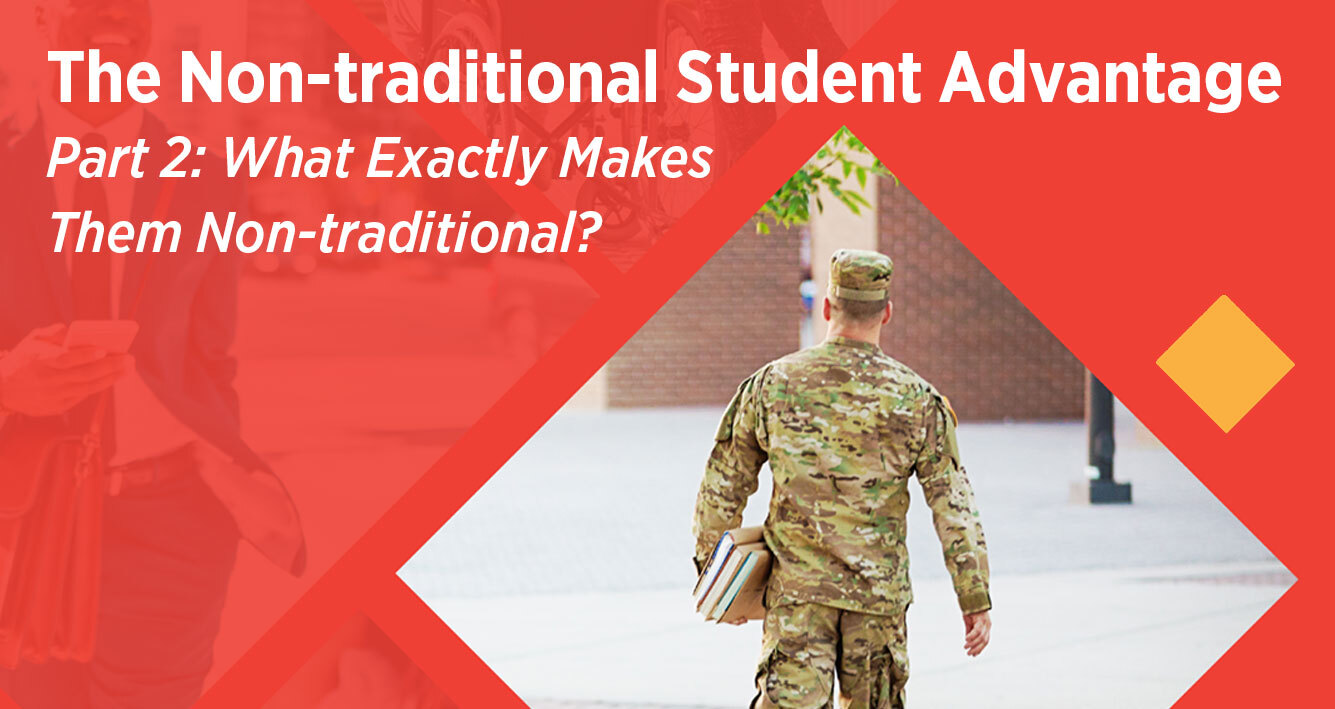
The Non-traditional Student Advantage Part 2: What Exactly Makes Them Non-traditional?

For a while, there were fairly common rules. First you graduate high school around age 18. Then go to university. Four years later you graduate with a degree and an employable set of skills. Got it. 

But times have changed. And university tuitions don’t stop rising. And that’s exactly what’s happening right now. Traditional students are heading for the enrollment cliff making way for a more non-traditional set of students. And that means new rules.

Last week we started this 5-part blog series on reaching and enrolling non-traditional students

Today’s students are vastly different from those of decades ago, but colleges are still structured as if 18- to 21-year-old, full-time students are in the majority. ~ The Lumina Foundation Report on Today’s Students

Let’s look at the basics. Typically, a traditional university student is:

  • 18-24 years old
  • Enrolled full time
  • Lives on campus
  • Financially dependent

Intead’s ebook is a timely resource appropriate for the seasoned administrator as well as educators just beginning to tackle the challenges of digital marketing today. Bringing together expert advice from experienced administrative colleagues and successful marketing strategies from work with Intead’s institutional partners, this book stimulates the reader to address the recruitment of non-traditional students from a holistic context that pays attention to student learning methods, delivery of academic content, academic success services, and other areas of student support non-traditional students need to achieve their goals. ~ Jon Stauff, Assistant Vice President for International Affairs at South Dakota State University


Per the National Center for Education Statistics (NCES), of the 15+ million students enrolled at US Colleges and universities in 2021, nearly 65%  were between ages of 18 – 24. Of course, age only tells us so much. A student can be both 18 and non-traditional.

By NCES standards, a non-traditional student is someone who meets one or more of the following criteria :

  • Outside the traditional 18-24 age range
  • Financially independent
  • Has one or more dependents
  • Is a single parent or caregiver
  • Does not have a high school diploma
  • Delayed enrollment into postsecondary education
  • Works full time
  • Enrolled part-time

Other bodies of research define the term more broadly, also including students who are either married or are veterans.

And yes, we hear you. There’s more than a few of you who are bristling at our use of the term “non-traditional.” Truth is, traditionally “traditional” students are no longer the overwhelming majority. And that matters. Which is why understanding the growing and highly important non-traditional audience has become a priority for enrollment teams. In fact, it should be a priority across all of your departmental teams, from nutrition services, to housing, registrar, IT, and career services. (Please tell us that Academic Affairs, Student Services, Career Services and Development are considered a given.)

We can ditch the non-traditional label in due time.

You may see where this is going and why it is important to you as an enrollment professional. The demographic cliff has arrived and non-traditional students are one option for your institution’s continued success. Take a few minutes and we will help you clarify the path forward.

Read on to learn more about reaching specific non-traditional student market niches and the process of engaging them…

Read More

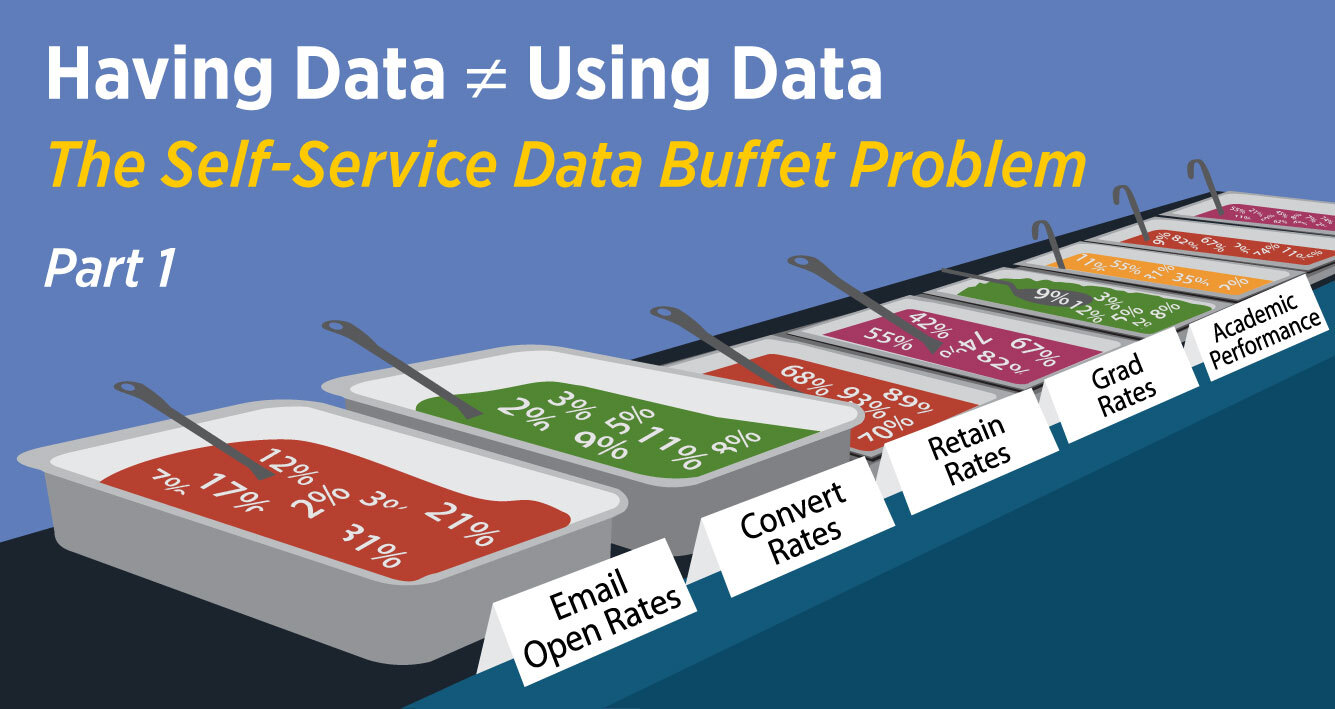
Having Data ≠ Using Data Part 1

You only thought you were using data to make smart decisions.

Understanding how to use data to support institutional planning and growth requires talents and skills that are learned and practiced and honed over time. All these tech companies selling tools and platforms into our systems want leadership to believe that all is simple, clear, and that their dashboards will transform your operational planning and decision making. Wondrous growth is just a click or two ahead. If only.

You’ve tried to create a self-serve data buffet for your leadership team so that they can dive in on their own and make informed decisions.

But…what if they’re not?

We mean, you gave your full team access to the tools with loads of features and data reporting. In the realm of marketing, your CRM captures and reports on email open rates, click through rates, conversion rates, and so much more. Your marketing dashboard tools pull data from Facebook’s Business Manager and Google Analytics (with updates to GA4 that your team is scrambling to implement and fine tune as you read this).

We all want to eke every last drop of data from the platforms available to us now.

Truth is, in the battle of data informed decisions vs human nature, human nature usually wins. Reality: creating, viewing, and understanding reports is not as simple as the tech vendors tell you it is.

Many of your leadership team are simply not data people. They may grab some of the data that supports their ideas, but ignore relevant data that would add more insight, nuance, or might even negate their suppositions.

What we have seen over the last decade is that many organizations are assuming their team’s new access to data dashboards and tools will naturally result in effective use of those tools. Often leaders simply don’t prioritize learning the necessary bells and whistles in the midst of other important deadlines. Still others can’t wrap their heads around it. They have other skills that your institution values and data analysis/interpretation is simply not one of them.

Simple test: Your marketing dashboard provides you with your email open rate monthly average. Among your other standard emails last month, on the 10th your team sent a mass email to a newly purchased, cold email list. What is worth reporting on to your leadership team? How can the data available inform your decisions and actions?

Read on to learn more about what self-service data is, why it can be useful, and how to actually make it work for you. (Oh, and we answer the question about the email open rates).

Read More

Recruiting Intel Digest: The Most Useful Stuff from Q2 2022

…and that’s a wrap for Q2 ‘22. While personally there were a few bumps along the way (thanks Covid for yanking #NAFSA2022 out from under me!), overall, the industry’s mood is decidedly improved over this time last year. Cautiously so, anyway.

Recent news we are following says that language programs are starting to recover from huge pandemic losses. Middle Eastern adults/executives are showing up first. As we know, language programs often act as canaries in the coal mine falling or rising in advance of fuller degree/certificate programs.

We bet you likely didn’t catch all of our posts this spring, admissions season being what it is – busy. Not to worry, we’ve compiled a few we think you won’t want to miss. Read on for our quarterly recap of the most valuable news from Q2 2022 and the Intead resources available to you.

Read More

How to Say 'No' to Ideas That Aren't Good Enough (Reboot)

Leaders of the student enrollment revolution, we’re here for you.

With so much planning going on for an enrollment cycle so very in flux, and past trend data not quite so predictive as it used to be, we thought now would be a good time to reboot one of our most popular posts, “How to Say ‘No’ to Ideas That Aren’t Good Enough.”

It should be a helpful tool at a time when focus is essential in the midst of so many #EdTech solutions and platforms for recruitment and enrollment continually seek your attention.

Read on for the 5 questions every leader must ask and every department must answer when presented with new plans – those that seem great, not so great, or maybe just crazy enough to work.

Join us at #Nafsa2022 in Denver where we will be offering up four presentations with a range of partners on everything from innovative influencer marketing to new ways to maximize the talent of your global recruiting agent network. We'll be focusing on the need for flexibility throughout your student recruitment and enrollment efforts. Schedule a meeting with a simple email.

We’re here to help you focus on the initiatives that will produce results and justify that budget.

Read More

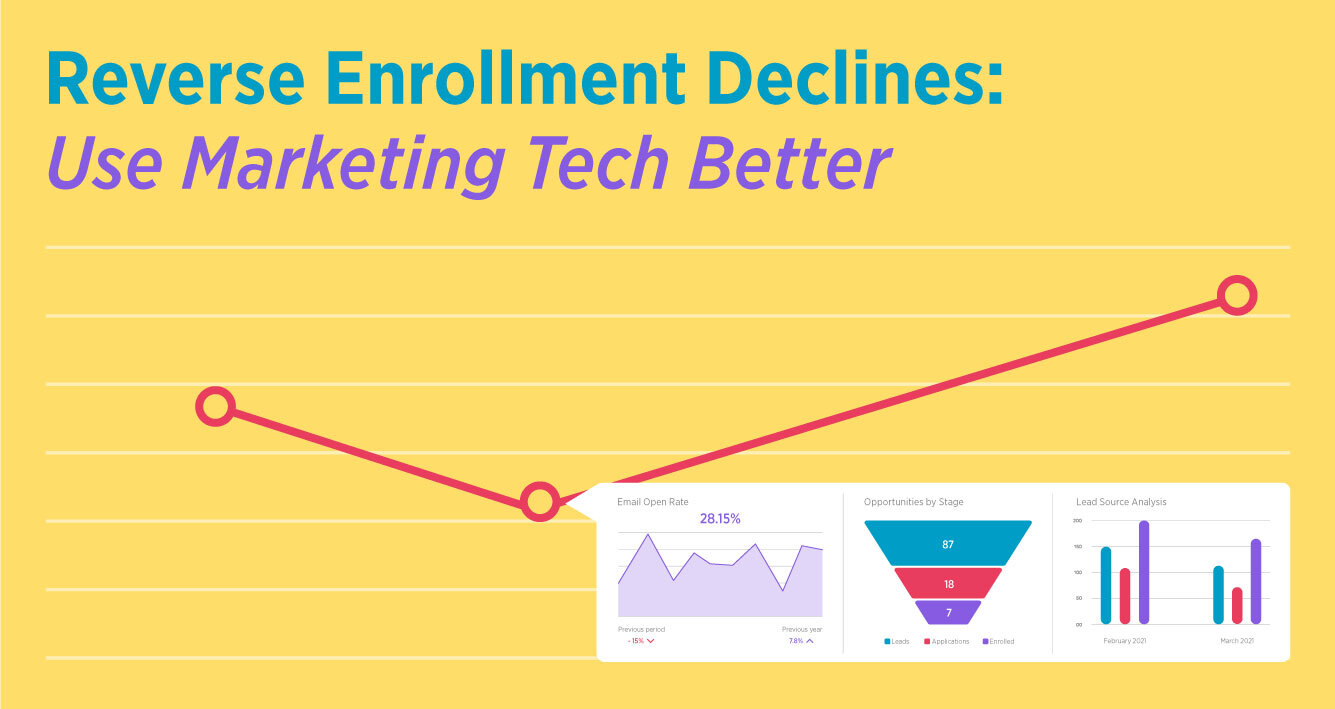
Reverse Enrollment Declines: Use Marketing Tech Better

So many dashboards. So little time.

Where is success hiding? How much investment will it take to achieve our targets?

With student mobility still in a state of flux, all bets are off for your predictive models. Or are they?

Today, we are talking to those with a CRM and marketing automation tools already in place.

Is this you? Your system works well enough and you can see some obvious gaps in functionality and interconnectedness. But you have what you have and there is no immediate opportunity to upgrade or change what you have. So…it is all about using the tools you have, better.

How do we get there? How do we know which features have real value to our operations? How can we use what we know to achieve better results?

We are heading into four wonderful days of interacting with our peers at the AIRC conference in Miami this week. The Intead team will be presenting on innovative ways to use the rising tide of influencer marketing for academia (it’s not going to be what you might think), and we will be presenting on innovative approaches to grad student marketing.

We can’t give enough thanks to our colleagues Toni Jaeger-Fine from Fordham Law School, Ita Duron from Massachusetts College of Health Sciences, and Kirsten Feddersen from Northeastern University all joining us on the dais to share our experiences and ideas. SO many ideas. Testing and confirming marketing approaches that are unique to each institution’s strengths.

Reach out if you would like to share a cup of coffee in Miami!

Read on for our two concrete recommendations for using your marketing tech better.

Read More

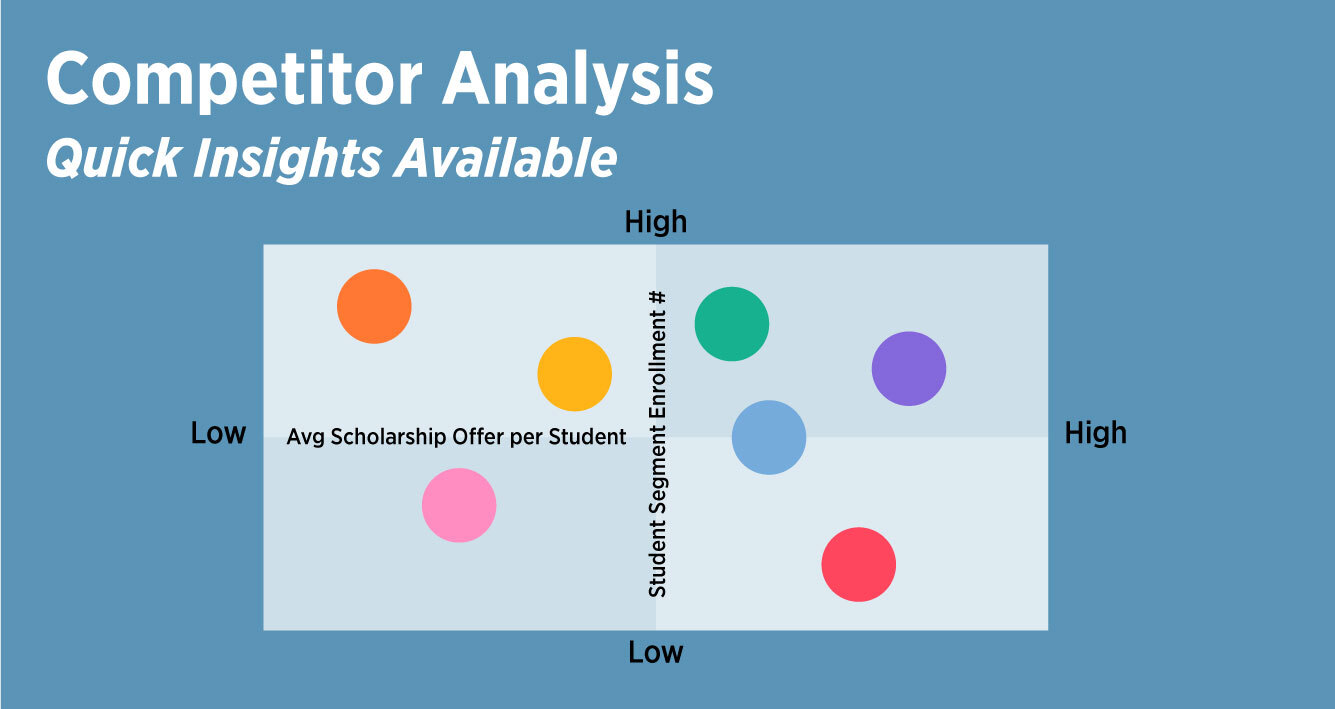
Competitor Analysis: Quick Insights Available

Every enrollment VP is fighting for students who will add value to their institution. Domestic is heading for the 2025 cliff while international is beginning to rebound from the pandemic travel restrictions. 

What better way to win market share than to tell the story that differentiates your institution? This week, for those of you not already familiar, we introduce you to Jon Boeckenstedt and a tool he’s created that can help you see quickly how your institution stacks up to your competition. Jon’s work consistently brings data insights and knowledge of the field to help institutions make better enrollment management decisions.

On the international side of things, be sure to register for the AIRC conference coming up in December where we will be presenting two valuable learning opportunities alongside colleagues from Northeastern University, Fordham Law School, and San Diego State University. Early bird rates are still on the table! See link below. And see you in Miami!

Read on to dive into the amazingly fast competitor insights you can gather and how you might use them to put the best version of your institution’s story out there. 

Read More

The Essential Guide to Implementing a University CRM System

With so much in enrollment management being in flux right now, going back to the basics is important. Managers across the country are looking to their 2021 intake reports and trying to predict spring and fall 2022. Challenging under normal circumstances, right?

So where are those reports coming from and how much is what should be a simple process driving you up a wall?

The more important the task, the more frustrating it is to have a tool that isn’t helping you succeed. For those among us still reviewing excel spreadsheets with enrollment data, we feel your pain.

It’s no surprise that many universities, high schools, and language schools feel incredibly irritated by customer relationship management (CRM) systems that don't meet their needs. We know this is a topic worth discussing in part, because some of our most read blog posts over the past 2 years (Post 1, Post 2, Post 3) are about enrollment managers' user experience with Technolution's #Slate.

If any of this sounds familiar—and if you wish you had more guidance on how to set up a system that will actually help you anticipate what your future enrollment will bekeep on reading.

Read More

How to Say 'No' to Ideas That Aren't Good Enough

Brilliant and creative enrollment professionals, we know your pain.

So many great ideas, so little time, and so little budget.

It’s the refrain of higher education (that, and “Don’t talk to me during application season”). And while we know you want to tackle everything with an enthusiastic “yes”, saying “no” more often than “yes” is nearly always required to keep your institution and your strategy on track.

With budget season inching towards the finish line, we know you’re already thinking about putting that budget into action in the new fiscal year. We also know that making the most of that budget will require focus, a concrete plan, and most importantly, that discipline to say “no” to lots of shiny new ideas that pass you by.

Steve Jobs said it best: “Deciding what not to do is as important as deciding what to do.” But with great ideas and options coming at you from all sides, how do you decide what will maximize value for your institution?

With this enrollment cycle murkier than ever and past performance clearly not indicative of future success, turning your gaze on some downhome marketing truths is a good idea.

Read on for five key questions to ask yourself next time that lightbulb moment hits you and your team. Our insights will help you hone your efforts on the ideas that will produce results and justify that budget.

Read More

Slate Users Speak: Getting Real About Technolutions’ CRM Platform Part 2

Welcome to Part 2 of our Slate series. You didn't think we'd forget about the international student recruitment/admissions perspective, did you? 

But let's stay with domestic student recruiting and enrollment management for just a moment. Intead is participating in a Chronicle of Higher Ed webinar event on Thurs, Feb. 4 that you truly won't want to miss. Colleagues from SUNY Fredonia, U of Richmond, and Robert Morris, along with some special guests all addressing the challenges of technology implementation on university campuses. Register Here.

Now, about that Slate CRM! In Part 1 last week we shared the experiences of a variety of Slate users in universities across the US, including admissions directors, associate directors, specialists, and one CRM manager/power user. We talked all things integration, training and support, and the universally dreaded: getting queries to give you the information you want. 

This week we're talking all things international, as well as sharing our users' feedback on the cost and value of Slate to their institution. 

In our work with institutions on international student recruitment campaigns, we're all too familiar with the domestic/international divide when it comes to resourcing and decision-making influence. And in our discussions with users about Slate integration, some international admissions staff reported a similar disconnect in their experiences with initial training and usage of the platform. 

Again, we are grateful to our interviewees for sharing their valuable time and perspectives with us. Read on to learn how international recruiting/admissions teams are making Slate work for them. 

Read More